The Night My Daughter’s Husband Learned That Her Silence Was Not His Protection
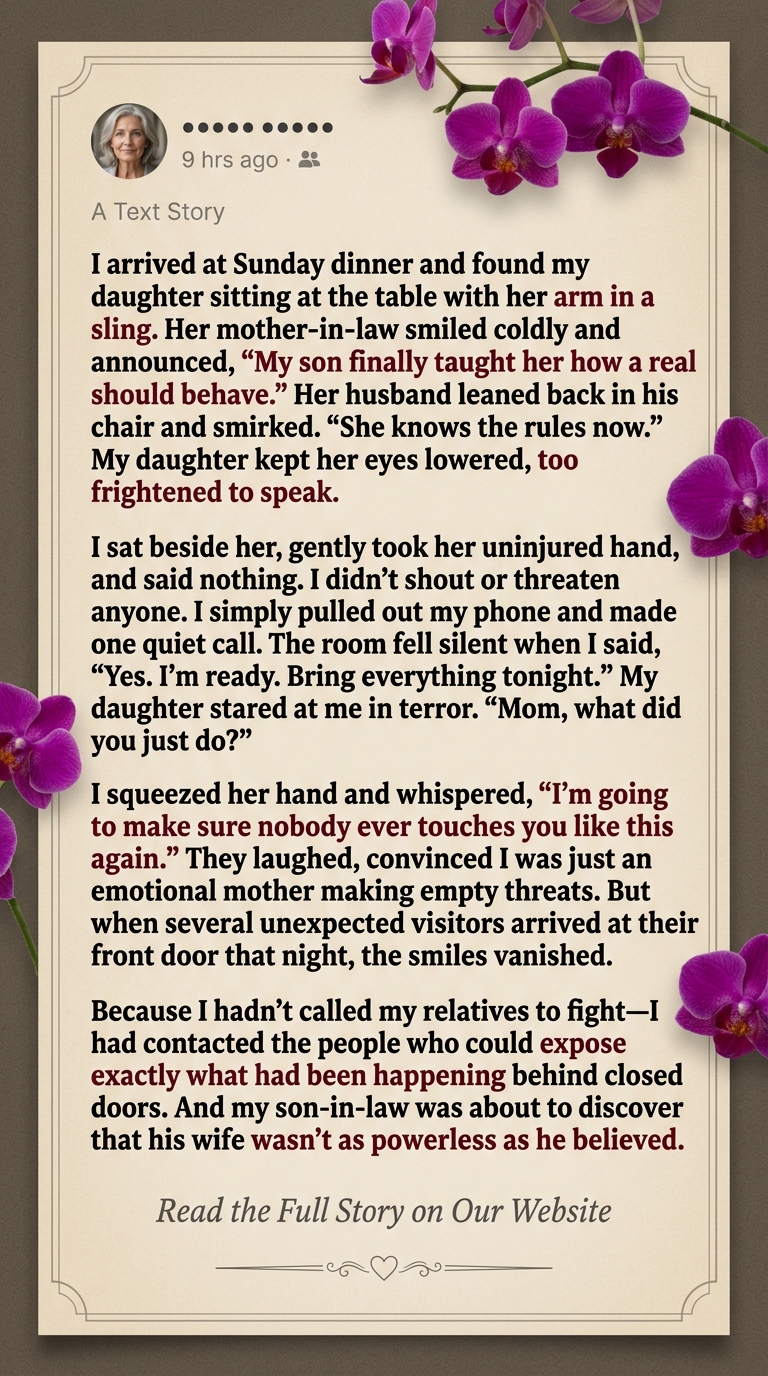
When I arrived at Sunday dinner, my daughter was sitting at the table with her left arm secured in a sling.
She looked smaller than I remembered, as though she had been trying to disappear inside her own clothes. Her face was pale, and a faint bruise marked the skin near her wrist.
Her mother-in-law, Patricia, noticed me staring and smiled over her wineglass.
“My son finally taught her how a real wife should behave.”
Across the table, my son-in-law, Derek, leaned back in his chair.
“She knows the rules now.”
Nobody laughed except Patricia.
My daughter, Emily, kept her eyes fixed on her plate.
I wanted to stand up and demand an explanation. I wanted to grab her hand and take her straight out of that house. But I had learned something during my years as a social worker: when someone is being controlled by the people around them, a confrontation can sometimes make things more dangerous after the visitor leaves.
So I sat beside Emily.
I gently took her uninjured hand.
Her fingers were ice-cold.
“Sweetheart,” I asked quietly, “what happened to your arm?”
Derek answered before she could speak.
“She fell. She’s always been clumsy.”
Patricia gave a dismissive wave.
“Marriage requires discipline. Some women need to learn that their husbands cannot be challenged over every little thing.”
I looked at Derek.
“Did a doctor examine her?”
He frowned.
“Why does that matter?”
“Because her arm is in a sling.”
“It’s handled.”
Emily’s fingers tightened around mine.
That tiny movement told me more than his answer did.
I had spent thirty years helping families navigate crises, including situations involving domestic abuse. I knew that a visible injury did not tell the whole story, and I knew that a person sitting quietly beside an abusive partner might be terrified of what would happen after everyone else went home.
I also knew that I needed to listen to my daughter rather than decide everything for her.
I excused myself to use the bathroom.
Once I was alone in the hallway, I took out my phone and made one call.
When the person answered, I said, “Yes. I’m ready. Bring everything tonight.”
Then I returned to the dining room.
Derek smirked.
“Who was that? Your friends coming to rescue you?”
“No,” I replied. “Someone who can help establish what happened here.”
Patricia laughed.
“You think you can frighten us with a phone call?”
I didn’t answer.
I stayed beside Emily throughout dinner. I noticed that Derek corrected her whenever she reached for something with her good hand. Patricia interrupted her whenever she tried to speak. And when Emily winced while adjusting her sling, Derek leaned toward her and whispered something that made her immediately lower her eyes.
I couldn’t hear his words.
I didn’t need to.
After dinner, while Patricia went into the kitchen, I leaned toward my daughter.
“Emily, do you want to come home with me tonight?”
Her eyes widened.
She looked toward Derek, who was standing near the fireplace.
“I can’t,” she whispered.
“Why not?”
She swallowed.
“He said if I leave, he’ll make sure I never see Sophie again.”
Sophie was my six-year-old granddaughter.
My heart tightened.
“Has he threatened to hurt you?”
Emily’s eyes filled with tears.
“Mom, please. Not here.”
I squeezed her hand.
“All right. I won’t force you to explain anything in front of them.”
She looked at me with a mixture of relief and fear.
“Please don’t make him angry.”
I wanted to promise her that I could fix everything immediately. But I knew better than to make promises I couldn’t guarantee.
Instead, I said, “You don’t deserve to be hurt. And you don’t have to handle this alone.”
At that moment, Derek walked back into the room.
“What are you two whispering about?”
“Nothing,” Emily said quickly.
He studied us for several seconds before smiling.
“Good. Because I don’t want any more drama.”
I met his gaze.
“Neither do I.”
He seemed satisfied with that answer.
He had no idea what was coming.
At 8:17 that evening, the doorbell rang.
Patricia stood up, irritated.
“Who on earth is that?”
Derek opened the door.
On the porch stood a woman named Rachel Morgan, a domestic violence advocate, accompanied by a uniformed police officer and another professional carrying a document folder.
Behind them was a second officer.
Derek’s smile vanished.
“What is this?”
Rachel spoke calmly.
“My name is Rachel Morgan. I’ve been asked to assist Emily with a safety assessment. The officers are here because a concern about a possible assault has been reported.”
Derek immediately turned toward me.
“You called the police on me?”
“I contacted people who could help determine what happened and make sure Emily had access to support,” I replied.
He laughed sharply.
“She fell! She’s told you that herself!”
The first officer stepped forward.
“Sir, we’re here to speak with everyone involved and assess the situation. We need you to remain calm while we do that.”
Patricia began protesting.
“This is a private family dinner. You cannot come into our house because an overemotional mother makes a phone call!”
The officers explained their role and asked to speak with Emily separately. They did not claim to have the authority to search the house or arrest Derek without an appropriate legal basis.
Rachel turned toward my daughter.
“Emily, would you feel comfortable speaking with us somewhere private?”
Emily looked at Derek.
He gave her a warning stare.
“Tell them you’re fine.”
For a moment, I thought she might obey him.
Then Sophie appeared at the top of the staircase, holding a stuffed rabbit.
“Mommy?”
Emily’s face crumpled.
She looked at her daughter, then at the officers.
“I need to talk to someone,” she whispered.
Rachel gently guided her toward the sitting room while one officer remained nearby.
Derek tried to follow.
“She’s my wife. I have a right to know what she’s saying!”
The officer asked him to remain in the dining room while Emily spoke privately.
Derek’s face darkened.
“You’re making a huge mistake,” he called after her.
Emily flinched.
I stood beside him.
“Stop threatening her.”
He turned on me.
“You think you’re going to take my family away from me?”
“No,” I said. “I’m trying to make sure my daughter and granddaughter are safe.”
For the first time that evening, he looked uncertain.
The next hour changed everything.
Emily spoke privately with Rachel and the officers. She explained that her arm had not been injured in a fall.
Three nights earlier, Derek had grabbed her during an argument about money. When she tried to pull away, he twisted her arm behind her back and shoved her against the kitchen counter. She had heard a sharp crack and collapsed in pain.
He later took her to an urgent care clinic, telling the staff she had slipped while carrying laundry.
He insisted that she repeat the story.
She had been afraid that if she told the truth, he would retaliate against her or prevent her from seeing Sophie.
The medical records confirmed that Emily had suffered a fracture. They could establish the injury, although the records alone could not establish who had caused it.
But Emily had more to tell.
She described months of intimidation, financial control, and threats. Derek monitored her phone, questioned her about ordinary purchases, and repeatedly told her that he could make sure she lost custody of Sophie if she ever tried to leave.
Patricia had helped him enforce those threats.
She had told Emily that a good wife tolerated her husband’s anger, and that a woman who exposed family problems deserved whatever consequences followed.
The officers documented Emily’s account and asked whether she wanted medical attention and assistance making a safety plan.
She said yes.
When Rachel returned to the dining room, she carried a small folder containing information about emergency accommodation, legal assistance, and support services.
Derek stared at it.
“What did she tell you?”
Rachel did not disclose Emily’s private statements to him.
“Emily has asked for support. We’ll explain the next steps to her directly.”
Derek turned toward me.
“You planned this.”
I shook my head.
“No. I planned to make sure she had people she could talk to without being threatened.”
Patricia’s face had turned pale.
“This is ridiculous. Every marriage has arguments.”
The older officer looked at her.
“An argument does not give someone the right to injure or intimidate their partner.”
Derek began pacing.
“You can’t arrest me based on a story.”
The officer explained that the situation would be assessed based on the available evidence, including Emily’s account, the medical records, and any other relevant information. He made no promise about an immediate arrest or a particular outcome.
Derek seemed to interpret that as permission to regain control.
He approached Emily as she came back into the room.
“Tell them you’re coming home with me.”
Emily stepped back.
“No.”
He stared at her.
“What did you say?”
She was shaking, but she repeated herself.
“I said no.”
Patricia gasped.
Derek’s expression became frighteningly cold.
“You’re going to regret this.”
One of the officers immediately stepped between them.
“Sir, do not threaten her.”
Derek backed away, muttering that everyone was conspiring against him.
Emily looked at me.
“Mom, I want to leave.”
I nodded.
“Then we’ll help you leave safely.”
Rachel coordinated with the officers to ensure Emily could collect essential belongings without being cornered or pressured. A separate arrangement was made for Sophie, who was frightened and confused by the adults’ arguments.
Before we left, Patricia approached Emily.
“You’re destroying your own family,” she hissed. “Do you think anyone will want you after this?”
Emily’s face tightened.
For a moment, I saw the old fear return.
Then she looked at her mother-in-law.
“I was trying to protect my family. I just didn’t realize I was the only one being asked to sacrifice everything.”
Patricia had no answer.
We left that night and went to a confidential safe location arranged through the advocate’s service.
Sophie fell asleep on the way, her head resting against her mother’s shoulder.
Emily stared out the window.
“I thought you were going to bring my uncles over to fight him,” she said quietly.
I shook my head.
“I didn’t want a fight, sweetheart. I wanted you to have choices, support, and a way to get out safely.”
She began to cry.
“I should have told you sooner.”
I reached over and held her hand.
“You told me when you were ready. What happened to you was not your fault.”
The days that followed were difficult.
Emily received medical care for her fracture and met with a counselor who specialized in domestic abuse. Rachel helped her connect with legal aid and understand the options available for protection and custody arrangements.
The police continued investigating the reported assault. They gathered the available medical records and interviewed relevant witnesses. The outcome would depend on the evidence and the applicable legal process, not on how loudly Derek protested.
I also learned that Emily had been hiding money for months, saving small amounts from grocery purchases and occasional babysitting work. She had kept the money in an old envelope inside a box of children’s books, hoping she might one day have enough to leave.
She had been preparing for an escape while pretending everything was normal.
When I found out, I felt both proud of her courage and devastated by how alone she had been.
We helped her secure her important documents, arrange a new phone number, and establish a safer way to communicate with people she trusted.
Sophie began meeting with a child counselor who helped her process the upheaval without making her feel responsible for the adults’ behavior.
For several weeks, Emily barely slept.
Every unexpected phone call made her jump. Every car that slowed near the house made her look toward the window.
I reminded her that recovery was not a race.
“You don’t have to feel brave every day,” I told her. “You only have to take the next safe step.”
Meanwhile, Derek’s public confidence began to crumble.
He sent messages claiming Emily had been manipulated. He told relatives that I had orchestrated a plan to steal his daughter. He insisted that his mother had only been trying to keep the family together.
But several people who had once dismissed Emily’s concerns began to reconsider when they learned that she had received treatment for a documented fracture and had described a pattern of intimidation.
Some apologized.
Others stayed silent.
I stopped trying to persuade everyone to believe us. Emily needed safety and stability, not a public debate about her marriage.
The legal process took time. Derek disputed her account, and the court had to consider the evidence and the needs of the child. Temporary arrangements were put in place while the relevant issues were reviewed. Emily followed her lawyer’s advice and continued cooperating with the authorities.
There were difficult days when she wondered whether leaving had been the right decision.
Then she would remember the moment Derek had ordered her to tell the officers she was fine.
And she would remember that she had said no.
Several months later, Emily and Sophie moved into a small apartment of their own. It wasn’t luxurious, but the windows filled the living room with afternoon sunlight, and Sophie could decorate her bedroom with the colorful stars she loved.
Emily began working part-time again after her medical team cleared her to return.
One Saturday morning, I visited and found her making pancakes while Sophie sat at the kitchen table drawing pictures.
Emily looked up and smiled.
“Mom, I slept through the night.”
It was such a small sentence, yet it nearly brought me to tears.
I hugged her.
“I’m glad, sweetheart.”
She leaned against me.
“I used to think leaving would mean I’d failed at marriage.”
I looked at her carefully.
“Leaving a situation where you’re being hurt isn’t failure. And you don’t have to prove anything to anyone by staying.”
She nodded.
“I know that now.”
The legal case continued, and Emily remained focused on rebuilding her life rather than on whether Derek would ever admit what he had done. She made decisions with her lawyer and support team, keeping Sophie’s safety and well-being at the center.
As for Patricia, she sent a letter several months later.
She wrote that she had convinced herself she was protecting her son by defending his behavior. She admitted that her words at dinner had been cruel and that she had helped make Emily feel trapped.
Emily read the letter twice.
Then she placed it in a drawer.
“I’m not ready to forgive her,” she told me.
“You don’t have to decide today.”
She smiled faintly.
“That’s what I’m learning. I can decide when I’m ready.”
A year after that Sunday dinner, I sat at Emily’s kitchen table while Sophie showed me a school project about the people who made her feel safe.
She had drawn her mother, me, her teacher, and Rachel.
At the bottom, she had written: Safe people listen when you say something is wrong.
I read the sentence twice.
Then I looked at Emily.
She was standing by the window, watching Sophie arrange her drawings on the refrigerator. Her arm had healed, and she no longer flinched every time someone raised their voice in another room.
She had a long way to go, but she was no longer living in fear of what would happen if she spoke.
That Sunday dinner had begun with a cruel joke about teaching a woman how to behave.
It ended with my daughter choosing to tell the truth.
I hadn’t rescued Emily by threatening her husband or proving that I was stronger than he was. I had helped her reach people who could listen, document what happened, and support her in making her own decisions.
And that was the lesson I wanted her to carry into the rest of her life.
Love does not require silence.
Marriage does not grant anyone ownership over another person.
And no one—not a husband, a parent, or an entire family—has the right to turn fear into a rule that someone else must live by.