The Empty Chair at My Daughter’s Wedding Revealed the Price of the Choice I Forced Her to Make
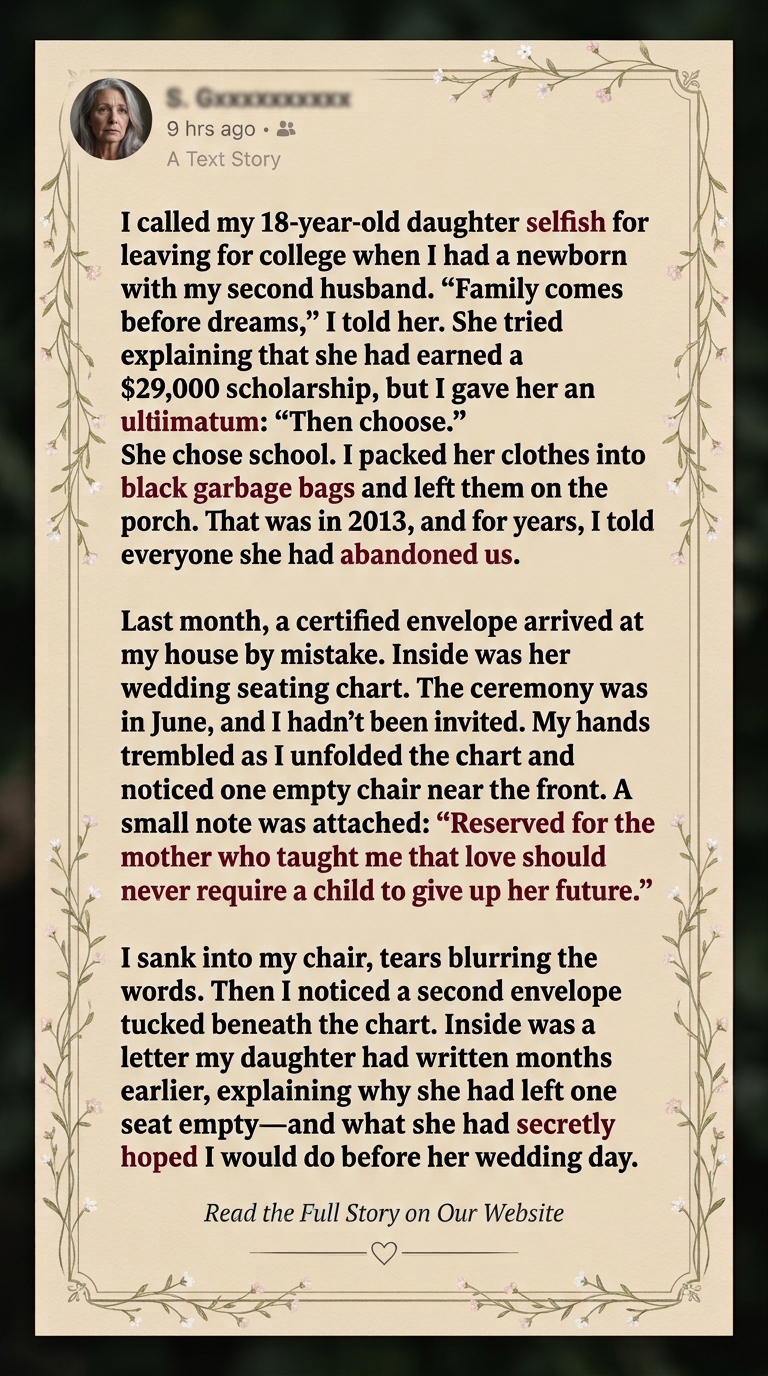
I called my eighteen-year-old daughter selfish for leaving home to attend college when I had a newborn with my second husband.
“Family comes before dreams,” I told her.
She stood in our kitchen holding a university acceptance letter, her eyes red from crying. She had earned a $29,000 scholarship, worked weekends at a grocery store, and spent her senior year applying to schools while helping me prepare for the baby.
I knew how hard she had worked.
I also knew I was exhausted.
My second husband, Mark, had returned to work two weeks after our son was born, leaving me alone with an infant, a mountain of laundry, and bills that seemed to multiply every time I opened the mailbox.
My daughter, Emily, was the only person who could calm the baby when he cried for hours. She washed bottles, prepared dinner, and sometimes stayed awake with her little brother so I could sleep.
I had grown dependent on her help without realizing how much I was asking her to sacrifice.
When she announced that she would leave for college in August, I felt something close to panic.
“How am I supposed to manage everything without you?” I asked.
She tried to explain that the university was several hours away and that the scholarship covered most of her tuition.
“I’ll come home during breaks, Mom. I can help when I’m here. But this is my chance to build a future.”
I heard the words, but all I could think about was the baby crying at three in the morning and Mark telling me that I needed to stop making everything so difficult.
I looked at Emily and said the cruelest thing I could have said.
“Then choose. You can stay here and help your family, or you can leave and stop pretending you care about us.”
She stared at me.
“Mom, you’re asking me to give up my entire future because you need help with the baby.”
“I’m asking you to put your family first.”
“I am your family.”
For a moment, I saw the hurt on her face.
Then I pushed it away.
“Apparently, not enough.”
Emily left the kitchen without another word.
Two days later, she packed her belongings into a borrowed car. I watched from the front window as she carried boxes down the porch steps.
I could have gone outside.
I could have hugged her, told her I was frightened, and asked whether we could find another arrangement.
Instead, I waited until she drove away.
Then I went into her bedroom, pulled the remaining clothes from her closet, stuffed them into black garbage bags, and left them on the porch.
I told myself I was teaching her a lesson.
When she called that evening, I let the phone ring.
The next morning, she sent a message saying she had arrived safely and had found a place to stay with another student until the dormitory opened.
I didn’t answer.
For years, I told everyone that my daughter had abandoned us.
When relatives asked why Emily never came home for holidays, I explained that she had become too independent to care about her family.
When my mother asked whether I had tried to reach out, I said Emily knew where to find me.
I repeated that story so often that I eventually stopped questioning it.
My husband, Mark, rarely challenged me. He said Emily was an adult and that we had enough problems without chasing someone who had chosen to leave.
Our son grew up believing his older sister had walked away because she didn’t want to be part of our family.
I never corrected him.
I didn’t know that Emily had kept every message I sent her during those first months, including the one in which I told her not to come home unless she was prepared to apologize.
I didn’t know she had cried in a dormitory bathroom after receiving it.
I didn’t know that she had worked two campus jobs while studying full-time, determined not to lose the scholarship she had fought so hard to earn.
And I certainly didn’t know that, for years, she had hoped I would one day realize what I had done.
Then, last month, a certified envelope arrived at my house.
The name on the front was mine, but the return address belonged to a wedding stationery company.
I assumed it was a mistake.
When I opened it, a seating chart slid onto the kitchen table.
At the top was Emily’s name beside the name of a man I had never met.
My daughter was getting married.
The ceremony was scheduled for June, and I had not been invited.
I sat down slowly.
I had known Emily was living in another state. I had heard through relatives that she had a good job and had recently become engaged.
But I had never asked for details.
Somewhere inside me, I had believed that if I waited long enough, she would eventually come home and apologize for leaving.
Instead, she was preparing to marry someone who knew her well enough to build a life with her.
I unfolded the seating chart.
Rows of guests were arranged around a small drawing of the ceremony space. Her future husband’s parents sat near the front. Friends and relatives filled the other rows.
Then I noticed an empty chair near the aisle.
A small note had been attached to it.
“Reserved for the mother who taught me that love should never require a child to give up her future.”
My hands began to tremble.
I read the sentence again.
At first, I thought it was an insult. A final way for Emily to remind me that I had failed her.
Then I noticed the handwriting.
It was hers.
Beneath the seating chart was a second envelope, sealed with a small gold sticker.
The letter inside was dated several months earlier.
“Mom,
“I don’t know whether you’ll ever read this. I’m writing it because I need to make a decision about the wedding, and I don’t want that decision to come from anger.
“For years, I told myself I didn’t care whether you were there. I said it so often that sometimes I almost believed it.
“But when I got engaged, the first person I imagined telling was you.
“I wanted to call you when I found my wedding dress. I wanted to ask you what Grandma wore when she married Grandpa. I wanted you to help me choose flowers and tell me whether the ceremony should be indoors or outside.
“I wanted a mother.
“Instead, I kept making these decisions with people who loved me and wanted me to succeed. They helped me build a life, and I’m grateful for them. But there has always been a part of me that wondered what it would have felt like to have you beside me.”
I stopped reading.
My throat tightened so painfully that I had to put the letter down.
Emily continued.
“I need you to understand something about the day I left for college.
“I didn’t leave because I stopped loving you. I left because I had worked so hard to earn a chance to become someone beyond the girl who helped with the baby, cooked dinner, and made sure everyone else was okay.
“I loved my little brother. I still do.
“But I was eighteen. I had just earned a scholarship that could change my entire future, and you made me feel as if accepting it meant betraying you.
“You told me to choose.
“I chose school because I was afraid that if I gave up that opportunity, I would spend the rest of my life resenting you and myself.
“I was right about that fear. For a long time, I was angry with you. I was angry when I graduated, when I got my first real job, and when I signed the lease on my first apartment. Every achievement reminded me that the person I wanted to share it with was the person who had told me to leave.”
I pressed the letter against my chest.
I remembered her graduation announcement.
It had arrived in the mail years earlier. Emily had graduated with honors, and a small paragraph mentioned that she had completed her degree while working two jobs.
I had shown it to Mark and said, “Well, she seems to have managed without us.”
I had never called to congratulate her.
I had never asked how she paid for everything.
The letter continued.
“I didn’t invite you to the wedding because I couldn’t bear the thought of standing at the front of the room, hoping you would come, only to discover that you still believed I owed you an apology.
“The empty chair is not there to punish you.
“It is there because I wanted to acknowledge that I still have a mother, even though we have not known how to be mother and daughter for a very long time.
“I have not decided whether I can invite you. I don’t know whether seeing you would make the day more painful than your absence.
“But I have one hope.
“Before the wedding, I hope you will stop telling people that I abandoned my family. I hope you will ask yourself why an eighteen-year-old girl felt she had to leave with her clothes in garbage bags.
“And if you ever contact me, I hope you will do it without asking me to apologize for choosing my future.”
I lowered the letter.
My eyes burned.
For years, I had described Emily’s departure as the day she abandoned us.
Now I could see that it had also been the day I had abandoned her emotionally, long before she drove away.
I had treated her scholarship as a threat instead of a triumph.
I had treated her independence as disloyalty.
And I had used the word family to demand that she give up the very future I had spent her childhood telling her to work toward.
But the final paragraph was what broke me.
“Mom, the wedding is in six weeks.
“I have left the chair empty because a small part of me still hopes you will understand.
“I don’t expect you to arrive at the ceremony or pretend that everything is fine.
“I only hope that before the day comes, you will tell the truth about why I left.
“If you can do that, perhaps we can begin again—not as the mother and daughter we were before, but as two people willing to learn how to love each other differently.
“I don’t know whether we can repair everything.
“But I don’t want the rest of my life to be built around the day I left home.
“Love, Emily.”
I sat at the kitchen table until the afternoon light faded.
I thought about the black garbage bags.
I could still remember the sound they made when I dragged them down the hallway. I remembered how angry I had been, how certain that I was right, and how satisfying it had felt to turn her bedroom into an empty space.
I had convinced myself that I was protecting my family.
In reality, I had been protecting myself from the frightening possibility that I could not manage everything alone.
I had asked my daughter to carry responsibilities that belonged to me and her stepfather. Then, when she chose not to sacrifice her future, I punished her for it.
The next morning, I called my mother.
She answered with her usual greeting, then fell silent when I told her about the wedding letter.
“Your daughter has been waiting a long time for you to understand,” she said.
“Why didn’t you tell me how much I hurt her?”
“I did, sweetheart. You told me I was taking her side.”
I closed my eyes.
“I thought she had abandoned us.”
“She was eighteen. She had a scholarship and a chance to build a life. You were her mother. She needed you to be proud of her, not afraid of losing her help.”
I began to cry.
My mother continued gently.
“You were overwhelmed. I know that. But being overwhelmed doesn’t mean every choice you make is fair.”
After we hung up, I sat alone for a long time.
Then I did something I had avoided for thirteen years.
I opened my phone and searched for Emily’s number.
I had saved it under her name, though I had not called her in years.
My thumb hovered over the screen.
I wanted to tell her that I had been tired, that the baby had been difficult, that Mark had been working long hours, and that I had felt frightened and alone.
All of it was true.
But none of it changed what I had done.
So I typed a message.
“Emily, I received the wedding chart and your letter. I read every word. You were right about the day you left. I made you feel that loving your family meant giving up your future, and I punished you when you refused. I packed your clothes into garbage bags because I wanted you to feel the rejection I felt. That was cruel, and you did not deserve it. You did not abandon us. I pushed you away. I am deeply sorry. You don’t owe me an invitation or forgiveness. I just wanted you to know that I finally understand.”
I read it three times before pressing send.
Then I put the phone down.
For the rest of the day, I tried not to check it.
I failed.
Every few minutes, I picked it up and stared at the screen.
That evening, a message appeared.
“Thank you for saying that, Mom. I need time to think.”
It was only one sentence.
But it was the first time in thirteen years that Emily had responded to me without anger or distance.
I did not send another message.
I did not ask whether she would invite me.
For the first time, I allowed her to decide what she needed without trying to control the outcome.
Over the following weeks, we exchanged a few messages. She told me about her work, her fiancé, and the house they had recently bought. I learned that she had become a school counselor, helping teenagers navigate difficult family situations.
When she told me that, I felt both pride and sorrow.
My daughter had built a career helping young people find their voices after years of feeling unheard.
I wondered how much of that work had grown out of her own experience.
One evening, she called.
I nearly dropped the phone when I saw her name.
“Hi, Mom,” she said.
I sat down.
“Hi, sweetheart.”
We spoke for almost an hour. She told me about her fiancé, Daniel, who worked as a civil engineer and had proposed during a weekend trip to the mountains.
She told me that she had found a wedding dress she loved and that her future mother-in-law had helped her choose flowers.
Then she grew quiet.
“I want to ask you something,” she said.
“Anything.”
“Why did you make me choose?”
I could have given her a dozen explanations.
I could have told her about the sleepless nights, the fear of raising a baby, the pressure I felt from Mark, and the belief that a good daughter should help her mother.
Instead, I told her the truth.
“Because I was scared. I was afraid I couldn’t manage without you, and I was afraid that if you left, I would have to admit how much I depended on you. Instead of asking for help, I tried to control you.”
Emily was silent.
“I thought I was teaching you responsibility,” I continued. “But I was asking you to take responsibility for problems that were mine to solve. I made your future feel like a betrayal. I’m sorry.”
When she spoke again, her voice was softer.
“I needed to hear that years ago.”
“I know.”
“I don’t know if I can forget what happened.”
“I don’t expect you to.”
She took a breath.
“I still want you in my life, Mom. But I need to know that if I say no to you, you won’t punish me for it.”
I felt tears slipping down my cheeks.
“I can’t promise I’ll never feel disappointed. But I can promise that your choices are yours. I won’t make you responsible for my feelings.”
She was quiet for a moment.
Then she said, “Would you like to come to the wedding?”
I covered my mouth.
“Are you sure?”
“Yes. I don’t want you to come because you feel guilty, and I don’t want to spend the day wondering whether you are angry with me. I want you to come because you want to celebrate my life.”
“I do,” I whispered. “More than anything.”
“Then come, Mom.”
I cried after we hung up.
Not because everything had been repaired, but because my daughter had opened a door I had spent thirteen years insisting she should open first.
The wedding took place in June at a small garden venue surrounded by flowering trees.
I arrived early, carrying a modest gift and a handwritten card. My hands shook as I walked toward the seating area.
The empty chair near the front was still there.
A small card rested on the seat.
“Reserved for the mother who taught me that love should never require a child to give up her future.”
I stood beside it for a moment.
Then Emily appeared in the doorway, wearing her wedding dress.
She looked radiant.
For a second, I saw the eighteen-year-old girl standing in our kitchen with her scholarship letter, trying to convince me that she could love her family and still leave home.
I wanted to tell that girl I was sorry.
Instead, I walked toward the woman she had become.
Emily took my hands.
“Thank you for coming,” she said.
“Thank you for inviting me.”
Her eyes filled with tears.
“I was afraid you wouldn’t understand.”
“I didn’t understand for a long time,” I said. “But I want to keep learning.”
She hugged me.
I held her carefully, aware that this was not a return to the past. It was the beginning of something new, something we would have to build slowly.
During the ceremony, I sat in the reserved chair and watched my daughter marry the man she had chosen.
When Daniel promised to support her dreams, I cried.
When Emily promised to stand beside him without losing herself, I cried harder.
Afterward, during the reception, she introduced me to her friends and colleagues. She told them I was her mother, and she did so without hesitation.
No one asked why I had been absent from her life for so long.
No one needed to know that story that afternoon.
What mattered was that I was there.
Later, when the music had quieted and guests were beginning to leave, Emily found me sitting beneath a tree near the garden.
“Mom?”
I looked up.
She sat beside me.
“I want you to know that inviting you doesn’t mean everything is fixed,” she said. “There are still things we need to talk about.”
“I understand.”
“But I don’t want to keep punishing you forever, either. I want to see whether we can have a relationship that feels good for both of us.”
I reached for her hand.
“I want that too.”
She smiled faintly.
“I think the first step is that you stop telling people I abandoned you.”
“I already have.”
She looked surprised.
“I called Aunt Linda and your grandmother. I told them I was wrong. I told them I made you feel you had to choose between your future and your family.”
Emily’s eyes filled with tears.
“Thank you.”
We sat together in the fading light, listening to the last guests talking near the reception tent.
For years, I had believed that motherhood meant being needed.
I thought that if Emily loved me, she would stay close enough for me to rely on her, even when her own life was waiting beyond our front door.
I had mistaken dependence for love.
Now I understood that raising a child was not about making sure they never left.
It was about helping them become someone who could leave—and still know they were loved.
Emily had not abandoned her family when she accepted that scholarship.
She had chosen a future she had worked hard to earn.
I was the one who had made love conditional.
As I watched my daughter walk back toward her husband, I felt the weight of those thirteen years settle over me.
I could never give her back the mornings I had missed, the graduations I hadn’t attended, or the years when she had celebrated her achievements without her mother.
But I could stop asking her to carry my regret.
I could show up.
I could listen.
And I could love her without demanding that she prove it by giving something up.
The empty chair at her wedding had not been a punishment.
It had been an invitation to become the mother she had needed all along.
This time, I was grateful I had finally understood.