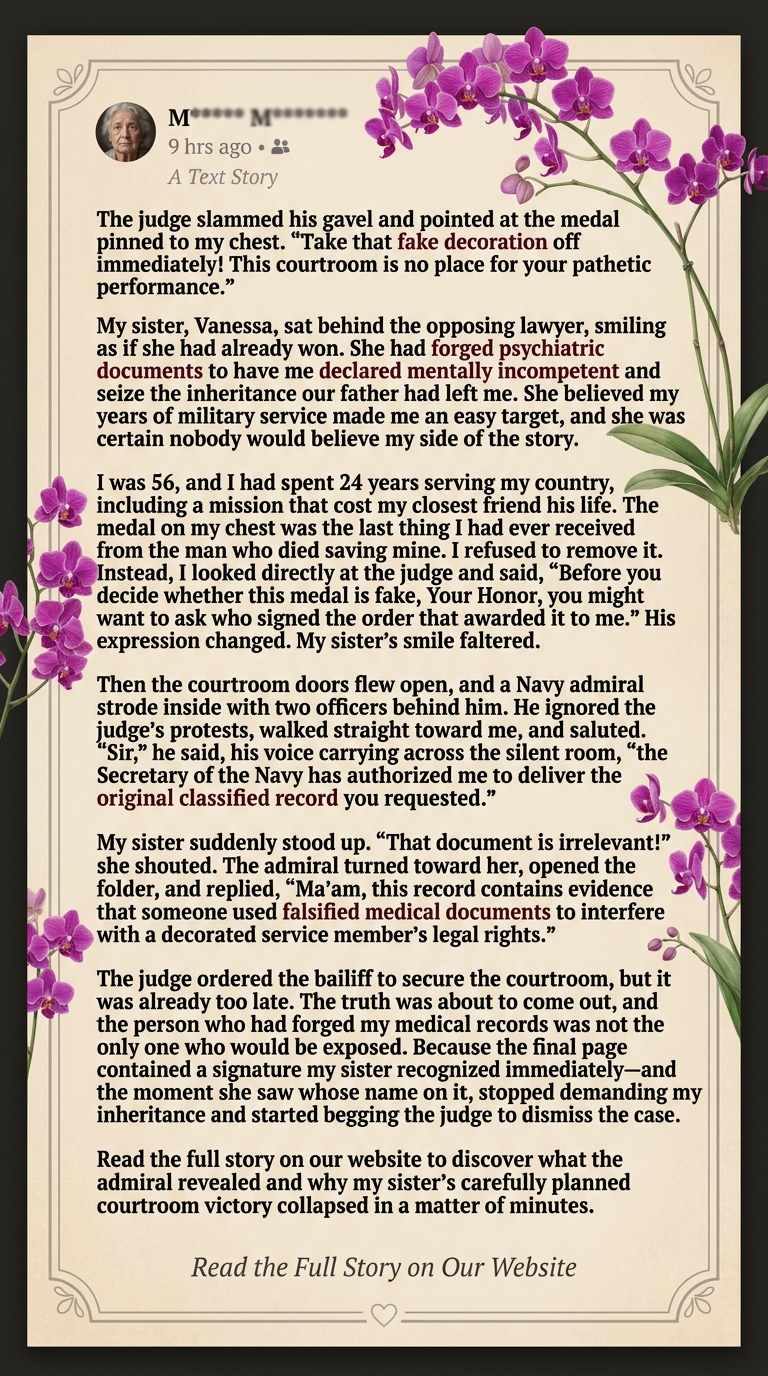
The Judge Called My Military Medal Fake—Then a Navy Admiral Walked Into the Courtroom and Saluted Me
The judge slammed his gavel so hard that the sound echoed through the courtroom. He pointed directly at the medal pinned to my chest, his face twisted with irritation.
“Take that fake decoration off immediately! This courtroom is no place for your pathetic performance.”
Behind the opposing lawyer, my sister, Vanessa, smiled as though she had already inherited everything our father had left behind. She wore a tailored black suit, carried an expensive leather handbag, and sat with the confidence of someone who believed the outcome had been decided long before the hearing began.
I was fifty-six years old. I had spent twenty-four years serving my country in the United States Navy, including a classified overseas mission that had cost my closest friend his life. The medal on my chest was not a costume accessory, and it was certainly not fake. It was the last official recognition I had received for a mission that still haunted me decades later.
Yet I sat in that courtroom accused of being mentally incompetent, financially irresponsible, and incapable of managing my own affairs.
My sister had filed a petition claiming that I suffered from a severe psychiatric condition that made me unfit to control the inheritance our father had left me. She had submitted medical documents bearing the names of doctors I had never met and signatures I had never authorized.
Her goal was simple: have me declared legally incompetent, obtain control over my finances, and transfer the family estate into her hands.
She thought my military background would make me an easy target. She assumed that because I had spent years avoiding publicity, nobody would question her claims. She also believed that if she described me as unstable often enough, people would stop listening to what I had to say.
For months, she had been telling relatives that my years in the military had damaged my mind. She claimed I suffered from delusions, became confused about ordinary events, and sometimes believed I had received honors that never existed.
The judge appeared to have accepted her story before I had even finished answering the first question.
“Mr. Carter,” he said impatiently, “your sister has presented medical evidence indicating that you have difficulty distinguishing reality from fantasy. Now you arrive wearing a medal and expect this court to believe you are a decorated military officer?”
I looked at him calmly.
“My service records are available for verification, Your Honor.”
“Enough,” he snapped. “Remove the medal.”
I kept my hands on the table.
“No, Your Honor.”
A murmur spread through the courtroom.
The judge leaned forward. “Are you refusing a direct instruction from this court?”
“I am refusing to remove an authentic military decoration because someone has falsely suggested that it is counterfeit. Before you decide whether this medal is fake, you might want to ask who signed the order that awarded it to me.”
For the first time that morning, the judge stopped speaking.
Vanessa’s smile weakened.
Her attorney, Richard Hale, immediately rose.
“Your Honor, my client’s brother is attempting to distract the court with irrelevant military theatrics. We are here to address his documented mental incapacity, not to debate his personal history.”
I turned toward him.
“Then let’s debate the documents.”
Hale looked uncomfortable, but he recovered quickly.
“My client has submitted medical evaluations from licensed professionals.”
“Which professionals?” I asked.
He ignored me.
The judge ordered me to remain silent while the attorneys continued their arguments. Vanessa sat back in her chair, apparently convinced that the interruption had been nothing more than a temporary setback.
She had no idea that I had spent the previous six weeks quietly investigating the documents she had submitted.
And she had no idea that I had requested a particular record through the appropriate military authorities.
A record that would connect the medal on my chest to an operation that had officially remained classified for nearly three decades.
A record that would also expose the person who had helped her obtain the false psychiatric reports.
I had hoped the court would examine the evidence before reaching a conclusion.
Instead, the judge appeared determined to dismiss me.
“Mr. Carter,” he said, “if you continue to disrupt these proceedings, I will have you removed from the courtroom.”
I looked directly at him.
“Then perhaps you should allow me one final opportunity to explain why the documents submitted against me are fraudulent.”
Before he could respond, the courtroom doors opened.
Everyone turned.
A Navy admiral entered, accompanied by two uniformed officers and a civilian attorney carrying a thick document case.
The admiral was in his early sixties, with silver hair and a row of decorations across his uniform. He moved with the unmistakable confidence of someone accustomed to command, but he did not look around the courtroom or acknowledge the curious spectators.
He walked straight toward the judge’s bench.
“Admiral Thomas Reynolds,” he introduced himself. “United States Navy. I have come in response to a properly authorized request concerning the service records of Commander James Carter.”
The judge frowned.
“This is an active court proceeding. You cannot simply walk in here and interrupt.”
“Understood, Your Honor,” the admiral replied. “I apologize for the interruption. However, the record I am carrying has direct relevance to the authenticity of the military decoration being challenged and to allegations that official records were misrepresented in this proceeding.”
He turned toward me.
Then he saluted.
“Commander Carter, the Secretary of the Navy has authorized the release of the original record for the limited purpose of verifying your service and addressing the allegations presented to this court.”
I returned the salute.
For several seconds, nobody spoke.
Vanessa stood abruptly.
“This is absurd!” she exclaimed. “That document has nothing to do with his mental condition. He could have arranged this entire performance!”
The admiral turned toward her.
“Ma’am, the authenticity of this record can be independently verified. It contains the original award authorization, the operational citation, and the official record of the mission in which Commander Carter served.”
He placed the sealed folder on the clerk’s desk.
“And it contains evidence that information from a restricted personnel file was improperly represented in a private medical assessment.”
The courtroom fell silent.
The judge ordered the bailiff to secure the courtroom and instructed everyone to remain seated while the document was examined. He then asked the admiral to explain the nature of the record.
Admiral Reynolds opened the folder.
“The medal worn by Commander Carter was awarded following a naval operation conducted twenty-eight years ago. The original order was signed by the authorized approving officer and is preserved in the official military archive. The serial information and award details match the decoration he is wearing today.”
He handed the award order to the court clerk.
The clerk examined the document before passing it to the judge.
The judge’s expression changed as he read the official authorization.
The medal was authentic.
But that was only the beginning.
The admiral continued.
“Commander Carter served in a unit assigned to a mission involving the recovery of classified intelligence and the evacuation of American personnel from a compromised location. During the operation, his team came under attack. One of his fellow officers, Lieutenant Michael Bennett, was killed while helping Commander Carter and two other personnel reach the extraction point.”
My throat tightened at the mention of Michael’s name.
I had spent years trying not to revisit that night.
Michael had been my closest friend. He had been the man who stayed beside me when everything went wrong, the man who pushed me toward the extraction vehicle when I was injured, and the man who never made it home.
The medal had never been about glory.
It was a reminder of the life I had been given at a cost I could never repay.
The admiral looked at the judge.
“The award was issued after a formal review of the operation. Commander Carter’s service history, award authorization, and supporting records have all been authenticated.”
The judge removed his glasses.
“Then why was this medal described as counterfeit in the petition?”
Nobody answered.
The admiral turned to the medical documents submitted by Vanessa’s attorney.
“That question is precisely why I requested permission to present this record. One of the psychiatric assessments submitted against Commander Carter contains details taken from a restricted military file. The assessment characterizes certain references to his classified service as evidence of delusional thinking.”
He paused.
“Those references were accurate. They were simply not available to the general public.”
A murmur swept through the courtroom.
Vanessa’s face had gone pale.
Her attorney rose again.
“Your Honor, we had no knowledge that any medical professional had relied on restricted information. My client supplied the reports in good faith.”
The admiral remained composed.
“The Navy’s review identified inconsistencies in the documents. The physician whose name appears on one assessment has stated that he did not examine Commander Carter and did not authorize the use of his signature on the report.”
The judge looked sharply at Hale.
“Counsel, is that true?”
Hale shuffled his papers.
“We have not independently verified that statement, Your Honor.”
“Then you will have an opportunity to explain why a report bearing a doctor’s signature has been presented as evidence if the doctor denies authorizing it.”
For the first time, Vanessa looked genuinely frightened.
But the admiral had not finished.
He removed another document from the folder.
“This is the record of the request made to obtain Commander Carter’s restricted personnel information. The request was submitted through a private medical consulting company that claimed it had authorization from the service member.”
He placed the document beside the medical reports.
“The authorization was not signed by Commander Carter.”
The judge studied the page.
“Who submitted it?”
The admiral glanced toward the civilian attorney accompanying him.
She opened a second folder and handed a copy to the clerk.
“The request was submitted by an employee of a company called Meridian Clinical Services. The company’s records indicate that the request was initiated using information provided by Vanessa Carter.”
My sister immediately shook her head.
“That is a lie! I never contacted any military office!”
The admiral did not argue with her.
“We are not asking the court to determine criminal responsibility based on this document alone. We are presenting the record so that its authenticity and origin can be independently examined.”
His restraint made the revelation even more devastating.
He did not need to accuse Vanessa of anything.
The documents were speaking for themselves.
The judge ordered a recess and directed both parties to preserve all relevant communications, medical records, and financial documents. He also instructed the court clerk to arrange verification of the disputed reports and advised the attorneys that no determination of mental incapacity would be made until the evidence had been properly reviewed.
Vanessa’s confident expression had vanished.
As the judge left the bench, she turned toward Richard Hale and whispered angrily.
“You said the reports were legitimate.”
Hale leaned toward her.
“Not here,” he muttered.
But the admiral had noticed their exchange.
He quietly asked the judge’s clerk to record that the documents had been presented for authentication and that further investigation might be necessary.
Then he returned to the counsel table and opened the final page of the military record.
“Your Honor,” he said when the judge returned, “there is one additional matter that may be relevant to the court’s inquiry.”
The judge gestured for him to continue.
“The individual who approved the original award was Rear Admiral Charles Whitmore, then serving as the commanding officer responsible for the operation. His signature appears on the award order and the accompanying citation.”
I stared at the page.
Charles Whitmore.
I knew that name.
He had been a respected officer who retired years ago, and I had not seen him since a memorial service for the men lost during the mission.
The admiral turned to the final attachment.
“During the subsequent review, the Navy also preserved correspondence concerning the operation. One letter was submitted by a member of the original team and retained in the archive. It identifies a discrepancy in a separate personnel record later used to question Commander Carter’s reliability.”
He handed the letter to the clerk.
The judge began reading.
Then he stopped.
His eyes moved to the signature at the bottom.
He looked up slowly.
“Is this signature authentic?”
The admiral nodded.
“Yes, Your Honor. The original correspondence was authenticated by the Navy’s records office.”
The judge turned toward Vanessa.
“Do you recognize the name at the bottom of this letter?”
My sister stared at the page.
Her lips parted, but no words came out.
The name was Dr. Alan Whitmore, the physician whose signature appeared on the psychiatric report claiming that I suffered from delusions and could not manage my own affairs.
Vanessa had claimed that Dr. Whitmore had personally examined me and concluded that I was mentally incompetent.
But the letter in the admiral’s folder established that Dr. Whitmore had worked with the Navy years earlier and had documented an entirely different issue: an administrative error involving an officer’s personnel file that had been corrected after a formal review.
More importantly, the physician had provided a written statement to the investigators confirming that he had never examined me, had never diagnosed me, and had never authorized the psychiatric report submitted in the inheritance case.
The judge looked toward Hale.
“Counsel, did your office verify this physician’s identity and obtain his consent before submitting the report?”
Hale swallowed.
“We relied on the documentation provided by our client.”
“Did you contact the physician?”
“No, Your Honor.”
“Did you verify the authenticity of the signature?”
“No.”
The judge’s voice hardened.
“And yet you presented this document as a professional medical assessment supporting a request to remove your client’s brother’s legal capacity?”
Hale lowered his eyes.
Vanessa suddenly stood.
“I didn’t know the doctor would deny it!” she cried. “I was told the documents were legitimate!”
The judge struck his gavel.
“Sit down, Ms. Carter.”
She obeyed, trembling.
For the first time, I saw something other than confidence in my sister’s face.
I saw fear.
Not fear that I was mentally incompetent or that the family estate was in danger.
Fear that the story she had constructed was collapsing in front of everyone who mattered.
The judge suspended the hearing on the petition and ordered an independent review of the disputed medical evidence. He also directed that the documents be referred to the appropriate authorities for examination of possible forgery, unauthorized access to records, and false statements made in legal proceedings.
The petition to declare me mentally incompetent could not proceed on the basis of the disputed reports.
The admiral closed his folder and stood.
“Your Honor, the Navy’s role here is limited to verifying Commander Carter’s service record and explaining the restricted documents. We will cooperate with any lawful request for further authentication.”
The judge thanked him.
Then the admiral turned toward me.
“Commander, your service record is intact. The award is authentic, and the official archive reflects the sacrifice made by Lieutenant Bennett and the rest of your team.”
I nodded, unable to trust my voice.
He saluted me once more before leaving the courtroom.
I returned the salute.
This time, nobody laughed.
Vanessa remained seated long after the other people in the courtroom began gathering their belongings.
When I approached her, she looked up at me with wet eyes.
“James,” she whispered, “please. We can work this out.”
I studied her face.
“You tried to have me declared incompetent so you could control Dad’s estate.”
“I was desperate.”
“For what?”
She looked toward Hale, then back at me.
“I owed money. More than you know. I thought the estate would solve everything, and I thought you would eventually agree to share it.”
“You could have asked me.”
“You would have said no.”
“Yes,” I replied. “I probably would have. But at least I would have had the chance to make that decision myself.”
She began crying.
I felt no satisfaction in seeing her frightened. She was my sister, the person who had shared my childhood, celebrated my successes, and stood beside me at our father’s funeral.
But she had also tried to take away my independence by making a court believe I could not be trusted to manage my own life.
I could not pretend that was a misunderstanding.
Over the following months, investigators examined the disputed medical reports, the consulting company’s records, and the communications surrounding the request for my military information. They established that the psychiatric assessment had been submitted without the named physician’s authorization and that the request for my restricted personnel information had used a false authorization.
The investigation also uncovered financial records showing that Vanessa had been struggling with substantial personal debts. She had expected to gain control over the estate and use its assets to settle those obligations.
Richard Hale cooperated with the review and supplied the communications his office had received. The authorities examined whether he had knowingly participated in submitting false evidence or had failed to perform the necessary checks. His responsibility was assessed separately from Vanessa’s.
The court ultimately dismissed Vanessa’s petition after the disputed reports were withdrawn and she could not provide reliable evidence supporting her claim that I was mentally incompetent. The estate remained under the control established by our father’s will, and I retained my legal authority over my own affairs.
The investigation into the falsified documents continued independently. Vanessa eventually admitted that she had arranged for the reports to be obtained through Meridian Clinical Services, believing that the documents would be accepted without further verification. She was held legally accountable for her role in the deception, and the court imposed consequences under the applicable law.
The outcome did not restore our relationship.
For several months, I avoided contact with her. I focused on settling our father’s estate, organizing his belongings, and returning to the quiet life I had built after leaving the Navy.
One afternoon, I visited the cemetery where Michael Bennett was buried.
I placed a small bouquet beside his headstone and stood there for a long time.
I thought about the mission that had taken him from us, the years I had spent carrying his memory, and the medal that had become a target in a courtroom where people knew nothing about what it represented.
I had never worn it to impress anyone.
I wore it because Michael had helped save my life, and because remembering him was one way I could continue honoring the promise I had made to myself after we lost him.
When I returned home, a letter from Vanessa was waiting in my mailbox.
She wrote that she was ashamed of what she had done. She admitted that she had allowed financial desperation to become an excuse for betraying her own brother. She did not ask me to restore her access to the estate or pretend that the court case had never happened.
She asked whether I might someday be willing to speak with her again.
I read the letter twice before placing it in a drawer.
I did not respond immediately.
Forgiveness is not an obligation, and it does not require pretending that trust has been restored. I knew that I might eventually be willing to have a conversation with my sister, but any future relationship would have to begin with honesty and respect for the boundaries she had once tried to destroy.
A year after the hearing, I attended a small military remembrance ceremony. I wore the same medal, polished carefully and fastened to my jacket.
As I stood among former service members and their families, I thought about the judge’s accusation and Vanessa’s smile in the courtroom.
They had believed that if they questioned my sanity loudly enough, the truth would become irrelevant.
They had mistaken my silence for weakness and my restraint for an inability to defend myself.
But the truth had never depended on how loudly I spoke.
It depended on records, evidence, and the willingness of people to examine the facts rather than accept the most convenient story.
I still missed Michael. I still wished my sister had chosen honesty before greed and fear took control of her decisions. And I still believed that family should mean more than shared blood or inherited property.
Family should mean that the people closest to you do not try to take away your dignity when they believe you cannot defend yourself.
The medal remained pinned to my chest as I left the ceremony.
It was not proof that I was better than anyone else.
It was proof of a promise kept, a friend remembered, and a life that had been examined by the people authorized to judge it.
My sister had tried to use a false diagnosis to take my inheritance. Instead, her deception was exposed, the estate was protected, and my independence remained intact.
I lost the relationship I once believed I had with my sister, but I did not lose my identity, my dignity, or the truth about the life I had lived.
And I never removed the medal.

