My Family Tried to Steal My Home on My Birthday—But They Never Expected Federal Investigators at the Door
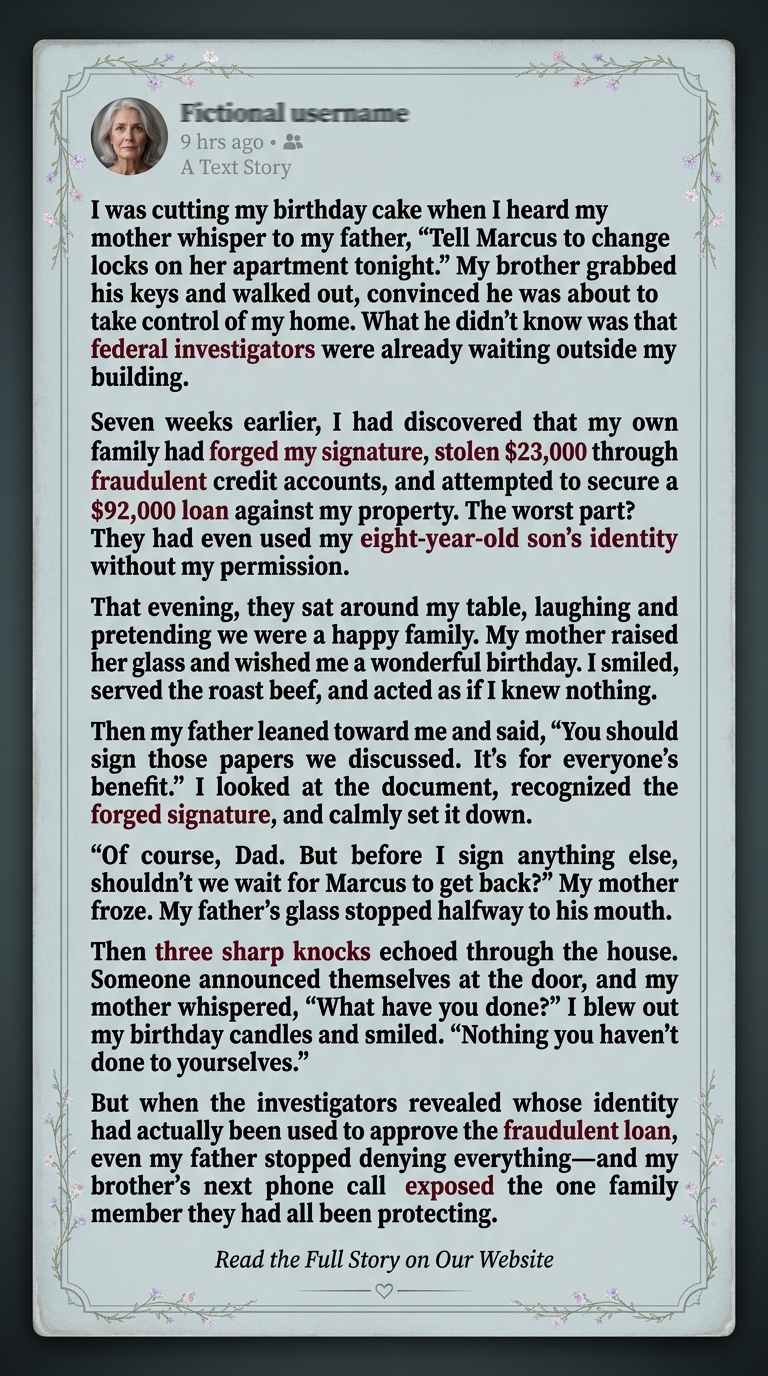
I was cutting my birthday cake when I heard my mother whisper to my father, “Tell Marcus to change the locks on her apartment tonight.” My brother pushed his chair back, grabbed his keys, and headed for the door with the confidence of someone who believed my home was already his. I kept slicing the cake, pretending I hadn’t heard a thing. What Marcus didn’t know was that federal investigators were already waiting outside my building, and the documents that could destroy our family’s carefully constructed lies were sitting in a folder beside my kitchen counter. Seven weeks earlier, I had discovered that someone had forged my signature, opened fraudulent credit accounts in my name, stolen $23,000, and attempted to secure a $92,000 loan against my property. Then I learned the most horrifying part: someone had used my eight-year-old son Noah’s personal information without my permission. That evening, my parents and brother sat around my dining table, smiling for photographs and pretending we were the happiest family in the world. My mother, Patricia, raised her glass. “To my beautiful daughter. May this be your best birthday yet.” My father, Richard, nodded solemnly. Marcus grinned and told me he had a surprise planned for later. I smiled back, served the roast beef, and asked everyone whether they wanted more potatoes. I had learned long ago that my family became most dangerous when they believed I was too trusting to notice what they were doing. When my father finally leaned toward me and slid a document across the table, I recognized the signature at the bottom immediately. It looked almost like mine. Almost. “You should sign these papers we discussed,” he said. “It’s for everyone’s benefit.” I studied the document, then placed it carefully beside my plate. “Of course, Dad. But before I sign anything else, shouldn’t we wait for Marcus to get back?” My mother stopped smiling. My father’s glass froze halfway to his mouth. Then three sharp knocks echoed through the house. A firm voice called from the other side of the door, identifying the investigators and asking everyone to remain where they were. My mother turned toward me, her face suddenly pale. “What have you done?” she whispered. I glanced at the birthday candles still burning on the cake. Then I blew them out. “Nothing you haven’t done to yourselves.”
Seven weeks earlier, I had believed my biggest problem was managing my small accounting consultancy while raising Noah alone. I owned a two-bedroom apartment in a quiet residential building, had a modest savings account, and had worked hard to create a stable life after my divorce. My parents lived twenty minutes away, and Marcus had always been the family favorite. He was charming, confident, and somehow never responsible for the consequences of his decisions. When his business failed, my parents helped him. When he missed payments, they made excuses. When I asked him to repay money he had borrowed from me, my mother accused me of being selfish. Still, I never imagined they would attempt to take my home. The first warning arrived in the form of a letter from a financial institution asking me to verify a credit account I had supposedly opened. I assumed it was a mistake until a second notice arrived, followed by a demand for payment on an account I had never authorized. I checked my credit reports and discovered multiple suspicious applications. The fraudulent accounts had accumulated approximately $23,000 in charges and advances. Then a title-services company contacted me about a loan application secured against my apartment. The proposed loan amount was $92,000. My signature appeared on the documents, and the application included copies of personal records that should never have been accessible to anyone outside my trusted circle. I contacted the lender, disputed the application, placed fraud alerts on my credit files, and reported the suspected identity theft. I also contacted the appropriate authorities and consulted an attorney. I did not confront my family immediately because I wanted the records preserved and the investigation handled properly. A few days later, I found a message on my mother’s tablet that she had left at my apartment after visiting Noah. It was a short exchange between her and Marcus. One message read, “Once the loan clears, we can settle everything.” Another said, “She won’t fight us if Dad explains that it’s for the family.” I took screenshots and sent them to my attorney. Then I discovered that the fraudulent application included Noah’s personal information. His identity had been used in supporting documentation to make the application appear more credible and to establish a financial connection that did not exist. Someone had taken information about my child and treated it as another tool for getting money. That was the moment my fear turned into something colder. I could forgive my family for many things. I could even understand desperation, bad decisions, or financial trouble. But I would not allow anyone to use my son’s identity to steal from us.
The following weeks were filled with phone calls, paperwork, and careful questions. Investigators reviewed the credit applications, the proposed property loan, the communications I had preserved, and records showing who had accessed the relevant personal information. My attorney advised me not to sign anything related to the property or discuss the investigation with anyone who might interfere with it. I followed that advice. Meanwhile, my mother called almost every day, asking whether I had received any “important financial documents.” My father started talking about a family trust that would supposedly simplify my finances and protect Noah’s future. Marcus offered to help me “manage the property” because, according to him, I was too busy with work to handle everything myself. Their sudden interest in my financial well-being might have seemed touching if I hadn’t already seen the loan application. The investigators eventually obtained sufficient evidence to take further action, but they needed to establish the roles each person had played. I learned that Marcus had submitted paperwork connected to the proposed loan and had been communicating with someone who claimed to be a loan broker. My father had supplied documents from an old folder containing my personal information. My mother had helped gather additional records and had repeatedly urged me to sign a property authorization. But the evidence suggested that someone else had done more than simply help the scheme along. There was an unexplained electronic verification attached to the loan file, a confirmation that appeared to show the property owner had approved the transaction. I had never made that confirmation. The investigators were tracing the electronic record through the lender and the third-party service that had processed it. They asked me to continue acting normally while they completed their work. When my birthday approached, my mother insisted that the family celebrate at my apartment. “You never let us do anything nice for you anymore,” she complained. “We’re your family. Surely you can spare one evening.” I agreed, not because I trusted her, but because I had no reason to believe a birthday dinner would change the investigation. I also wanted to see whether they would attempt to make me sign something again. I prepared the food, bought the cake, and set the table. By six o’clock, the apartment smelled of rosemary, roasted meat, and fresh bread. Noah was staying overnight with a trusted friend, a plan I had arranged in advance so he would not be present if the evening became uncomfortable. I placed the investigator’s contact information in my phone and kept my attorney’s instructions in mind. Then I opened the door to my family.
For the first hour, the evening looked almost ordinary. My mother fussed over the table decorations. My father complained about traffic. Marcus told an exaggerated story about a business opportunity he was supposedly close to securing. They laughed at old family memories, and my mother insisted on taking several photographs of us together. I played my part because I wanted them to believe I was still the daughter who would do anything to keep the peace. After dinner, my mother presented me with a small gift and kissed my cheek. “You know we only want what’s best for you,” she said. I thanked her and set the gift beside my chair. Then my father produced a thin folder. “There’s one more thing,” he announced. “We’ve been talking about how to protect the family financially. This arrangement will make everything easier.” I opened it and found a property authorization that would allow a designated representative to act on my behalf in matters involving my apartment. The accompanying pages referred to the proposed loan and contained language authorizing access to property records. The signature at the bottom was supposed to be mine. It was not. “Why does this say I’ve agreed to secure a loan?” I asked. My father sighed as if I were a difficult child. “It’s a technicality. The loan is only temporary. We have expenses, and the money will come back into the family.” “Whose expenses?” I asked. Marcus shifted in his chair. My mother reached for the folder. “Don’t turn your birthday into an argument. Your father is trying to help.” I looked at her. “Then why does the document contain a signature I never wrote?” For a moment, nobody spoke. My father recovered first. “We can fix the wording. Just sign the updated version, and we’ll handle the rest.” He slid another page toward me. I recognized the same signature, this time attached to a statement claiming I had voluntarily authorized the transfer of certain property rights. I placed the paper on the table without signing it. “Of course, Dad,” I said evenly. “But before I sign anything else, shouldn’t we wait for Marcus to get back?” My mother’s eyes darted toward the door. Marcus had already risen, reaching for his keys. “I’m just going to take care of something,” he said. I smiled at him. “Changing the locks?” His hand stopped. My father’s face went blank. My mother whispered, “You weren’t supposed to hear that.” “You’re right,” I replied. “I was supposed to be too trusting to understand what you were planning.” Three sharp knocks sounded at the door. My mother grabbed the edge of the table. My father slowly lowered his glass. When the investigators identified themselves and requested that everyone remain inside, Marcus took one step backward. For the first time that evening, my brother looked genuinely afraid.
The investigators entered with the appropriate authorization and explained that they were following up on suspected financial fraud and identity theft connected to the fraudulent credit accounts and attempted property loan. They asked everyone to remain calm while they documented the papers on the table and secured relevant evidence. My mother immediately began protesting. “This is a family misunderstanding. My daughter is upset, and she’s making everything sound criminal.” One investigator looked at the documents beside my plate. “Ma’am, these records include an application for a secured loan, disputed signatures, and personal information belonging to a minor. We’re investigating how those materials were obtained and used.” My father leaned back in his chair. “I never took any money. I was trying to help my children.” “Then you should have no difficulty explaining the documents you supplied,” the investigator replied. Marcus tried to speak over everyone. “I was handling the application, but Dad said she agreed to it. I thought the paperwork was legitimate.” My father turned toward him. “You told me she had approved everything!” Marcus stared at him. “You gave me her documents!” Their accusations collided in the middle of the room, each trying to transfer responsibility to the other. My mother began to cry, insisting that she had only wanted to keep the family together. I sat quietly, watching the people who had spent years telling me that family meant loyalty suddenly abandon one another the moment loyalty became expensive. The investigators separated their accounts and began asking about specific dates, communications, and financial transactions. They confirmed that the credit accounts had been opened using false information and that the attempted loan had not been authorized by me. Because the loan had not been completed, my apartment had not been transferred or lawfully encumbered by the fraudulent application. The lender had placed the application on hold after inconsistencies emerged, and the investigation had helped prevent it from proceeding. My father insisted he had never intended to steal my home. My mother claimed she had only gathered documents because Marcus needed financial help. Marcus, meanwhile, repeatedly asked whether anyone could prove that he had submitted the application. The investigator told him that the digital records were being examined and that he should direct further questions through his attorney. Then the lead investigator turned to me. “There is one additional issue we need to clarify,” she said. “The information used to verify the property loan did not originate solely from the documents your family provided. Someone used a separate identity-verification account to make the application appear to have been approved by you.” My father stopped denying everything. His face lost its color. My mother stared at him. Marcus looked from one parent to the other. “What does that mean?” he asked. The investigator opened a folder. “It means we have evidence that someone with access to a legitimate verification account submitted a confirmation that was not authorized by the property owner.” My father slowly covered his face with both hands. For the first time, I understood that he had just recognized something he had been desperately hoping would never come to light.
The name connected to the verification account was not Marcus’s. It belonged to my mother, Patricia. She had maintained a legitimate financial-services account through a small bookkeeping business she once operated. Investigators had traced the false verification to that account, along with a series of messages showing that she had helped create the appearance that I had approved the loan. She had not merely gathered my personal information or repeated my father’s excuses. She had used her own access to make the fraudulent application appear authentic. My father stared at her in disbelief. “You told me Marcus had arranged the verification.” My mother shook her head frantically. “I was trying to help him. He said the money would solve everything.” Marcus looked as if the floor had disappeared beneath him. “You said you only gave them the old paperwork!” he shouted. “You said nobody could use it without her signature!” The investigator raised a hand, instructing everyone to stop speaking over one another. The evidence showed that Marcus had submitted the loan application and used my personal records, while my father had supplied documents and pressed me to sign additional authorizations. My mother’s verification account had been used to support the false claim of consent. But the deeper financial review revealed the reason they had been so desperate. Marcus had accumulated substantial debts after his business collapsed. He had concealed the extent of those debts from our parents and had borrowed money from a private lender connected to the supposed loan broker. The $92,000 property loan was meant to provide enough money to repay the most urgent creditors and keep Marcus from losing the business assets he still controlled. My parents had convinced themselves that the loan was temporary and that I would eventually accept their explanation. But the $23,000 in fraudulent credit activity had already been used to cover Marcus’s overdue payments and other expenses. The attempt to secure the loan was not a harmless family arrangement. It was an effort to use my identity and my home to rescue my brother from financial ruin without my knowledge or consent. Then came the revelation that broke the last of my father’s resistance. Investigators had found messages in which my mother discussed using Noah’s personal information to strengthen the loan application. The information had been taken from copies of documents I had once provided to my parents when Noah was born, years before I understood how carefully they were keeping those records. My mother had argued that using his information would make the family’s financial position look more stable. My father had known the documents were being collected, although he claimed he had not understood that Noah’s identity would be used in a financial application. When the investigator read that portion of the evidence aloud, my father lowered his head. “I knew they had his information,” he whispered. “I didn’t ask what they were doing with it.” I looked at him, feeling something inside me finally settle into certainty. “You didn’t ask because you didn’t want to know.” He began to cry, but I could no longer comfort him. My son had been dragged into a scheme before he was old enough to understand what identity theft meant. Whatever affection I still felt for my parents could not erase that fact.
The investigators did not announce instant convictions or declare the case finished that night. They collected the documents, recorded the relevant statements, and explained that the evidence would be reviewed through the proper legal process. Marcus was taken for further questioning, and my parents were instructed to cooperate with the investigation. The case later established that the fraudulent credit accounts and attempted property loan had been part of a coordinated effort to obtain money through false representations. The evidence against Marcus included the loan application, communications with the broker, and records showing that he had benefited from the fraudulent credit activity. My mother’s electronic verification and related messages established her involvement in making the loan appear authorized. My father’s role in supplying documents and pressuring me to sign additional papers was also examined. Each person faced consequences according to the evidence and the applicable law. Marcus eventually accepted responsibility for his role in the fraud and agreed to restitution as part of the resolution of the criminal proceedings. My mother faced penalties for her part in the false verification and the misuse of personal information. My father was required to account for his involvement and the documents he had provided; he could no longer hide behind the claim that everything had been done for the family. The lender withdrew the fraudulent loan application, and the disputed credit accounts were investigated and corrected through the appropriate procedures. My attorney helped me protect the title to my apartment, challenge the fraudulent debts, and place additional safeguards around my financial records. Noah’s information was flagged for protection, and I began the process of ensuring that no unauthorized accounts could be opened using his identity. The financial recovery took time, but the attempted loan never took possession of my home. The $23,000 in fraudulent charges did not become a debt I had to accept as my own. Most importantly, my son’s identity was secured before the scheme could spread further. My family had tried to make me feel guilty for protecting myself. In the end, the records showed that the person who had needed protection most was the child they had all claimed to love.
In the months that followed, I struggled with feelings I had never expected to experience toward my own parents. Anger was easy. Grief was harder. I grieved the family I had believed I had, the birthdays when my mother hugged me while quietly judging what she could take from me, and the conversations in which my father had told me that family always looked after its own. I wondered how many of those moments had been sincere. I also wondered whether I should have recognized the warning signs sooner. My attorney reminded me that the responsibility for fraud belonged to the people who chose to commit it, not to the person who trusted her relatives. I repeated that to myself whenever guilt crept in. Marcus sent me a letter from his attorney acknowledging that he had used my information and apologizing for putting Noah at risk. He wrote that he had convinced himself I would eventually forgive him because we were siblings. I did not reply immediately. Months later, I sent a brief response explaining that any future relationship would depend on honesty, accountability, and time. I did not offer him money, promise to help him rebuild his business, or pretend that an apology could restore what had been lost. My father called several times. In our last conversation, he admitted that he had known the plan was wrong but had convinced himself that I would sign eventually. “I thought you would do it for your brother,” he said. “You were always the responsible one.” “Being responsible doesn’t mean letting everyone else take what I’ve built,” I answered. He apologized, but I told him that an apology was only the beginning of accountability. My mother did not apologize for months. Her first message was about how humiliating the investigation had been and how relatives were treating her differently. I read it once and put my phone down. She was still more concerned about her reputation than the child whose identity she had helped misuse. I did not respond. I had spent too many years trying to make my family comfortable with the truth. This time, I allowed the truth to stand without defending it.
On my next birthday, I celebrated quietly with Noah. We ordered his favorite pizza, decorated a small cake with too many candles, and watched a movie curled up on the couch. He knew that some adults in our family had made serious mistakes, but I had kept the details age-appropriate. He did not need to carry the burden of what they had done. When he asked why Grandma and Grandpa no longer visited, I told him that grown-ups sometimes made choices that hurt other people, and that it was my job to keep him safe. He thought about that for a moment, then nodded and asked whether he could have the biggest slice of cake. I laughed and gave it to him. Later that night, after he had fallen asleep, I stood by the window and looked out at the apartment building Marcus had once planned to enter with a new set of keys. The locks were still mine. The deed was still mine. My home was safe. Yet the most important thing I had protected was not a property or a bank account. It was the quiet life Noah and I had worked so hard to build. I had once believed that keeping a family together meant absorbing the damage its members caused. I now understood that love without boundaries can become permission for people to keep hurting you. I could care about my parents and brother without giving them access to my home, my finances, or my child’s future. I could grieve what we had lost without pretending it had never happened. As I cleared the last birthday plate from the table, I noticed the old folder of financial records sitting beside my desk. I placed it in a locked drawer, then turned off the kitchen light. The birthday that began with a plan to steal my home had ended by showing me exactly what I needed to protect. My family had believed that my love made me easy to manipulate. They had mistaken patience for weakness and forgiveness for permission. They were wrong. I had not destroyed my family by refusing to sign their papers. They had endangered it when they decided my trust was something they could exploit. And when I finally chose to protect my son and myself, I discovered that a peaceful home was worth far more than the approval of people who only loved me when I was willing to sacrifice everything for them.

