My Stepfather Told the ER Doctor We Fell Down the Stairs—Then the Recording Exposed My Mother’s Secret
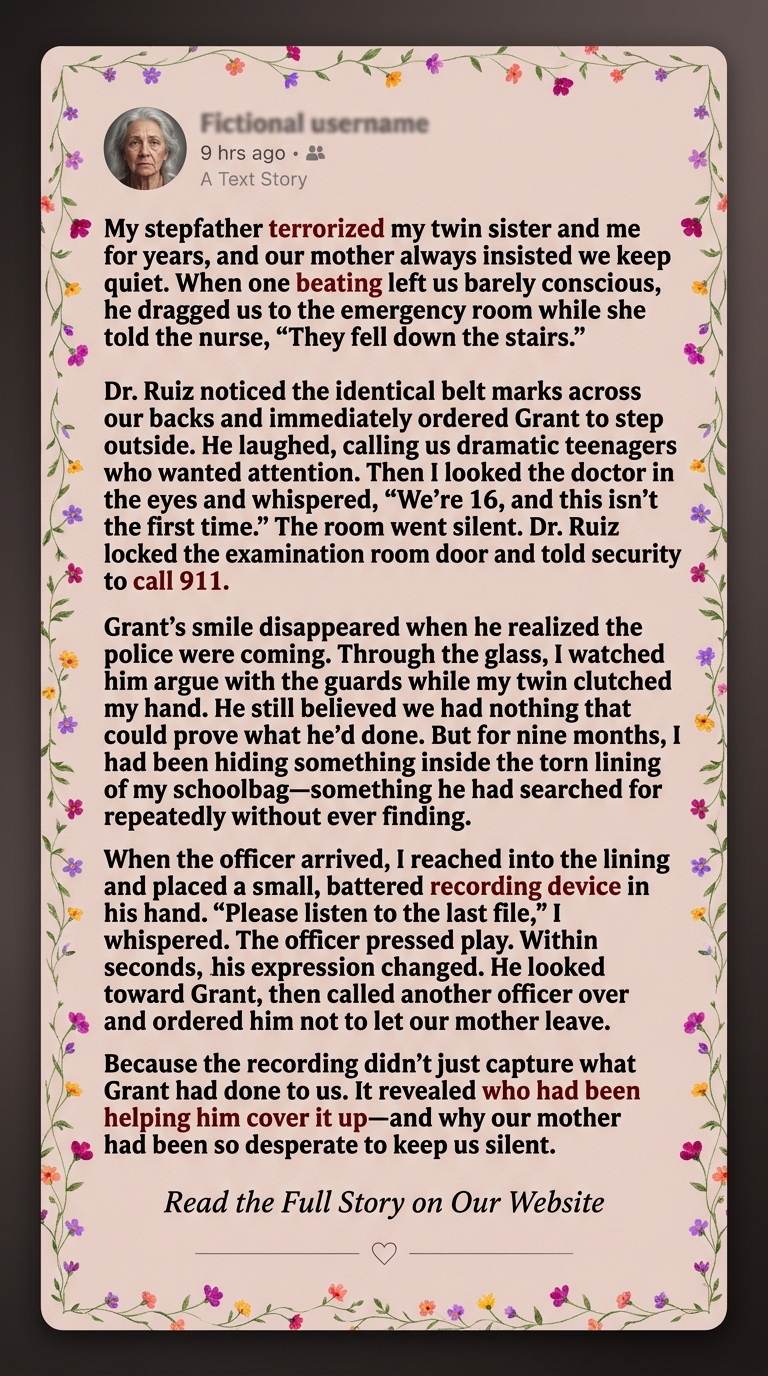
My stepfather had terrorized my twin sister and me for years, and our mother always insisted we keep quiet. “Families handle their problems privately,” she would whisper whenever we begged her to protect us. By sixteen, my sister Lily and I had learned to recognize the sound of Grant’s boots in the hallway, the particular way he slammed a cupboard when he was angry, and the terrifying silence that came just before he hurt one of us. The night everything changed, he beat us so badly that we could barely stand. When he finally stopped, he dragged us to the emergency room and told the receptionist we had fallen down the stairs. Our mother stood beside him, nodding as if she had rehearsed the story a hundred times. “They’re clumsy girls,” she told the nurse. “They both fell.” But Dr. Elena Ruiz noticed the identical belt marks across our backs, the bruises at different stages of healing, and the way Lily flinched whenever Grant moved near her bed. She asked him to step outside. He laughed. “They’re dramatic teenagers. They want attention.” I turned my head toward the doctor, gathering every ounce of strength I had left. “We’re sixteen,” I whispered. “And this isn’t the first time.” Dr. Ruiz stopped writing. Her expression changed, and she quietly asked the nurse to remain with us while she stepped into the hallway. Moments later, the examination-room door closed, security arrived, and someone called 911. Through the glass, I watched Grant argue with the guards, his face turning red as he realized he could no longer control the story. Lily gripped my hand so tightly that our fingers hurt. Grant still believed we had nothing that could prove what he had done. He had searched our room, our backpacks, and even the pockets of our winter coats, looking for anything that might expose him. But for nine months, I had hidden something inside the torn lining of my schoolbag: a small, battered recording device that held the one thing he had never imagined we could keep. When the first officer arrived, I asked him to come close. I reached into the bag, carefully pulled the device from its hidden compartment, and placed it in his hand. “Please listen to the last file,” I whispered. The officer pressed play. Within seconds, his expression changed. He looked toward Grant, then called another officer over and instructed him to ensure our mother remained available for questioning. The recording didn’t merely capture Grant’s violence. It revealed who had helped him cover it up—and why our mother had been so desperate to keep us silent.
The recording device had come into my possession the previous winter, when our school’s media club held a workshop on recording interviews and oral histories. I had borrowed the inexpensive device for a class project and discovered that it could save audio files without needing an internet connection. I returned the school’s equipment afterward, but I had already realized something important: Grant could search our belongings, take our phones, and demand to know every conversation we had, but he could not erase what he did if I found a safe way to preserve the evidence. I never intended to provoke him or put Lily in greater danger. I simply wanted someone to believe us. The first recording was accidental. I had forgotten to switch the device off after a school interview and left it in the inner pocket of my bag. That evening, Grant came into our bedroom furious because Lily had asked our mother for money for a school trip. He shouted that we were ungrateful, accused us of turning our mother against him, and threatened to make us regret embarrassing him. When I later listened to the file, I heard everything. My hands shook so badly that I nearly dropped the device. I knew I needed help, but I was terrified of what would happen if Grant discovered it. I began saving short recordings whenever it was safe to do so, never deliberately escalating a confrontation and never allowing the device to remain visible. Some files contained threats. Others captured him admitting that he had hurt us and warning our mother to stick to the story about accidents. I kept the device wrapped in an old piece of fabric and tucked it into a narrow opening I had carefully sewn into the lining of my schoolbag. For nine months, I carried it everywhere. I wanted to tell a teacher, a counselor, or the police, but Grant had convinced us that he knew people who could make our lives worse if we talked. Our mother reinforced that fear. She told us that nobody would believe two troubled teenagers over a respected adult with a steady job. When Lily once threatened to tell our school counselor, Grant took away her phone and kept us home for two days, claiming we were sick. Afterward, our mother sat on the edge of our bed and cried. “Please,” she begged. “If you tell anyone, you’ll destroy this family.” Lily looked at her and asked the question we had both been afraid to say aloud. “What about what he’s doing to us?” Our mother covered her face. She never answered. After that, I stopped expecting her to save us. I began looking for someone outside our home who could.
At the hospital, the recording gave the officers a reason to investigate immediately, but it was not the only evidence. Dr. Ruiz had documented our injuries, including the matching belt marks, older bruises, and signs that the latest assault was not an isolated event. She had also recorded our separate statements before Grant could reenter the examination room. The nurse had noticed that Lily and I repeatedly looked toward the door whenever footsteps approached. Hospital staff followed safeguarding procedures and kept us away from Grant while law enforcement arrived. The officer listened to the final file through headphones. In it, Grant’s voice was unmistakable. “If anyone asks, you tell them they fell. You understand me?” My mother answered, “I told the nurse already.” Then Grant said, “And if they keep asking questions?” There was a pause. My mother replied, “I’ll tell them the girls have been acting out. I’ll say they’re making things up because they want you gone.” The recording continued. Grant’s voice grew colder. “Good. And don’t forget what we discussed about their father.” My mother hesitated. “I know.” “Then do your part,” he snapped. “If those girls start talking, you remind them what happens to people who betray this family.” The officer stopped the recording and looked at me. “Do you know what he meant when he mentioned your father?” I shook my head. Our biological father had died when we were young, and Grant rarely allowed us to speak about him. Whenever we asked our mother questions, she told us to leave the past alone. The officer asked whether we felt safe returning home. Lily began crying before I could answer. “No,” I said. “We don’t.” He nodded and told us we would not be sent back with Grant that night. For the first time in years, an adult had heard us say we were afraid and responded by taking the fear seriously. Through the glass, I watched Grant realize that the officers were no longer treating him as a concerned stepfather. One officer stood between him and the examination room while another escorted him away for questioning. He looked directly at me as he passed. His expression was full of hatred, but for once, I did not look away. Lily squeezed my hand. “Is it over?” she whispered. I wanted to tell her yes. Instead, I told her the truth. “I think someone is finally listening.”
The most disturbing revelation came when investigators separated our mother from Grant and asked her about the recording. At first, she insisted she had only repeated the story Grant gave her because she was frightened of him. She claimed she had never helped him hurt us and knew nothing about the older injuries documented by the doctor. But when the officers played the conversation again, she stopped denying that she had helped conceal the abuse. She began crying and said Grant had threatened her, too. Investigators did not accept her explanation at face value. They asked about specific incidents, dates, and earlier visits to medical facilities. Then they showed her a document recovered from our home: a letter she had written to our school several months earlier, claiming Lily and I had behavioral problems and were inventing accusations to get Grant removed from the household. The letter had been sent after our school counselor requested a meeting because Lily had arrived at school with a bruised wrist. Our mother had used the letter to persuade the school that the injuries were the result of horseplay and that we were unreliable witnesses. But the recording revealed something more. In a file made six weeks earlier, our mother could be heard asking Grant whether he had hidden the old medical records. He replied that he had burned the copies he found in a drawer. She then said, “If anyone learns what happened before we moved here, they’ll ask why I never took them away.” Grant answered, “You’re the one who signed the forms. You’re the one who told them to write down accidents.” The officer replayed that section several times. My mother had not merely been too frightened to intervene in the present. She had helped create a false account of our injuries and had concealed evidence of earlier abuse. When investigators confronted her with the recording, she finally admitted that she had lied to medical staff and the school. She insisted she had done it because she believed Grant would become more dangerous if anyone challenged him. That fear may have been real, but it did not erase what her choices had cost us. She had repeatedly placed the responsibility for keeping the family together on two children who were being hurt inside their own home. And when we tried to tell the truth, she had used her position as our mother to make us appear untrustworthy. The officer asked why she had not sought help privately. My mother stared at the table for a long time. “Because I was afraid of losing everything,” she whispered. “The house, the money, the life I had.” Then she added, “And because Grant told me the girls would be taken away if anyone found out.” The officer answered quietly, “They needed someone to protect them. You were the adult who had that responsibility.” My mother began sobbing. I heard about that conversation later, when a child-protection worker explained what had been uncovered. At the time, all I knew was that the truth about our mother was worse than I had imagined. She had been afraid of Grant, but she had also been protecting the life she wanted, even when protecting it meant sacrificing us.
The next several days were confusing and exhausting. Lily and I remained under medical care while child-protection professionals arranged a safe placement away from Grant. A trained advocate explained our options, answered our questions, and made sure we understood that we had not caused any of this. Investigators secured the recording device, created verified copies of the audio files, and documented how I had stored them. They also gathered hospital records, the school letter, photographs of earlier injuries, and statements from people who had noticed signs of abuse. The recordings were not treated as a magical solution that proved every accusation by themselves. Instead, they helped investigators establish a timeline and identify people and records that needed to be examined. Grant denied the allegations at first. He claimed the bruises came from sports and that Lily and I had coordinated our story because we disliked his rules. But his explanation became harder to maintain as the evidence accumulated. The hospital’s findings were inconsistent with the staircase story, and the audio files contained his own threats and instructions to conceal the violence. The investigation also uncovered earlier messages in which he warned our mother not to allow us to speak with school staff alone. Eventually, he was charged with offenses relating to the abuse and intimidation, and the court ordered him to have no contact with us while the case proceeded. Our mother was investigated for her role in the cover-up and the false statements she had made. Because she had acknowledged lying to medical staff and interfering with attempts to report the abuse, she faced serious legal and child-welfare consequences of her own. The court did not simply return us to her because she was our mother. A safeguarding assessment was required, and our safety remained the priority. When we finally learned that we would not have to go back to the house, Lily cried with relief. I held her and cried, too. We had spent years imagining that escaping would require a dramatic rescue, a perfect piece of evidence, or someone powerful deciding to believe us. In reality, it took a doctor willing to ask the right questions, hospital staff who followed the signs they observed, investigators who preserved the evidence, and professionals who treated our safety as more important than our family’s reputation. The recording mattered, but so did the people who listened.
Several weeks later, a detective asked whether I was ready to hear the remaining part of the file that had caused investigators to question our mother. I sat beside Lily in a quiet office, with a child advocate nearby. The detective explained that the audio included a conversation about our biological father, Daniel, who had died when we were eight. We had always been told he died in a car accident after losing control on a wet road. We remembered very little about the days before his death, only that our mother had been distraught and that Grant had entered our lives not long afterward. The detective played the file. Grant spoke first. “If the girls ever find the old report, we’re finished.” My mother answered, “They won’t. I threw it away.” “You said that last time.” “I kept one copy because I thought I might need it.” There was a long silence. Then Grant said, “You need to stop pretending you were going to tell them the truth. You signed the statement.” My mother’s voice cracked. “I didn’t know you were going to drive that fast. I told you to slow down.” “You got in the car with me,” he replied. “And when the police asked, you told them Daniel had been driving.” The detective paused the audio. Lily stared at him, unable to speak. I felt as if the room had tilted. The detective explained that the recording raised serious questions about the circumstances of our father’s death, but the authorities would need to verify the information before drawing conclusions. They obtained the original collision report and located an archived statement that had not been included in the file given to our family. The records showed that our mother had been driving the car on the night of the crash. Grant had been a passenger, and Daniel had been in the back seat with us. The vehicle had left the road after our mother lost control. Daniel had suffered fatal injuries while trying to protect us during the collision. Our mother had later given investigators an inaccurate account of who had been driving, and Grant had supported her version. The original inquiry had not established intentional wrongdoing, but the false statement had distorted the record and concealed the true circumstances. The newly discovered evidence prompted a formal review of the old case. Investigators did not immediately label our father’s death a deliberate act, and they did not claim the recording alone could prove more than it contained. But they established that our mother had concealed crucial information and that Grant had helped her maintain the false account. That discovery explained the threat he had used to keep her obedient: he knew she feared the consequences of the lie she had told about our father. He had used that secret to control her, and she had allowed that control to become another reason to keep us silent. The truth about Daniel’s death did not undo the loss we had carried since childhood. It did, however, return something to us that we had never been given: an honest account of what happened.
The legal proceedings took months, and not every question was answered at once. Grant eventually pleaded guilty to multiple offenses connected to the abuse and intimidation after the evidence against him became overwhelming. The court imposed a prison sentence and a long-term no-contact order. He was prohibited from approaching us or communicating with us through other people. Our mother faced separate proceedings for her role in concealing the abuse, making false statements, and interfering with efforts to protect us. Her conduct was examined in context, including the threats she described, but the court made clear that her actions had helped prolong the harm we suffered. She lost custody, was required to comply with safeguarding restrictions, and received legal consequences for the offenses established against her. She wrote us several letters while the proceedings were underway. In the first, she begged us to understand that she had been afraid. In the second, she said she had made mistakes but had always loved us. In the third, she finally acknowledged that she had told doctors and school staff we were lying when she knew we were asking for help. She admitted that she had protected Grant because she was terrified of losing her home and the life she had built with him. She wrote that she wished she could go back and choose us instead. Lily read the letter once and handed it back to the advocate. “I wish she had chosen us when we needed her,” she said. I felt the same way. We did not have to decide immediately whether to forgive her, and nobody pressured us to do so. Our advocate explained that forgiveness was a personal choice, not a condition of healing or a requirement for moving forward. We were allowed to feel love, anger, grief, and relief at the same time. We were allowed to miss the mother we wished we had while protecting ourselves from the mother who had failed us. As the months passed, we began to sleep through the night more often. Lily returned to drawing, something Grant had mocked because he considered it childish. I started planning for college and found a counselor who helped me understand why I still flinched when someone raised their voice. We had spent years believing that surviving meant enduring whatever happened without making trouble. We were slowly learning that surviving could also mean asking for help, setting boundaries, and allowing other people to protect us.
A year after the night at the emergency room, Lily and I visited a small park near the school we had attended before everything came to light. It was a clear autumn afternoon, and the trees were turning gold around the walking path. We had moved into a safe home with a relative approved by child-protection professionals, and we were receiving ongoing support. Our lives were not suddenly perfect. We still had difficult days, nightmares, and moments when an ordinary sound brought back memories we wished we could forget. But we were safe, we were together, and nobody was telling us that the truth would destroy the family. Lily sat on a bench and watched children playing near the swings. “Do you ever think about what would have happened if Dr. Ruiz hadn’t noticed?” she asked. I thought about the emergency room, the doctor’s calm voice, and the way she had taken our words seriously without demanding that we prove everything before she helped us. “Yes,” I admitted. “I think about it a lot.” Lily looked at me. “I was so scared when you gave the officer the recorder.” “I was scared, too.” “You didn’t look scared.” I smiled sadly. “I had nine months to practice looking calm.” She laughed softly, and for a moment we sounded like the children we had been before Grant taught us to fear every unexpected noise. Then she leaned against my shoulder. “I’m glad you kept it.” I rested my head against hers. “I’m glad you kept holding my hand.” The recording had helped expose the truth, but it had never been the thing that made us brave. We had been brave every time we got up for school after a terrible night, every time we tried to ask for help, and every time we refused to believe that the way Grant treated us was what we deserved. We had not saved ourselves because we were fearless. We had survived because we kept finding ways to protect one another until someone with the power to help finally listened. I still carried the battered schoolbag for a while after the investigation, though the torn lining had been repaired and the recording device was kept with the evidence. Eventually, I put the bag away. I no longer needed to carry proof of what had happened everywhere I went. The truth had been documented, the people responsible had faced consequences, and our future was no longer controlled by the people who had hurt us. For years, our mother had told us that speaking up would destroy our family. What she never understood was that silence had already destroyed the safety a family was supposed to provide. The night Dr. Ruiz locked that examination-room door, she gave us something we had been denied for far too long: a chance to be heard without being punished for telling the truth. And when I think about that night now, I remember the officer pressing play, Lily’s fingers wrapped around mine, and the moment Grant’s certainty finally disappeared. We were sixteen-year-old girls who had been told no one would believe us. We were wrong about one thing: someone did believe us. And that was where our lives finally began to change.