I Sent My 14-Year-Old Son Away—Twenty Years Later, I Found Him Fixing My Truck
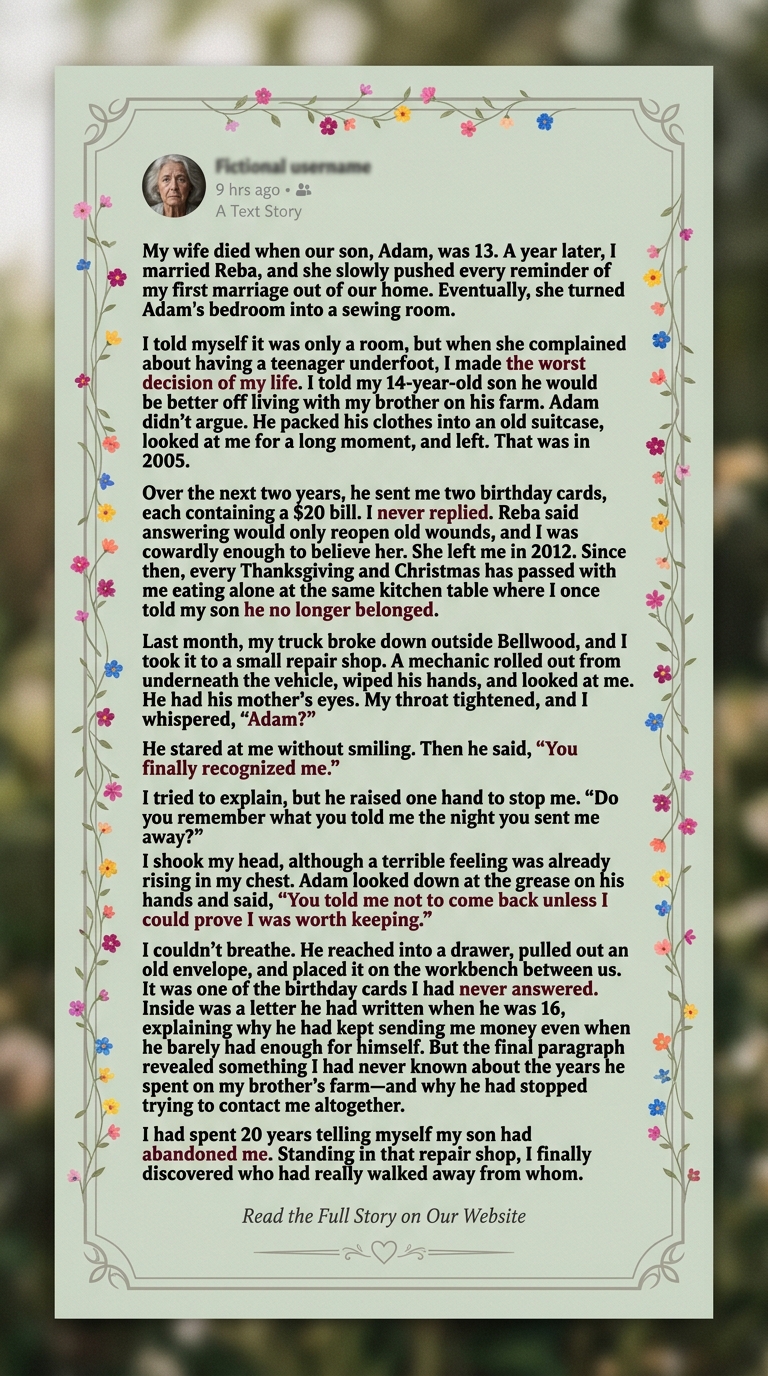
My wife died when our son, Adam, was thirteen. For a year, it was just the two of us, trying to survive in a house that still smelled of her perfume and held too many memories. Then I married Reba, convincing myself that a new beginning was what Adam and I both needed. At first, she seemed kind enough. She cooked dinner, helped with the bills, and smiled whenever our neighbors complimented her. But gradually, the photographs of my first wife disappeared from the walls. Her favorite blanket vanished from the couch. The little ceramic birds she had collected were packed into boxes and shoved into the attic. Whenever I asked about them, Reba said we needed to stop living in the past. I told myself she was right. I wanted peace, and I was willing to sacrifice almost anything to keep it. Eventually, Reba turned Adam’s bedroom into a sewing room, claiming she needed somewhere quiet for her work. Adam, who had already lost his mother, began sleeping in a cramped room beside the laundry area. He stopped inviting friends over and spent more time outside, helping neighbors with odd jobs or sitting alone on the back porch. I noticed his silence but convinced myself it was ordinary teenage behavior. Then, one evening, Reba complained that having a teenager in the house was ruining our marriage. She said Adam was disrespectful, that his sadness made everyone uncomfortable, and that I had allowed him to become too dependent on me. Instead of defending my son, I listened. A week later, I sat Adam down at the kitchen table and told him he would be better off living with my brother, Daniel, on his farm. He was fourteen. He stared at me for several seconds, as if waiting for me to laugh and admit I had made a terrible joke. When I didn’t, he quietly asked, “Is this what Mom would have wanted?” The question cut deeper than I expected, but I buried the feeling beneath irritation. “Your mother is gone, Adam. We have to move forward.” He lowered his eyes. “I know, Dad.” He packed his clothes into an old suitcase that night. Before leaving, he stood in the doorway and looked at me with a sadness I would spend the next twenty years trying to forget. “Do you want me to go?” he asked. I should have said no. I should have taken him into my arms and told him that no matter how difficult life became, he would always have a home with me. Instead, I said, “This is probably best for everyone.” Adam nodded once and walked out. That was in 2005. Over the next two years, he sent me two birthday cards, each containing a twenty-dollar bill. I never answered either one. Reba told me that replying would only reopen old wounds and encourage Adam to come back before we were ready. I was cowardly enough to believe her. She left me in 2012, taking her sewing machines, her furniture, and almost everything she had brought into the house. By then, the damage was done. Every Thanksgiving and Christmas passed with me eating alone at the same kitchen table where I had told my son he no longer belonged. Last month, my truck broke down outside Bellwood, and I took it to a small repair shop. A mechanic rolled out from beneath the vehicle, wiped his hands on a rag, and looked directly at me. He had his mother’s eyes. My throat tightened. “Adam?” I whispered. He stared at me without smiling. “You finally recognized me.” I tried to explain, but he raised one hand to stop me. “Do you remember what you told me the night you sent me away?” I shook my head, although a terrible feeling was already rising in my chest. Adam looked down at the grease on his hands and said, “You told me not to come back unless I could prove I was worth keeping.” I couldn’t breathe. He opened a drawer, pulled out an old envelope, and placed it on the workbench between us. It was one of the birthday cards I had never answered. Inside was a letter he had written when he was sixteen, explaining why he had kept sending me money even when he barely had enough for himself. But the final paragraph revealed something I had never known about the years he spent on my brother’s farm—and why he had stopped trying to contact me altogether.
I stared at the envelope as though it might disappear if I touched it. The paper had yellowed along the edges, and my name was written in Adam’s childhood handwriting, the same careful letters he had used on every school assignment he brought home. “Why do you still have this?” I asked. Adam folded his arms. “Because you never answered it.” His words were quiet, but they left no room for excuses. I opened the letter with trembling fingers. It began simply: Dear Dad, I hope you’re doing okay. Uncle Daniel says I shouldn’t expect you to call, but I still think about you every day. I know you wanted me to become more independent, so I’m trying. The next few paragraphs described his life on the farm. My brother had given him a small bedroom above the equipment shed, enrolled him in the local school, and taught him how to care for the animals and repair machinery. Adam wrote about feeding calves before sunrise, hauling hay, and learning to mend fences. He said the work helped him sleep because exhaustion kept the memories away. He also wrote about missing his mother. Sometimes he would walk to the edge of the property and sit beneath an old oak tree, remembering how she used to read to him before bed. He had kept one photograph of her hidden inside his suitcase because it was the only picture Reba had not taken from him. Then I reached the paragraph about the birthday money. I’m sending you twenty dollars because Uncle Daniel paid me for helping repair the tractor. I know it’s not much, but Mom always said gifts aren’t about the amount. I thought maybe if I sent you something, you’d know I still wanted to be your son. I don’t need you to buy me anything. I just want you to tell me I can come home. My vision blurred. I had imagined those twenty-dollar bills as childish attempts to get attention. I had never considered that they might have been everything he could spare after working long days for the chance to earn a little money of his own. The letter continued: Dad, I heard you told Uncle Daniel I was better off here. I don’t understand why you couldn’t tell me that yourself. I keep thinking I must have done something wrong. If I become more helpful, if I get better grades, if I stop being sad about Mom, maybe you’ll want me back. I pressed my hand against my mouth. I had not merely sent my grieving child away. I had made him believe that being loved was something he had to earn.
I turned to the final paragraph. The handwriting was smaller there, as if Adam had run out of space or courage. There’s something I haven’t told you. Last week, Uncle Daniel got a letter from you—or at least one that looked like it came from you. It said I shouldn’t write anymore because you needed to protect your new marriage, and that I should stop expecting to return. Uncle Daniel thought you must have changed your mind about me. I didn’t want to believe it, but I promised I wouldn’t bother you again. I’m keeping this card for your birthday because I don’t know how else to tell you I love you. If you ever want me, you know where I am. I read the paragraph twice. I had never written that letter. “Adam,” I said, struggling to find my voice, “I never sent anything like that.” His expression barely changed. “I know that now.” He explained that Daniel had kept the letter, along with the envelope it arrived in. The handwriting looked like mine, but the return address had been written incorrectly, and the postmark came from a town where Reba had visited a friend around that time. Daniel had questioned her about it during a phone call, and she had insisted that I had asked her to handle the message because I couldn’t bear to speak to Adam directly. Daniel had believed her. He was caught between his brother and a boy who desperately wanted to believe his father still loved him. He had urged Adam to focus on school and stop waiting for a reconciliation that might never come. “When I turned sixteen, I asked Uncle Daniel to call you,” Adam said. “He did. Reba answered. She told him you didn’t want to speak to me and that calling again would only upset you.” I felt sick. “Why didn’t Daniel tell me?” Adam looked at me for a long moment. “Because he believed the letter was yours. He thought he was respecting your wishes.” I sat heavily on a stool. For years, I had told myself Adam had chosen to stay away. I had blamed his silence on teenage pride, stubbornness, and the distance between our lives. But my son had been waiting for me to reach out, and someone had deliberately convinced him that I wanted him gone. “Did you ever try again?” I asked. Adam nodded. “When I was eighteen, I sent another letter to the house. It came back unopened. There was a note written on the envelope saying I should stop contacting you.” He paused. “I thought you had finally made your decision clear.” I wanted to ask how he could have believed that I didn’t love him, but the answer was right in front of me. I had given him every reason to believe it.
“Why didn’t you come looking for me when Reba left?” I asked, though I immediately regretted the question. Adam looked toward the garage doors, where sunlight spilled across the concrete floor. “Because by then, I’d spent seven years believing I wasn’t wanted. I didn’t know whether you were still married. I didn’t know where I fit into your life. And I was tired of asking people to love me.” He told me that Daniel had eventually discovered the truth about the letter after Reba left me. He had confronted her, and she admitted that she had written it because she wanted Adam to stop contacting us. She had been afraid that if Adam returned, I would prioritize him over her, and she wanted to eliminate anything that reminded me of my first marriage. Daniel had urged Adam to reach out to me again, but Adam had refused. He was twenty-one, working full-time at a repair shop, and trying to build a life that didn’t depend on whether I finally chose him. “I was angry,” he said. “Not just at Reba. At you. She might have lied to me, but you were the one who sent me away in the first place. You were the one who let me leave with a suitcase and never called.” I bowed my head. “You’re right.” I had spent years rehearsing explanations for the night I sent him away. I had told myself I was trying to keep my marriage together, that I thought Daniel’s farm would be good for him, that teenagers needed independence. None of those explanations changed the fact that Adam had been fourteen and grieving, and I had chosen my own comfort over his need for a father. “I was weak,” I said. “I wanted Reba to be happy, and I convinced myself you would be fine without me. I told myself you were better off because admitting I had abandoned you would have meant facing what kind of father I had become.” Adam looked at me without speaking. I forced myself to continue. “I don’t expect you to forgive me because Reba lied. I made the first choice. She made the rest of it easier for me to avoid responsibility, but I was the one who let you go.” His jaw tightened. For the first time, I saw tears gathering in his eyes. “Do you know what I wanted when I sent you those cards?” he asked. “I wasn’t asking for money. I wasn’t asking you to come get me. I wanted one sentence. Just one. Something that said I was still your son.” I had no answer. I could only sit there, listening to the truth I should have heard twenty years earlier.
Adam didn’t invite me to dinner that day. He finished checking the truck, explained what needed to be repaired, and gave me an estimate. I paid him, thanked him, and stood awkwardly beside the workbench, unsure whether I had the right to ask for anything else. Before I left, I turned toward him. “Would you let me call you sometime?” He wiped his hands on a rag. “You can call,” he said. “That doesn’t mean everything goes back to normal.” “I understand.” He gave me a small nod, and I drove away with the old letter on the passenger seat. For the first time in years, I did not go home and tell myself that my son had abandoned me. I went home and admitted that I had abandoned him first. That night, I took the two birthday cards from the drawer where I had kept them. I had saved them all those years, though I had never admitted why. Each contained a twenty-dollar bill and a short note wishing me a happy birthday. I had told myself I kept them because throwing away a gift would be rude. The truth was that I could not bring myself to discard the only things my son had sent me after I told him to leave. I placed the new letter beside them and cried until my chest hurt. Then I wrote Adam a letter of my own. I did not ask him to forgive me. I did not blame Reba, although I named the lie she had told. I wrote that I was sorry for sending him away, sorry for failing to answer his cards, and sorry for making him believe he had to prove his worth to his own father. I told him that he had never needed to earn a place in my life. I should have made that clear when he was fourteen, and I had failed him. I mailed the letter the next morning, then waited. Three days passed. Then a week. I began to worry that I had said too much, or not enough. On the ninth day, my phone rang. It was Adam. “I got your letter,” he said. My heart pounded. “Thank you for reading it.” He was quiet for a moment. “I don’t know what I’m supposed to do with an apology after twenty years.” “You don’t have to do anything,” I told him. “You don’t owe me a response, a visit, or forgiveness. I just wanted you to know the truth.” He breathed out slowly. “I believe you about the letter Reba wrote. Uncle Daniel showed me the envelope after he found out what happened. But I’m still angry with you.” “You have every right to be.” Another silence followed. Then he said, “You can call me again next week.” It wasn’t forgiveness. It wasn’t a promise that we would become a family again. But it was a door left open a few inches, and I was determined never to force it wider than he wanted.
Over the next six months, we rebuilt our relationship one conversation at a time. I called on Sundays, as he had suggested, and learned about the life I had missed. He had become a skilled mechanic, eventually opening the small repair shop where we had reunited. He was married to a woman named Sarah, who worked as a physical therapist, and they had a daughter, Lily, who was seven. The first time he mentioned her, my heart tightened with the realization that I had a granddaughter I had never met. I did not ask to see her immediately. I told him I would be grateful for the opportunity if he ever felt comfortable introducing us, but that I would respect his decision either way. Adam appreciated that I had finally learned not to demand what I had not earned. When we spoke about his childhood, I listened without defending myself. He told me how lonely he had been on the farm, how he used to lie awake wondering whether I remembered his birthday, and how he had stopped asking Daniel about me because he couldn’t bear another answer suggesting I wanted him gone. I told him about the years I spent eating alone, the holidays when I wondered whether he was thinking about me, and the shame that had kept me from searching for him. He did not let me turn my loneliness into an excuse. “You were lonely because of your choices,” he said once. “I was lonely because I was a child who had been sent away.” I accepted that. It was the first time I understood that regret was not the same as suffering the consequences of what I had done. Reba had left me, but my punishment was not simply being alone. It was knowing I had sacrificed the relationship that mattered most to keep a marriage that did not last. When Adam finally invited me to meet Sarah and Lily, we arranged a quiet lunch at a park. I arrived early and sat on a bench, my hands trembling. Adam came walking toward me with a little girl holding his hand. She had his dark hair and her grandmother’s eyes. “Dad,” he said, introducing me to her, “this is my grandfather.” Lily studied me for a moment, then asked whether I knew how to fix a bicycle. I laughed, surprised by the sudden lump in my throat. “I’m afraid your dad is much better at that than I am.” “That’s okay,” she said. “He can teach you.” Adam smiled faintly. It was the first unguarded smile I had seen from him since the repair shop. We spent the afternoon talking, eating sandwiches, and watching Lily chase pigeons across the grass. I did not pretend to be the grandfather she should already have known. I was simply a man who had been given a chance to begin showing up.
On the twentieth anniversary of the day Adam left my house, I drove to Bellwood and parked outside his repair shop. I had called ahead, and he had agreed to have lunch with me. I brought the two birthday cards and the letter he had written when he was sixteen, carefully placed in a new envelope. “I thought you should have these back,” I said, setting them on the table between us. Adam opened the envelope and looked at the cards for a long time. “I forgot I wrote some of this,” he admitted. “I was so angry when I wrote it.” “You had every reason to be.” He ran a thumb over the edge of one card. “I used to imagine that you’d call me on my birthday and tell me to come home. For years, I thought if I just waited long enough, you’d remember that I was your son.” His voice grew quiet. “Eventually, I stopped waiting. Not because I stopped loving you, but because I needed to build a life where I wasn’t measuring my worth by whether you wanted me.” I felt the truth of his words settle into me. “I’m sorry I made you feel that way.” Adam nodded. He did not say that everything was forgiven, and I did not ask him to. Instead, he told me about a new apprentice he had hired, a young man who reminded him of himself at fourteen. The boy had been living with an uncle after a difficult family situation, and Adam had been teaching him how to repair engines and apply for technical school. “I can’t fix what happened to me,” he said. “But I can make sure someone else doesn’t feel like they have to prove they’re worth keeping.” I looked at my son, and for the first time, I saw not the boy I had sent away but the man he had become despite me. He had taken the pain I caused him and built something decent from it. That was not a gift I deserved, but it was one I could respect. Before I left, Adam walked me to my truck. He hugged me briefly, then stepped back. “Sunday,” he said. “Call me Sunday.” I nodded, afraid that if I spoke, I would start crying. “I will.” This time, I kept my promise.
I still eat Thanksgiving dinner at the same kitchen table where I once told my fourteen-year-old son he no longer belonged. But the table is no longer set for one. Adam, Sarah, and Lily came for Thanksgiving last year, and they brought a pumpkin pie that Lily insisted we decorate with too much whipped cream. We did not spend the day pretending the past had never happened. We talked about his mother, whose photograph now stands on the mantel beside a picture of Adam and his daughter. He told Lily stories about the woman who used to read him bedtime stories, and I listened, grateful that my first wife’s memory had finally returned to our home without anyone trying to erase it. Adam and I still have difficult moments. Some wounds do not disappear just because someone apologizes. Trust grows slowly, through repeated choices, and I understand that my son has every right to protect the life he built without me. I no longer expect him to make me feel like a good father. That is my responsibility, not his. Sometimes, when I see the old birthday cards in the drawer, I think about the twenty dollars he sent me when he was sixteen. He had so little, yet he was still trying to give me something. I had been too proud and too frightened to accept it. For twenty years, I told myself my son had abandoned me. I said he never called, never visited, and never tried to come home. But the truth was written in two birthday cards and a letter I should have answered. Adam had reached for me again and again, and I had allowed my silence to become the final answer he believed. Reba had lied to him, but she could not have kept us apart without my original betrayal and my willingness to look away. I was the father. I was the adult. I was the one who should have protected him. The most painful thing I learned in that repair shop was not that my son had suffered without me. It was that he had spent years believing he was the problem. He was never the problem. He was a grieving child who needed his father, and I had taught him that love was something he had to earn. I cannot give him back those years. I cannot undo the birthdays he spent wondering whether I remembered him, or the nights he fell asleep believing he was unwanted. But I can answer when he calls. I can show up when he invites me. I can listen when he tells me the truth, even when it hurts. And I can spend whatever time remains proving through my actions what I should have told him when he was fourteen: he was always worth keeping. I was simply too much of a coward to act like it.