Three Men Were Digging in My Backyard Before Sunrise—Then I Saw Who Was Waiting in the SUV
At 5:40 on a Tuesday morning, my neighbor called me with a warning that changed everything I thought I knew about my late husband.
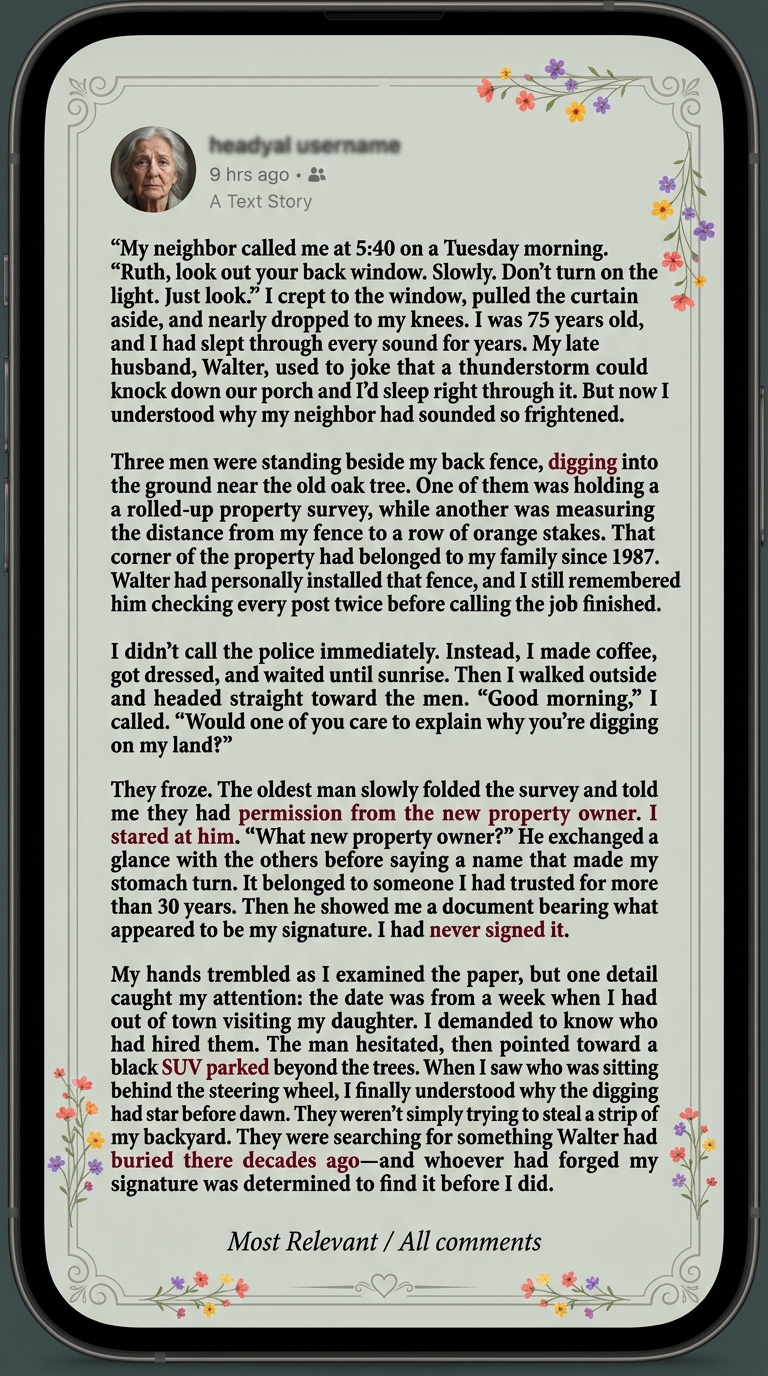
“Ruth, look out your back window. Slowly. Don’t turn on the light. Just look.”
I was seventy-five years old, and in all the years I had lived in that house, I had never heard fear in Margaret’s voice like that.
My husband, Walter, used to joke that I could sleep through a thunderstorm tearing the roof off our porch. But that morning, one look through my bedroom curtain brought me fully awake.
Three men were digging beside my back fence near the old oak tree. One held a rolled-up property survey, another drove orange stakes into the ground, and the third was shoveling dirt into a plastic container.
That corner of the yard had belonged to my family since 1987. Walter had built the fence himself, checking every post twice before declaring the job finished. He had planted the oak tree the following spring, telling me that one day our grandchildren would sit beneath its branches.
Walter had been gone for four years.
I stood at the window, watching strangers dig into the ground he had once tended with such care.
My first instinct was to call the police. Instead, I called Margaret back and asked her to stay on the phone while I dressed. She lived two houses away and had apparently spotted the men while taking her dog outside.
“Please don’t go out there alone,” she urged.
“I’m not going to let strangers dig up my yard while I hide behind a curtain.”
“Ruth, something about this feels wrong.”
She was right. But I needed to know what they thought they were doing.
I made coffee, put on my navy cardigan, and waited until the first light of dawn spread across the grass. Then I walked through the kitchen, opened the back door, and headed toward the fence.
“Good morning,” I called. “Would one of you care to explain why you’re digging on my property?”
All three men stopped.
The oldest, a broad-shouldered man with a gray beard, slowly folded his survey.
“We have authorization from the new property owner, ma’am.”
I stared at him.
“What new property owner?”
He glanced toward the other two before answering.
“Mr. Charles Bennett.”
For a moment, I couldn’t breathe.
Charles had been our family attorney for thirty-two years. He had helped Walter and me buy that house, prepare our wills, settle my husband’s estate, and organize the paperwork after Walter’s funeral. He had sat at my kitchen table drinking coffee while I cried over the empty chair beside me.
I had trusted him with every important document I owned.
“Charles Bennett doesn’t own this property,” I said.
The man reached into a folder and handed me a photocopy.
It appeared to be a deed transferring a portion of my backyard to Charles for a nominal sum. Beneath the legal description was a signature that looked remarkably like mine.
I examined the date.
It was from the previous October, when I had spent ten days visiting my daughter, Emily, in North Carolina.
“I never signed this.”
The man shifted uncomfortably. “We were told everything was legally approved.”
“By whom?”
He hesitated, then pointed toward the trees beyond the far end of my property.
A black SUV was parked beside the service road.
Someone sat behind the steering wheel.
As the morning light strengthened, I recognized the silver hair, the familiar posture, and the expensive watch resting against the steering wheel.
Charles Bennett.
My attorney wasn’t simply authorizing the digging.
He was watching it happen.
I marched toward the SUV, holding the questionable deed in my hand. Charles lowered his window just enough to speak.
“Ruth,” he said, sounding more irritated than surprised. “You weren’t supposed to be home yet.”
Those words frightened me more than the forged signature.
“Why are you digging in my yard?”
He glanced toward the oak tree.
“There’s something Walter left behind. Something that belongs to me.”
“What did Walter leave behind?”
Charles’s expression hardened.
“Don’t make this more difficult than it needs to be. You don’t understand what you’re dealing with.”
I had heard those words before, usually from men who assumed an older woman could be frightened into silence.
“Then explain it to me.”
He rolled up the window.
The SUV pulled away, leaving me standing beside the road with a false deed in my hand and three strangers waiting in my backyard.
I returned to the house and called Margaret.
“Please come over,” I told her. “And bring your phone.”
Within fifteen minutes, she was sitting at my kitchen table while I placed the deed between us.
“This is the man who handled Walter’s estate?” she asked.
“Yes.”
“And he thinks he can steal your property?”
“I think he’s looking for something.”
I remembered something Walter had said several months before his death. He had been sitting beneath the oak tree, watching me plant spring bulbs, when he suddenly asked whether I would ever consider selling the house.
“Not unless I had to,” I had answered.
He had nodded slowly.
“Good. If anyone ever tries to convince you that a piece of this property belongs to them, Ruth, don’t sign anything. And don’t let them dig beneath that oak.”
At the time, I had laughed.
“What’s buried under there? Pirate gold?”
Walter had smiled, but his eyes had remained serious.
“Something more valuable than gold.”
I had asked him what he meant. He’d promised to explain after he finished a few things at work.
He never got the chance.
Walter suffered a sudden stroke six weeks later. By the time I returned from the hospital, the man who had shared my life for forty-six years was gone.
Now Charles Bennett was digging beneath the very tree Walter had warned me about.
I picked up my phone and called my daughter.
Emily answered on the third ring.
“Mom? Is everything okay?”
“No,” I said. “I need you to tell me something. Did your father ever give you any documents to keep for him?”
There was a long pause.
Then she whispered, “He told me you might ask one day.”
My heart began to pound.
“What did he give you?”
“Not over the phone. Mom, are you alone?”
“Margaret is here.”
“Good. Don’t confront Charles again. I’ll explain everything when I get there.”
“Emily, what is going on?”
“I can’t explain it properly until I show you what Dad left me. But there’s something you need to know first.”
She took a shaky breath.
“Charles has been asking me about the oak tree for years.”
I looked through the kitchen window at the dark patch of disturbed earth.
“Why?”
“Because Dad discovered what Charles had been doing with the money from his clients.”
The words landed like a blow.
I sat down.
“What money?”
“Mom, Dad believed Charles had been diverting money from estate accounts into companies that didn’t appear to have any real business. At first, Dad thought it was a bookkeeping error. Then he found records connecting those companies to properties Charles had acquired through his clients.”
I pressed my fingers against my forehead.
“Why didn’t Walter tell me?”
“He was afraid that if Charles realized Dad had discovered the scheme, he’d destroy the evidence. Dad said the records had to be kept somewhere Charles wouldn’t think to look.”
“Under the oak tree?”
“I don’t know exactly what’s buried there. Dad never told me the location. He only gave me a letter and instructions to contact his old accountant if anything happened to him.”
I glanced toward the backyard.
“Your father has been dead for four years.”
“I know, Mom. But last week Charles called me and asked whether Dad had left me anything. When I refused to answer, he said it would be better for everyone if the past stayed buried.”
I gripped the edge of the table.
“He forged my signature.”
“Then he’s desperate.”
By eight o’clock, Emily had arrived at the house carrying a small metal box. She hugged me tightly before sitting beside me at the kitchen table.
“I should have come sooner,” she said.
“You couldn’t have known this would happen.”
She opened the box and removed a sealed envelope bearing Walter’s handwriting.
For Ruth, if Charles ever comes looking.
My hands trembled as I broke the seal.
Inside was a letter, a key, and a small sheet of paper covered in numbers.
Walter’s letter began simply.
My darling Ruth, if you’re reading this, then something has happened that I hoped you would never have to face. I have reason to believe Charles has been stealing from clients whose estates he manages. I have spent months trying to verify the evidence without alerting him.
I found irregular transfers involving a property investment company called Northbridge Holdings. Several clients were persuaded to sign documents they did not fully understand. In other cases, property records were altered without proper authorization.
I have copied the relevant records and secured the originals. They are hidden in a waterproof container beneath the flat stone at the eastern roots of the oak tree. The key opens the small lock on the container.
I stopped reading.
Emily covered her mouth.
The letter continued.
I did not bury money, Ruth. I buried proof. The numbers on the separate sheet identify the account entries and the dates of the transfers. My accountant, Samuel Price, has copies of the records that led me to this discovery. If Charles tries to claim the land or searches the tree, contact Samuel and the authorities before touching anything.
I wanted to tell you everything, but I needed to protect you if I was wrong about Charles. I am sorry for leaving you with this burden. Please remember that the truth is worth protecting, but your safety comes first.
All my love, Walter.
I read the letter twice, tears blurring the words.
Walter had spent the last months of his life investigating the man I had trusted for decades. And he had done it quietly, perhaps believing that revealing the truth would place us both in danger.
I folded the letter carefully.
“Charles isn’t looking for treasure,” I said.
Emily shook her head.
“No. He’s looking for the evidence that could expose him.”
I called my attorney, a woman named Patricia Shaw whom I had hired after Walter’s death to handle a minor estate matter. She was not connected to Charles’s firm and had never worked with him.
I told her about the false deed, the digging, and Walter’s letter.
Patricia listened without interrupting.
“Do not touch the disturbed area,” she said. “Do not let those men continue digging. I’m contacting the county authorities and arranging for an investigator to meet us. We’ll also have the purported deed examined and preserve the original records.”
“What if Charles gets to the container first?”
“Then we make sure he doesn’t have an opportunity to do that. But please don’t attempt to retrieve it yourself while those men are there.”
For once, I followed someone’s instructions without argument.
Patricia arrived with an investigator shortly before ten. The men had stopped digging after Charles left, and they agreed to step away while the property dispute was reviewed.
The investigator photographed the area, documented the orange stakes, and collected a copy of the questionable deed. Patricia confirmed that the official property records still identified me as the owner and that no valid transfer of the disputed section had been registered.
The purported deed would need formal examination, but its existence was enough to justify a closer investigation.
When the officials had secured the site, I showed them Walter’s letter.
The investigator read it carefully.
“Mrs. Hayes, if these records are what your husband believed them to be, they may be evidence of a much larger financial investigation. We need to recover them in a way that preserves their condition and establishes where they came from.”
We waited for the appropriate personnel to arrive.
At noon, with the area documented and the recovery supervised, the investigator located a flat stone near the eastern roots of the oak. Beneath it lay a weathered waterproof container.
The key from Walter’s box opened the small lock.
Inside were several sealed plastic sleeves, a notebook, photocopies of account statements, and a digital storage device.
There was no money.
There didn’t need to be.
The records included dates, account numbers, company names, and transaction descriptions. Several entries appeared to correspond with property transfers and estate distributions that had been questioned by former clients of Charles’s firm.
The investigator placed everything into evidence packaging.
As she did, Patricia pointed to one page.
“Look at this.”
It was a copy of a property authorization bearing my name. The signature was almost identical to the one on the deed Charles had shown the contractors.
But Walter had written a note in the margin.
Ruth was visiting Emily. She was not present when this was supposedly signed.
The page included a reference number linking it to a transfer involving Northbridge Holdings.
My own name had been used in the same pattern of suspicious transactions Walter had been investigating.
I finally understood why Charles had been so determined to obtain that strip of land.
The property transfer wasn’t merely an attempt to steal part of my backyard. The false deed would have given him a way to claim a legal interest in the property and create a misleading paper trail around the records hidden beneath it. If the container had disappeared before the deed was challenged, he could have denied knowing anything about the evidence.
He had expected me to be an elderly widow who would be too frightened, confused, or embarrassed to fight him.
He had underestimated the woman who had spent forty-six years married to Walter Hayes.
That afternoon, Charles called.
I put the phone on speaker while Patricia and the investigator listened.
“Ruth,” he said, his voice smooth again, “I understand there has been some confusion about the property boundary. We should discuss this privately before you involve people who don’t understand the situation.”
“What situation, Charles?”
“The documents are complicated. Walter made some arrangements that he never properly explained to you.”
“Did Walter ask you to forge my signature?”
Silence.
Then he said, “You need to be careful about making accusations.”
“I am being careful. That’s why my attorney and the investigator are listening to this conversation.”
His tone changed immediately.
“You’ve made a serious mistake.”
“No, Charles. My husband made sure I would know what to do if you ever came looking for what he buried.”
He hung up.
Patricia nodded to the investigator, who documented the call.
The formal investigation lasted several months. The financial records were compared with bank statements, property filings, and records supplied by former clients. Samuel Price, Walter’s former accountant, confirmed that he had helped Walter trace irregular transactions and had preserved related accounting records.
The evidence ultimately established that Charles had misappropriated funds from several estate accounts and used misleading property documents to conceal the transfers. Investigators also found evidence linking him to the attempted fraudulent transfer of part of my property.
The signature on the deed was determined not to be genuine. The notary information had been misused, and the contractors had been hired under false pretenses. They cooperated with investigators after learning that the authorization they had been shown was disputed.
Charles was charged with offenses arising from the financial misconduct and fraudulent property documents. The case proceeded through the legal system, and he was ultimately convicted on multiple counts. The court ordered restitution where possible, and his professional license was revoked.
Not every dollar taken from his former clients could be recovered. Some money had passed through several accounts and disappeared into failed investments. But the records Walter had preserved helped establish what had happened and allowed affected families to pursue claims they might otherwise have been unable to prove.
As for my property, the false deed was rejected, and the disputed boundary transfer was never completed. Patricia helped me update my property records and put additional safeguards in place.
The orange stakes were removed. The disturbed earth was restored, and a new section of fence was installed where the old posts had been damaged.
I kept Walter’s letter in a fireproof box beside our marriage certificate.
Not because I wanted to remember Charles.
Because I wanted to remember the man who had known me well enough to leave instructions I could follow, even after he was gone.
A few months later, Emily came to visit. We sat beneath the oak tree with two cups of tea while late-afternoon sunlight moved across the grass.
“Do you ever wish Dad had told you everything?” she asked.
I considered the question.
“Sometimes,” I said. “I wish I could have helped him. I wish he hadn’t carried so much of it alone.”
Emily leaned against my shoulder.
“He was trying to protect us.”
“I know. But I think he also wanted us to have a life that wasn’t consumed by fear.”
I looked up at the branches above us. Walter had planted the tree when we were young, long before either of us imagined that it would one day shelter evidence of a crime.
For years, I had thought of the oak as a reminder of the life we built together. Now it represented something else, too: the importance of preserving the truth, even when the people hiding it seem respectable, powerful, and trustworthy.
I was seventy-five. I had lost my husband, endured a betrayal by someone I had trusted for three decades, and discovered that the quiet life I believed I understood had contained a dangerous secret.
But I had not lost my home.
And I had not lost my voice.
The next spring, I planted white flowers around the oak’s roots. I placed a small wooden bench beneath its branches, where Walter used to sit with his coffee and read the newspaper.
On the first warm morning after the flowers bloomed, I sat there alone and listened to the birds in the trees.
My neighbor Margaret came through the gate carrying a fresh loaf of bread.
“It’s peaceful again,” she said.
I smiled.
“Yes. It is.”
She glanced toward the fence.
“Do you ever think about what would have happened if you hadn’t looked out that window?”
I thought about the three men digging before dawn, the false deed, and the black SUV disappearing down the road.
“Every day,” I admitted. “But Walter left me what I needed most—not money, not property, but the truth.”
I placed my hand against the rough bark of the oak.
For the first time in four years, I felt no fear when I thought of the secret buried beneath it.
The evidence had been recovered. The fraud had been exposed. The house and land remained mine.
And the man who had believed he could erase my husband’s final act of courage had learned that some things cannot be buried forever.