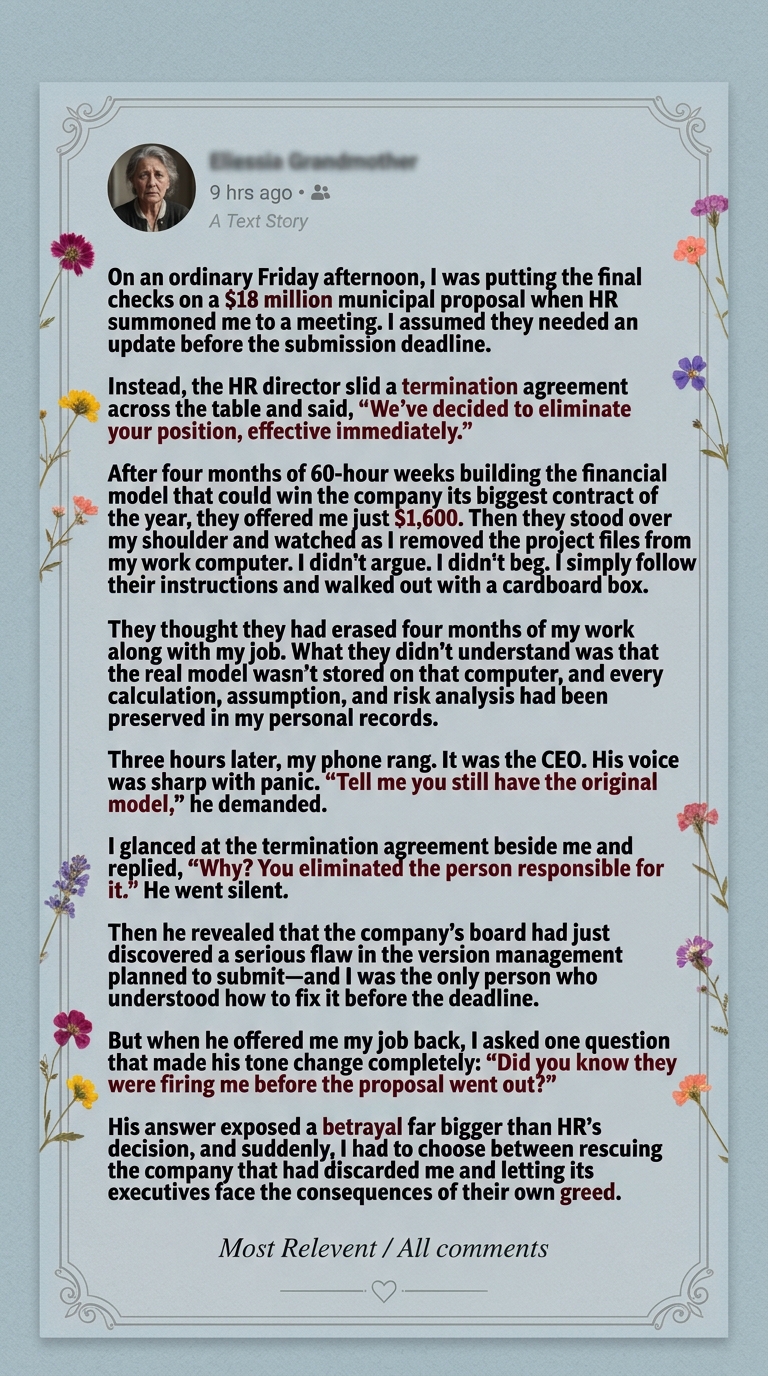
They Fired Me Before the $18 Million Bid Was Submitted—Three Hours Later, the CEO Begged Me to Save It
On an ordinary Friday afternoon, I was checking the final figures on an $18 million municipal proposal when an email from Human Resources appeared on my screen.
Please report to Conference Room B immediately.
I assumed someone needed clarification before the submission deadline. For four months, I had worked nearly sixty hours a week building the financial model that could secure my employer, Meridian Civic Solutions, its largest contract of the year. I had reconciled thousands of cost entries, tested dozens of pricing scenarios, and documented every assumption that could affect the city’s final decision.
The proposal was due Monday morning.
I had planned to spend the weekend reviewing the final sensitivity analysis and making sure the risk disclosures matched the numbers.
Instead, I walked into a conference room and found the HR director, a corporate attorney, and my department head sitting behind a stack of paperwork.
“Please have a seat, Natalie,” the HR director said.
Her voice was unusually cheerful.
I sat down.
She slid a termination agreement across the table.
“We’ve decided to eliminate your position, effective immediately.”
For a moment, I thought she was joking.
“Today?”
“Today.”
“But the municipal proposal is due Monday. I’m responsible for the financial model.”
“Management has decided to reassign those responsibilities.”
“To whom?”
“That isn’t relevant to this meeting.”
I looked at the agreement. It offered me $1,600 in severance in exchange for a broad release of employment-related claims, subject to the terms outlined in the document. There was also a confidentiality clause and a requirement that I return all company property immediately.
I had spent four months building a model that could help generate millions of dollars in revenue.
They were offering me less than the cost of a weekend away.
“I’d like time to review this with an attorney,” I said.
The corporate attorney nodded stiffly. “You’re entitled to seek independent advice. The company’s offer remains available under the terms specified in the agreement.”
My department head, Marcus Bell, stared at the table.
He had praised my work only two days earlier. He had told me that the financial model was the strongest our department had produced in years. He had even asked me to prepare a presentation explaining the pricing strategy to the executive team.
Now he wouldn’t look me in the eye.
“Is this related to my performance?” I asked.
“No,” the HR director replied. “This is an organizational decision.”
“Then why now?”
She folded her hands.
“We’re not going to debate the decision.”
That was when I understood that the meeting wasn’t an opportunity to discuss my future. The decision had already been made, and they expected me to cooperate without asking inconvenient questions.
The HR director handed me a checklist.
I was to surrender my laptop, company phone, access badge, and project documentation. An IT employee would supervise while I removed my personal items from my desk and signed out of my workstation.
I had one final question.
“Am I expected to transfer the proposal work to someone else?”
“Management will handle the transition,” she replied.
I nodded.
I didn’t argue. I didn’t beg. And I didn’t sign an agreement I hadn’t had time to review.
I returned to my desk, packed my family photographs and a coffee mug into a cardboard box, and followed the IT employee’s instructions for returning the equipment.
He watched as I signed out of the company system.
“That’s everything,” he said.
I looked at the darkened screen.
“No,” I replied quietly. “It isn’t.”
He didn’t understand what I meant.
Neither did anyone else in that office.
The company had disabled my access to its systems. It had not erased the months of professional analysis I had already documented in my personal work journal, nor had it eliminated the independent notes I had retained in accordance with company policy. Those records contained my methodology, the sequence of assumptions I had tested, and the unresolved questions I had repeatedly raised during internal reviews.
I had not copied confidential company files or taken proprietary data with me. I had no intention of doing so.
But I knew how I had built the model.
I knew which assumptions mattered, which calculations were linked, and which apparently harmless changes could distort the final price.
And I knew that the version management planned to submit had not passed my final review.
I carried my box through the lobby and walked into the afternoon sunlight.
For the first time in four months, nobody was asking me to attend a meeting, revise a spreadsheet, or explain a variance.
I should have felt relieved.
Instead, I felt as though someone had deliberately removed me from a moving train just before it reached a dangerous curve.
At home, I placed the termination paperwork on my kitchen table and made myself a cup of tea. I called an employment attorney to arrange a consultation, then opened my personal notebook to review the sequence of events that had led to my dismissal.
At 5:17 p.m., my phone rang.
The caller ID showed Daniel Price, Meridian’s CEO.
I answered.
“Natalie, tell me you still have the original model.”
His voice was sharp with panic.
I leaned back in my chair.
“Why? You eliminated the person responsible for it.”
He went silent.
Then he said, “The board has just discovered a serious problem with the version management plans to submit. We need you to fix it.”
I looked at the termination agreement beside me.
“What kind of problem?”
“The price calculation doesn’t reconcile with the assumptions in the supporting schedules. The city’s independent review team could reject the proposal if we submit it like this.”
“How did you discover that?”
“The finance director found a discrepancy during the final board review.”
I closed my eyes.
I knew exactly where the problem was.
Three days earlier, I had identified a mismatch between the proposed labor escalation rate and the cost assumptions used in the long-term maintenance schedule. The discrepancy wasn’t a simple arithmetic error. It affected several linked calculations, including the contingency allowance, the annual operating costs, and the projected margin.
I had flagged it in my written review and requested that management approve a correction.
Marcus had told me the executive team wanted to keep the pricing unchanged.
I had refused to certify the final model until the discrepancy was resolved.
Now, apparently, someone had submitted a version that ignored my warning.
“Who changed the assumptions?” I asked.
Daniel exhaled.
“Marcus made some adjustments.”
“Without my approval?”
“I don’t know the details.”
“You’re the CEO. You should.”
“Natalie, this isn’t the time for an argument. We have less than two days before the submission deadline. I need you back in the office tonight.”
I glanced at the severance agreement.
“Am I still employed by Meridian?”
A pause.
“We can reverse the termination.”
“Can we?”
“Yes. I’ll authorize it.”
“And the $1,600 offer?”
“Forget about the paperwork. We’ll work something out.”
I almost laughed.
Four months of work had been reduced to a small severance offer, but a few hours after my departure, the same executives suddenly believed my expertise was indispensable.
I wasn’t interested in revenge. I wanted to know whether this had been an incompetent decision or a deliberate attempt to make me disappear before the proposal was submitted.
“Before I agree to anything,” I said, “I need to ask you one question.”
“Go ahead.”
“Did you know they were firing me before the proposal went out?”
The silence on the line was longer this time.
Then Daniel answered carefully.
“I knew there were discussions about restructuring your department.”
“That wasn’t my question.”
He sighed.
“Yes. I knew your position was being considered for elimination.”
“Before or after the bid was submitted?”
“Before.”
I sat very still.
“Why?”
“The company has been under pressure to reduce costs. Your salary is substantial, and the board wanted a leaner structure going into the next fiscal year.”
“My salary is listed in the budget. You knew I was the only person who had built and validated the financial model.”
“We expected Marcus to take over.”
“Marcus has never built a model of this complexity.”
“He has experience.”
“Experience isn’t the same as understanding the assumptions. I documented the problem because I knew this would happen.”
Daniel’s voice tightened.
“Natalie, I’m asking you to help us protect an $18 million opportunity. This contract matters to everyone in the company.”
“Then why did you remove the person who understood it?”
He didn’t answer.
I pulled my notebook closer and turned to the page where I had recorded the final review meeting.
Marcus had insisted that the labor escalation rate remain unchanged, despite updated information from a subcontractor. I had warned him that using the old rate would understate future costs. He had replied that the bid needed to remain competitive and that management would accept the risk.
I had asked for the instruction in writing.
He had declined.
The next morning, my termination meeting had appeared on my calendar.
Now the connection seemed difficult to dismiss.
“Daniel,” I said, “did Marcus tell the board that I had approved the final model?”
Another pause.
“Yes.”
“Then you have a bigger problem than a spreadsheet.”
I ended the call after telling him that all future discussions needed to go through my attorney until the employment issue was resolved.
I spent the next hour reviewing my notes, making a timeline, and identifying the questions I needed answered before I would consider helping. I didn’t touch confidential company files. I didn’t access Meridian’s systems. I simply organized the information I already had and prepared to explain the technical issue without disclosing anything I wasn’t authorized to disclose.
At 7:06 p.m., Daniel called again.
This time, he sounded less like a CEO issuing instructions and more like a man who had realized that the situation was slipping beyond his control.
“The board wants to speak with you tomorrow morning,” he said. “They’re willing to offer a consulting agreement.”
“What are the terms?”
“We’ll pay your usual daily rate for the emergency work. If the proposal is accepted, we’ll discuss a permanent position.”
“No.”
He went quiet.
“No?” he repeated.
“I won’t accept an undefined promise of future employment as payment for emergency work. I need a written scope, compensation terms, access to the relevant records, and confirmation that I won’t be required to certify calculations I haven’t independently reviewed.”
“We don’t have time for a lengthy negotiation.”
“You had time to terminate me.”
He said nothing.
I continued.
“I also need to know whether management submitted a version of the proposal after I raised the discrepancy. If my work is being represented as approved when I never approved it, that needs to be corrected before I become involved.”
Daniel’s tone changed.
“I’ll arrange the meeting.”
The following morning, I entered Meridian’s boardroom with my attorney. Daniel sat at the far end of the table beside the finance director and two board members. Marcus was there, too, looking as if he hadn’t slept.
The submitted model was projected on a large screen.
The discrepancy was obvious once I saw the relevant schedules side by side.
The model used one labor escalation rate in the operating-cost calculation and another in the maintenance schedule. The lower rate made the proposal appear more competitive, but it also understated the cost of fulfilling the contract over its full term.
The board chair, Helen Brooks, looked at me.
“Can you correct this before Monday?”
“I can identify the necessary corrections and rebuild the affected calculations. But I need to know which source assumptions are authoritative, and I need the people responsible for approving them to be present.”
Marcus shifted in his chair.
“We’re not here to assign blame,” he said.
“No,” I replied. “We’re here because the version you intended to submit contains a discrepancy I identified three days ago.”
Helen turned toward him.
“Did you receive a written warning from Natalie?”
Marcus hesitated.
“I received questions about the assumptions.”
“Did you receive a warning?”
“Yes.”
“And did you tell the board that she had approved the final model?”
He looked at Daniel.
Daniel’s face had gone rigid.
Marcus finally answered.
“I said the model was substantially complete.”
“That isn’t what I asked.”
“No,” he admitted. “I told the board that the financial model had been approved for submission.”
Helen removed her glasses.
“Was it?”
“No.”
The room fell silent.
I had expected defensiveness, perhaps another attempt to blame the discrepancy on a technical misunderstanding. I hadn’t expected Marcus to admit the truth so quickly.
Helen turned to me.
“Why were you terminated the day before we discovered this?”
I looked at Daniel.
“That’s a question management needs to answer.”
Daniel clasped his hands.
“The company was under pressure to reduce payroll expenses. We believed the transition could be managed internally. We were wrong about the level of specialized knowledge required.”
“Did you know she had refused to certify the model?” Helen asked.
“Yes.”
“Then why did you allow the termination to proceed before the proposal was finalized?”
Daniel hesitated.
“Because we expected Marcus to complete the remaining work.”
Helen stared at him.
“You expected him to complete a model he had never built, after the person who built it had explicitly refused to approve the revised assumptions?”
Daniel looked down.
“Yes.”
The board chair shook her head slowly.
“That is not a staffing decision. That is a failure of governance.”
I sat quietly while the board members discussed the immediate risks. The company’s desire to reduce expenses had become so important that the executives had ignored a material warning about the proposal. Worse, they had represented the model as approved when it wasn’t.
I could help correct the calculations. I could not make that decision disappear.
Helen returned her attention to me.
“What would you need to complete the work?”
I laid out my conditions.
First, Meridian would engage me under a written emergency consulting agreement, with compensation at a premium rate reflecting the urgency and specialized work required.
Second, the company would provide the relevant project records and confirm which assumptions had been formally approved. I would not reconstruct missing information from memory or guess at undocumented decisions.
Third, I would be permitted to document every correction and the reason for it.
Fourth, I would not sign a certification claiming that I had approved earlier versions of the model.
Finally, the company would preserve all communications and version histories related to the proposal and my termination.
Marcus looked uncomfortable.
“That sounds excessive for a short-term correction.”
“No,” I replied. “It sounds appropriate for an $18 million public contract.”
Helen nodded.
“Agreed.”
Daniel leaned forward.
“Natalie, if you do this, I want to discuss bringing you back permanently. We need someone with your skills.”
I looked at him.
“Yesterday, you were comfortable eliminating my position. Today, you’re asking me to rescue a contract because management ignored my warning. Why should I believe the company will treat me differently next month?”
He had no immediate answer.
I wasn’t asking for an apology designed to calm the room. I wanted the organization to confront the decision it had made and the incentives that had produced it.
Helen finally spoke.
“The board will commission an independent review of the termination decision and the approval process for this proposal. We will also review how the company represented the model’s status. Your consulting agreement will be separate from that review.”
That was the first answer I had heard that sounded like accountability rather than panic.
I agreed to the emergency engagement.
Over the next thirty-six hours, I worked with the finance director and the project team to rebuild the affected schedules. We verified the labor assumptions against the approved source documents, recalculated the contingency allowance, and reran the sensitivity analysis under several plausible cost scenarios.
The corrected model showed that the original pricing left less room for unexpected increases than management had assumed. The bid remained competitive, but the margin was narrower, and the risk disclosures needed to reflect that reality.
I documented every change.
On Sunday evening, I presented the corrected model to the board. I explained which assumptions had changed, how those changes affected the projected cost, and which risks remained unresolved. I refused to promise that the proposal would win.
“What I can tell you,” I said, “is that the corrected model is internally consistent, traceable to the approved assumptions, and transparent about the risks. Whether the city selects us will depend on the full proposal and the other bidders.”
Helen thanked me.
The company submitted the proposal on time.
Several weeks later, the city confirmed that Meridian had advanced to the next stage of evaluation. The contract had not yet been awarded, but the corrected proposal passed the initial financial review without the discrepancy that had threatened its credibility.
I received my consulting payment under the signed agreement.
I did not return as an employee.
The independent review found that the decision to terminate me had been made primarily to reduce payroll costs before the proposal’s final submission. It also found that Marcus had represented the model as approved despite my written objection. Daniel had known about the termination plan and had failed to ensure that the company had a qualified replacement before removing me.
The board placed Marcus on a performance plan and removed his authority to approve financial models without independent review. Daniel received a formal reprimand and was required to implement a revised proposal-approval process. The company also introduced a rule requiring documented technical sign-off before any major public-sector bid could be submitted.
Those changes didn’t undo what had happened to me, but they addressed the failures that had allowed it.
A month later, Daniel invited me to his office.
He looked tired.
“I owe you an apology,” he said. “I treated your role as a cost line instead of recognizing the expertise behind it. I knew the timing was risky, but I allowed the decision to proceed because I thought the company could absorb the consequences.”
“You assumed the consequences would fall on someone else,” I replied.
He nodded.
“Yes.”
He offered me a senior role with a higher salary, a larger team, and direct oversight of financial modeling for public-sector proposals.
I asked for the written offer.
Then I reviewed it with my attorney and considered it for several days.
Ultimately, I declined.
The salary was generous. The title was impressive. But I had learned something that mattered more than either: an organization could recognize your value only after a crisis and still fail to become a place where you could trust its judgment.
I didn’t need to punish Meridian. I didn’t need to sabotage the proposal or watch the company collapse. The executives had to answer for their own decisions, and I had no obligation to rescue them indefinitely.
Instead, I accepted a position with a smaller consulting firm whose leadership had approached me after hearing about my work on the proposal. My role focused on financial risk, bid integrity, and independent model review. I was given the authority to challenge assumptions without being pressured to certify figures I didn’t believe were defensible.
On my first Friday there, I left the office at five o’clock.
No emergency call followed. No executive demanded that I repair a problem created by a decision I hadn’t been allowed to question. I went home, cooked dinner, and spent the evening with people who had nothing to do with spreadsheets or contract deadlines.
I thought back to the cardboard box I had carried out of Meridian and the $1,600 offer lying on my kitchen table.
They had believed that by eliminating my position, they had eliminated the person responsible for the model.
They had confused access to a computer with ownership of expertise.
The calculations had never been the most valuable part of my work. The real value was knowing why those calculations were there, which assumptions could be trusted, and when a number that looked convenient was actually dangerous.
I had saved the company from submitting a flawed proposal, but I had not done it because the executives deserved another chance to take me for granted.
I did it under clear terms, with my professional integrity intact, and with the truth documented.
That distinction mattered.
The company had made its choice when it dismissed me. I made mine when I refused to let its panic dictate the terms of my future.
And when I finally closed my laptop on that ordinary Friday evening, I knew that the most important contract I had secured wasn’t the city’s $18 million proposal.
It was the agreement I had made with myself: never again would I confuse being indispensable to a failing decision with being respected by the people making it.