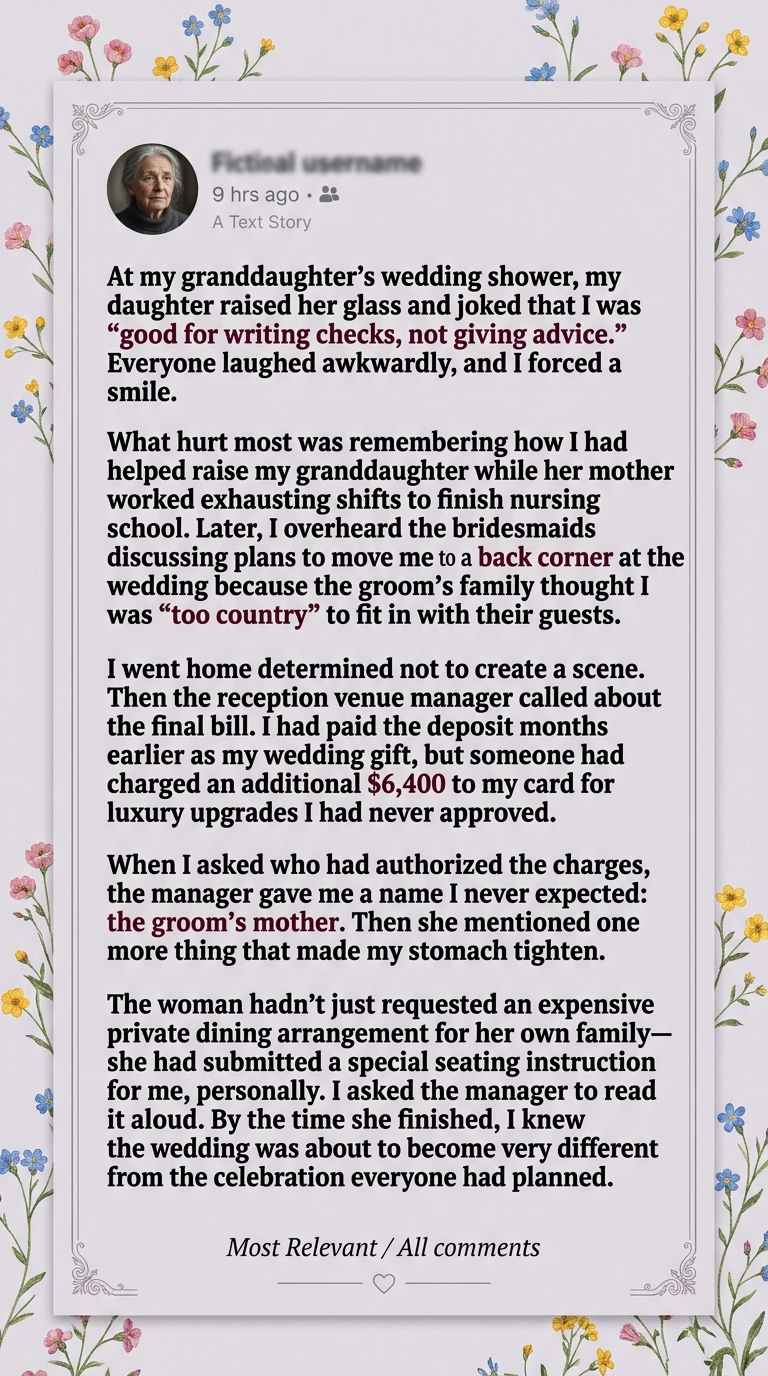
When my daughter raised her champagne glass at my granddaughter’s wedding shower and joked that I was “good for writing checks, not giving advice,” the room erupted in uncomfortable laughter.
I smiled because that was what everyone expected me to do.
I had spent most of my life swallowing hurt to keep the family together. I had helped raise my granddaughter, Lily, while her mother, Vanessa, worked exhausting hospital shifts to finish nursing school. I had packed lunches, attended school meetings, paid for school supplies, and sat beside Lily through childhood fevers and teenage heartbreaks. When Vanessa needed help, I never asked whether it was convenient. I simply showed up.
Now, at sixty-eight, I was apparently useful only when someone needed my money.
What I didn’t know was that the groom’s mother had already made plans to humiliate me at the wedding—and that my own daughter had helped her do it.
My name is Eleanor Brooks, and I live in a small country town where people still wave when they pass you on the road. My husband, Robert, died eight years ago, leaving me a comfortable home, a modest retirement account, and a habit of putting family before myself.
I never considered myself wealthy. I had simply saved carefully, paid off my house, and learned to live within my means.
Vanessa, on the other hand, had always wanted a life that looked more impressive from the outside. After graduating from nursing school, she moved to the city, bought a large house, and surrounded herself with people who cared about restaurant reservations, designer handbags, and invitations to the right events.
I was proud of her achievements, but somewhere along the way, she began treating my ordinary life as something she needed to apologize for.
Lily was different. Despite growing up in the city, she still loved coming to my house. She would take off her expensive shoes, sit on my porch steps, and tell me everything that had happened at work or with her friends. When she got engaged to Daniel, she called me before she even told some of her closest friends.
“Grandma, I’m getting married!” she had shouted over the phone.
I cried so hard I could barely answer.
Daniel seemed like a good young man. He was polite, thoughtful, and genuinely attentive to Lily. His family, however, belonged to a different world. His mother, Margaret Whitmore, ran a successful chain of private medical clinics and had a reputation for getting exactly what she wanted.
At our first meeting, she glanced at my plain handbag and asked whether I had driven all the way from the countryside.
“Yes,” I replied. “It’s only two hours.”
“How quaint,” she said, smiling without warmth. “I imagine it’s very peaceful out there.”
I told myself I was being oversensitive. Margaret was simply accustomed to a different lifestyle.
When Lily announced that she wanted her wedding reception at the Grand Bellmont Hotel, a historic venue known for its elaborate ballroom and expensive catering, I offered to contribute.
“I’ve been saving something for your wedding,” I told her. “Your grandfather and I always hoped we’d be able to help you start your married life.”
Lily hugged me.
“You don’t have to do that, Grandma.”
“I know. I want to.”
I paid the venue’s initial deposit, which covered the ballroom reservation and a portion of the catering costs. I considered it my wedding gift, and I made one request: I wanted a seat where I could see Lily’s face during the reception.
She promised I would.
Then came the wedding shower.
It was held in Vanessa’s house, a beautifully decorated place with fresh flowers on every table and enough champagne to make everyone feel important. I wore a navy-blue dress I had bought especially for the occasion and brought a small box containing a pearl necklace that had belonged to my mother.
I had hoped to give it to Lily privately.
Instead, Vanessa made a toast before the gifts were opened.
“To Lily and Daniel,” she began. “May their marriage be full of love, laughter, and financial stability.”
Everyone laughed.
Then she turned toward me.
“And a special thank-you to my mother, who’s always been incredibly generous. She’s excellent at writing checks, even if we’ve learned over the years that advice isn’t exactly her specialty.”
The laughter that followed was louder than the joke deserved.
I felt my cheeks burn.
Vanessa smiled at me as though she had given me a compliment.
I forced a smile and lifted my glass.
“All that matters is that Lily is happy.”
But I couldn’t forget the years I had spent helping Vanessa raise her daughter. I remembered sleeping in a hospital chair when Lily had pneumonia because Vanessa had to work the next morning. I remembered teaching Lily to read, attending her school performances, and comforting her when her first serious relationship ended.
I had never kept a record of those sacrifices. They were simply what love required.
Apparently, Vanessa remembered them differently.
I stayed for another hour, opened a few gifts, and made polite conversation. Then I went looking for the restroom and passed a half-open door near the kitchen.
Inside, several bridesmaids were discussing the wedding seating arrangements.
“I heard Margaret wants the family tables near the dance floor,” one woman said.
“Yes,” another replied. “She wants the important guests where everyone can see them.”
“What about Lily’s grandmother?”
A short silence followed.
Vanessa’s voice answered.
“Margaret thinks she’d be more comfortable away from the main tables. She’s worried Mom won’t fit in with Daniel’s business guests.”
Someone laughed nervously.
“Because she’s from the country?”
“Something like that,” Vanessa said. “Honestly, it’s easier if we just put her near the back. Mom won’t complain. She never does.”
I stood frozen in the hallway.
The woman who had helped raise Vanessa’s daughter, who had paid the deposit for the wedding, and who had never asked for recognition was being discussed like an inconvenience that needed to be hidden.
I walked away before they could see me.
That evening, I drove home in silence. I considered calling Lily, but I didn’t want to burden her during what should have been one of the happiest periods of her life. Perhaps the bridesmaids were exaggerating. Perhaps the seating plan had not been finalized.
I decided I would attend the wedding, smile for the photographs, and leave without causing a scene.
Then, three days before the ceremony, the venue manager called.
“Mrs. Brooks, I’m contacting you about the outstanding balance on the reception account.”
I sat down at my kitchen table.
“I thought everything was in order. I paid the deposit months ago.”
“Yes, ma’am. The deposit is recorded. However, there are additional charges totaling six thousand four hundred dollars that were placed on your card.”
My stomach tightened.
“What additional charges?”
“Luxury dining upgrades, a private family dining arrangement, premium champagne, and several changes to the reception package. They were authorized under the name Margaret Whitmore.”
“I never approved those charges.”
The manager paused.
“I understand, ma’am. Our records show that the request was submitted with your card information, but the authorization documentation appears incomplete. I wanted to speak with you before processing the final payment.”
I opened my banking application and checked the pending transactions.
There it was: a charge for $6,400.
I had never authorized it, verbally or in writing.
“Please don’t process that payment,” I said. “I need a copy of every document connected to the request.”
“Of course. There’s also a special seating instruction attached to the revised arrangements. Given your concern, I think you should hear it directly.”
My fingers tightened around the phone.
“What does it say?”
The manager hesitated before reading the note.
“Mrs. Eleanor Brooks is to be seated at the farthest table from the bridal party, preferably beside the service entrance. She should not be placed with the Whitmore family or the groom’s business associates. Her presence should not interfere with the formal photographs.”
For several seconds, I couldn’t speak.
The words were cold, deliberate, and humiliating.
“Who submitted that instruction?” I finally asked.
“Mrs. Whitmore. The request was made through the wedding planning account.”
I thanked the manager, ended the call, and sat staring at the wall.
I had expected thoughtlessness from Vanessa. I had even begun to expect it from Margaret.
But I had never imagined that someone would use my card without permission and then arrange to hide me away as though I were something embarrassing.
For the first time, I stopped asking myself how to avoid upsetting everyone else.
I called the venue manager back.
“I’d like to arrange a meeting tomorrow. Please invite whoever is responsible for the wedding account, and make sure all authorization records are available.”
“Certainly, Mrs. Brooks.”
“And please don’t change anything else until we’ve reviewed the account.”
“Understood.”
After hanging up, I opened the drawer where I kept my financial records. I found the original deposit receipt, the signed payment agreement, and the message from Lily thanking me for helping with the wedding.
I also found a printed copy of the venue’s terms. Additional charges required approval from the cardholder, and any disputed payment could be placed on hold while the venue investigated.
I organized everything into a folder.
Then I made one more call—to Lily.
“Grandma!” she answered cheerfully. “I’m so excited. Three days!”
“So am I, sweetheart. I need to ask you something about the reception arrangements.”
Her voice softened.
“What’s wrong?”
I took a breath.
“Did you know your future mother-in-law requested that I be seated near the service entrance, away from the family tables?”
Silence.
“What?”
“She also authorized $6,400 in additional charges on my card. I never approved them.”
Lily didn’t answer immediately. When she finally spoke, her voice sounded small.
“I knew Margaret wanted to make changes to the reception, but I didn’t know about your card. And I certainly didn’t know about the seating instruction.”
“Your mother knew about it,” I said gently. “I overheard her discussing the seating arrangement at the shower.”
Another silence followed.
“Grandma, I’m so sorry.”
“I don’t need an apology right now. I need to know whether you want me to attend your wedding.”
“Of course I do! You’re my grandmother.”
“Then I need you to understand that I won’t accept being humiliated or charged for something I didn’t authorize.”
“I understand.”
“Do you? Because this isn’t about a chair or a dinner upgrade. It’s about whether the people planning your wedding believe they can treat me however they please because they assume I’ll stay quiet.”
Lily began to cry.
“I’ll talk to Daniel tonight. I promise.”
I wanted to believe her, but I had learned not to confuse promises with solutions.
The following morning, I met with the venue manager in a small conference room overlooking the ballroom. The staff had prepared a detailed account of every change requested since the original deposit.
Margaret arrived twenty minutes late, carrying a designer handbag and wearing an expression of mild annoyance.
Vanessa came with her.
I hadn’t expected my daughter to attend, and seeing her made my chest ache.
“What’s all this about?” Margaret asked as she sat down. “We have a wedding in two days. I hope this isn’t going to become a lengthy dispute over a few upgrades.”
The manager opened the folder.
“Mrs. Brooks has disputed the additional charges because she did not authorize them. We need to resolve the matter before finalizing the account.”
Margaret turned toward me.
“Eleanor, surely you understand that wedding arrangements sometimes change. I assumed you would be happy to contribute a little more.”
“You assumed incorrectly.”
Her eyebrows rose.
“I beg your pardon?”
“I agreed to pay the deposit as a gift to my granddaughter. I did not agree to pay for premium champagne, private dining, or luxury upgrades selected by you.”
Margaret gave a dismissive laugh.
“Your granddaughter is marrying into a family with certain expectations. We simply wanted the reception to reflect the occasion.”
“Then you should have paid for it yourself.”
Vanessa shifted in her chair.
“Mom, perhaps we should just settle the bill and discuss the rest later.”
I looked at her.
“With what money, Vanessa? Mine?”
She lowered her eyes.
The manager slid a printed authorization form across the table.
“This is the document submitted for the additional charges. It contains Mrs. Brooks’s card details, but the signature field is blank. Our system shows that the request was submitted through the wedding planning account under Mrs. Whitmore’s name.”
Margaret’s expression tightened.
“I was coordinating the reception. I thought the original arrangement included a budget for changes.”
“It did not,” the manager replied. “The original contract specifically required written approval for additional charges.”
Margaret turned to me.
“You’re making a terrible fuss over something that benefits your own granddaughter.”
“No,” I said. “I’m refusing to pay for something I never agreed to.”
The manager explained that the disputed charges would remain on hold and that the venue would not process them without proper authorization. Margaret protested, but the manager remained firm.
Then he brought up the seating plan.
“I also need to clarify this instruction, which was submitted as part of the revised arrangement.”
He read the note aloud.
“Mrs. Eleanor Brooks is to be seated at the farthest table from the bridal party, preferably beside the service entrance. She should not be placed with the Whitmore family or the groom’s business associates. Her presence should not interfere with the formal photographs.”
Vanessa’s face turned red.
I watched Margaret carefully.
She didn’t deny writing it.
Instead, she folded her hands and said, “I was trying to make the event comfortable for everyone.”
“By hiding me?” I asked.
“By keeping the seating arrangements appropriate.”
“What makes me inappropriate?”
Margaret glanced at my plain cardigan and practical shoes.
“Your lifestyle is quite different from ours, Eleanor. I thought you would be more comfortable with people you have more in common with.”
I nodded slowly.
“Then you should have asked me where I would be comfortable. You should not have used my money to arrange a wedding that makes me feel unwelcome.”
Vanessa finally looked up.
“Margaret, you told me the seating plan was about managing space. You never told me you had written that.”
Margaret’s expression sharpened.
“You knew your mother would be better seated away from the main tables.”
“I knew you wanted a different arrangement. I didn’t know you were going to put her beside the service entrance.”
“You agreed it was sensible.”
“I agreed because you said there were too many guests and that we had to compromise. I never agreed to humiliate her.”
For the first time, I saw Vanessa look genuinely ashamed.
The venue manager closed the folder.
“The additional charges will remain disputed until the cardholder’s authorization is verified. As for the seating plan, the couple has final approval over the reception arrangements. We will not implement any instruction that hasn’t been approved by them.”
Margaret stood abruptly.
“This is absurd. I will not have my family’s celebration dictated by a woman who has contributed only a deposit.”
The room went still.
I looked at her, then at Vanessa.
“That deposit was a gift. It was never the price of admission to your family.”
I gathered my papers and stood.
“I will pay the original amount I agreed to pay. I will not pay a penny more. And if my granddaughter wants me at her wedding, I will attend as her grandmother, not as a source of funding.”
I left before Margaret could respond.
For the first time in years, I felt no need to explain myself further.
That afternoon, Daniel called me.
“Mrs. Brooks, Lily told me what happened. I wanted to apologize for my family’s behavior.”
“You didn’t write that seating instruction,” I replied.
“No, but I should have paid more attention to what was happening. Lily told me Margaret had been making decisions without consulting her. I thought they were ordinary disagreements about the wedding.”
He paused.
“She showed me the messages. I had no idea your card had been used.”
“Do you believe her?”
“Of course I do. The venue has the records. I spoke with the manager myself.”
I felt some of the tension leave my shoulders.
Daniel continued.
“Lily and I have decided to take control of the remaining arrangements. My mother will not be managing the reception anymore. We’re moving the seating plan back to the original version, and we’re removing every upgrade she requested.”
“That sounds reasonable.”
“And there’s something else. Lily wants to speak to you herself, but she asked me to tell you that she doesn’t want you sitting at the back. She wants you beside her grandfather’s empty chair.”
I closed my eyes.
My husband had been gone for eight years, and I had never expected anyone to make room for his memory at the wedding. The thought of Lily remembering him moved me more than any expensive arrangement could have.
“Tell her I’ll speak to her tonight,” I said.
When Lily called, she apologized without excuses.
“I should have paid more attention to what was happening,” she said. “I let Margaret take over because I wanted everyone to be happy. I didn’t realize how far she was going.”
“You cannot make everyone happy, Lily. You can only decide what kind of behavior you’re willing to accept.”
“I know that now.”
She told me she had spoken to her mother as well. Vanessa had admitted that the joke at the shower had been cruel, and that she had allowed Margaret’s opinions to influence her. She had been so eager to make the wedding look sophisticated that she had begun treating the people who had supported her as though they were liabilities.
“I was ashamed of things that should never have embarrassed me,” Vanessa told me when she called later that evening. “You worked hard your whole life. You helped me become a nurse. You helped raise Lily. I let other people make me feel as though those things were somehow less important than money and appearances.”
I listened quietly.
“I’m sorry, Mom,” she continued. “I don’t expect you to forgive me immediately. I just want you to know that I understand what I did.”
“I appreciate you saying that,” I replied. “But I need you to show me you understand it by how you treat me from now on.”
“I will.”
I didn’t promise that everything would return to normal. Some wounds need time, and some apologies must be proven through action.
The day of the wedding arrived under a clear blue sky.
I wore my navy-blue dress from the shower, paired with my mother’s pearl necklace. I had considered buying something more fashionable, but then I realized I was about to spend money trying to satisfy people who had already decided I wasn’t good enough.
I chose to dress for myself instead.
When I arrived at the Grand Bellmont Hotel, the venue manager greeted me warmly and escorted me into the ballroom.
The seating plan had been changed.
My name was on a card at the front family table, beside an empty chair bearing a small framed photograph of Robert. Lily had asked the florist to place a white rose beside it.
I stood there for a moment, unable to speak.
Then Lily appeared in her wedding dress.
“Is it all right?” she asked, taking my hand.
I nodded, tears gathering in my eyes.
“It’s beautiful, sweetheart.”
She hugged me tightly.
“Grandpa should be here. I wanted to make sure he had a place.”
I kissed her cheek.
“He would have been so proud of you.”
The ceremony was lovely. Daniel looked at Lily as though she were the only person in the world, and when they exchanged vows, I felt every worry from the preceding week fall away.
At the reception, Margaret sat at the family table, but she no longer controlled the arrangements. She was polite, though distant. She made no further attempt to discuss the disputed charges, and the venue confirmed that my card had not been billed for the unauthorized upgrades.
The original deposit remained my wedding gift to Lily.
Everything else was paid for by the people who had chosen those expenses.
During the speeches, Vanessa stood with a microphone in her hand. She looked nervous, and I wondered whether she would simply offer the usual congratulations.
Instead, she turned toward me.
“I want to say something about my mother,” she began.
The room quieted.
“At the wedding shower, I made a joke about her being good for writing checks but not giving advice. I thought it was harmless. It wasn’t. I embarrassed someone who has spent most of her life helping me and my daughter without asking for recognition.”
She paused, swallowing hard.
“When I was in nursing school, Mom worked extra hours and helped raise Lily so I could finish. When I was exhausted, she was there. When I struggled financially, she helped me. And when I wanted to give Lily a beautiful wedding, she offered a gift because she loved her granddaughter.”
Vanessa looked directly at me.
“I allowed my concern with appearances to make me ashamed of the very person who taught me what family means. I’m sorry, Mom. You deserved better from me.”
No one laughed this time.
I felt the room watching me, but I wasn’t embarrassed. I was simply sad that it had taken a public humiliation for my daughter to recognize what she had done.
I stood and hugged her.
“I hope we can do better from here,” I whispered.
“We will,” she replied.
Later, Margaret approached me near the terrace doors. For a moment, I thought she might offer an apology.
Instead, she said, “I hope you understand that I only wanted the wedding to reflect our family’s standards.”
I met her gaze.
“Then perhaps your family should consider whether its standards include treating people with respect.”
She looked away.
“I suppose we see things differently.”
“Yes,” I said. “We do.”
I didn’t argue further. I had no need to persuade her that my life had value.
The evening continued with music, dancing, and laughter. Lily danced with Daniel, then with Vanessa, and finally with me. When the band played an old song Robert used to hum while working in the garden, I closed my eyes and let my granddaughter lead me across the floor.
For a few minutes, I could almost imagine him beside us.
As the reception wound down, Lily pulled me aside.
“Grandma, I want to ask you something.”
“Of course.”
“Would you be willing to help us establish a small scholarship for nursing students? Daniel and I have been talking about it. We want to honor the people who helped us get where we are.”
I smiled.
“That sounds wonderful.”
“We don’t want you to pay for it,” she added quickly. “We want to contribute ourselves. I just thought you might help us choose someone who needs the opportunity.”
I squeezed her hand.
“I would be honored.”
It was the first time in a long while that someone had asked for my advice without treating it as an inconvenience.
A few weeks later, the venue completed its investigation into the unauthorized charges. My card was never billed for the $6,400, and the original deposit was applied exactly as agreed. Margaret remained responsible for the additional expenses she had requested, and she eventually paid the venue directly after the dispute was resolved.
She never offered me a sincere apology, and I stopped waiting for one.
Vanessa, however, began visiting more often. Sometimes she brought groceries; sometimes she simply came to sit on the porch and talk. She asked about my garden, listened when I spoke, and stopped treating my quiet life as something that needed to be explained away.
Our relationship did not become perfect overnight. There were still difficult conversations, and trust had to be rebuilt one ordinary day at a time. But Vanessa began to understand that a mother’s love was not measured by how much money she could provide or how conveniently she could fit into someone else’s plans.
It was measured by the care she gave when nobody was watching.
Months later, Lily and Daniel established their nursing scholarship with their own savings. At the first small gathering for the scholarship recipient, Lily introduced me as the person who had helped raise her and taught her that generosity was not a performance.
I sat beside her, wearing my mother’s pearl necklace, and listened as she spoke.
I had once believed that keeping peace meant accepting whatever treatment my family offered. I had thought that if I stayed quiet, paid what I could, and asked for nothing in return, people would eventually understand my worth.
I was wrong.
Kindness does not require humiliation. Generosity does not purchase respect, and refusing to pay for someone else’s choices does not make a person selfish.
At Lily’s wedding, I learned that I could love my family without allowing them to diminish me.
And when my granddaughter looked across the table and reached for my hand, I knew that the most valuable gift I had given her was never the deposit, the necklace, or the money I had saved.
It was the example of a woman who finally understood that she could be generous without being used, loving without being silent, and proud of where she came from without apologizing to anyone.