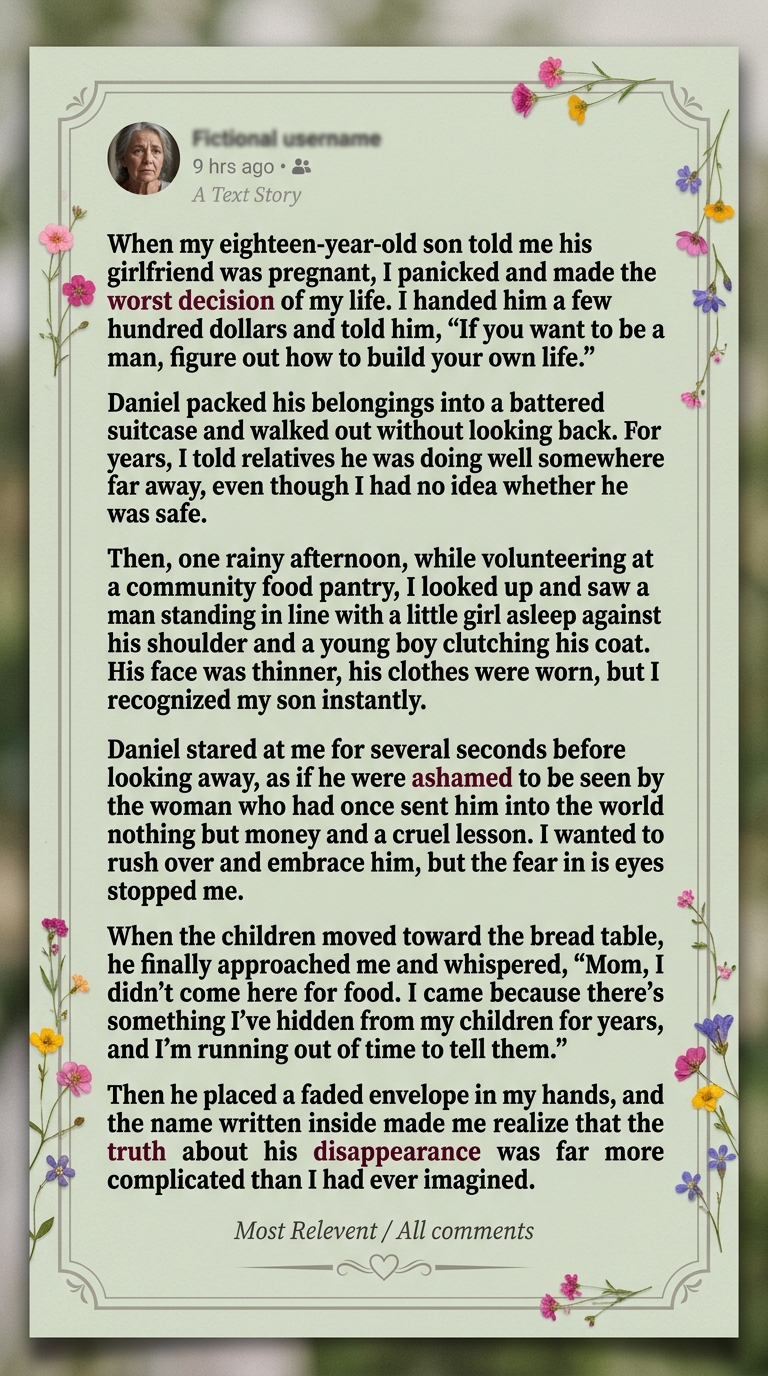
The first time I saw my son in twelve years, he was standing in a food pantry line with a sleeping little girl on his shoulder and a young boy clutching his worn coat.
Rainwater dripped from his sleeves onto the tiled floor. His shoes were splitting at the seams, and his face had grown thinner than I remembered. But I recognized him immediately.
Daniel.
My only son.
For twelve years, I had told relatives that he was living somewhere far away, building a life for himself. I said he was doing well whenever anyone asked. Sometimes I even invented little details about his work because I couldn’t bear to admit the truth.
I had no idea where he was.
I had no idea whether he was healthy, whether he had a home, or whether he had ever forgiven me.
And now he was standing in front of me, waiting for a bag of groceries.
I wanted to run to him, wrap my arms around him, and tell him how sorry I was. But when our eyes met, he looked away with an expression I had never seen on his face before.
Shame.
I had put that expression there twelve years earlier, when I gave my eighteen-year-old son a few hundred dollars and told him to figure out how to become a man.
I had spent twelve years regretting those words.
I never imagined I would get the chance to take them back.
My name is Margaret Ellis. I was forty-six when Daniel left home, and I believed I was a practical woman who understood responsibility. My husband had died when Daniel was fourteen, leaving me to manage a small house, a modest income, and a boy who was still struggling with the loss of his father.
I worked long hours at a medical billing office. I paid the mortgage, kept food on the table, and made sure Daniel finished school. I loved him deeply, but I rarely knew how to talk about fear without turning it into anger.
When Daniel was eighteen, he came home one Thursday evening and asked me to sit down.
His hands were trembling.
“Mom, I need to tell you something.”
I put down the laundry I was folding.
“What’s wrong?”
He took a breath.
“Emily is pregnant.”
For a moment, I thought I had misunderstood him.
“Pregnant?”
He nodded.
“She’s eleven weeks along.”
I stared at him, waiting for him to explain that there had been a mistake. Daniel was still in his final year of school. He worked part-time at a hardware store, drove an old car that barely ran, and had no savings beyond what he earned each week.
Emily was seventeen. She lived with her aunt, and her own family was already struggling financially.
A baby would change everything.
“Does her family know?” I asked.
“Her aunt knows. She’s furious. Emily’s afraid she’ll have to leave.”
I sat down slowly.
“What are you going to do?”
Daniel looked at me with the hopeful expression of a young man who still believed his mother could help him find a way through anything.
“I want to finish school. I want to get a full-time job. I want to take care of Emily and the baby. I know it’s going to be hard, but I thought maybe I could stay here for a while, until I get on my feet.”
I heard the words, but all I could think about was the mortgage, the bills, and the possibility of another person depending on me.
I had spent four years barely holding our lives together after my husband’s death. I was exhausted, frightened, and terrified of returning to the uncertainty I had worked so hard to escape.
Instead of telling Daniel I was scared, I attacked him with the one thing I knew how to use: responsibility.
“You should have thought about that before getting her pregnant.”
His face tightened.
“I know.”
“You’re eighteen. You don’t have a proper job, you don’t have a house, and you don’t have enough money to support yourself. How exactly do you intend to raise a child?”
“I’m trying to figure that out.”
“Trying isn’t enough.”
He looked down at his hands.
“That’s why I’m asking for help.”
Something inside me snapped. I mistook his fear for an attempt to make his problems mine.
I went to my bedroom, opened the drawer where I kept emergency cash, and counted out three hundred dollars. When I returned, Daniel was still sitting at the kitchen table.
I placed the money in front of him.
“If you want to be a man, figure out how to build your own life.”
He stared at the bills.
“You’re giving me money to leave?”
“I’m giving you money to start taking responsibility for yourself.”
“Mom, I didn’t ask you to raise my child. I asked if I could stay here while I found work.”
“You are not bringing a baby into this house and expecting me to support you both.”
His eyes filled with tears, but he refused to let them fall.
“What if I can’t find somewhere to go?”
I should have stopped then.
I should have taken his hand and told him that making a mistake did not mean he had to face the consequences alone.
Instead, I crossed my arms.
“Then you’ll have to work harder.”
Daniel stood without another word. He packed a few clothes into a battered suitcase, took his school documents, and left his father’s old watch on the kitchen table.
At the door, he turned around once.
“Someday, you’ll understand what you did tonight.”
Then he walked into the darkness.
I stood at the window and watched him disappear down the street.
I told myself he would call in a few days. I convinced myself that he needed to learn how difficult life could be before he understood the value of what I had given him.
He never called.
A month later, I learned from a relative that Daniel and Emily had left town. Someone said they had gone to another state. Someone else claimed Daniel had found work on a construction crew.
I had no way to verify either story.
I called his old number repeatedly, but it had been disconnected. I wrote to his last known address and received the letter back unopened.
Eventually, I stopped searching.
Not because I stopped loving him, but because every unanswered question made me confront what I had done. It was easier to tell people that Daniel was building a life somewhere else than to admit that my own son might be struggling because I had refused to help him.
Years passed.
I continued working, retired, and began volunteering at a community food pantry twice a week. I told myself I was giving back to the community, but the truth was more complicated.
Every time I handed a bag of groceries to a young parent, I wondered whether Daniel had ever stood in a line like that.
Every time I saw a teenage boy carrying a child, I wondered whether he had been forced to grow up too quickly.
And every time someone asked whether I had children, I answered that I had a son.
I simply didn’t know how to explain where he was.
Then, on a rainy Tuesday afternoon, he came through the food pantry door.
I recognized him before he reached the registration table.
He had a little girl asleep against his shoulder, her small arms wrapped around his neck. A boy of perhaps six stood beside him, holding tightly to his coat.
Daniel looked toward the shelves of canned food, avoiding the eyes of the volunteers. When he reached the front of the line, I saw his name on the registration form.
My hands began to shake.
“Daniel,” I whispered.
He looked up.
For several seconds, neither of us moved.
Then he glanced at the children and looked away.
I wanted to rush around the table, but something in his expression stopped me. He wasn’t simply angry. He looked as though he had spent years preparing himself for the possibility of seeing me again and had never decided what he would do if it actually happened.
I kept my voice steady.
“Would you like me to help you with your groceries?”
He nodded once.
I filled a bag with bread, canned vegetables, rice, milk, and fruit. I added a box of cereal because I remembered how much he had loved it as a child.
He noticed.
“You still remember,” he murmured.
“I remember everything.”
He looked down at the sleeping girl.
“Thank you.”
When the children moved toward the bread table, Daniel approached me.
“Mom, I didn’t come here for food.”
I swallowed.
“Then why are you here?”
He reached inside his coat and removed a faded envelope. The paper was yellowed at the edges, and the flap had been opened and resealed several times.
“I came because there’s something I’ve hidden from my children for years, and I’m running out of time to tell them.”
He placed the envelope in my hands.
The name written on the front made my breath catch.
Margaret Ellis.
My name.
But beneath it, in handwriting I recognized immediately, were the words:
To be opened only when Daniel is ready to tell his mother what happened.
The handwriting belonged to Emily.
I looked up at my son.
“Where is Emily?”
His eyes filled with tears.
“She died four years ago.”
The room seemed to grow silent around us.
I reached for the edge of the table to steady myself.
“Oh, Daniel.”
He shook his head.
“Please. Not yet. You need to read what’s inside first.”
I opened the envelope carefully.
Inside was a letter, a hospital discharge document, and a small photograph of Emily holding a newborn baby.
I recognized the date on the photograph. It was taken less than a year after Daniel left home.
My hands trembled as I began reading.
Margaret,
You don’t know me very well, and I understand why you might not want to hear from me. I know you were frightened when Daniel told you about the baby. I was frightened too.
I need you to know that Daniel never abandoned us. He worked every job he could find. He carried boxes, cleaned restaurant kitchens, and repaired roofs in the summer heat. He slept in a car when we couldn’t afford a room. When I was too sick to work, he stayed beside me even when it meant losing a day’s wages.
He has never blamed you for what happened. He says you were afraid, and that he understands why you sent him away.
I stopped reading.
Daniel stared at the floor.
“That’s not true,” I whispered. “I didn’t deserve his understanding.”
He didn’t answer.
I continued.
Our daughter, Sophie, was born prematurely. She spent three weeks in the hospital, and Daniel barely slept. He held her whenever the nurses allowed it. When we finally brought her home, he cried because he was afraid he wouldn’t be able to protect her.
We were struggling, but we were happy in the small ways that mattered. Daniel would come home from work, wash his hands, and take Sophie while I cooked. He talked to her about you. He told her that her grandmother had once been a kind woman who worked hard and loved her family.
He has never told her what happened the night he left your house.
I looked at Daniel.
“Why didn’t you tell her?”
“Because I didn’t want her to grow up hating you,” he said quietly. “She deserved to decide who you were for herself.”
The words hurt more than any accusation could have.
I read on.
Two years after Sophie was born, we had another child, Noah. Daniel found steady work with a small construction company, and for the first time, we began to believe we might have a future.
Then I became ill.
At first, the doctors thought it was an infection. Later, they discovered a serious heart condition. Daniel took time off work to care for me, but we couldn’t afford the treatment I needed. He sold his tools, our furniture, and almost everything we owned.
I know he would never ask you for help. He believes he lost the right to ask the night you sent him away.
My vision blurred.
I had imagined Daniel struggling for a few months before finding his footing. I had imagined him building a stable life, perhaps becoming a successful tradesman, perhaps even forgiving me.
I had never imagined him selling his belongings to pay for the care of a dying woman while raising two children alone.
The letter continued.
I am writing because I don’t know how much time I have left. If I die, Daniel will try to manage everything himself. He will tell the children that he is fine, even when he is not.
Please don’t wait for him to ask you for help. He has been carrying too much for too long.
If you ever find him, don’t ask him why he didn’t come home. Ask him what he needs now.
Emily.
I lowered the letter.
For twelve years, I had waited for my son to apologize for leaving.
He had been the one who left with a suitcase and three hundred dollars, but I had been the one who closed the door.
And while I spent those years protecting my pride, he had been trying to keep his family alive.
I looked at the hospital document. It confirmed Emily’s death four years earlier, following complications from her heart condition.
The photograph showed her holding Sophie, who appeared to be only a few days old. Daniel stood beside the hospital bed, looking exhausted and terrified, but his hand rested gently on Emily’s shoulder.
He looked like a boy pretending to be a man because no one else was available to do the job.
I pressed the letter against my chest.
“Daniel, I’m so sorry.”
He closed his eyes.
“I know.”
“No. You don’t know how sorry I am.”
He looked at me then, and I saw the pain he had carried for years.
“Mom, I spent a long time being angry with you. I wanted you to know how hard things were. I wanted you to see what happened when you sent me away.”
He swallowed.
“But when Emily got sick, I didn’t have time to be angry anymore. I had two children who needed me. So I worked. I did whatever I could.”
“Why didn’t you contact me when she became ill?”
He gave a sad smile.
“Because I remembered what you said. You told me to build my own life. I thought asking you for help would mean I had failed.”
I shook my head.
“You were eighteen. You were a child yourself.”
“I know that now. I didn’t know it then.”
His words settled between us.
For twelve years, I had told myself that Daniel needed to learn responsibility. The truth was that I had demanded a level of independence from him that I had never expected of myself. I had been frightened, but instead of admitting my fear, I had made him carry it.
And he had carried it for far too long.
I looked at the children.
Sophie was now a little girl with dark curls and solemn eyes. Noah stood beside the bread table, carefully choosing a loaf as though he were afraid to take the wrong one.
They were my grandchildren.
I had missed their births, their first steps, their first words, and every ordinary moment that makes a family. I had missed the chance to hold them when they were sick or comfort them when they were frightened.
I had missed all of it because I had been too proud to admit I had made a terrible mistake.
“Where are you living?” I asked.
Daniel hesitated.
“At a temporary housing center. I’ve been doing construction work when I can get it, but my back has been giving me trouble. I missed several weeks after an injury, and we fell behind on rent. The center is helping us while I look for something permanent.”
“Are you ill?”
“Nothing serious. I just need to be careful.”
I knew from his expression that he was minimizing his situation, as he had probably done for years.
“How long have you been here?”
“About six weeks.”
“And you’ve been raising these children alone?”
He nodded.
“Since Emily died.”
I wanted to ask a hundred questions, but I remembered Emily’s letter.
Don’t ask him why he didn’t come home. Ask him what he needs now.
So I asked the only question that mattered.
“What do you need, Daniel?”
His face crumpled.
For a moment, he looked like the eighteen-year-old boy who had stood in my kitchen asking for help.
“I need somewhere safe for the children,” he whispered. “I need work I can manage without making my back worse. And I need to know that if something happens to me, they won’t be alone.”
I reached for his hand.
“You have somewhere safe now.”
He stared at me.
“Mom—”
“I’m not asking you to forgive me today. I’m not asking you to move in with me or pretend that twelve years never happened. But I’m telling you that you and these children do not have to face everything alone anymore.”
He looked toward Sophie and Noah.
“I don’t know if I can trust you.”
The honesty hurt, but I accepted it.
“You don’t have to trust me because I’m your mother. Let me earn it.”
He studied my face for a long time.
Then he nodded.
That afternoon, I left the food pantry with my son and my grandchildren.
I did not take them straight to my house. I knew that one emotional reunion could not repair twelve years of separation, and I didn’t want to overwhelm the children by moving them into the home of a grandmother they barely knew.
Instead, we went to a small diner nearby. I bought them hot meals, and I listened while Daniel explained what had happened since Emily’s death.
He had worked for a construction company until his back injury forced him to stop doing heavy labor. After losing that job, he had taken temporary work wherever he could find it. Some weeks, he earned enough to pay for a motel room. Other weeks, he relied on shelters and community services.
He had applied for housing assistance, but the waiting lists were long. He had been trying to secure steady employment in building maintenance, a job that would allow him to work without lifting heavy materials.
He had not come to the food pantry intending to find me. He had come because the children needed groceries and the housing center had run short of supplies.
The envelope had been in his possession for years.
“Why bring it today?” I asked.
He looked at Sophie, who was eating a slice of toast.
“She asked me last night why she didn’t have a grandmother. She said her friends talk about visiting theirs, and she wanted to know whether I had ever had one.”
He gave a tired smile.
“I told her I did. She asked why she had never met you.”
“What did you say?”
“I told her there were things I needed to explain first. Then I found Emily’s letter in my suitcase. I realized I couldn’t keep putting it off.”
He looked at me.
“I didn’t come here expecting you to rescue us. I just wanted the children to know the truth about where they came from.”
I reached across the table and touched his hand.
“Then we’ll tell them the truth, slowly and carefully. They deserve that.”
Sophie looked up.
“Dad, is this Grandma?”
Daniel glanced at me.
“Yes, sweetheart. This is your grandmother Margaret.”
She studied me with the seriousness of a child trying to understand a complicated new fact.
“Why haven’t we met before?”
I could have blamed distance, circumstances, or misunderstandings. I could have told her that adults sometimes made mistakes and left it at that.
But I had promised myself I would never again hide behind an excuse.
“Because I made a very bad decision when your dad was young,” I said. “I was frightened, and I hurt him. I should have helped him instead of sending him away.”
Sophie looked at her father.
“Are you still mad at her?”
Daniel thought for a moment.
“Sometimes,” he answered honestly. “But I’m trying to work through it.”
Sophie nodded as though that made sense.
Then she held out the piece of toast she had been eating.
“Do you want some, Grandma?”
My eyes filled with tears.
“Thank you, sweetheart. That’s very kind.”
It was the smallest gesture, but it felt like the beginning of something I had no right to demand and every reason to cherish.
Over the following weeks, I helped Daniel find a job through a local employment program. A small property-management company needed someone experienced enough to handle inspections, basic repairs, and maintenance schedules. The position did not require heavy lifting, and the manager agreed to accommodate Daniel’s recovery while he completed physical therapy.
I also helped him apply for a subsidized apartment. He insisted on paying his own expenses as soon as he could, and I respected that. I covered the initial deposit and essential furnishings, but we agreed in writing that it was a gift, not a loan.
Daniel had spent years believing that accepting help meant surrendering his dignity. I wanted him to understand that he could receive support without losing his independence.
The children began visiting my house on weekends. At first, Sophie stayed close to her father, while Noah explored the garden with cautious curiosity. I made pancakes, read bedtime stories, and learned that Sophie loved drawing animals and Noah was fascinated by anything with wheels.
I did not try to become the grandmother they had missed. I could not recover those years, and pretending otherwise would have been unfair to all of us.
I simply showed up.
When Daniel needed a ride to physical therapy, I drove him. When Sophie had a school project, I helped her find books at the library. When Noah woke from a nightmare during an overnight visit, I sat beside his bed until he fell asleep again.
Gradually, the children began to trust me.
Daniel was slower.
He was polite, grateful, and careful not to ask for too much. Sometimes, when I offered help, he would begin to refuse automatically before catching himself.
One evening, several months after our reunion, he came to my house after work. The children were upstairs playing, and he sat with me at the kitchen table.
“I need to tell you something,” he said.
I waited.
“When I left home, I hated you.”
I nodded.
“I understand.”
“No, Mom. I don’t think you do. I hated you because I thought you had decided I wasn’t worth the trouble. Every time I couldn’t afford food or rent, I remembered that you had looked at me and decided I needed to learn a lesson more than I needed a home.”
I felt the words settle deep inside me.
“I did decide that,” I admitted. “I told myself I was teaching you responsibility. The truth is, I was afraid of what your life would demand from mine, and I punished you for it.”
Daniel stared at the table.
“I used to imagine coming back successful. I thought if I had enough money and a good job, you’d realize you had been wrong.”
“I was wrong long before you had anything to prove.”
He looked up.
“Why didn’t you look harder for me?”
The question I had feared for years had finally arrived.
I could have told him about the letters I sent, the calls I made, and the few people I asked for information. But those efforts had ended too soon, and I knew it.
“I did look,” I said. “But not hard enough. Eventually, I convinced myself that you didn’t want to be found. It was easier to believe that than to admit you might need me and I had no idea how to reach you.”
He nodded slowly.
“I didn’t know how to come back.”
“I wish you had.”
“So do I.”
We sat quietly for a long time.
Then Daniel reached into his jacket and removed the faded envelope.
“I’ve kept this letter with me for years. Sometimes I read it when I was angry. Sometimes when I was tired. Emily wanted me to give you a chance to know the truth, even if I never felt ready to forgive you.”
He placed it on the table.
“I think she hoped we’d find our way back to each other.”
I looked at the envelope.
“She was a wise woman.”
“She was the strongest person I’ve ever known.”
He smiled faintly.
“She never blamed you, Mom. She knew you were scared. She just wished you’d understood that Daniel at eighteen needed a mother more than he needed a lesson.”
I pressed my lips together, fighting tears.
“She was right.”
Daniel reached across the table and took my hand.
It was not a complete reconciliation. Twelve years of absence could not be erased by one conversation, and love did not automatically repair the damage caused by shame and neglect.
But it was the first time my son had reached for me without needing something practical.
It was enough for that evening.
A year later, Daniel was working full-time and living with Sophie and Noah in a modest two-bedroom apartment a few streets from my house. His back had improved, and he had begun taking evening courses in property maintenance so he could qualify for a supervisory position.
He paid his own bills and managed his household, but he no longer treated every offer of help as an insult. Sometimes he asked me to pick up the children from school. Sometimes he invited me to dinner. On difficult anniversaries, he occasionally called simply because he wanted to talk about Emily.
I kept a photograph of her beside the one I had of Daniel as a little boy. She had been a part of his life long before I learned what kind of woman she was, and I wanted her memory to have a place in our home.
On the second anniversary of our reunion, Daniel invited me to the children’s school for a family celebration. Sophie had written a short essay about someone who had taught her an important lesson.
She stood in front of her class and read from a sheet of paper.
“My grandmother taught me that people can make mistakes and still learn to do better. She wasn’t there when I was little, but now she comes to my school events, helps me with my homework, and makes pancakes that are sometimes burned.”
The class laughed.
Sophie smiled.
“She told me that she can’t change what happened before I knew her. But she can choose what she does now. I think that’s important because my dad says the past matters, but it doesn’t have to decide everything.”
I sat in the back of the classroom, crying quietly.
Afterward, Sophie ran to me and wrapped her arms around my waist.
“Did you like it, Grandma?”
“I loved it.”
“Good. I wrote it myself.”
“I can tell.”
Noah joined us, holding a paper airplane he had made. Daniel stood a few steps away, watching with a soft expression.
For the first time since he had walked out of my house, I saw my son look at me without shame or suspicion.
There was still sadness in his eyes when he remembered the years we had lost. There probably always would be. But there was something else now, too.
Trust, slowly growing where resentment had once lived.
That evening, after the children had gone to bed, Daniel and I sat on my porch. The air was warm, and the neighborhood was quiet.
“I used to think the worst thing you did was send me away,” he said.
I turned toward him.
“What do you think now?”
He considered the question.
“I think the worst part was that we both spent years believing we had to live with it alone.”
I felt tears gather in my eyes.
“I am so sorry.”
“I know, Mom.”
He took a breath.
“I can’t give those years back to you. And I can’t pretend they didn’t hurt. But I don’t want to spend the rest of my life making you pay for them, either.”
I reached for his hand.
“Thank you.”
He squeezed it.
“Emily used to say that forgiveness wasn’t the same as pretending something never happened. It meant deciding what you wanted to build after it did.”
I thought of the envelope she had written before her death, the letter that had finally brought us together.
“She understood something I took far too long to learn.”
Daniel smiled.
“She understood a lot of things.”
We sat until the porch light attracted the moths and the night air grew cool.
I had once believed that sending my son away would force him to become responsible. Instead, I had left him to carry grief, poverty, and fear without the support he had needed most.
He had survived, but survival had cost him more than I could ever repay.
I could not return the years he spent struggling. I could not give him back the chance to bring Emily home to a family that welcomed them. I could not become the mother he needed when he was eighteen.
But I could be the mother he needed now.
I could listen without judging, offer help without demanding gratitude, and love his children without asking them to fill the empty years for me.
And I could tell the truth about what I had done.
For twelve years, I had told people my son was somewhere far away, building a life of his own.
Now, when someone asked about Daniel, I told them that he was a good father, a hardworking man, and someone who had endured more than he should have had to endure alone.
I also told them that I had made a terrible mistake when he was young, and that it took me twelve years to understand the damage it had caused.
I no longer needed to protect my pride by hiding the truth.
Because the greatest lesson my son taught me was not about responsibility, independence, or the cost of raising a family.
It was that a person can spend years believing they are teaching someone how to stand on their own, when all they are really doing is making that person afraid to ask for help.
And sometimes, the most important thing a parent can do is stop demanding that a child prove they can survive alone—and finally become the place they can come home to.