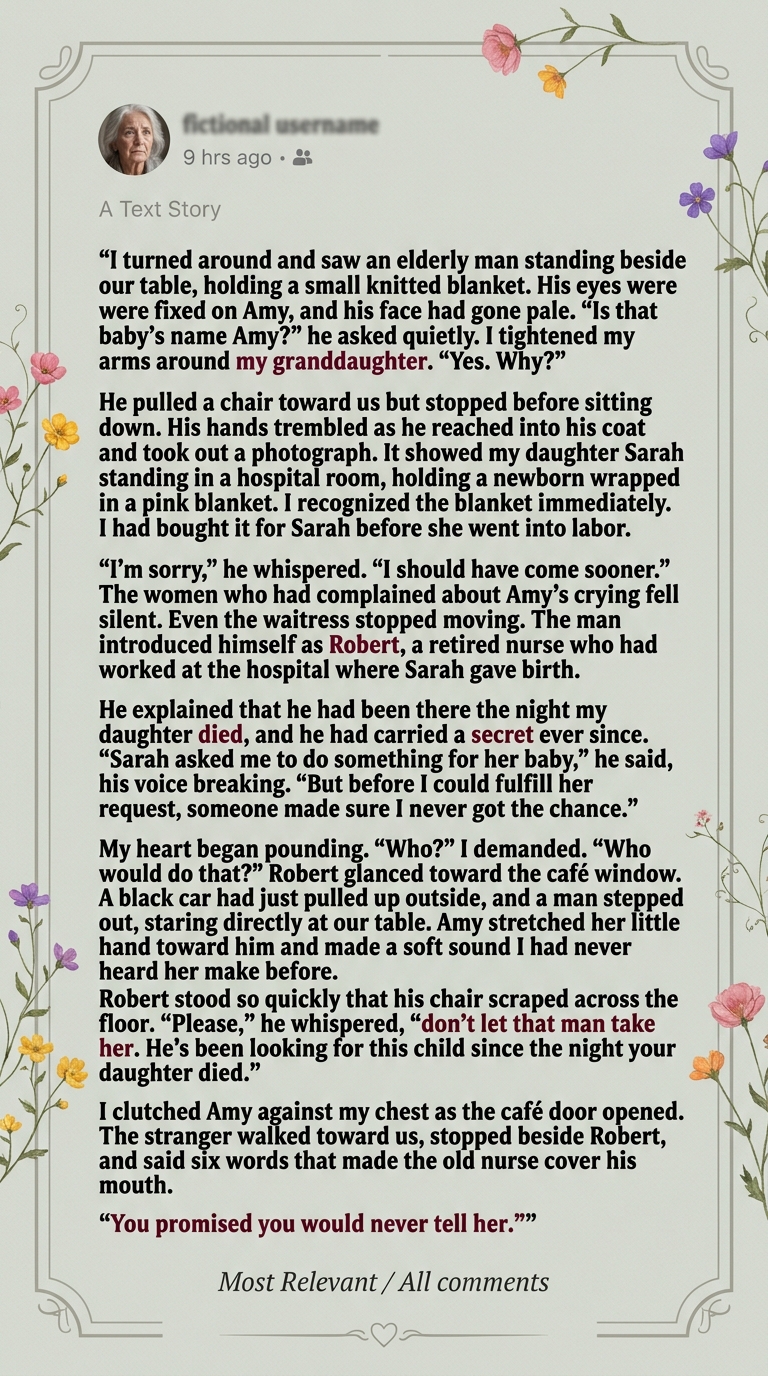
The old man stood beside our table, his eyes fixed on the baby in my arms.
“You promised you would never tell her,” the stranger said.
Robert, the retired nurse, covered his mouth with one trembling hand. For a moment, neither man spoke. Then Robert looked at me, and I saw something in his expression that frightened me more than the stranger’s arrival.
Shame.
“I made that promise to protect a child,” Robert whispered. “But I was wrong to keep it this long.”
The stranger pulled out the chair opposite me and sat down without asking permission. He was in his early fifties, neatly dressed in a dark coat, with silver at his temples. His expression was controlled, but his eyes kept returning to Amy.
“My name is Michael Grant,” he said. “And I believe we need to talk about your granddaughter.”
I tightened my arms around the eleven-month-old girl. “You can talk from there. You are not coming near her.”
Michael nodded, as though he had expected nothing less.
The women who had complained about Amy crying had gone completely silent. The waitress stood near the counter with a coffee pot in her hand, watching us. Outside, Michael’s black car idled beside the curb.
Robert placed the small knitted blanket on the table. It was pale yellow, worn soft around the edges, with a tiny blue star stitched into one corner.
“I knitted this for Sarah,” he said. “She asked me to give it to Amy if anything happened to her.”
My daughter’s name struck me like a physical blow.
Sarah had died eleven months earlier, three days after giving birth to Amy. The doctors had told us there had been complications following an emergency cesarean section. She had developed a severe infection, and despite surgery, antibiotics, and everything the hospital could do, her body had failed her.
I had been there when she was admitted. I had held her hand before they rushed her into surgery. I had also been there when a doctor came out and told me my daughter was gone.
But I had never seen Robert.
“Why do you have something that belonged to my daughter?” I demanded.
“Because Sarah trusted me,” he replied. “And because I was too afraid to honor that trust.”
Michael leaned forward. “Robert, you need to tell her the whole truth.”
Robert flinched at the command.
“No,” he said quietly. “You have spent eleven months trying to control what gets said. You don’t get to do that anymore.”
Michael’s jaw tightened.
I looked between them. “What happened to Sarah?”
Robert drew a slow breath. “Your daughter was frightened that someone would try to take her baby. Before she went into surgery, she asked me to contact a woman named Helen Price. She wanted Helen to become Amy’s legal guardian if Sarah didn’t survive.”
I stared at him.
“Why wouldn’t she ask me?”
“She intended to explain everything to you,” Robert said. “But she believed the explanation would put you in danger, too. She had been trying to protect you.”
“Protect me from whom?”
Robert glanced at Michael.
The answer was written on the stranger’s face.
“Me,” Michael said.
A bitter laugh escaped me. “You expect me to believe that you came here to confess to something?”
“No,” he replied. “I came because I have spent eleven months looking for my daughter.”
Amy shifted against my chest. She had stopped crying, but her small fingers were curled tightly around the collar of my sweater.
Michael’s gaze softened when he looked at her.
“I am her biological father,” he said.
For several seconds, the café seemed to tilt around me.
Sarah had never mentioned a Michael. She had spoken about work, her friends, the man she dated briefly before Amy’s birth, and her hopes for the future. But she had never told me that the father of her child might one day arrive in a black car and claim he had been searching for her.
“You’re lying,” I said.
“I wish I were.”
“You had eleven months to find your daughter. Now you suddenly appear in a café and expect me to hand her over?”
“I don’t expect you to hand her over.” Michael paused. “I expect you to hear what happened to Sarah.”
Robert lowered his eyes.
Michael took a folded document from his coat but did not slide it toward me.
“Sarah and I were together for almost two years,” he explained. “We met while working on a hospital expansion project. I was a civil engineer, and she was a junior administrator. We fell in love, but my family disapproved of her. My father controlled the company I worked for, and he believed Sarah was beneath the family.”
“That sounds like a family problem,” I said. “Not a reason to abandon a child.”
“I didn’t abandon her. When Sarah told me she was pregnant, I wanted to marry her. My father threatened to cut off the funding for a medical center I had been helping establish. I thought I could negotiate with him. I thought I had time.”
“And Sarah?”
“She refused to let me make decisions for her. She ended the relationship after she discovered I had discussed her pregnancy with my father without her permission.”
His voice faltered.
“She told me she wouldn’t raise a child in a family where people treated love as a business arrangement. She said if I wanted to be a father, I had to stand up to my family first.”
“Did you?”
“Not soon enough.”
I looked down at Amy. Her dark eyes were fixed on my face, innocent of the history being unfolded around her.
Michael continued. “When I finally went to see Sarah, she had moved. Her phone number had changed, and she had asked mutual friends not to give me her address. I tried to find her, but I couldn’t. Then, eleven months ago, I received a message from her.”
“What did it say?”
“That she was in the hospital and that the baby had been born. She asked me to come immediately.”
My heart began to pound again.
“You knew she was in the hospital?”
“Yes. I arrived that night. But my father had learned about the message. He was afraid that if I acknowledged Sarah and the baby, the scandal would damage his business dealings. He sent a lawyer to tell me that Sarah had changed her mind and wanted no contact with me.”
“And you believed him?”
“No.” Michael looked down at his hands. “But I let him convince me that I should wait until Sarah was stable enough to speak for herself. I thought I was avoiding a confrontation while she recovered.”
He swallowed.
“By the time I learned she had died, the hospital had already released the baby to the family listed on the discharge papers. I was told that Sarah had never named me as the father.”
I turned to Robert. “Is that true?”
“Not entirely,” he said.
The words hung between us.
Robert explained that Sarah had asked him to deliver a sealed envelope to Helen Price, a former social worker who had helped her during the final months of her pregnancy. The envelope contained a letter naming Michael as Amy’s father, a copy of a signed paternity acknowledgment, and instructions for a legal guardianship arrangement if Sarah died.
Sarah had also included a letter for me.
But before Robert could deliver the envelope, he had been called into an emergency ward. When he returned, the envelope was gone from his locker. A hospital administrator told him that the family had collected Sarah’s belongings and that he should not interfere with the arrangements.
He had tried to raise the matter with his supervisor. The response had been a warning that his conduct could be investigated for violating patient confidentiality.
Robert had been close to retirement. His wife was undergoing cancer treatment, and he feared losing the income and insurance that kept her care affordable. He told himself that he could find another way to help Sarah’s child later.
Then his wife died. He retired. And shame became easier to carry than the truth.
“Who took the envelope?” I asked.
Robert looked at Michael.
“My father,” Michael answered. “At least, I believe he did. He had access to the hospital through the foundation he funded, and he had every reason to keep Sarah’s letter from reaching me.”
“Believing isn’t proof.”
“No,” he said. “It isn’t.”
That answer surprised me. I had expected him to blame everyone else and demand that I accept his version of events. Instead, he reached into his coat and removed another paper.
“This is a copy of the report I filed with the police three months ago. I asked them to investigate the disappearance of Sarah’s belongings and the circumstances surrounding the guardianship papers. I also requested a court-ordered paternity test.”
I didn’t take the paper.
“Why didn’t you come to me directly?”
“I didn’t know where you lived. My father had hired investigators, and I suspected that someone was watching anyone connected to Sarah. When I finally located you, I saw that you were caring for Amy. I didn’t want to frighten you or cause a legal battle before I had evidence.”
“You followed me to this café.”
“Yes,” he admitted. “I saw you here twice before I approached you. I know that sounds terrible. I should have spoken to you sooner.”
It did sound terrible. But it also sounded like a man who knew his mistakes could not be undone simply by explaining them.
I glanced toward the window. The black car was still there, but a second vehicle had stopped behind it. Two people were speaking beside the curb.
Robert noticed my gaze.
“There’s something else,” he said. “Sarah didn’t only ask me to contact Helen. She told me that if Michael ever came looking for Amy, I should make sure he knew about the letter she wrote to you.”
My breath caught.
“Where is it?”
“I don’t have it. I thought it had been destroyed. But last week, I received a package at my home. There was no return address. Inside was this blanket and a note telling me to meet you today.”
He pushed the knitted blanket closer to me.
I stared at the blue star in its corner. I remembered Sarah sitting on my sofa, rubbing her pregnant belly while she watched me knit a tiny hat. She had smiled and said that babies deserved something made by hand, something that could outlast all the expensive things people bought them.
“Who sent the package?” I asked.
“I don’t know,” Robert replied. “But the note said you would be at this café at noon.”
The skin on the back of my neck prickled.
Michael rose and looked toward the door.
“My father knows I’m here,” he said. “And if he arranged this meeting, he may have intended to frighten you into giving up Amy.”
“Then why would he send Robert?”
“Because he knows Robert has been carrying the secret. He may want to know how much Robert remembers.”
At that moment, the café door opened again.
A tall man in his late seventies entered, leaning on a polished walking stick. His silver hair was combed neatly back, and his expensive overcoat looked untouched by the damp weather. He scanned the room until he found our table.
Michael’s face hardened.
“Father.”
The older man approached us with a calmness that felt more threatening than anger.
“Michael,” he said. “You are making a scene.”
“You shouldn’t be here.”
“I could say the same to you.” His eyes moved to Amy. “So this is Sarah’s child.”
I drew Amy closer.
“Don’t look at her as though she’s a possession,” I said.
He turned to me with a thin, courteous smile.
“My name is Richard Grant. I believe we can resolve this misunderstanding privately.”
“There is no misunderstanding. You are a stranger to my granddaughter.”
“Legally, that may be more complicated than you realize.”
Michael stepped between us. “You have no authority over her.”
Richard’s smile disappeared.
“Your mother spent years protecting this family from scandal. I will not allow a dead woman’s decisions to destroy what remains of it.”
“My mother is dead,” Michael replied. “And Sarah is dead. Stop using them as excuses for your behavior.”
Richard’s hand tightened around his walking stick.
Then he turned to Robert.
“You made a promise.”
Robert stood, though his knees shook. “I promised Sarah I would protect her baby. I failed her once. I won’t fail her again.”
“You have no evidence of anything,” Richard snapped. “An old nurse’s memory and a knitted blanket won’t overturn legal documents.”
“Then you won’t mind explaining why Sarah’s original letter disappeared,” I said.
Richard looked at me sharply.
For the first time, his composure slipped.
It was a small change, no more than a tightening around the mouth, but I saw it. So did Michael.
I continued, “You seem to know exactly what was in that letter. You knew Robert made a promise. And you came here before anyone had even told you what we were discussing.”
Richard’s eyes narrowed.
“You have no idea what you’re dealing with.”
“Then explain it.”
He looked around the café, noticing the waitress still standing nearby and the customers who had begun paying attention. He lowered his voice.
“Sarah was unstable. She was determined to punish my son for a disagreement that had nothing to do with the child. I offered to provide financial support and arrange a proper home. She refused.”
“She wanted to choose her own guardian,” Robert said.
“She was a young woman with no understanding of the consequences.”
“She understood enough to keep you away from her baby,” I replied.
Richard’s expression turned cold.
“Your granddaughter will have opportunities with our family that you cannot provide. A private school, a trust fund, a future without financial uncertainty. Surely you want what is best for her.”
“I want what is best for her, too,” I said. “That’s why I’m not handing her over to a man who speaks about her future as though he’s purchasing a building.”
Richard’s gaze flicked to Michael.
“You’ve been manipulated. Sarah knew exactly how to make you feel guilty.”
Michael looked at him for a long moment.
“No. I was manipulated by you. Sarah simply refused to be.”
Richard raised his walking stick slightly and pointed it toward the blanket.
“Give me that.”
I held it against my chest.
“Why?”
“Because it belongs to my family.”
“Then your family should have treated its members better.”
He took a step forward.
Michael blocked him. “Don’t.”
Richard stopped, then reached into his coat and pulled out his phone.
“You have made your choice,” he told Michael. “Do not expect my assistance again.”
“I haven’t needed your assistance for a long time.”
Richard turned to leave, but Robert spoke before he reached the door.
“Mr. Grant, did you tell the hospital administrator to remove Sarah’s belongings from my locker?”
The older man stopped.
“Be careful, Robert.”
“Did you?”
Richard turned slowly. His eyes were hard and bright.
“I told the hospital to protect a family from an unnecessary scandal. That is all.”
Michael took out his phone.
“Say that again.”
Richard stared at the device.
“You wouldn’t dare.”
“I’ve spent eleven months regretting what I didn’t do,” Michael said. “I’m not making the same mistake twice.”
Richard lunged toward the phone, but Michael stepped back. A chair toppled as the two men collided. The waitress shouted for them to stop, and several customers rose from their seats.
I stood with Amy in my arms, my heart hammering. Robert moved between the men, pushing Richard away.
“Enough!” he shouted. “This is about a child, not your pride.”
Richard straightened his coat. He looked around at the watching faces, then walked out without another word.
Through the window, I watched him enter the second vehicle. It pulled away immediately, leaving Michael’s car behind.
Michael remained beside our table, breathing hard.
“I’m sorry,” he said. “You shouldn’t have had to see that.”
“No,” I replied. “I shouldn’t have had to discover any of this in a café.”
He lowered his head. “You’re right.”
For the first time since he had arrived, I believed he understood that the pain wasn’t his alone.
I sat down again, rocking Amy gently. She had begun to fuss, perhaps sensing my tension. Robert placed the yellow blanket over her legs.
“She used to calm down when Sarah sang,” he said softly. “Sarah would sing the same little tune every night before her shift ended.”
I looked at him. “You knew my daughter well.”
“Not as well as I should have. But she was kind to everyone in that ward. Even when she was frightened, she worried more about other people than herself.”
His eyes filled with tears.
“I should have delivered that envelope. I should have risked my job.”
I wanted to tell him that he had done his best, that he had been frightened, that he could not have known how far Richard would go. But those words would have been too easy. Robert had made a choice, and Sarah had paid for it by losing the chance to leave her daughter a message.
“You can’t change what you did,” I told him. “But you can tell the truth now.”
He nodded. “I will.”
Michael sat opposite me again. “There’s one thing you should know about the letter. If my father took it, he may still have it. He keeps every important document in a private archive at his estate.”
“Then how do we get it?”
“We don’t break into his house,” Michael said. “We let the police investigate. The report I filed includes the names of the hospital administrator and the lawyer my father used. If Richard interfered with Sarah’s documents, there will be records.”
I studied him carefully.
“And the paternity test?”
“I’ll take one whenever the court approves it. I won’t ask you to trust me because of a photograph or a story. You have every right to protect Amy.”
That mattered more than he knew.
I had spent eleven months trying to keep my granddaughter safe in a world that had already taken her mother. I wasn’t going to surrender her future to a man simply because he shared her blood.
“If the test proves you’re her father,” I said, “you can get to know her. Slowly. With legal arrangements that protect her. And you will never use money to make decisions about her without consulting me.”
Michael nodded immediately.
“Agreed.”
“And if you ever let your father threaten her again, you’ll never get another chance.”
“I understand.”
I didn’t shake his hand. Not then. Trust was not something he could earn in one conversation.
But I allowed him to look at Amy while I finished my coffee. When he smiled at her, she studied him with grave curiosity, then reached for the silver button on his coat.
He laughed softly, and for a moment, the tension in his face eased.
“Sarah used to do that,” he murmured. “She always tried to steal the buttons off my jackets.”
The memory sounded real. It hurt to hear it, but it also reminded me that Sarah had lived a whole part of her life beyond the one I knew.
Before we left the café, Robert gave me the blanket. He told me he would make a formal statement to the police and provide every detail he remembered. Michael left his number with me, then stepped back without asking to hold Amy.
That small restraint stayed with me.
The investigation took several weeks. The paternity test confirmed that Michael was Amy’s biological father. The police interviewed Robert and the hospital staff, then obtained records showing that Richard’s lawyer had contacted the hospital on the night Sarah died. An internal email revealed that the lawyer had requested the removal of “sensitive personal materials” before the family collected Sarah’s belongings.
Richard claimed he had acted to protect his son’s privacy. But the missing envelope was eventually found in a locked cabinet in his estate’s archive, along with copies of the documents Sarah had prepared.
The letter to me was still sealed.
When the police returned it, I waited until I was alone at home before opening it.
My daughter’s handwriting filled two pages.
Mom, if you’re reading this, then I wasn’t able to come home with my baby. I’m sorry I didn’t tell you everything about Michael. I was afraid that his family would try to control my life and Amy’s, and I didn’t want to put you in the middle of it.
Michael isn’t a cruel man, but he is afraid of disappointing his father. I don’t know if he’ll ever find the courage to stand up to him. If he does, please don’t punish him for every mistake he has made. But don’t trust him just because he says he loves her. Let him prove that he can put Amy first.
I chose you because you have always understood that love is not ownership. If I cannot raise my daughter, please teach her that she belongs to herself. Let her know I wanted her more than anything, and that the pink blanket you bought her was the first thing I placed beside her in the hospital.
I love you, Mom. Take care of my little girl.
I read the letter twice, then pressed it to my chest and cried until my eyes hurt.
Sarah had known she might die. She had been afraid, but she had still tried to give her daughter a future shaped by love rather than fear.
The truth did not erase my anger. Richard’s interference had robbed Sarah of the chance to decide what happened to her child, and Robert’s silence had delayed the truth. Michael’s cowardice had left Sarah to face too much alone.
But the truth gave us something the lies never could: a chance to make better choices.
Richard eventually faced a civil inquiry over the interference with Sarah’s records. He was not convicted of causing her death; the medical evidence showed that her infection had been a tragic complication, not an act of sabotage. But the inquiry established that he had improperly used his influence to obstruct the delivery of Sarah’s personal documents. He was forced to cooperate with the investigation and withdrew from the charitable foundation he had used to influence the hospital.
Michael did not ask me to forgive his father. He also stopped defending him.
Over the next year, Michael visited Amy every Sunday afternoon. At first, he brought no gifts, only a picture book or a small toy and the patience to sit on the floor while she crawled toward him. He learned how she liked her food cut, which song calmed her when she woke from a nap, and how she rubbed her eyes when she was tired.
He attended her first birthday party and stood quietly beside me when we placed a small photograph of Sarah on the table.
Robert came, too. He brought another knitted blanket, this one white, with a blue star stitched in the corner.
“I thought she deserved something new,” he said.
I hugged him. It was the first time I had done so.
By Amy’s second birthday, Michael had become a steady part of her life. He and I still disagreed sometimes, especially about how much protection she needed, but we learned to talk before those disagreements turned into battles. He never tried to replace me, and I never pretended he could replace Sarah.
On the anniversary of her death, we took Amy to the cemetery. I laid the pink blanket over the flowers beside Sarah’s headstone, then folded it carefully and tucked it back into my bag.
Amy pointed at the photograph engraved on the stone.
“Mama,” she said.
My throat tightened. She was too young to understand death, but she knew the word and recognized the face.
“Yes, sweetheart,” I whispered. “That’s your mama.”
Michael knelt beside her and told her a story about Sarah stealing the buttons from his jacket. Amy laughed at the silly part, though she couldn’t yet understand why the story made the adults cry.
As we walked back to the car, I thought of the day Robert had approached our table with the blanket in his hands. I had believed a stranger had arrived to take the only piece of my daughter I had left.
Instead, the truth had arrived—late, painful, and imperfect, but still in time to save us from living the rest of our lives inside a lie.
I had promised Sarah I would protect Amy. For a long time, I thought that meant keeping everyone at a distance.
Now I understood that protection meant something harder: knowing whom to trust, setting boundaries when love became control, and allowing the people who were willing to change to prove themselves.
Amy was not a secret to be guarded or a prize to be claimed. She was a little girl who deserved to know where she came from without being burdened by the mistakes of the people who loved her.
And when I tucked her into bed that night, beneath the pink blanket her mother had chosen, I told her the truth about Sarah—not the frightening parts she was too young to understand, but the important ones.
Her mother had loved her.
Her grandmother would always protect her.
And no matter how long it took, the truth would never again be hidden from her.