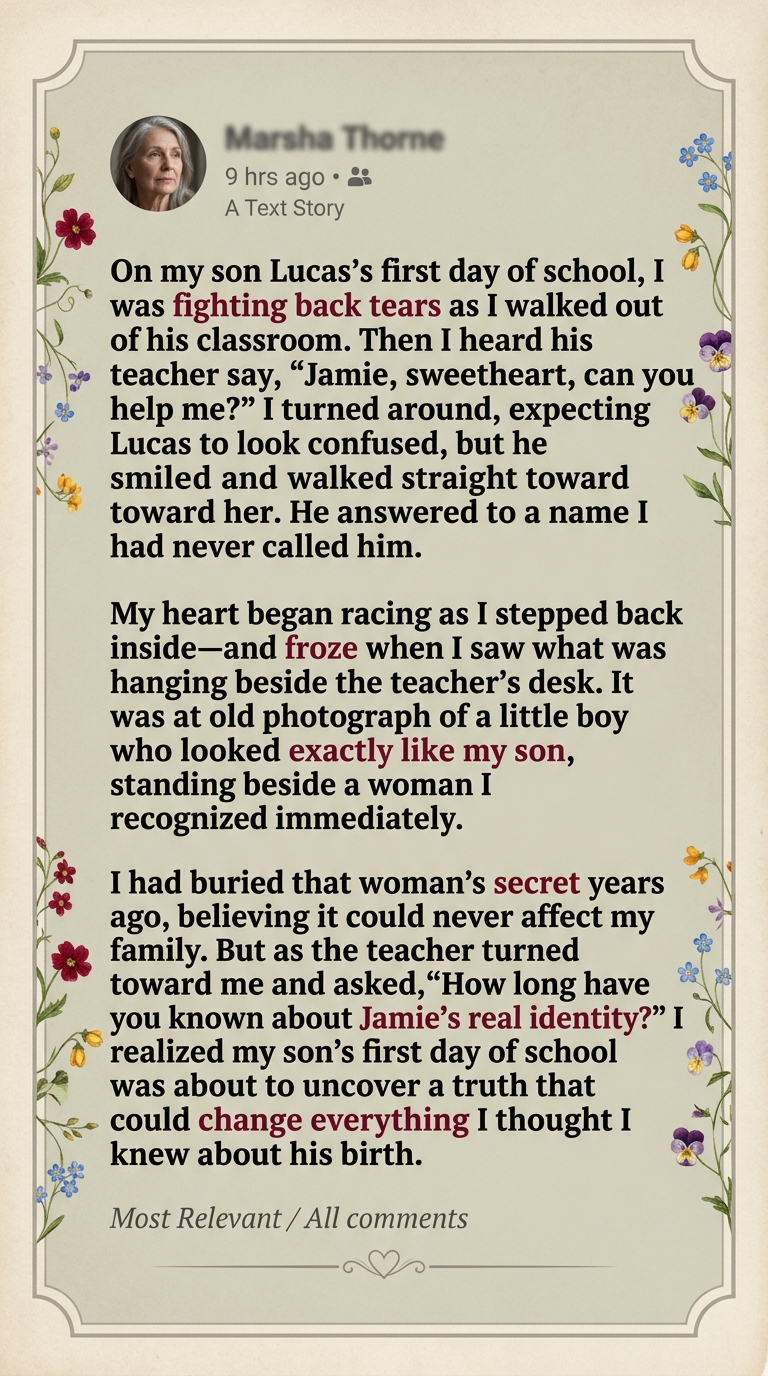
On Lucas’s first day of school, I cried before I even reached the parking lot.
He had been so excited that morning, jumping around the kitchen in his little blue uniform while I packed his lunch. He insisted on carrying his own backpack, even though it kept slipping off his shoulders, and he reminded me three times that he was a big boy now.
My husband, Daniel, took pictures of us beside the front door. Then he kissed Lucas on the forehead and told him to listen to his teacher.
I had spent six years preparing for that moment. I thought dropping my son off at school would be one of those ordinary milestones every parent remembered forever.
I never imagined it would be the day my entire understanding of my family fell apart.
Lucas settled into his classroom quickly. He found a box of building blocks, introduced himself to another boy, and began constructing a crooked tower before I had even finished speaking with his teacher.
Mrs. Bennett seemed kind and experienced. She had warm brown eyes, silver threaded through her dark hair, and a way of making nervous parents feel that their children would be safe.
“He seems ready for this,” she told me with a smile.
“I hope so,” I replied, trying not to cry.
She laughed softly. “You might be the one who needs more time.”
She was right.
I bent down, kissed Lucas, and told him I would be back to get him that afternoon.
“Bye, Mommy!” he called, already reaching for another block.
I walked toward the door with a strange ache in my chest. I had barely stepped into the hallway when I heard Mrs. Bennett speak behind me.
“Jamie, sweetheart, can you help me?”
I stopped.
Jamie?
I turned around, expecting to see another child approaching her.
Instead, Lucas stood up.
He walked straight toward the teacher, smiling as if she had called him by his favorite nickname.
My stomach tightened.
“Lucas?” I called.
He glanced at me, confused by my tone.
Mrs. Bennett looked up. Her smile disappeared the instant she saw my face.
For several seconds, nobody spoke.
Then Lucas tugged at her sleeve and asked, “Can I put the blocks away now, Mrs. Bennett?”
She nodded slowly.
I stepped back into the classroom.
“Why did you call my son Jamie?”
Mrs. Bennett’s expression changed in a way I couldn’t understand. She looked from Lucas to me, then toward the wall beside her desk.
I followed her gaze.
There, hanging above a shelf of children’s books, was an old photograph in a simple wooden frame.
It showed a little boy standing beside a young woman in a pale yellow dress. The boy had dark curls, a small dimple in his left cheek, and a crooked smile I knew better than my own reflection.
He looked exactly like Lucas.
The woman beside him was someone I had spent years trying to forget.
My older sister, Rebecca.
I felt the blood drain from my face.
Rebecca had died when I was twenty-four. At least, that was what I had told everyone after the accident that supposedly took her life. I had never spoken about her in detail, and Daniel had learned early in our marriage that the subject was painful.
But the photograph was impossible to dismiss.
Rebecca was standing beside a child who looked like my son, and the teacher had called that child Jamie.
Mrs. Bennett gently guided Lucas toward a table where several children were drawing.
“Lucas, sweetheart, why don’t you show your new friend how you made that tower?”
He happily followed her instructions.
Then she turned back to me.
“Could we speak privately?”
My hands had begun to shake.
“What is going on?”
She closed the classroom door and lowered her voice.
“How long have you known about Jamie’s real identity?”
I stared at her.
“His name is Lucas. I’m his mother.”
“I understand that you have raised him as Lucas.”
“Raised him?” I repeated. “I gave birth to him.”
Mrs. Bennett looked genuinely troubled.
“I’m not questioning the love you have for him. But I need to understand what you were told before I can explain why that photograph is here.”
I glanced toward my son. He was drawing a house with a bright red roof, completely unaware that his first day of school had become a nightmare for his mother.
“Tell me everything,” I whispered.
Mrs. Bennett sat down.
“My name is Eleanor Bennett. I worked with children in temporary care for many years before becoming a teacher. Rebecca was someone I knew through a family support program. She brought Jamie to several of our activities when he was very young.”
I gripped the back of a chair.
“How old was he?”
“Almost three in this photograph.”
“And why is he called Jamie?”
She hesitated.
“Because that was the name Rebecca used for him.”
My heart hammered.
“Are you saying my sister had a child?”
“Yes.”
The room seemed to tilt.
Rebecca had never told me she had a son. She had been secretive in the months before her death, but I had assumed she was struggling with a relationship. I remembered her calling me late at night, asking whether I would still love her if she had made a terrible mistake.
I had told her that everyone made mistakes.
She had started crying.
Two weeks later, she was gone.
I had buried her secret years ago, believing it could never affect my family.
Now it was sitting in a classroom, drawing a red-roofed house.
“Where is Jamie’s father?” I asked.
Mrs. Bennett looked down at her hands.
“That is one of the questions I hoped you could answer.”
“I don’t know anything about a child named Jamie.”
She studied my face, then seemed to make a decision.
“Rebecca brought him to our program after leaving a difficult relationship. She was frightened that someone would try to take him away from her. She told me that the child’s father had powerful connections and that she had been advised not to challenge him.”
“Who?”
“She never gave me a name. She said the man had been told that the baby hadn’t survived.”
I felt suddenly cold.
“The baby?”
Mrs. Bennett nodded.
“Rebecca said she had been pressured to sign papers surrendering her parental rights. She refused, but she was afraid that if she challenged the arrangement, she would lose her son permanently. She disappeared from the program not long afterward.”
I could barely breathe.
“Then what happened?”
“Several months later, I heard that Rebecca had died. I was told the boy had been placed with a distant relative, but I never learned which one. I kept the photograph because I wanted to remember them.”
I looked toward Lucas again.
He had my husband’s dark eyes, my mother’s dimple, and the same small scar on his chin he had gotten when he fell against our coffee table as a toddler.
He was my son.
I knew that with the certainty of a mother who had watched him grow from a newborn into a laughing, stubborn little boy.
But suddenly, I wasn’t sure what that meant.
“Mrs. Bennett,” I said carefully, “Lucas is six years old. I gave birth to him in a hospital. I have his birth certificate, his medical records, everything.”
She nodded.
“Then we need to understand why his resemblance to Jamie is so striking, and why he responded to that name.”
I wanted to tell her that children sometimes resembled one another. I wanted to insist that the photograph was a coincidence.
But I remembered something I hadn’t thought about in years.
When Lucas was a baby, Daniel had insisted that we name him Lucas Michael Hayes. I had wanted to name him after my grandfather, but Daniel said he had a family reason for choosing the name.
I had never asked what that reason was.
And the hospital where I delivered Lucas had been selected by Daniel, who said his company had a partnership with the maternity unit.
I had trusted him.
I had trusted everyone.
“Can you give me a copy of that photograph?” I asked.
Mrs. Bennett nodded.
“I can, but I think you should speak with your husband before making any decisions.”
I looked at her sharply.
“Why would you say that?”
“Because when you walked in this morning, I recognized your face. You look remarkably like Rebecca. I had hoped you might know what happened to Jamie.”
She paused.
“But the moment I saw your reaction, I realized you might not know the whole story.”
I left the classroom with my legs trembling.
Lucas ran after me when he noticed me near the entrance.
“Mommy! Look what I made!”
He held up a drawing of a house with a red roof and two stick figures standing in front of it.
One was labeled MOMMY.
The other was labeled ME.
I hugged him so tightly that he squealed.
“Mom, you’re squishing me!”
“Sorry, sweetheart.”
He looked up at me.
“Are you coming back later?”
“Of course.”
I kissed his forehead and forced myself to smile.
Then I walked to my car, locked the doors, and called Daniel.
He answered on the second ring.
“Hey, how did the first day go?”
“Who is Jamie?”
Silence.
Not the confused silence of someone hearing an unfamiliar name.
The silence of someone who had been waiting for the question.
“Where did you hear that name?” he asked.
My hand tightened around the phone.
“Lucas’s teacher called him Jamie. There was a photograph of Rebecca beside her desk. Daniel, what is happening?”
He exhaled slowly.
“Listen to me. Don’t talk to anyone about this until I get there.”
“Why?”
“Because you don’t understand what you’re dealing with.”
“Then explain it.”
“I’ll be there in twenty minutes.”
He hung up.
I sat in the car, staring at the school entrance.
My husband had not asked whether Lucas was okay. He had not asked what the teacher had said or why she had a photograph of my dead sister.
He had simply told me to stay quiet.
For the first time in six years, I wondered whether the man I loved had ever been honest with me about our son.
Daniel arrived twenty-three minutes later.
He climbed into the passenger seat and shut the door.
For a long moment, neither of us spoke.
Then he said, “I can explain.”
“Start with Rebecca.”
He closed his eyes.
“Your sister was involved with my brother, Michael.”
I stared at him.
“You have a brother?”
“Had. He died before you and I met.”
I had never heard of Michael. Daniel had told me that he was an only child, raised by a single mother who died when he was a teenager. I had accepted that explanation without question.
“Why did you tell me you were an only child?”
“Because Michael’s life was complicated.”
“That isn’t an answer.”
Daniel rubbed his face.
“Michael was older than me. He was impulsive, and he got involved with people who were dangerous. When he met Rebecca, he was trying to get out of that life. They were together for almost a year.”
My throat tightened.
“And Jamie?”
“Michael’s son.”
I turned toward him.
“Are you telling me Lucas is Rebecca’s child?”
Daniel nodded slowly.
“No.”
The word was so quiet that I almost didn’t hear it.
“Then what are you saying?”
He looked at me with red eyes.
“Lucas is Michael’s son. Rebecca gave birth to him. But she couldn’t keep him.”
I felt as though the air had been sucked from the car.
“Then who gave birth to Lucas?”
“You did.”
I shook my head.
“Stop talking in circles.”
Daniel took a breath.
“Rebecca died before you and I met. Michael had already been killed. Their son was placed in temporary care. My family was trying to protect him from people connected to Michael’s old business. When I met you, I knew you had lost your sister, and I knew how much you wanted a child.”
I stared at him, unable to speak.
“Your pregnancy was real,” he continued quickly. “I was there at the hospital. I held Lucas when he was born. I never doubted that you were his mother.”
“Then why did you say he was Michael’s son?”
“Because he was.”
I looked at my husband and felt something inside me begin to break.
“Are you saying we adopted him without my knowledge?”
Daniel didn’t answer.
The silence was enough.
I got out of the car.
He followed me into the school parking lot, begging me to listen, but I couldn’t bear to look at him.
“You let me believe I had given birth to my son,” I said. “You let me carry him, deliver him, and spend six years believing I knew where he came from.”
“You did give birth to him.”
“No. You said that already. I mean, you let me believe he was biologically mine.”
Daniel’s face crumpled.
“I was afraid you’d reject him.”
I stared at him.
“You thought I would reject a child because he wasn’t biologically mine?”
“I didn’t know what you would do. You had just lost Rebecca. You were grieving. You wanted a baby more than anything, and when the opportunity came—”
“What opportunity?”
He looked away.
I stepped closer.
“Daniel, tell me the truth.”
He finally did.
Six years earlier, after Rebecca died, Daniel’s mother had contacted him. Michael’s son had been placed in temporary care, and the family was desperate to prevent him from being taken in by people connected to Michael’s criminal associates. Daniel’s mother had known about my grief and my desire to become a mother.
She had arranged for us to adopt the child.
But the adoption had not been straightforward. There were legal questions about Rebecca’s parental rights, her death, and the identity of the child’s father. Rather than wait for the authorities to complete the process, Daniel’s mother had used her connections to arrange a private placement through a doctor who knew the family.
Daniel had agreed.
He had told himself that the paperwork would eventually be corrected, that the child would be safe, and that I would never need to know the painful details.
Then he had watched me fall in love with the baby.
And he had kept lying.
“Where are the adoption papers?” I asked.
“They’re in my office.”
“Are they legal?”
He hesitated.
“I don’t know.”
I stared at him.
“You brought a child into our home through an arrangement you can’t even confirm was legal, and you never told me?”
“I thought I was protecting him.”
“You were protecting yourself from having to explain what you had done.”
He began to cry.
I didn’t comfort him.
I returned to the classroom and asked Mrs. Bennett to help me arrange a meeting with the school’s counselor. I collected Lucas at the end of the day and took him home to a house that suddenly felt unfamiliar.
I did not tell him that his father had lied. I did not tell him that his biological parents were dead or that his life had begun with secrets. He was six years old. He deserved the truth, but he also deserved to hear it in a way that would not make him feel as though his entire world had been taken from him.
That evening, I called a family lawyer.
The next morning, I contacted the hospital where Lucas had supposedly been born. I requested my medical records and the records relating to his birth. The hospital confirmed that I had delivered a baby boy on the date Daniel had always given me.
But the file contained a discrepancy.
The newborn’s blood type did not match the blood type listed on Lucas’s current medical records.
At first, I assumed there had been a clerical error. Then the hospital explained that the original newborn screening information had been amended several weeks after the birth.
The amendment had been requested by a physician who had since retired.
My lawyer asked the hospital to preserve the records and explain the change.
Meanwhile, Daniel finally gave me the adoption documents. They were incomplete. Some had been signed by people who lacked the authority to consent, and others referred to a temporary guardianship rather than a finalized adoption.
The arrangement had never been properly completed.
Lucas had been living with us for six years without a clear legal record of how parental responsibility had been transferred.
I felt sick.
The child I loved more than anything had been caught in the middle of an adult decision made without my informed consent.
But there was one question I could no longer ignore.
If Lucas was Michael’s biological son, why did the hospital records suggest that I had given birth to a different child?
I requested a DNA test through an accredited laboratory, with my lawyer’s guidance. Daniel initially resisted, insisting that it would only hurt Lucas and complicate matters further.
I told him that the truth had already complicated everything.
The results arrived two weeks later.
Lucas was not biologically related to me.
Nor was he biologically related to Daniel.
The report confirmed that he was the biological son of Michael and Rebecca.
I sat at the kitchen table with the document in front of me, unable to move.
The boy I had carried home from the hospital was not the baby I had delivered.
My own newborn had disappeared from the records.
I called the hospital’s legal department immediately.
The review that followed uncovered a catastrophic breach involving a retired physician and a private adoption intermediary. On the night I gave birth, another infant had been delivered at the same hospital. That baby’s mother had died shortly after delivery, and the father was unknown. The physician had known the families involved through Daniel’s mother and had improperly altered records to place Rebecca’s son with me.
The doctor had convinced himself that he was saving a child from danger and giving a grieving woman the family she desperately wanted.
He had never obtained the lawful consent required for the arrangement.
My biological son had been placed with another family under a separate set of records, and the hospital had failed to notice the discrepancy because the original files had been altered.
The discovery triggered a formal investigation. The hospital notified the authorities, and my lawyer helped me obtain the records needed to identify the family who had raised my biological son.
His name was Oliver.
He was six years old, lived with a couple in a neighboring state, and had been adopted through what they believed was a legitimate process. They had no idea that his records might be connected to mine.
I didn’t rush to contact them directly. I knew that they loved him, and I had no intention of frightening a child or tearing apart another family without guidance. The authorities arranged the initial contact, and both families received support from professionals experienced in adoption and family reunification.
When I finally met Oliver, he stood beside his adoptive mother and held her hand.
He had my eyes.
He had my father’s dimple.
And when he smiled, I saw a face I had imagined for six years without ever knowing I had been imagining the wrong child.
I cried, but I did not reach for him without asking.
“Hi, Oliver,” I said gently. “My name is Anna.”
He looked up at his mother, then back at me.
“Are you my birth mom?”
I swallowed.
“Yes,” I said. “But you don’t have to call me anything special. I’m glad to meet you.”
He studied my face for a moment.
“Do you like dinosaurs?”
I laughed through my tears.
“I love dinosaurs.”
He grinned and began telling me about a book he had brought.
It wasn’t an instant reunion. It was a beginning.
Over the following months, both families worked with counselors and legal professionals to determine what was best for the children. Oliver remained with the parents who had raised him while we built a careful relationship. Lucas continued living with me, and his legal status was clarified through the proper process. He remained the child I had raised, the boy who called me Mommy, and the person I would protect for the rest of my life.
Daniel and I separated.
I loved Lucas too deeply to punish him for the lies adults had told, and I loved Oliver too much to pretend that the truth didn’t matter. But I could not remain married to a man who had allowed a physician to alter birth records and had hidden the truth from me for six years.
Daniel eventually admitted that he had known the arrangement was improper. He had not known every detail of the hospital’s actions, but he had chosen not to ask questions because the result seemed to solve everyone’s problems. His mother had wanted to protect Michael’s child, he had wanted to make me happy, and he had convinced himself that the truth would only cause pain.
Instead, his silence had multiplied that pain.
The physician lost his medical license, and the investigation led to legal consequences for those involved in falsifying the records. The hospital established a process for reviewing affected files and helping the families who had been harmed.
Years later, Lucas and Oliver knew the truth about their beginnings. They were not forced to become brothers overnight, nor were they expected to feel a particular way about the adults who had made decisions for them. They were allowed to ask questions, feel angry, and build their own understanding of what had happened.
On the anniversary of Lucas’s first day of school, I took both boys to a park near our home.
Lucas ran ahead with a soccer ball, while Oliver followed, laughing as he tried to steal it. Watching them together, I felt the strange ache of all the years we had lost and the quiet hope of the years still ahead.
For a long time, I had believed that being a mother meant knowing every detail of my child’s life.
Now I understood something different.
Being a mother meant showing up when the truth was painful, protecting a child from the mistakes of adults, and loving him without making him responsible for the circumstances of his birth.
Lucas was still my son.
Oliver was my son, too.
And neither boy had ever been a secret that deserved to be buried.