The rain had been falling since noon, turning the windows of the little restaurant into blurred mirrors. Amy sat across from me, swinging her feet beneath the table while she carefully arranged the peas on her plate into a crooked smiley face.
She had Sarah’s eyes. That was what I noticed most about my granddaughter: the same deep brown eyes that used to brighten whenever my daughter laughed. Sometimes, when Amy tilted her head or wrinkled her nose, I could almost believe Sarah had simply stepped out of the room and would return at any moment.
But Sarah had been gone for four years.
She died shortly after giving birth to Amy, leaving me with a newborn, a house full of baby supplies, and a grief so heavy that even breathing seemed like work. Her boyfriend, Daniel, disappeared before the funeral. He never called, never wrote, and never asked about his daughter. I spent months searching for him before anger finally replaced hope.
To Amy, I explained that her father was someone I had never been able to find. I told myself that was kinder than admitting he had walked away from her before she was old enough to recognize his face.
That afternoon, Amy was telling me about a butterfly she had seen at preschool when someone stopped beside our table.
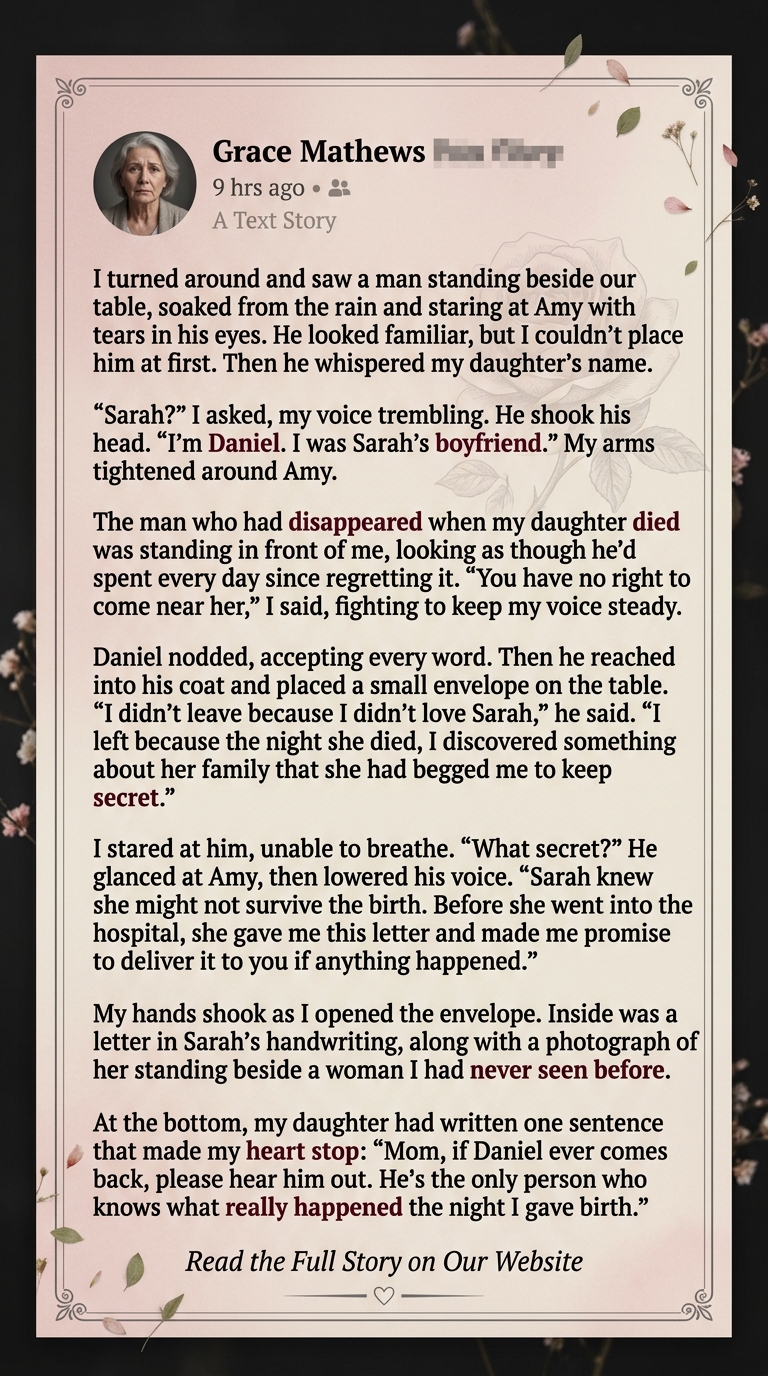
I turned around and saw a man standing there, soaked from the rain. His dark hair clung to his forehead, and water dripped from the sleeves of his coat. He looked older than the man in the photograph Sarah had once kept beside her bed, but I recognized him almost immediately.
His gaze settled on Amy, and tears filled his eyes.
“Sarah?” he whispered.
My stomach tightened.
“I’m her mother,” I said. “Sarah is dead.”
He closed his eyes briefly, as if hearing the words aloud hurt more than he had expected.
“I’m Daniel. I was Sarah’s boyfriend.”
I pulled Amy closer.
“You have no right to come near her.”
“I know.”
“You vanished. You weren’t at the hospital. You weren’t at her funeral. You didn’t even have the decency to find out whether your daughter was alive.”
Daniel lowered his head. He didn’t defend himself, and somehow that made my anger worse.
“I deserve all of that,” he said. “But before you send me away, please read this.”
He placed a small envelope on the table. My daughter’s name was written across the front in familiar blue ink.
My hands went cold.
“Where did you get this?”
“Sarah gave it to me the night she went into the hospital. She made me promise that if anything happened to her, I would deliver it to you.”
I stared at him.
“Then why did you wait four years?”
“Because I was a coward. And because I believed something about your family that I should have questioned sooner.”
Amy looked between us.
“Grandma, why are you crying?”
I forced a smile and brushed a strand of hair from her forehead.
“It’s all right, sweetheart. Finish your lunch.”
Daniel stepped back toward the entrance, giving us space.
“I’ll wait outside,” he said. “If you want me to leave afterward, I will.”
He walked into the rain without another word.
I opened the envelope.
Inside was a folded letter and a photograph. Sarah stood beside a woman I had never seen before. The woman wore a pale green dress and rested one hand on Sarah’s shoulder. Behind them was a hospital corridor.
On the back of the photograph, Sarah had written a date. It was two days before Amy was born.
I unfolded the letter.
Mom,
If Daniel ever comes back, please hear him out. I know you hate him for leaving, but he knows something about the night I gave birth that I couldn’t explain to you without hurting someone you love.
The woman in the photograph is Helen Mercer. She was the night supervisor at the hospital. She helped me understand why my medical records had been changed.
I wanted to tell you everything, but I was afraid you would try to fix it before I had the chance to prove what happened.
Please don’t assume Daniel abandoned us because he didn’t care. Ask him what he saw in the hospital corridor. Ask him who came into my room after midnight.
Mom, if you remember nothing else, remember this: I did not agree to the procedure they said I had requested.
I love you. Take care of my little girl.
Sarah.
I read the letter twice, then a third time, hoping the words would rearrange themselves into something less terrible.
They didn’t.
My daughter had been afraid of something before she died. Something connected to her medical care. Something she had tried to tell me about, yet I had been so consumed by my own worries that I hadn’t recognized how frightened she was.
I remembered Sarah calling me from the hospital the night before Amy’s birth. She had sounded tired and unusually quiet. When I asked whether everything was all right, she said the doctors wanted to discuss a change to her treatment plan.
I told her to trust the professionals.
She had paused before answering.
“I wish I could, Mom.”
Then someone entered her room, and she ended the call.
For four years, I had remembered that conversation as an ordinary moment. Now it returned to me with a sharpness that made my chest ache.
I stood, took Amy’s hand, and walked to the entrance.
Daniel was waiting beneath the narrow awning, his coat still dripping.
“Come back inside,” I said. “You’re going to tell me everything.”
We found a quiet corner away from the other diners. I ordered Amy a hot chocolate and asked the waitress to bring Daniel coffee.
He wrapped both hands around the cup without drinking.
“Sarah was twenty-eight weeks pregnant when she first became worried,” he began. “Her blood pressure had been rising, and she was afraid she might have to deliver early. Her obstetrician recommended a treatment plan, but a few days later, she discovered that her chart contained a consent form for a procedure she didn’t remember discussing.”
“What procedure?”
“A sterilization procedure to be performed during delivery, if the circumstances allowed it.”
For a moment, I couldn’t understand what he was saying.
“Sarah wanted another child someday,” I whispered. “She told me that.”
“I know. She told me, too. She said she would never have agreed to it without a long conversation and time to think.”
“Why would anyone put that in her chart?”
“That’s what she wanted to know.”
Daniel explained that Sarah had asked the hospital for a copy of her records. She found a consent form bearing a signature that looked like hers, but the date was wrong. It was dated on a day when she had been at home, too sick to leave bed.
She confronted the doctor, who told her the form was a clerical error and promised to correct it.
But the correction never appeared.
Sarah then contacted Helen Mercer, the night supervisor whose photograph I held in my hand. Helen had noticed discrepancies in the electronic records and agreed to help Sarah understand them. She discovered that a staff member had entered the consent form after Sarah’s admission, using a signature copied from another document.
“Did the hospital actually perform the procedure?” I asked.
Daniel shook his head.
“No. Sarah refused it again when she arrived for delivery. She was clear about that. But the argument that followed was worse than she expected. She was frightened that if she kept challenging the staff, they might label her difficult and ignore her medical concerns.”
My throat tightened.
“What happened the night she died?”
Daniel looked down at his untouched coffee.
“Sarah was admitted after her blood pressure spiked. The doctors decided she needed an emergency delivery. I was with her for most of the evening. She was scared, but she kept making jokes about how Amy would probably arrive with a full head of hair and a terrible temper.”
A painful smile crossed his face and vanished.
“Just after midnight, a doctor came in with a form. He said it was routine paperwork. Sarah asked him whether it included the procedure she had refused. He said it didn’t. But she read the page and saw that it did.”
“And then?”
“She refused to sign. The doctor left, but I followed him into the corridor and demanded an explanation. Another staff member told me to go back to Sarah’s room. When I returned, a nurse was preparing medication, and Sarah was asking what it was for.”
Daniel swallowed.
“I didn’t know what to do. I was angry, frightened, and young enough to believe that if I shouted loudly enough, someone would have to tell me the truth.”
He told me that he had gone to find Helen, who was reviewing the records at the nurses’ station. When he returned, Sarah had been taken for the emergency delivery.
Amy was born alive and healthy. Sarah, however, suffered a severe complication after delivery and died despite the medical team’s attempts to save her.
“The hospital told me her death was caused by a sudden complication that no one could have predicted,” Daniel said. “But Helen showed me the medication entry. It had been changed after the fact. She told me the original entry suggested Sarah had received a drug she had specifically asked them to avoid because of a previous reaction.”
I gripped the edge of the table.
“Are you saying the hospital killed my daughter?”
“No,” he said immediately. “I’m saying I didn’t know what happened, and neither did Helen. We suspected the records had been altered, but suspicion wasn’t proof. Sarah had been frightened that the hospital would protect itself, and she had asked Helen to preserve whatever evidence she could.”
“Then why didn’t you tell the police?”
“I tried to report what I’d seen. The hospital said I was distraught and confused. They showed me a signed statement claiming Sarah had consented to the procedure, and when I challenged it, they threatened to accuse me of interfering with her care.”
He looked at me with red-rimmed eyes.
“Then your brother arrived.”
My brother, Robert, had been the person who handled most of the arrangements after Sarah died. He had always been confident, practical, and eager to take charge when I was overwhelmed.
“What did Robert have to do with this?”
“He told me Sarah had been planning to leave town with Amy and that she had accused me of being unstable. He said she had asked the family to keep me away from the funeral because she didn’t want me involved in Amy’s life.”
I shook my head.
“That’s a lie. Sarah never said anything like that.”
“I know that now. At the time, I was barely functioning. I had just watched the woman I loved die, and I was being told that her family blamed me. Robert said he would make sure I never saw Amy if I kept making accusations against the hospital.”
“You believed him?”
Daniel’s face crumpled.
“I believed that if I stayed, I would make things worse. I told myself I would come back when I had evidence. But I had no money, no legal help, and no idea how to challenge a hospital that had already made me look unreliable. I left town to work, and every month I found another reason to wait. I told myself I was protecting Amy from a fight she didn’t deserve.”
“You were protecting yourself,” I said.
He didn’t argue.
“Yes.”
His honesty did not erase the years he had missed. It did, however, make it harder to dismiss him as a man who had simply stopped caring.
“Why come back now?”
“Because Helen died last spring. Before she passed, she sent me a message telling me she’d kept a copy of the original records. She said she had finally found a way to prove that the consent form was entered after Sarah had refused it.”
He reached into his coat again and placed a second envelope on the table. This one contained a photocopy of an old hospital audit report and a small flash drive.
“I’ve spent the past six months working with a lawyer. The hospital agreed to release the records after an independent review was opened. I came back because I wanted you to know the truth, and because Amy deserves to know who her father is.”
I looked at the flash drive as if it might explode.
“And you expect me to believe all this because you brought me some papers?”
“No. I expect you to verify every word.”
That answer stayed with me.
The following morning, I contacted a lawyer who specialized in medical negligence and patient-record disputes. I gave her Sarah’s letter, the photograph, the audit report, and the flash drive. She advised me not to make public accusations until the evidence had been independently examined.
For the first time since Sarah’s death, I had a task that did not involve simply enduring my grief.
The review took months.
The audit records showed that the disputed consent form had been entered into Sarah’s file after she had explicitly refused the procedure. The electronic log identified the employee account used to create it, and the hospital’s internal investigation found that the same account had been used to alter other patient records.
The medication records were more complicated. The original entry had been overwritten, and the surviving evidence could not establish beyond doubt whether the medication had caused Sarah’s fatal complication. Several clinicians had made decisions during a rapidly deteriorating emergency, and the experts who reviewed the case disagreed about which actions had materially affected the outcome.
But one finding was undeniable: Sarah’s refusal had not been properly documented, and the hospital had failed to maintain an accurate record of a decision that concerned her bodily autonomy.
The hospital issued a formal acknowledgment of its recordkeeping failures and referred the matter to the appropriate medical regulators. The employee responsible for entering the false consent form was disciplined, and the review uncovered additional cases that required investigation.
I had wanted a simple answer. I wanted one person to blame for everything that had happened, someone whose punishment could somehow balance the loss of my daughter.
Instead, I received a harder truth. Some wrongdoing could be proved. Some questions could not be answered with certainty. And no official finding could return Sarah to us.
The review also uncovered something unexpected.
Robert had contacted the hospital shortly after Sarah died, asking for copies of her records. He had been given the same false consent form and told that Daniel had threatened staff. Rather than question the contradictions, he had accepted the hospital’s account and used it to justify keeping Daniel away from Amy.
When I confronted him, he initially denied everything.
Then I showed him the letter Sarah had written.
He sat at my kitchen table for a long time without speaking. Finally, he admitted that a hospital administrator had told him that Daniel was making reckless accusations and that continued contact with him could expose the family to legal trouble. Robert had convinced himself that he was protecting me and Amy from a scandal.
“You could have asked me,” I said.
“I thought I was sparing you another loss.”
“You took away my chance to decide what I could bear.”
His eyes filled with tears.
“I know.”
I wanted to forgive him immediately, because he was my brother and because I had already lost too much. But forgiveness offered too quickly would have been another way of avoiding the truth.
I told him I needed time. He accepted that, and for once he did not try to control the conversation.
As for Daniel, I did not suddenly welcome him into Amy’s life as though four years could be erased by a letter. He had missed birthdays, first words, fevers, scraped knees, and the countless ordinary moments that make a child feel loved. His reasons for leaving were understandable, but his absence had still been his choice.
We began with supervised visits at a family center. Daniel arrived early every time, bringing no extravagant gifts and making no promises he couldn’t keep. He learned Amy’s favorite stories, the songs she sang when she was nervous, and the fact that she refused to eat carrots unless they were cut into tiny stars.
At first, Amy treated him like a polite stranger.
One afternoon, she asked him, “Did you know my mom?”
Daniel nodded.
“She was the funniest person I ever met.”
“Was she funny like Grandma?”
He smiled sadly. “A little. But your mom laughed louder.”
Amy considered this.
“Did she love me?”
Daniel’s eyes filled with tears, but his voice remained steady.
“Before she ever saw your face, she loved you more than anything.”
Amy looked at him for a long moment, then returned to coloring. It wasn’t an embrace or a dramatic declaration of forgiveness. It was a small answer to a question she had carried without knowing how to ask it.
Over time, she began calling him Daniel less often and Dad occasionally, though never because anyone demanded it. I made sure she understood that she could love him without betraying the memory of her mother, and that she could ask questions whenever she was ready.
I also kept Sarah’s letter in a wooden box beside her photograph. I read it on the difficult days, not because it solved the mystery of her death, but because it reminded me of the daughter I had almost forgotten beneath my grief: a woman who had been frightened, determined, and brave enough to insist that her choices mattered.
Two years later, Amy’s school held a small family day. She asked Daniel and me to come together. She had drawn a picture of three people holding hands beneath a yellow sun, with a fourth figure in the sky.
“That’s Mom,” she explained, pointing to the figure above us. “She’s watching.”
I knelt beside her.
“I think she’d be very proud of you.”
“Because I drew everybody?”
“Because you keep asking questions, even when the answers are hard.”
Amy smiled and ran back to her classmates.
Daniel stood beside me, watching her go.
“I can’t make up for the years I missed,” he said.
“No,” I replied. “You can’t.”
He nodded, accepting the truth without asking me to soften it.
“But you can be here for the years you have left,” I added.
For the first time, his expression changed from regret to something quieter and more hopeful.
We never learned with absolute certainty what had caused Sarah’s final collapse. I eventually stopped demanding that the unanswered parts of her death yield a perfect explanation. The evidence had exposed real failures and prevented the hospital from burying them, but it could not turn uncertainty into justice simply because I needed it to.
What I could do was protect the truth we had recovered.
Sarah had not abandoned Daniel. She had not consented to a procedure she had refused. She had not been wrong to question the people responsible for her care. And she had not left Amy without a father because she had failed to love him.
Daniel had failed Sarah and Amy in his own way, too. Fear had made him disappear when they needed him most. But he had returned, accepted responsibility, and learned that love was not measured by how deeply someone regretted the past. It was measured by what they were willing to do differently in the present.
On the fourth anniversary of Sarah’s death, Amy and I visited her grave. Daniel came with us, carrying a small bunch of yellow flowers because Amy had told him they were her mother’s favorite.
Amy placed the flowers beside the stone and whispered something she did not share with either of us.
Then she took my hand and Daniel’s.
“Can we go get hot chocolate now?” she asked.
I laughed through my tears.
“Yes, sweetheart. We can.”
As we walked away together, I understood that hearing Daniel out had not meant excusing his absence, nor had uncovering the hospital’s failures meant finding a single villain to carry all our pain. It meant allowing the truth to be complicated without letting it remain hidden.
Sarah’s letter had brought us back to the night we lost her. But its greatest gift was what came afterward: a chance to stop living inside the worst moment of our lives and begin, carefully, to live again.