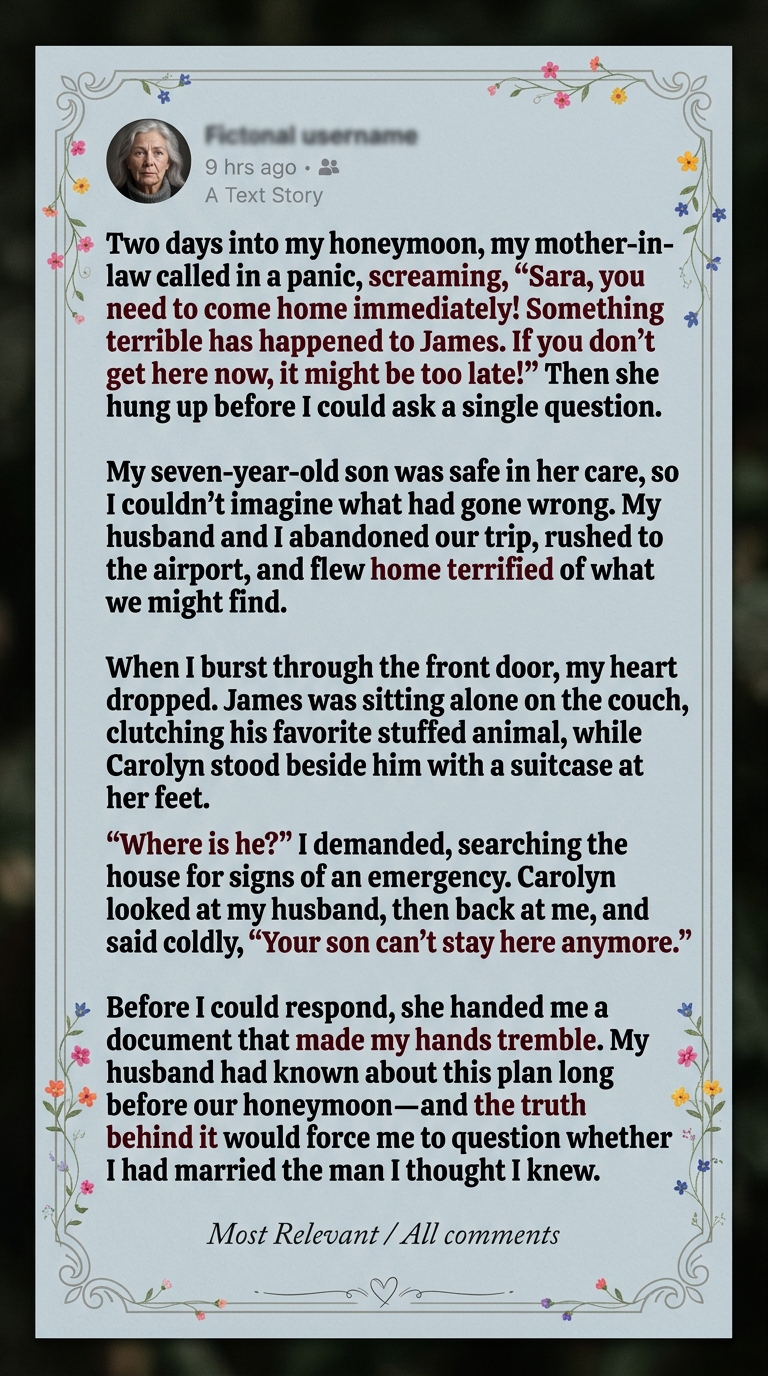
Two days into my honeymoon, my mother-in-law called in a panic, screaming so loudly that I had to pull the phone away from my ear.
“Sara, you need to come home immediately! Something terrible has happened to James. If you don’t get here now, it might be too late!”
Before I could ask what had happened, the call ended.
My seven-year-old son was supposed to be spending the week with his grandmother while my new husband, Michael, and I enjoyed a long-awaited honeymoon. James had been excited about staying at Carolyn’s house, especially because she had promised to take him to the zoo and let him sleep in the guest room with his favorite stuffed rabbit.
Now I couldn’t stop imagining him lying in a hospital bed, frightened and calling for me.
Michael found me pacing beside the hotel bed, struggling to explain what I’d heard.
“We’re leaving,” I told him. “Right now.”
He didn’t argue. We packed in minutes, rushed to the airport, and spent the entire flight home trying to reach Carolyn. She ignored every call.
When we finally pulled into her driveway, I was shaking so badly that I struggled to unlock the car door.
I ran through the front entrance, calling James’s name.
He was sitting alone on the couch, wearing his blue pajamas and clutching his stuffed rabbit. His eyes were swollen from crying. Beside him stood Carolyn, dressed as though she were about to leave on a trip. A suitcase rested at her feet.
There was no ambulance. No paramedics. No sign of an emergency.
“James!” I rushed toward him and wrapped my arms around his shoulders. “Sweetheart, are you hurt? What happened?”
He buried his face against my chest.
“Grandma says I can’t live here anymore.”
I looked up at Carolyn.
“What are you talking about?”
She glanced at Michael, then turned back to me with an expression so cold it barely resembled the woman who had smiled at us during our wedding.
“Your son can’t stay here anymore,” she said. “You need to take him away today.”
I stared at her, waiting for an explanation that would make sense of the words.
“Why would he need to leave? What did he do?”
“Nothing,” she replied. “That’s the problem. He’s been allowed to get away with everything for too long.”
I tightened my arms around James.
“He’s seven years old.”
“And he will continue to be a problem if you refuse to establish boundaries.”
Michael stepped between us.
“Mom, what is this? You said there was an emergency.”
Carolyn opened her suitcase and pulled out a thick document folder.
“The emergency is that your wife has been hiding something from you, and I’m no longer willing to participate in the deception.”
She handed the folder to Michael.
He looked down at the first page, and the color drained from his face.
I recognized the document immediately. It was a proposed guardianship agreement, the kind a family lawyer might prepare when a parent was unable to care for a child. My name appeared at the top. James’s full name was typed beneath it.
But the section identifying the proposed guardian contained Carolyn’s name.
The final page included a signature that looked like mine.
I had never signed it.
“What is this?” I demanded.
Carolyn folded her arms.
“An agreement Michael and I discussed before the wedding. We thought it was the best way to protect James from a situation that could become very difficult.”
I turned toward my husband.
“Michael?”
He couldn’t meet my eyes.
My stomach dropped.
“Tell me you don’t know about this.”
He opened his mouth, closed it, then looked at his mother.
“Mom, you weren’t supposed to give her that yet.”
For several seconds, I couldn’t hear anything except the pounding of my heart.
Not I don’t know what this is.
Not She’s lying.
He had known.
I stood slowly, keeping one hand on James’s shoulder.
“You knew your mother was planning to take my son away from me?”
“It’s not like that,” Michael said quickly. “Sara, please. Let me explain.”
“Then explain.”
Carolyn gave a sharp, humorless laugh.
“Perhaps I should explain. Michael came to me months ago because he was concerned about James’s adjustment to your relationship. He wanted a plan in place in case the marriage didn’t work.”
“An adjustment?” I repeated. “James has been kind to Michael from the beginning.”
“Children don’t always show their distress openly,” she replied. “Michael and I agreed that if the situation became unstable, James should stay with me until things settled down.”
I looked at the document again.
“Why does it say I voluntarily relinquish custody?”
Carolyn’s expression hardened.
“Because that’s what the lawyer prepared.”
“I never asked a lawyer to prepare anything.”
Michael finally stepped toward me.
“Sara, I didn’t intend for it to happen this way.”
“Then how did you intend for it to happen?”
He rubbed both hands over his face.
“I thought we might need a temporary arrangement. My mother believed James would benefit from a more structured environment, and I thought—”
“You thought what?”
He glanced at James, who had gone very still beside me.
“I thought that if we had problems after the wedding, it would be easier if James stayed with her for a while.”
I felt something inside me turn cold.
“You wanted to send my son away if our marriage became difficult?”
“No. I wanted to protect our marriage from unnecessary stress.”
The words were so absurd that, for a moment, I could only stare at him.
James began to cry quietly.
I knelt in front of him.
“Sweetheart, look at me. You haven’t done anything wrong. Nobody is sending you anywhere without me. Do you understand?”
He nodded, but his little fingers clutched my sleeve.
“Are you going to make me leave you, too?”
The question broke my heart.
“Never,” I whispered.
I kissed his forehead, then stood and faced Michael.
“Get our bags from the car. We’re leaving.”
“Sara, please. Don’t make a decision while you’re upset.”
“You made a decision about my child without me. I am making one about where he sleeps tonight.”
Michael didn’t move.
Carolyn picked up her suitcase.
“You’re overreacting. This is precisely why we needed a plan.”
I turned toward her.
“You called me screaming that something terrible had happened to my son. You made me believe he was injured or dying. You forced us to abandon our honeymoon so you could hand me a document designed to remove him from my care.”
“I needed you to come immediately.”
“You wanted me frightened enough not to question you.”
For the first time, she looked away.
I took James’s hand and walked toward the door.
Michael followed us into the driveway.
“Sara, wait. I love you. I love James, too.”
I stopped beside the car.
“Then tell me the truth. Why did you agree to this?”
He looked toward his mother’s house before answering.
“Because she said you would eventually choose him over me.”
I stared at him.
“What?”
“Before the wedding, she told me that once we were married, James would always come first. She said I would never have a real partnership with you because every decision would revolve around your son. She convinced me that if we didn’t establish boundaries early, I would spend the rest of my life being an outsider in my own home.”
“So you decided to prove to her that you could control where my child lived?”
“No. I thought I was preventing a problem before it started.”
“You didn’t prevent a problem, Michael. You created one.”
He reached for my hand, but I pulled away.
“Please. I made a mistake. I should have told you.”
“Yes, you should have. Before the wedding. Before the honeymoon. Before you let your mother frighten a seven-year-old boy into believing his own mother might abandon him.”
James climbed into the back seat, still holding his rabbit. I buckled him in and shut the door.
Michael stood beside my window.
“Where are you going?”
“To my sister’s house.”
“Can we talk tomorrow?”
I looked at the man I had married two days earlier and wondered how much of our relationship had been built on things he had decided I didn’t need to know.
“I don’t know,” I said. “But I know I can’t pretend this didn’t happen.”
Then I drove away.
That night, James slept in my sister’s guest room with the light on. I sat beside him until he finally drifted off, one hand wrapped around his stuffed rabbit and the other gripping my fingers.
When I returned to the living room, my sister, Rachel, was waiting with two cups of tea.
“Do you want to tell me what happened?” she asked.
I handed her the documents.
She read them in silence, her expression growing more troubled with every page.
“This is not a normal family disagreement,” she said. “Did you sign anything?”
“No.”
“Did you authorize anyone to sign for you?”
“Absolutely not.”
Rachel pointed to the signature.
“Then you need legal advice before you do anything else.”
The next morning, I contacted a family lawyer named Ms. Bennett. She reviewed the documents and explained that the agreement was not a court order and did not, by itself, give Carolyn any right to take James. The signature appeared to be a reproduction of my signature from another document, but she advised that a forensic review would be needed to establish how it had been created.
She also warned me not to let Michael or Carolyn pressure me into signing anything while I was distressed.
“If they genuinely believed James needed support,” she said, “they could have discussed a temporary caregiving arrangement with you. Preparing a document that suggests you’ve surrendered your parental rights is a very different matter.”
I asked whether Michael could legally take James away from me.
“That depends on the circumstances and the applicable law, but nothing you’ve shown me gives him or his mother an automatic right to remove your son from your care. Keep the originals, document what happened, and don’t sign anything without independent advice.”
For the first time since Carolyn’s call, I felt that I could breathe.
Then Michael sent me a message.
Please let me explain everything. There is something else you need to know about why Mom was so determined to get James out of the house.
I stared at the screen for a long time before replying.
Tell me the truth. All of it.
He arrived at Rachel’s house that afternoon, carrying a folder of his own. I agreed to speak with him in the kitchen while Rachel remained nearby. James was watching a movie upstairs.
Michael looked exhausted. He hadn’t shaved, and his shirt was wrinkled.
“I should have told you about the agreement,” he began. “There’s no excuse for that.”
“That’s a start. Now tell me what else you’re hiding.”
He opened the folder and placed several printed emails on the table.
They were exchanges between him and Carolyn from the weeks before our wedding.
At first, they seemed to confirm what he had already admitted. Carolyn had repeatedly warned him that becoming a stepfather would be difficult. She worried that I would prioritize James and that Michael would never have a say in family decisions.
But then I reached an email dated three weeks before the wedding.
Carolyn had written that she had spoken with an attorney about becoming James’s guardian if I ever became unable to care for him. Michael had replied that he didn’t believe I would ever agree to such an arrangement.
Her response chilled me.
She doesn’t have to agree now. We only need to establish that the child would be better off with someone who can give him the attention he needs. Once she sees that you and I are united, she’ll eventually understand that this is for everyone’s good.
I looked up.
“She planned this before we were married.”
Michael nodded.
“She brought it up several times. I kept telling her that I wasn’t going to take James away from you.”
“But you let her prepare the paperwork.”
“Yes.”
“Why?”
He stared at the table.
“Because I thought if I let her prepare it, she would stop talking about it. I thought I could keep the document from ever being used.”
I laughed once, without humor.
“You thought that if you quietly agreed to something terrible, it would somehow disappear.”
“I know how it sounds.”
“Do you?”
He swallowed.
“I was afraid of losing you. I wanted to make my mother happy, and I wanted our marriage to work. I kept thinking I could manage both without forcing you to confront her.”
“So you made the decision for me.”
“Yes.”
He looked at me then, and I saw genuine shame in his expression. But shame was not the same as accountability, and I was no longer willing to confuse the two.
“What happened that made her decide to act during our honeymoon?”
Michael hesitated.
“James had an argument with her the day before we left.”
“What kind of argument?”
“He overheard Mom telling a friend that after the wedding, you’d have to stop treating him like a little prince. He told her he didn’t want to move into her house permanently, and she said he would have to learn to accept what adults decided.”
My hands tightened around the emails.
“What did you do?”
“I told her to leave him alone. I said we would discuss boundaries after the honeymoon.”
“And she decided to force the issue while we were gone.”
Michael nodded.
“She told me she would speak to you when you came back. I thought she meant she would explain her concerns. I didn’t know she planned to frighten you into rushing home.”
I wanted to believe that he had not known the full extent of his mother’s plan. But the documents, the emails, and his own admissions showed that he had repeatedly allowed a dangerous idea to grow while hoping someone else would stop it.
“Michael, when you married me, you knew James was part of my life. He wasn’t a temporary obstacle. He wasn’t a problem to solve after the wedding.”
“I know.”
“Then why did you marry me if you believed my son would prevent you from having the family you wanted?”
He looked as though I had struck him.
“Because I love you. And I love James.”
“Love is not something you get to claim while secretly preparing to send a child away.”
He began to cry.
“I made a terrible mistake. Please don’t end our marriage over something I can fix.”
I looked toward the stairs, where James was laughing at the movie.
“This isn’t just about a document. It’s about whether I can trust you with my child, with our home, and with the decisions that affect our family. You didn’t make one mistake. You made a series of choices, each time hoping I would never find out.”
“I can change.”
“Maybe you can. But you don’t get to demand that I trust you while you’re still explaining why I shouldn’t have needed to know.”
I asked him to leave.
For the next several weeks, I focused on James. He began having nightmares and asking whether people could make him live somewhere without his permission. I reassured him that he was safe, and I arranged sessions with a child therapist who helped him express the fear he had experienced at Carolyn’s house.
I also filed a formal complaint about the document and provided the emails to my lawyer. The review confirmed that I had not signed the agreement and had not authorized anyone to sign it for me. The lawyer who had prepared the draft acknowledged that Carolyn had requested it without my participation, and the matter was referred for further review because the document had been presented as though I had already consented.
Carolyn sent me a long letter explaining that she had only wanted to protect Michael and prevent a difficult family situation. She said she loved James and had never intended to hurt him.
I believed she might love him in her own way. But love did not make her actions harmless, and good intentions could not undo the terror she had caused.
I wrote back that any future contact with James would have to be arranged through me and would depend on his comfort. I did not agree to visits simply because Carolyn was his grandmother.
Michael, meanwhile, began seeing a counselor on his own. He sent me a written apology that did not blame his mother, my parenting, or the pressures of becoming a stepfather. He admitted that he had allowed fear and a desire for approval to override his responsibilities as a husband.
He also agreed that any future decisions involving James would require my informed agreement and that he would not ask his mother to act as an authority over my son.
I appreciated the apology, but I did not rush back to him.
After three months, I agreed to meet Michael in a public park while James played on the swings nearby. We talked for nearly two hours. For the first time, Michael listened without interrupting, defending himself, or asking me to make him feel better about what he had done.
“I know I can’t undo it,” he said. “I don’t expect you to forget. I just want the chance to show you that I understand.”
I studied his face.
“Understanding isn’t a promise, Michael. It’s what you do when the next difficult decision comes.”
“I know.”
“And James will never be made to feel that he has to earn his place in my life.”
“Agreed.”
I did not promise to return to the marriage. I told him we could continue counseling together if I felt ready, but that reconciliation would depend on sustained honesty and on whether James could feel safe around him again.
Michael accepted those conditions.
Over the following months, he kept his word. He did not pressure me to come home, and he did not use gifts or grand gestures to win James’s affection. When James agreed to see him, Michael let the boy choose what they did and never asked him to keep secrets from me. He also maintained distance from Carolyn while she continued to insist that she had done nothing wrong.
Eventually, James began to relax around him. He still remembered the day at Carolyn’s house, and sometimes he asked whether Michael might change his mind about wanting him in the family.
Each time, Michael answered directly.
“You belong with your mom, and nobody should have made you feel otherwise. I was wrong to let that happen.”
It took nearly a year before I decided to give our marriage another chance. We did not return to the honeymoon we had abandoned. Instead, we rebuilt our relationship slowly, with counseling, honest conversations, and clear boundaries. Michael understood that being a husband did not mean competing with my son, and being a stepfather did not give him the right to decide where James belonged.
Carolyn eventually apologized to James in a letter that acknowledged what she had done without asking him to forgive her. James chose not to visit her for a long time. I respected that choice. Reconciliation, if it ever came, would happen at his pace.
On the anniversary of the day we returned from our honeymoon, Michael and I sat with James at our kitchen table, helping him build a model airplane for school. The house was noisy with scattered pieces, spilled glue, and arguments over which wing belonged where.
I looked at my husband and remembered the woman I had been when Carolyn called: a new bride who believed she knew the man she had married, a mother who thought her child was safe because she had entrusted him to family.
I could not return to that innocence. But I had learned that trust was not proven by wedding vows or promises made when life was easy. It was proven by the choices people made when love required courage, honesty, and the willingness to disappoint someone else.
Michael had nearly lost our family because he tried to keep everyone happy except the people who depended on him most.
We did not erase what happened. We built something more honest in its place.
And James, who had once sat frightened on his grandmother’s couch clutching a stuffed rabbit, grew up knowing one thing without question: he was never a burden to be negotiated away, and he never had to earn his place in the family that loved him.