I bought the Mississippi farm because nobody else wanted it.
The farmhouse needed a new roof, the well pump worked only when it felt like it, and half the fence posts leaned at angles that suggested they had given up on life. Weeds swallowed the old vegetable garden, and the barn smelled of damp wood, mouse droppings, and thirty years of neglect.
But the land was beautiful. Forty acres of rolling pasture stretched toward a line of magnolia trees, and a narrow creek ran behind the house. After years of working as a mechanic in Jackson, I wanted somewhere quiet enough to rebuild my life without hearing another person’s opinion about how I should live it.
The previous owner, Walter Bell, had died the year before. His son, Raymond, handled the sale and warned me that the property came with a few complications.
“My father was a stubborn man,” Raymond told me while handing over the keys. “There are things around here he wouldn’t let anybody touch.”
“Like what?”
He glanced toward the barn.
“An old Chevrolet. He parked it in there the day my mother disappeared. Never drove it again. Never sold it, either.”
I assumed he was exaggerating.
“Did your mother leave him?”
Raymond’s expression tightened.
“That’s what the sheriff said. Dad never agreed. For thirty years, he kept insisting she’d come back.”
He climbed into his truck, then rolled down the window.
“If you find anything strange in that barn, don’t assume it means what you think it means.”
I watched him drive away, wondering whether I had purchased a farm or inherited somebody else’s unfinished argument.
For the first two weeks, I concentrated on practical work. I repaired the porch steps, cleared the drainage ditch, and replaced several broken windows. The barn was my last priority. Its roof sagged over one corner, and I intended to empty it before winter.
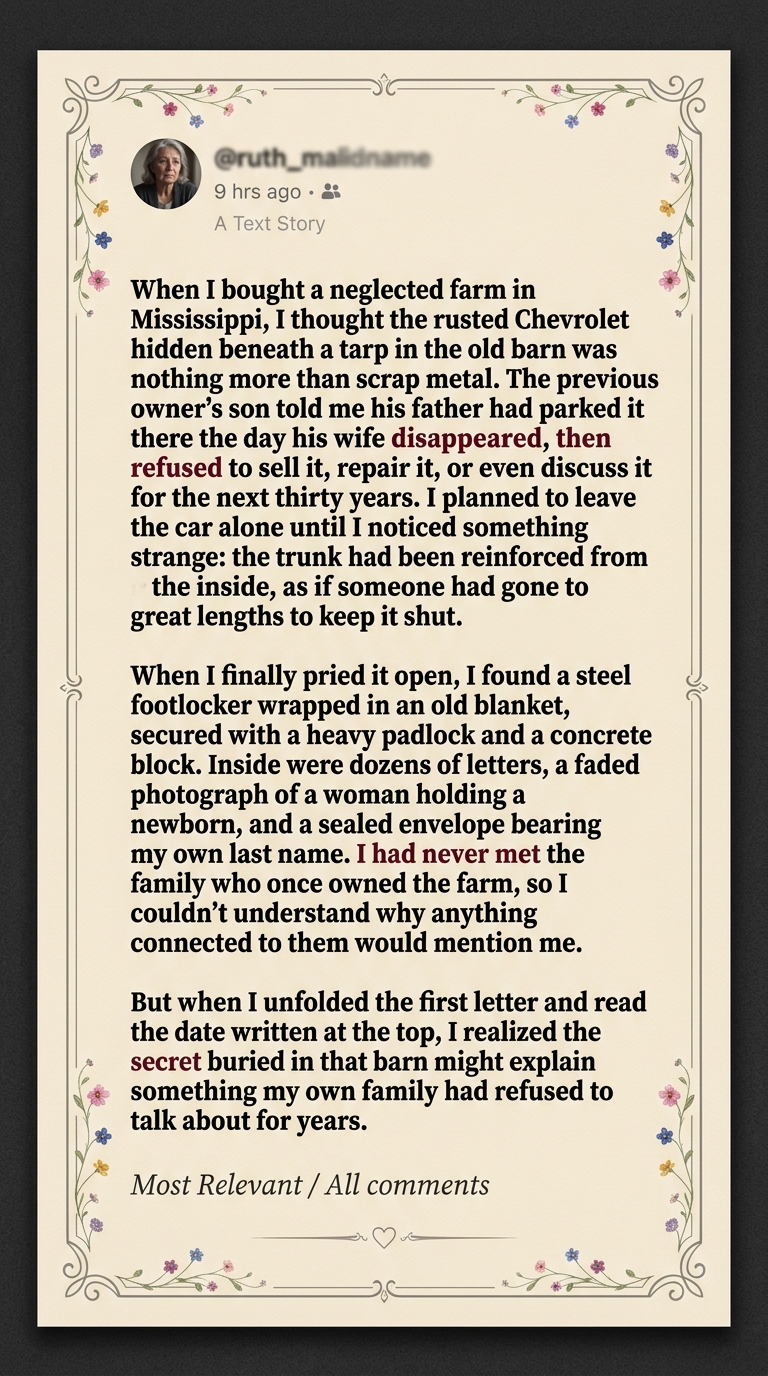
The Chevrolet sat beneath a gray tarp near the back wall. When I pulled the covering away, I found a 1967 Chevrolet Impala, its faded blue paint blistered with rust. The tires had collapsed, and dust covered the windshield so thickly that I could barely see the steering wheel.
The trunk caught my attention because its lid had been reinforced from the inside. Someone had welded narrow steel bars across the seam, then covered the work with several layers of paint. Whatever was inside, the owner had gone to considerable trouble to keep it there.
I tried the trunk key I found on the ring hanging from the barn’s workbench. It didn’t fit.
After an hour of scraping rust and testing the lock, I fetched a pry bar from my toolbox. The trunk resisted until the old metal finally tore away from the latch.
Inside was a steel footlocker wrapped in a wool blanket. A concrete block had been wedged against it, and a thick padlock secured the handles.
I dragged the footlocker onto the barn floor. It was heavier than I expected, and when I shifted it, something inside moved with a dull metallic clunk.
I cut through the padlock with a bolt cutter.
The lid opened with a groan.
Inside lay dozens of letters tied into bundles with faded ribbon, a photograph of a young woman holding a newborn, and a sealed envelope with my own last name written across the front.
MERCER.
I stood motionless.
I had never met the Bell family before buying the farm. My father, Thomas Mercer, had died when I was twenty-six, and my mother had passed away five years later. I had no living relatives who could explain why my name appeared among the possessions of strangers.
The photograph showed a dark-haired woman sitting on the porch of the farmhouse, holding a baby wrapped in a white blanket. She wore a wedding ring and smiled directly at the camera.
On the back, someone had written:
June 14, 1968. Evelyn and her little boy, Daniel.
I turned the photograph over again.
The date was fifty-eight years old.
I carried the letters and envelope into the farmhouse, washed the dirt from my hands, and sat at the kitchen table. The first letter was dated June 15, 1968, one day after the photograph had been taken.
The handwriting was neat and unfamiliar.
Walter,
I have decided to leave before you return from the county office. I cannot raise Daniel in a house where the truth is treated as a crime. I know what you promised your father, but I will not let another generation pay for his choices.
Do not look for me. If you ever loved me, let my son grow up without fear.
Evelyn.
I read the letter twice.
According to Raymond, his mother had disappeared on the day Walter parked the Chevrolet in the barn. But the letter suggested she had left deliberately, and the reference to Walter’s father raised questions I couldn’t begin to answer.
I opened the sealed envelope bearing my surname.
Inside was a single page.
To the Mercer family,
If this letter has reached you, then Walter has finally allowed the truth to survive him. The boy in the photograph was not abandoned. He was taken from the only person who had the right to raise him.
His name was Daniel Mercer.
Ask your family what happened in June 1968.
I read the final sentence until the words blurred.
My father had been born in 1968.
His name had been Daniel Thomas Mercer.
For as long as I could remember, my mother had told me that my father was born in a hospital in Memphis and raised by his parents in a small house outside the city. She said his mother had died when he was very young and that his father had been a difficult man who rarely spoke about the past.
I had never seen a photograph of my paternal grandparents. Whenever I asked, my mother said the family had lost most of its old pictures in a house fire.
Now I was holding a photograph of a woman who might have been my grandmother, sitting on the porch of the farmhouse I had just purchased.
I called the county clerk and asked about historical birth records. The clerk explained that records from that period were available through the state archive, though I would need to provide proof of my relationship to the person named.
I also contacted Raymond.
When I told him what I had found, he went silent.
“Can you send me a photograph of the letter?” he finally asked.
I did.
He called back twenty minutes later.
“That handwriting is my mother’s,” he said. “I haven’t seen it in decades.”
“Your mother was named Evelyn?”
“Yes.”
“And you knew she had a baby?”
He hesitated.
“My father told me I was his only child. He said my mother left before I was born, but the dates never made sense. I was six when she disappeared. I remember her.”
His voice broke slightly.
“I remember her making biscuits on Sunday mornings. I remember her singing while she hung laundry. Then one day she was gone, and my father told us she had chosen another life.”
“What happened the day she disappeared?”
“I was at my aunt’s house. When I came back, the barn doors were locked, and my father wouldn’t let me near the Chevrolet. He said the car was none of my business.”
I looked at the reinforced trunk.
“Did he ever explain why he kept it?”
“No. But every year on June fifteenth, he went into that barn alone. He stayed for hours.”
Raymond agreed to meet me the following morning.
When he arrived, he was carrying a small cardboard box of photographs and papers he had recovered from his father’s house after the funeral. He looked older than I remembered, with silver hair and a careful, tired expression.
He sat at my kitchen table and examined the photograph of Evelyn holding the baby.
“That’s my mother,” he whispered.
He touched the edge of the photograph.
“I thought I’d forgotten her face.”
I showed him the letters. He read several in silence, occasionally stopping to wipe his eyes. The correspondence revealed that Evelyn had been trying to leave Walter for months before she disappeared. She wrote about arguments over money, about Walter’s increasing suspicion, and about a secret his father had demanded they keep.
But the letters did not explain the baby.
Raymond picked up a letter dated June 2, 1968.
“This is the first time she mentions Daniel.”
The letter was addressed to a woman named Margaret Mercer, my paternal grandmother.
Margaret,
I know you are frightened of what your husband will do if he learns the truth. But Daniel is your grandson, and he deserves a life that isn’t built on a lie. Walter has agreed to help me leave, but I don’t trust him to keep his word. If anything happens to me, please remember that I never abandoned my son.
Evelyn.
I felt a chill run through me.
“Your father agreed to help her leave?”
Raymond nodded slowly.
“Maybe that’s why he kept the car. Maybe he helped her escape and regretted it afterward.”
“Then why did she write as though she feared him?”
Neither of us had an answer.
We spent the afternoon sorting the remaining letters. Most were addressed to Margaret Mercer, who lived in Memphis with her husband, Robert. The correspondence described a dispute over a child, a forged document, and a meeting that never took place.
One letter, dated June 13, 1968, was different.
Margaret,
I will come to the farm tomorrow with Daniel. I cannot keep him hidden from you forever. He deserves to know who his family is, and you deserve to know what your husband has done.
Please meet me before Walter returns. If he discovers I have written to you, he may try to stop me.
Evelyn.
The next letter was dated June 16.
It was addressed to Walter.
You told me the baby would be safe. You told me Robert had agreed to let me raise him. Instead, you brought the sheriff to the house and accused me of kidnapping my own child.
I will never forgive you for that.
You can keep the money. You can keep the farm. But you cannot make me believe that you did this for Daniel’s sake.
Evelyn.
I set the letter down.
The story was becoming clearer, but it was not yet complete. Evelyn had tried to leave with her baby. Walter had somehow become involved, and Robert Mercer—my grandfather—appeared to have played a role in a dispute that had been buried for decades.
I decided to visit the county courthouse in person.
The next morning, a records clerk helped me locate an old court file involving Evelyn Bell and Robert Mercer. The file contained a petition for guardianship, a handwritten statement, and a copy of a birth certificate.
The birth certificate listed Daniel Thomas Mercer as the son of Robert and Margaret Mercer.
But the date of the guardianship petition was troubling. It had been filed two weeks before Daniel’s birth.
The petition claimed that Daniel’s mother, Evelyn, was unmarried and unable to provide a stable home. It requested that the child be placed with Robert and Margaret after birth.
At the bottom was Evelyn’s signature.
It looked convincing, but the letter I had found in the barn suggested she had never agreed to give up her son.
I asked the clerk whether the case had ever been reviewed.
“No,” she said. “It appears the petition was withdrawn after the child was placed with the grandparents. The file was closed.”
“Placed with them how?”
She checked another page.
“There’s a note stating that the biological mother voluntarily surrendered custody. No hearing was held.”
I stared at the document.
The note had been signed by Walter Bell.
I returned to the farm with copies of the records and found Raymond waiting on the porch.
“I remembered something,” he said before I could speak. “My father used to receive letters from a lawyer in Memphis. He burned them in the kitchen stove, but once I saw a name on one of the envelopes. Robert Mercer.”
He looked at the papers in my hand.
“Did you find out what happened?”
I showed him the guardianship petition.
Raymond’s face darkened.
“My father helped them take the baby.”
It was a reasonable conclusion, but I wanted proof. The signature on the petition might have been forged, and the records left unanswered whether Evelyn had ever been allowed to challenge the arrangement.
I contacted an attorney who specialized in historical records and family cases. She explained that we might be able to establish the chain of events through archived correspondence, court records, and any surviving family documents. She also warned that we should not accuse anyone of a crime based on incomplete records.
I agreed.
Over the next two weeks, I searched the farmhouse from cellar to attic. I found old receipts, a broken pocket watch, and a bundle of newspaper clippings about a fire at a Memphis warehouse in June 1968. One article mentioned Robert Mercer, a business owner who had died in a car accident several months after the fire.
Another clipping reported that a woman named Evelyn Bell had been questioned in connection with the warehouse incident but was never charged.
The story had been buried in the local newspaper’s archive, but the details caught my attention. The warehouse belonged to Robert Mercer. The fire had destroyed financial records, and investigators had suspected arson.
I returned to the letters.
Evelyn had written that Robert had done something terrible, something she intended to reveal. The night she disappeared, she had apparently planned to meet him at the farm.
Could the warehouse fire have been connected to the baby? Or had the dispute over Daniel been part of a larger family conflict?
I found the answer in a letter hidden beneath the footlocker’s false bottom.
It was dated June 17, 1968, and addressed to Margaret Mercer.
Margaret,
I have learned that Robert did not simply take Daniel from me. He arranged for the court to believe I had surrendered him, using a statement I never signed. Walter knew the truth and agreed to help me leave because he was afraid Robert would destroy us both.
I now understand why Robert wanted the warehouse records burned. He was hiding the money he stole from his business partners. He offered Walter a share if he helped make me disappear from Daniel’s life.
Walter refused to take the money, but he still helped Robert keep the child. He thought he could protect Daniel by leaving him with you. He was wrong.
I will not return to the farm. I will not let Robert use my son to silence me. If you ever find the courage to tell Daniel the truth, please tell him that I loved him every day I was away.
Evelyn.
I sat at the kitchen table until the light faded from the windows.
The letters suggested that my grandfather had used a false guardianship petition to take Daniel from Evelyn. Walter had been complicit, though perhaps not for the reasons I had first imagined. He had helped Robert conceal the truth, believing he was protecting the child from a dangerous family scandal.
But one question remained: why had Evelyn disappeared without returning to reclaim her son?
I found the answer in the last letter, dated September 1972.
It was addressed to Walter and had been returned unopened.
Walter,
I have tried to contact Daniel through the court, but every request has been denied. I have no money for another appeal. I am living in Louisiana now, and I am ill. If I cannot see him, at least tell him that I never abandoned him.
I am sending one final photograph. Please keep it somewhere safe. One day, someone may come looking for the truth.
Evelyn.
There was no explanation of her illness, no address, and no indication of what happened after she sent the letter. But the postmark showed that she had been alive four years after the disappearance.
I gave the letter to the attorney, who helped me trace the address. The house no longer existed, but an archived death certificate revealed that Evelyn Bell had died in Louisiana in 1981.
Her death certificate listed no children.
I felt a sharp anger rise inside me. Even in death, the records had erased her connection to Daniel.
I began searching for any surviving relatives who might know more. Eventually, I found a retired woman named Clara who had worked at a church in the town where Evelyn lived. She remembered Evelyn as a quiet woman who volunteered in the kitchen and never spoke about her past.
“She kept a photograph of a little boy in her purse,” Clara told me over the phone. “She used to say that one day he’d come looking for her.”
“Did she ever tell you why she couldn’t see him?”
Clara was quiet for a moment.
“She said his family had money and influence, and that they had convinced everyone she was unfit. She tried to fight them, but she couldn’t afford a lawyer. After a while, she stopped talking about it. I think she was ashamed that she hadn’t been able to bring him home.”
I thanked Clara and ended the call.
For the first time, I understood the full weight of the letters. Evelyn had not simply disappeared. She had been separated from her son, denied the means to challenge the decision, and forced to live with the belief that her child would grow up thinking she had abandoned him.
I wondered what my father had been told. Had he ever known the truth? Had my mother known? The family had kept its silence so thoroughly that I could not tell where the lies had begun.
I returned to the farmhouse and sat in the barn beside the empty Chevrolet. The reinforced trunk no longer seemed like the strange obsession of a stubborn old man. It was a locked room for a truth Walter could neither destroy nor admit.
I called Raymond and told him what I had learned.
He listened without interrupting.
“My father spent his last years refusing to talk about her,” he said. “I used to think he was angry because she had left him. Now I think he was ashamed because he helped her lose her son.”
“I think so, too.”
“Why keep the letters?”
“Maybe he wanted the truth to survive him. Maybe he was too afraid to deliver it himself.”
Raymond exhaled.
“I wish he’d told me.”
“So do I.”
The next step was to understand what had happened to my father after the guardianship arrangement. I contacted the state archive again and obtained a copy of his adoption and birth records. The documents confirmed that he had been raised by Robert and Margaret Mercer, who were listed as his legal parents.
There was no formal adoption order in the file.
Instead, the records showed that the guardianship petition had been accepted on the basis of Evelyn’s supposed consent. The original signed statement was missing, and the court had never verified her signature.
The attorney explained that, by modern standards, the recordkeeping was deeply troubling, but the passage of time limited what could be legally challenged. The evidence did not establish every detail of what Robert had done, and we could not determine whether Walter had deliberately helped falsify the petition or had simply failed to challenge it.
Still, the letters, the court records, and the photograph formed a consistent account: Evelyn had tried to remain in her son’s life, and powerful people had made it nearly impossible.
I wondered whether my father had ever suspected the truth.
I remembered him as a reserved man who disliked family reunions and avoided questions about his childhood. He rarely spoke about Robert. When my mother once asked why he never visited his father’s grave, he said, “Some people don’t deserve to be remembered.”
At the time, I assumed they had argued over money.
Now I wondered whether he had known that the man who raised him had helped separate him from his mother.
I searched my father’s old papers, which I had kept in boxes after his death. Most were ordinary documents: tax returns, work records, and faded photographs. At the bottom of one box, I found a small envelope containing a letter written in his hand.
It was dated three months before he died.
To my son,
There are things I should have told you, but I was afraid the truth would destroy the only family I had ever known. I learned when I was a young man that Margaret and Robert were not my birth parents. I found a name in an old court file: Evelyn Bell.
I tried to find her. By the time I understood what had happened, she was already gone.
I was angry with the people who had raised me, but I was also afraid that learning more would make me feel as though my entire life had been a lie. So I stopped searching.
I regret that decision. If you ever discover anything about the woman who gave birth to me, please don’t let my fear become your silence.
Dad.
I read the letter until I could no longer see the page clearly.
My father had known enough to search for Evelyn, but not enough—or not enough courage—to finish the journey. He had carried the question for decades, then left it for me to answer.
I took the letter to Raymond’s house the next day. He read it slowly, then set it on the table.
“My father wasn’t the only one who stayed silent,” he said. “Your father did, too.”
“Yes.”
“Do you think he would have forgiven them if he’d found her?”
“I don’t know.”
Raymond looked toward the window.
“Maybe that’s what the letters were for. So the next person wouldn’t have to guess.”
We decided to preserve the documents properly. The attorney arranged for copies to be made, and we contacted the local historical society, which agreed to archive the letters and photographs. We retained the originals, but the evidence would no longer be hidden in a rusted car on a neglected farm.
I also contacted the church where Evelyn had volunteered. Clara had died several years earlier, but the current pastor agreed to place a small memorial notice in the church newsletter, acknowledging Evelyn Bell as a mother who had spent her life trying to reconnect with the son she had lost.
It was a small gesture, but it mattered to me.
For years, my family had carried a story in which a woman had abandoned her child and vanished. The records showed something different: a woman who had fought to remain a mother, who had been pushed out of her son’s life, and who had died without knowing whether he ever understood what happened.
I could not give Evelyn the years she had lost. I could not tell my father what I had discovered. But I could refuse to let the lie remain the only version of her life.
Several months later, I returned to the barn with a mechanic and began restoring the Chevrolet. I didn’t intend to drive it regularly. I simply wanted to save the car that had held the evidence for so long.
When we removed the final rusted panel from the trunk, we found a small brass key taped beneath the metal. It opened a drawer in the old workbench, where Walter had kept receipts, tools, and a notebook.
The notebook contained a single entry dated June 15, 1968.
Evelyn left before sunrise. Robert took the boy to Memphis. I told myself it was the only way to keep him safe. I have been telling myself that for thirty years.
There were no further entries about the night of the disappearance.
I sat with the notebook in my hands and understood that Walter had spent his life trying to convince himself that silence was protection. Perhaps he had believed that keeping the car locked and the letters hidden would prevent the truth from hurting anyone else.
Instead, it had allowed the lie to survive long after everyone who created it was gone.
I placed the notebook beside the letters and closed the trunk.
The farm was no longer simply a place where I hoped to start over. It had become the place where my family’s history finally emerged from the dark.
I never found a perfect explanation for every choice the people before me had made. I could not know exactly what Walter feared, what Robert intended, or how much my father understood before he died. The records left gaps that no amount of searching could fill.
But I knew what mattered.
Evelyn had loved her son. She had tried to reach him. She had not willingly surrendered him and vanished from his life.
My father had been denied the chance to know his mother, and he had spent his final years afraid to reopen the wound. I had inherited that silence without knowing it.
Now I had a choice.
I could put the letters back into a box, tell myself the past was too complicated to explain, and leave the next generation to wonder. Or I could preserve the evidence, share what I knew, and let the truth stand even where it remained incomplete.
I chose the truth.
On the anniversary of the day I found the footlocker, I drove to the cemetery where my father was buried. I brought a copy of Evelyn’s photograph and placed it beside his headstone.
For a long time, I stood there without speaking.
Then I told him what I wished he had been able to hear while he was alive.
“Dad, I found her. I found your mother. And she never stopped loving you.”
The wind moved through the trees, carrying the scent of wet earth across the cemetery.
I knew he could not hear me. I knew the words could not return the years he had lost.
But for the first time, the silence in my family belonged to the past.