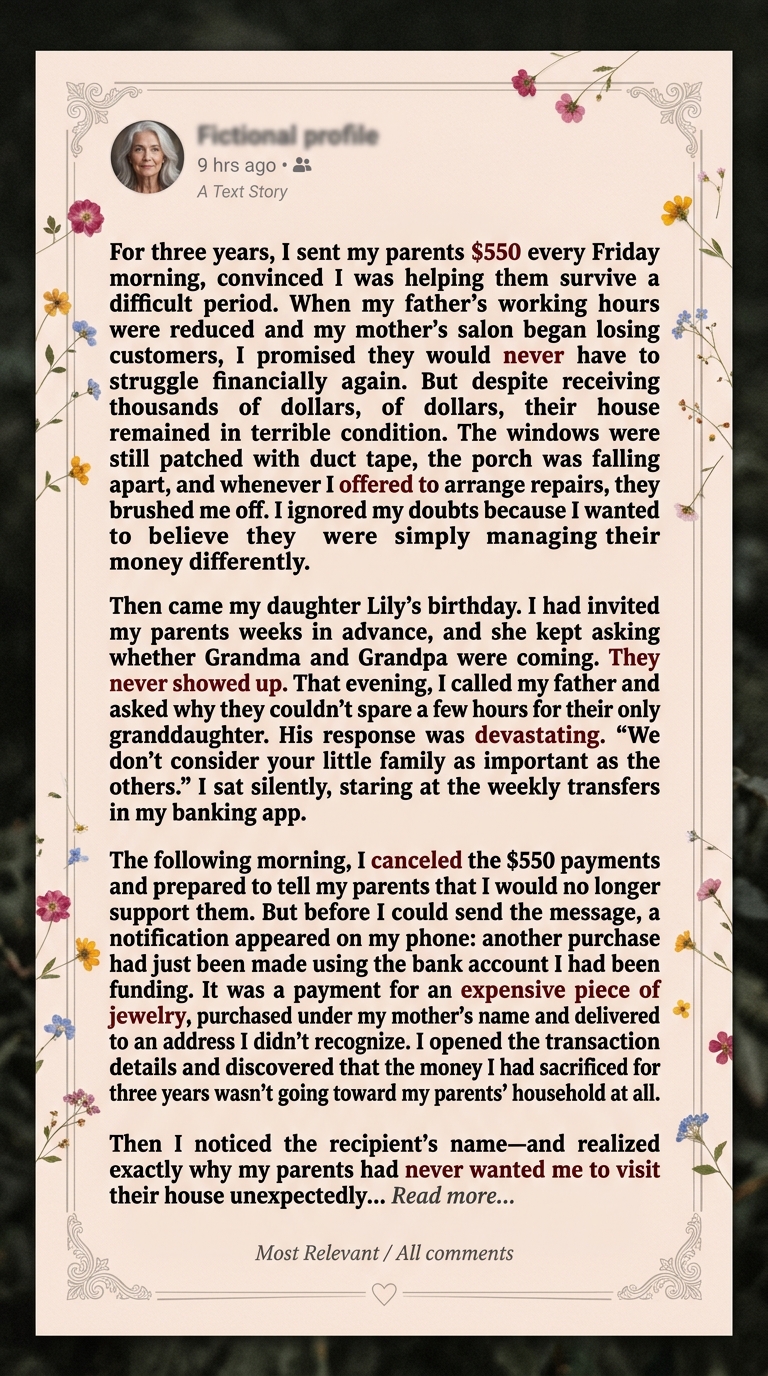
For three years, every Friday morning began the same way. Before making coffee, before checking my emails, before even getting dressed, I transferred $550 into my parents’ bank account.
I had made the promise when my father’s employer reduced his working hours and my mother’s small salon began losing customers. They were both in their late sixties, and I worried that they would lose the house they had spent most of their lives paying for.
“You raised me,” I told them. “Let me take care of you now.”
My father had gone quiet for a moment before thanking me. My mother cried. I remember feeling proud that I could finally give something back to the people who had sacrificed so much for me.
I never imagined that helping them would become the most expensive mistake of my life.
The first few months seemed normal. My mother occasionally mentioned rising utility bills, and my father complained about the cost of groceries. Whenever I visited, however, I noticed the house was deteriorating.
The living room window had a crack covered with duct tape. The wooden porch sagged beneath anyone who stepped on it. One of the kitchen cabinets was missing a door, and the bathroom ceiling had a brown stain that grew larger every time it rained.
I offered to hire someone to repair everything.
My father always refused.
“There’s no need to waste your money,” he would say. “We’re managing.”
My mother had another explanation. She claimed she was waiting for the right contractor and wanted to compare prices.
I accepted their answers because I didn’t want to insult them by questioning how they spent the money.
Then Lily turned eight.
She had been talking about her birthday party for weeks. She wanted a purple cake, paper butterflies, and both sets of grandparents sitting around the table.
My parents lived less than an hour away. I called them three weeks before the party and made sure they knew the date.
“Of course we’ll come,” my mother promised. “Grandma wouldn’t miss her little girl’s birthday.”
On the morning of the party, Lily helped me arrange the chairs. She placed two special ones beside the cake table.
“Those are for Grandma and Grandpa,” she explained.
By noon, most of the guests had arrived. Lily kept looking toward the driveway whenever a car passed.
At one thirty, she asked whether I could call Grandma.
I did.
My mother answered briefly and said they were busy. She didn’t offer an explanation or even ask to speak to Lily.
I tried my father next. His phone rang until he finally answered.
“Are you coming?” I asked.
“We’re not going to make it.”
“Dad, Lily has been waiting all morning.”
He sighed as though I were inconveniencing him.
“We have other things to do.”
I glanced at my daughter, who was pretending not to listen.
“She’s your only granddaughter. You couldn’t spare a few hours?”
My father paused.
Then he said something I would never forget.
“We don’t consider your little family as important as the others.”
I thought I had misunderstood him.
“What does that mean?”
“It means exactly what I said. Don’t turn this into an argument.”
He ended the call.
I stood in the kitchen, holding my phone, while children laughed in the backyard. Lily eventually stopped looking at the driveway. She blew out her candles without her grandparents and smiled for the photographs, but I noticed she never mentioned them again that afternoon.
That evening, after everyone had left, I opened my banking application.
Three years of payments stared back at me.
One hundred and fifty-six transfers. Eighty-five thousand eight hundred dollars.
I had postponed replacing my own car. I had delayed renovating our bathroom. I had even turned down a family vacation because I believed my parents needed the money more.
The following morning, I canceled the recurring transfer.
I was preparing a message explaining that I could no longer support them when a notification appeared.
It was a purchase confirmation from the account I had been funding.
The transaction was for an expensive diamond bracelet purchased under my mother’s name. The amount was more than four thousand dollars.
I stared at the screen.
My parents had told me they couldn’t afford to repair a leaking ceiling, yet someone had just purchased a diamond bracelet using the money I sent them.
I opened the transaction details.
The delivery address wasn’t my parents’ house.
It belonged to a woman named Vanessa Cole.
At first, the name meant nothing to me. Then I noticed the billing profile.
The bracelet had been purchased for Vanessa’s twenty-ninth birthday.
I knew that name.
Vanessa was my father’s daughter from his first marriage. She was my half-sister, though I had met her only a handful of times. She lived in a beautiful apartment across town and had a career in property development.
My father had always described her as independent and successful.
I had never known my parents were financially supporting her.
I called the bank immediately.
The account receiving my transfers was not a joint account belonging to my parents, as I had assumed. It was an account in my mother’s name, and my father had been given authorized access. The purchase had been made with a linked debit card.
I asked the bank to block future transactions from my scheduled payments and reviewed the account history.
What I found made my stomach turn.
There were monthly payments to a luxury apartment management company, a private fitness club, several high-end clothing stores, and a company that specialized in cosmetic treatments.
There were also regular transfers to Vanessa.
Some were labeled as rent. Others were described as business expenses.
I printed the statements and drove to my parents’ house.
For once, I didn’t call ahead.
When I arrived, I noticed something strange. My father’s old car wasn’t in the driveway, but my mother’s salon van was parked outside.
I knocked.
No one answered.
I tried the front door, which was unlocked.
Inside, the house looked exactly as it had during my previous visits. The damaged window was still covered with duct tape. The porch still sagged. The stained ceiling had not been repaired.
But the living room was empty of several pieces of furniture.
My mother’s favorite armchair was gone. So was the television. Even the dining table had disappeared.
I heard voices coming from the kitchen.
Then I saw a handbag on the counter.
It was an expensive designer bag I recognized from one of Vanessa’s social media photographs.
I followed the voices.
My mother was sitting at the kitchen table with Vanessa. My father stood beside the refrigerator, holding a cup of coffee.
They all turned when I entered.
For several seconds, nobody spoke.
Vanessa recovered first.
“What are you doing here?”
I placed the printed bank statements on the table.
“I could ask you the same question.”
My mother immediately stood up.
“You should have called before coming.”
“I did that for three years. Apparently, I should have stopped.”
My father put down his cup.
“What’s this supposed to mean?”
I pointed to the statements.
“It means I know where my money has been going.”
Vanessa glanced at the papers, then looked at my parents.
“Why is she looking at those?”
My father answered before my mother could.
“It’s none of her business.”
I laughed once, though there was nothing funny about it.
“Eighty-five thousand dollars came from my salary. I think that makes it my business.”
My mother sat down again.
“We were going to explain.”
“When?”
She looked at Vanessa.
That small movement told me more than any explanation could have.
I turned to my half-sister.
“Did you know where this money came from?”
Vanessa folded her arms.
“Dad told me they had some savings. I thought they were helping me because they wanted to.”
“Helping you buy jewelry?”
Her expression tightened.
“I didn’t ask you to send them money.”
“No. You didn’t. But you accepted it.”
My father stepped between us.
“Enough. Vanessa has been going through a difficult period.”
I looked around the deteriorating kitchen.
“So have you, apparently.”
My mother began crying.
She explained that Vanessa’s property business had suffered losses after a project fell through. She had fallen behind on her apartment payments and was facing the possibility of losing her professional license because of unpaid business obligations.
My parents had decided to help her.
At first, they used their savings. Then my father suggested that I could help them temporarily.
They had not told me about Vanessa because they knew I would question why a successful adult woman needed financial assistance while my parents were living in a deteriorating house.
But the arrangement had grown.
Vanessa began asking for help with rent, car payments, professional expenses, and personal purchases. My mother started using the weekly transfers to cover those costs.
My father insisted they were only doing what parents were supposed to do.
“She is my daughter,” he said. “I couldn’t let her lose everything.”
I looked at him.
“And what am I?”
He didn’t answer.
My mother wiped her cheeks.
“You have a good job. You have your husband. You have Lily. You don’t need us the way Vanessa does.”
That was when I understood the truth behind his words on Lily’s birthday.
They had not simply forgotten her.
They had decided that my family mattered less because they believed I could manage without them.
I pointed toward the missing furniture.
“Where is everything?”
My mother hesitated.
Vanessa finally answered.
“Some of it was sold. The rest is in storage.”
“Why?”
She looked uncomfortable.
“The apartment needed furnishing.”
I stared at her.
My parents had sold their own furniture to help furnish Vanessa’s apartment while telling me their house was too expensive to repair.
My father raised his voice.
“Don’t stand there judging us. We did what we thought was right.”
“You could have asked me to help her. I might even have agreed to some of it. But you lied about your situation for three years.”
“We didn’t lie,” he snapped. “We just didn’t tell you everything.”
“That is what lying is when you take someone’s money under false pretenses.”
Vanessa stood up.
“You’re making this sound like I stole from you.”
“I didn’t say you stole anything. I said you benefited from money that was given to me under a completely different understanding.”
She looked toward my father, expecting him to defend her.
He did.
“Your sister has a future to protect. You already have yours.”
I felt something inside me settle.
Not anger. Not even surprise.
Just clarity.
I gathered the statements and turned toward the door.
“I’m finished paying for this arrangement. The transfers are canceled. Don’t use my name or my money again.”
My mother followed me into the hallway.
“Please don’t punish us because of one misunderstanding.”
I stopped.
“Mom, it wasn’t one misunderstanding. It was three years of decisions. You knew Lily was waiting for you yesterday. You knew I was paying your bills. You knew the house needed repairs. You chose to spend the money somewhere else.”
She lowered her eyes.
“We didn’t think you would find out.”
That answer hurt more than anything else.
I left without saying goodbye.
For the next several days, my phone filled with messages.
My mother said I was abandoning them. My father accused me of turning against my own family. Vanessa sent a message claiming I had humiliated her and that she would repay the money someday.
I didn’t respond immediately.
Instead, I contacted the bank and arranged for a full review of the account. I learned that my father had used his authorized access to make purchases and transfers that my mother had approved. There was no evidence that the bank had made an error, and I understood that the money I had willingly transferred was not automatically recoverable.
That didn’t mean I had to keep paying.
I changed my banking passwords, removed the linked payment arrangements, and made it clear in writing that neither parent had permission to use my financial information.
I also spoke to a financial adviser about protecting my own household from future requests. My husband had been supportive throughout, but I realized that I had never fully explained how much I was sending every month.
When I finally told him the total, he sat quietly for a long time.
“Why didn’t you tell me how bad it had become?”
“I thought I was doing the right thing.”
“You were trying to help them,” he said. “But helping someone shouldn’t require hiding the truth from the people who share your life.”
He was right.
A month later, my father called.
He sounded different. Less certain.
The bank had reviewed the account, and my parents were facing a serious financial shortfall. Without my weekly payments, they could no longer maintain the lifestyle they had quietly built around Vanessa’s needs.
My father asked whether I could restart the transfers, even temporarily.
I asked him one question.
“Have you repaired the window?”
He went silent.
“Have you fixed the porch?”
Another pause.
“Have you spoken to Lily?”
He sighed.
“I don’t know why you keep bringing up the birthday.”
“Because that was the day you told me who mattered to you.”
He said he was sorry.
I wanted to believe him, but an apology made only after the money stopped was not enough to restore three years of trust.
I told him I would help arrange an assessment of the house and find out whether they qualified for any local assistance. I was willing to help them identify genuine necessities and make a realistic budget.
But I would not give them unrestricted access to my money again.
He called that cruel.
I called it a boundary.
Over the following months, my parents made changes. My father took additional part-time work, and my mother began renting a chair in another salon rather than maintaining her own expensive space. They sold the car they could no longer afford and moved into a smaller home with lower expenses.
Vanessa eventually moved out of her luxury apartment. Her business had not recovered, and she had to sell several personal possessions to settle outstanding debts.
She never repaid the jewelry money.
My parents did not ask me to cover it again.
The relationship remained strained, but it did not end completely. My mother began sending occasional messages asking about Lily. At first, Lily ignored them. Eventually, she agreed to speak to her grandmother on the phone, though she no longer asked when they would visit.
One afternoon, my mother asked whether she could come to Lily’s school performance.
I told her she was welcome to attend.
She arrived early and sat in the back row. When Lily spotted her, she hesitated before giving a small wave.
After the performance, my mother approached us with a gift bag.
Inside was a modest art set and a handwritten birthday card. There was no expensive jewelry, no dramatic apology, and no promise that everything would return to the way it had been.
My mother simply knelt beside Lily.
“I’m sorry I missed your birthday,” she said. “You deserved better.”
Lily looked at her for a moment.
“Are you coming next time?”
My mother nodded.
“If you still want me there.”
Lily considered that before answering.
“Then you have to come.”
My mother began to cry.
I didn’t rush to comfort her or pretend that everything was fixed. Trust was not something I could transfer every Friday morning. It would have to be rebuilt through ordinary choices, kept promises, and time.
That evening, I looked at my banking app.
The $550 payment was gone from my scheduled transfers.
For the first time in three years, Friday morning belonged to my own family again.
I had spent a long time believing that being a good daughter meant making sure my parents never struggled, no matter what it cost me. I finally understood that generosity without honesty can become a way for people to take advantage of love.
I still wanted my parents to be safe. I still hoped they would become part of Lily’s life.
But I no longer confused financial support with unconditional permission to hurt us.
And I would never again sacrifice my daughter’s happiness to keep people comfortable who had decided she was not important enough to show up for.