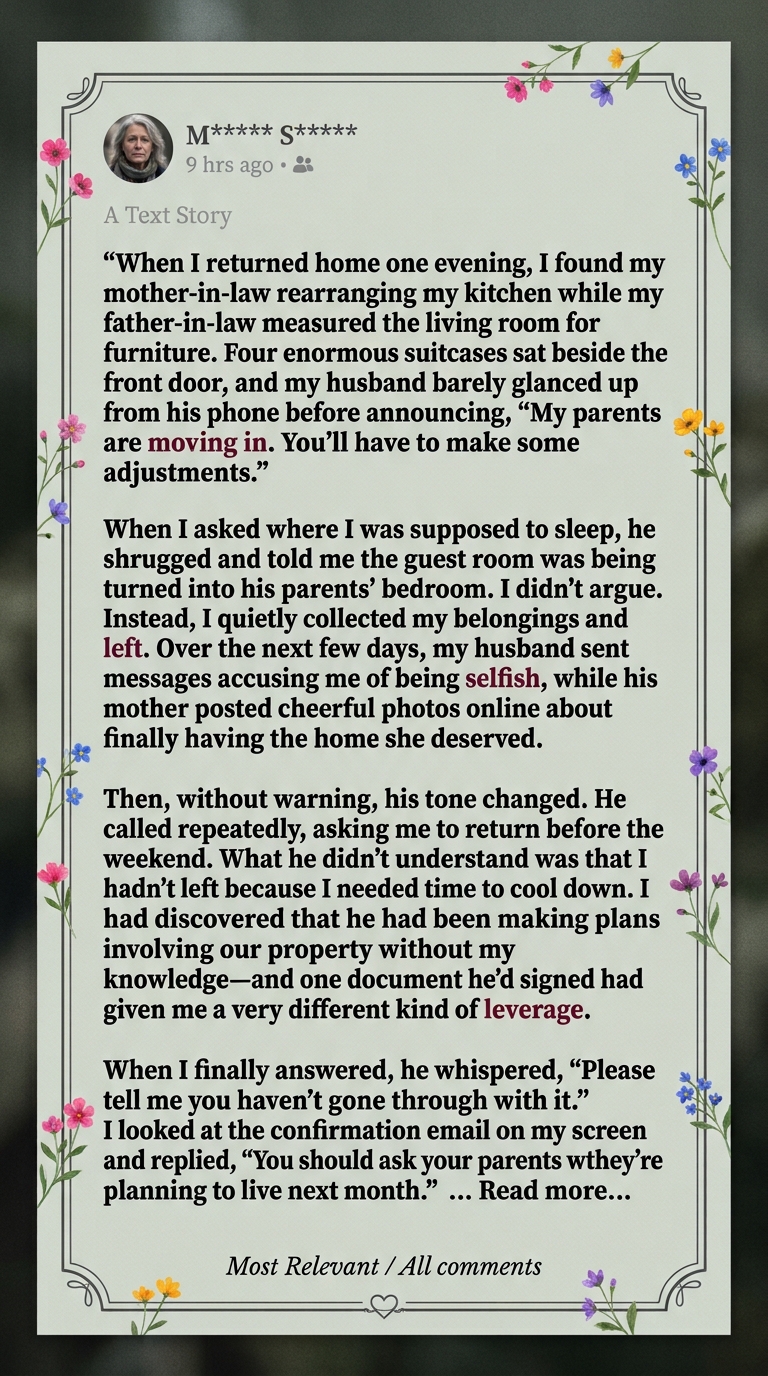
When I returned home that Thursday evening, I found my mother-in-law rearranging my kitchen.
She had removed half the contents of my cupboards and placed them on the counter. My father-in-law stood in the living room holding a measuring tape, examining the space where our television cabinet used to be.
Four enormous suitcases sat beside the front door.
For a moment, I wondered whether I had walked into the wrong house.
Then my husband, Mark, looked up from his phone.
“My parents are moving in,” he announced. “You’ll have to make some adjustments.”
I put my handbag down.
“What?”
His mother, Patricia, smiled without turning around.
“We’re finally going to have everyone under one roof. It’ll be lovely.”
I looked at the suitcases again.
“When did this decision happen?”
Mark shrugged.
“Last weekend. My parents’ landlord is selling their apartment, and they need somewhere to stay. I told them they could move in.”
“You told them they could move in here?”
“Obviously.”
I stared at him.
“This is our home. You didn’t even discuss it with me.”
He sighed.
“Please don’t start. They’re my parents. I’m not going to leave them homeless.”
I wasn’t suggesting that.
I was asking why he had made a decision that affected both of us without speaking to me.
Then I noticed his mother carrying a stack of towels toward the hallway.
“Where are you putting those?” I asked.
“In the bathroom. We’ll need more storage.”
“Our bathroom?”
She finally turned.
“Well, I suppose we’ll share it until we get organized.”
I looked toward the guest room.
“Where are you planning to sleep?”
Mark barely lifted his eyes.
“The guest room is becoming their bedroom. You can use the small office if you need somewhere quiet.”
I waited for him to laugh.
He didn’t.
The office was barely large enough for a desk and a filing cabinet. It had no proper bed, and I used it for my work.
“And where are you sleeping?” I asked.
“With my parents until we figure things out.”
That was when I understood something.
They hadn’t simply decided to stay for a few weeks.
They had decided that I was the person who needed to adjust to their arrival.
I looked at Patricia.
“Did you know Mark hadn’t discussed this with me?”
She gave me a small smile.
“Marriage requires compromise, dear. You’ll understand when you have a family of your own.”
I had been married to Mark for six years.
Apparently, that hadn’t counted.
I didn’t argue.
I went upstairs, entered our bedroom, and collected a suitcase. I packed clothes for several days, my laptop, important personal documents, and the small jewelry box my grandmother had given me.
Mark followed me into the hallway.
“What are you doing?”
“I’m leaving.”
He laughed.
“Don’t be dramatic.”
I zipped the suitcase.
“I’m not being dramatic. I’m removing myself from a situation where nobody thinks my opinion matters.”
He leaned against the doorframe.
“Where are you going to go?”
“Somewhere I can sleep without asking permission.”
His expression hardened.
“You’re seriously going to abandon me because my parents need help?”
I looked at him.
“No. I’m leaving because you decided I didn’t belong in my own home.”
I walked downstairs.
Patricia watched me pass with an expression that was almost satisfied.
“Give it a few days,” she said. “You’ll realize family comes first.”
I didn’t answer.
I closed the front door behind me.
For the first night, I stayed in a hotel.
The following morning, I rented a small furnished apartment near my office. It wasn’t luxurious, but it was quiet, clean, and entirely mine.
Mark began messaging me before lunchtime.
Mark: You embarrassed me in front of my parents.
Mark: You need to come home and apologize.
Mark: Mom is trying to make things comfortable for everyone.
I didn’t respond.
By Saturday, his messages had become more aggressive.
Mark: My parents have already unpacked. You can’t keep acting like this.
Then Patricia posted a photograph online.
She was sitting in my living room, smiling beside a cup of tea.
Her caption read:
Finally settled into the home we deserve. Sometimes life gives you exactly what you’ve earned.
Several relatives commented with congratulations.
I stared at the photograph.
Behind her was the framed wedding picture Mark and I had placed above the fireplace.
She had moved it to the side table.
I closed the application.
I had bigger concerns than social media.
Three weeks before this happened, I had received an unexpected letter from the property management company responsible for our house.
The letter confirmed that a document connected to the property had been submitted for review.
I had initially assumed it was routine paperwork.
Then I discovered an unfamiliar name listed as a proposed occupant under a separate residential arrangement.
I contacted the property management office and requested clarification.
They couldn’t discuss the matter without confirming my identity and reviewing the ownership records.
That was when I learned Mark had been making plans involving the house.
Our property was not entirely owned by Mark and me.
Six years earlier, when we purchased it, we had struggled to qualify for the mortgage. My aunt, Margaret, had helped us by providing a substantial portion of the deposit.
In return, she had required a carefully structured ownership agreement.
The house was registered in both our names, but a separate occupancy agreement protected the rights of both registered owners. Any long-term residential arrangement involving another household required written approval from both of us.
My aunt had insisted on that provision because she had once watched a relative lose control of a property after allowing family members to move in without clear terms.
At the time, I thought she was being overly cautious.
Now I was grateful.
I contacted our property solicitor, Helen Brooks, and asked her to review the documents.
She discovered that Mark had submitted a proposed long-term occupancy agreement for his parents.
He had described the arrangement as temporary, but the document included a provision allowing his parents to remain in the property for up to five years, subject to conditions that were extremely difficult to terminate.
Worse, Mark had signed a declaration stating that both registered owners had agreed to the arrangement.
My signature was missing.
He had also attached a letter claiming I had given verbal approval.
I had never done so.
Helen explained that the document could not establish the rights Mark was trying to create because the agreement required my written consent.
However, it was important to respond formally before anyone relied on it.
She advised me to issue a written objection and request that the proposed arrangement be withdrawn from the property records.
I agreed.
I also asked her to examine the mortgage and ownership documents for anything else Mark might have submitted.
That review revealed another problem.
Mark had contacted a lender about refinancing the house to release equity.
He had listed the proposed occupancy arrangement as part of his explanation for why his parents would be living there.
The application had not been approved, but it showed that he had been discussing financial changes involving our property without telling me.
The lender had not received my consent.
Helen sent formal notices to the property management company and the lender, confirming that I did not approve any new occupancy arrangement or refinancing involving the property.
Then she advised me to arrange an independent valuation and consider whether I wanted to pursue a sale or negotiate a buyout.
I chose to explore both options.
I wasn’t going to let Mark decide what happened to the house while treating me as though I were a guest.
A week later, his messages changed.
The accusations stopped.
Instead, he called repeatedly.
When I finally answered, he sounded frightened.
“Where are you?”
“I’m at my apartment.”
“Have you spoken to a lawyer?”
“Yes.”
He went quiet.
“Claire, what have you done?”
“I’ve made sure nobody can change the arrangements for our house without my consent.”
He lowered his voice.
“Please tell me you haven’t gone through with it.”
I looked at the confirmation email on my screen.
The property company had acknowledged my formal objection, and the lender had placed the refinancing inquiry on hold pending further documentation.
I replied calmly.
“You should ask your parents where they’re planning to live next month.”
He began breathing heavily.
“Claire, listen. My parents are already here. We can’t just throw them out.”
“I haven’t thrown anyone out. I have refused to approve a five-year occupancy arrangement that you submitted without my knowledge.”
“I didn’t think you’d object.”
“You didn’t ask.”
“They needed somewhere to stay.”
“Then you should have discussed temporary arrangements with me. You had no right to sign my name into a declaration claiming I agreed.”
“I never signed your name.”
“You signed a statement saying I had approved it. I hadn’t.”
He fell silent.
Then he said, “Mom and Dad are going to lose their deposit on the apartment they wanted to rent.”
I frowned.
“What deposit?”
He hesitated.
It turned out his parents hadn’t simply lost their apartment because their landlord was selling.
They had been negotiating to move into a smaller property, but Patricia had rejected it because she wanted a larger place. Mark had promised that our house would become their permanent home.
He had even encouraged them to give up their previous rental arrangement early.
They had paid a deposit on furniture and arranged delivery for several large items.
Now, because I had refused to approve the long-term occupancy agreement, they were facing the possibility of having to find another place.
I closed my eyes.
“You made promises to your parents using a house you don’t control alone.”
“It’s my house too!”
“Yes. And I’m your wife and co-owner. That means you don’t get to make every decision by yourself.”
He began pleading.
“Can we please meet? I’ll explain everything.”
I agreed to meet him at our solicitor’s office.
When I arrived, Mark was already sitting in the waiting room.
He looked exhausted.
He had shaved badly, and his shirt was wrinkled. For the first time since I had left, he didn’t look angry.
He looked worried.
Helen joined us and placed several documents on the table.
She explained that Mark’s proposed occupancy agreement had no effect without my required written approval. His declaration was a serious matter because it represented my consent inaccurately.
She also explained that the lender would not proceed with the refinancing inquiry without the necessary approvals and supporting documents.
Mark rubbed his forehead.
“I didn’t think it would become this complicated.”
Helen looked at him.
“It became complicated when you signed documents on behalf of another registered owner.”
He turned toward me.
“I was trying to help my parents.”
I nodded.
“I understand that. But you were also trying to give them long-term control over a home we purchased together.”
“They’re not trying to take your house.”
“Then why did the agreement give them five years of occupancy?”
He didn’t answer.
I continued.
“Why did you tell the property company that I had approved it?”
He looked down.
“Because I knew you’d say no.”
That was the first completely honest thing he had said.
Helen left us alone for a few minutes.
I asked Mark whether he had considered what would happen if his parents and I disagreed about the house.
He said he assumed I would eventually accept the arrangement.
I asked whether he expected me to give up my bedroom, my office, my privacy, and my right to decide who lived in my home.
He said his parents were old-fashioned and needed time to adjust.
I reminded him that I had already spent years accommodating his family.
When his father lost his job, I had paid several of their utility bills. When Patricia needed surgery, I had driven her to appointments and helped manage her recovery. I had never refused to help them.
But I had never agreed to surrender our home.
Mark looked at me.
“What do you want?”
I took a breath.
“I want the property arrangement corrected. I want the refinancing application withdrawn. And I want us to decide whether this marriage can continue.”
His expression changed.
“You want a divorce?”
“I want a marriage where my consent matters.”
He reached across the table.
“Claire, please. I can fix this.”
I moved my hand away.
“You could have fixed it before you moved four suitcases into our hallway.”
We spent the next several weeks negotiating.
I agreed that his parents could remain temporarily while they found alternative accommodation, provided they signed a short-term agreement with a clear end date and followed the household rules.
Mark had to acknowledge in writing that I had not approved the original long-term arrangement.
He also withdrew the refinancing inquiry.
Patricia was furious when she learned that her stay would be temporary.
She called me ungrateful and accused me of breaking up the family.
I reminded her that I had never invited her to move in permanently.
She hung up.
Within a month, Mark’s parents found a smaller apartment.
They moved out on a Sunday morning.
Patricia refused to speak to me as she carried her last suitcase through the front door.
His father, however, paused beside me.
“I should have asked you before we started measuring the furniture,” he said quietly.
I nodded.
“That would have helped.”
He looked uncomfortable.
“We thought Mark had arranged everything.”
“He arranged something. He didn’t have my agreement.”
He nodded once and left.
The house was finally quiet.
But the marriage was not repaired.
Mark expected me to return immediately, as though removing his parents had erased what he had done.
I couldn’t.
For months, we attended counseling. He admitted that he had grown accustomed to making decisions for both of us because I usually avoided confrontation.
He also admitted that he had promised his parents the house partly because he wanted their approval. He had always felt responsible for proving that he was a successful son, and giving them a place to live seemed like a way to demonstrate that he had finally made it.
I understood his insecurity.
But I also understood that it wasn’t my responsibility to pay for it with my independence.
Eventually, we agreed to separate.
The house was independently valued, and after reviewing our respective contributions and the legal ownership documents, we reached a settlement. Mark chose to purchase my share using financing that was approved without relying on the disputed occupancy arrangement.
I moved into my own home several months later.
It was smaller, but I chose every room, every piece of furniture, and every detail.
On the first night, I sat on the living room floor surrounded by unopened boxes and listened to the quiet.
No one had rearranged my kitchen.
No one had measured my bedroom.
No one had decided where I was allowed to sleep.
I finally understood that the most important thing I had protected wasn’t the property itself.
It was my right to have a voice in my own life.
Mark and I eventually completed the divorce.
He sent one final message afterward.
“I wish I’d understood how much I was asking you to give up.”
I read it, then put my phone away.
I hoped he had learned something from what happened.
As for me, I never regretted leaving that Thursday evening.
My husband had believed that marriage gave him the authority to make decisions for both of us.
He had forgotten that a shared home requires shared consent.
And the document he signed without asking me had become the very reason he couldn’t force me to stay.