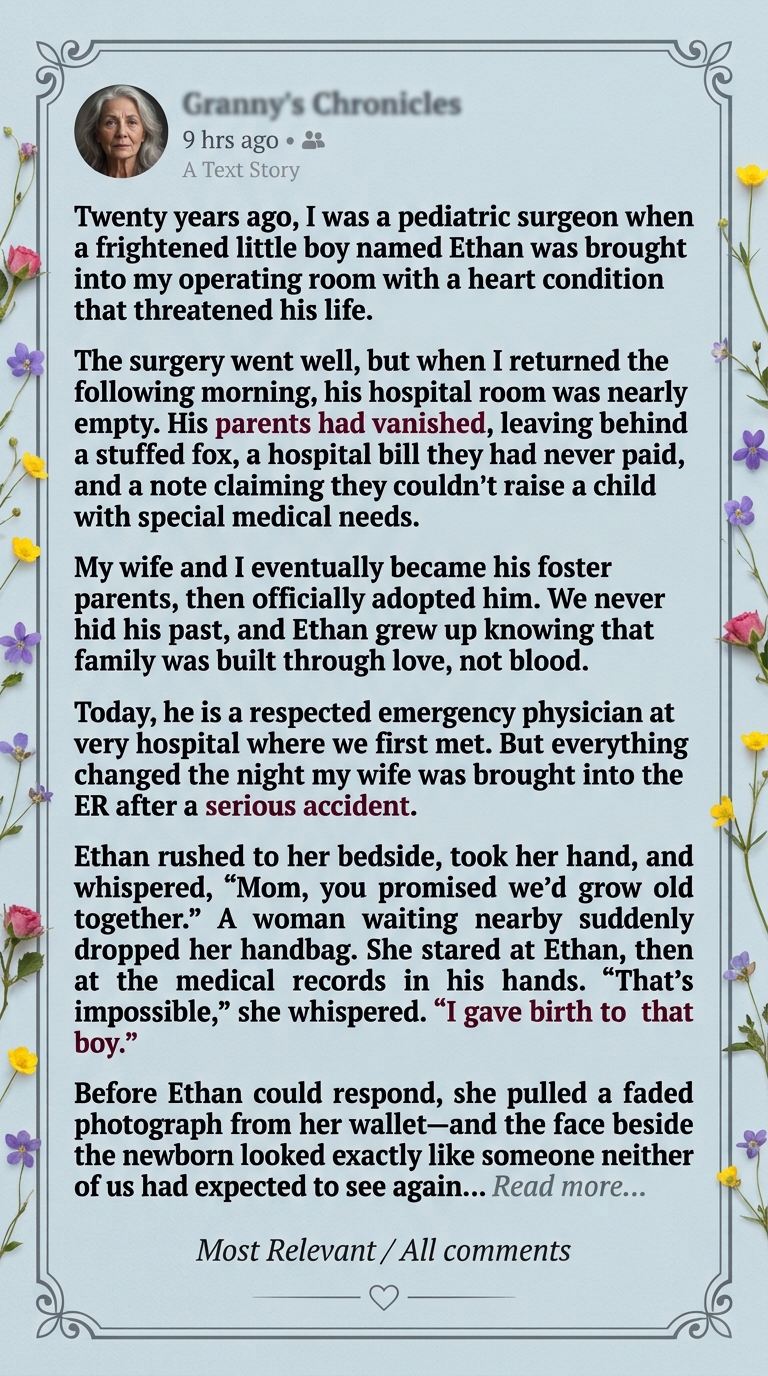
Twenty years ago, I was a pediatric surgeon when a frightened little boy named Ethan was brought into my operating room with a heart condition that threatened his life. His parents had driven him to the hospital after he collapsed at home, and by the time the ambulance arrived, his condition had become critical.
He was only three years old.
I still remember how tightly he clutched a stuffed fox while the nurses prepared him for surgery. His mother stood beside the bed, crying so hard she could barely speak. His father kept asking whether the operation would be successful.
“We’re going to do everything we can,” I assured them.
The surgery lasted nearly six hours. Ethan’s condition was complicated, but we managed to repair the defect. When I finally stepped out of the operating room, I was exhausted but relieved.
The following morning, I returned to check on him.
His hospital room was nearly empty.
The bed had been stripped, his parents were gone, and the only things remaining were his stuffed fox and an unpaid hospital bill. A nurse handed me a folded note she had found on the bedside table.
It contained only a few sentences.
“We cannot raise a child with special medical needs. We are leaving him here because we cannot give him the life he deserves. Please find someone who can.”
I read it twice, hoping I had misunderstood.
The hospital contacted the authorities, and Ethan was placed under temporary protective care while his medical needs were assessed. I continued checking on him, even after he was transferred to a specialized pediatric ward.
My wife, Laura, was a social worker at another hospital. When I told her about the little boy, she asked whether she could visit him.
The first time she met Ethan, he was sitting in a small playroom, holding his stuffed fox.
“What’s his name?” she asked.
Ethan looked down at the toy.
“Fox.”
“That’s a good name,” she replied. “Does Fox have a family?”
Ethan shook his head.
“Not anymore.”
Laura sat beside him.
“Maybe Fox just hasn’t found his family yet.”
Ethan looked at her for a long moment before quietly asking, “Can he come home with you?”
That question stayed with us.
We already had a daughter, Emma, who was six years old. We discussed the possibility of fostering Ethan with the hospital’s social services team, knowing that his medical condition would require regular appointments, medication, and careful monitoring.
The process wasn’t simple. We had to complete assessments, attend training, and demonstrate that we could meet his medical and emotional needs.
But neither of us hesitated.
Several months later, Ethan came home.
Emma was curious about her new brother. She showed him her toys, introduced him to the family dog, and insisted that he should have the larger bedroom because he needed more space for his medical equipment.
At first, Ethan struggled to believe he belonged with us.
He apologized whenever he spilled something. He asked permission before taking food from the refrigerator. At bedtime, he sometimes woke up crying because he dreamed that we had left him at the hospital.
Laura would sit beside him until he fell asleep again.
One night, he asked me a question that I have never forgotten.
“Are you going to send me away if I get sick again?”
I sat on the edge of his bed.
“No, Ethan. Getting sick doesn’t make you less part of this family.”
He looked at me uncertainly.
“Even if I need another operation?”
“Even then.”
He slowly reached for my hand.
A year later, after the required legal process was completed, we officially adopted him.
We never hid his past. We kept the note his biological parents had left, along with the hospital photograph taken shortly after his surgery. When he was old enough to understand, we explained that he had been born into another family but had become part of ours.
He asked questions over the years, but we never invented answers we didn’t have.
We told him his biological parents had made a decision we couldn’t explain, and that their decision had never been his fault.
Ethan grew into a thoughtful, determined young man.
His medical history made him interested in medicine, but he never wanted to become a surgeon. He told me he preferred emergency medicine because he liked being the person who arrived when someone needed help immediately.
After years of studying, he became an emergency physician.
He joined the hospital where we had first met, the same hospital where I had repaired his heart when he was a little boy.
On his first day, he stood outside the emergency department wearing his new white coat.
“Do you think I’ll be good at this?” he asked.
I smiled.
“You already know what it feels like to be frightened and helpless in a hospital. Never forget that when you’re treating someone else.”
He nodded.
“I won’t, Dad.”
I had never been prouder.
Then, last autumn, everything changed.
Laura was involved in a serious car accident while returning from a community health event. Another driver had lost control on a wet road, and her vehicle had been struck from the side.
She was transported to our hospital with internal injuries and a head injury.
I was attending a conference in another city when I received the call.
By the time I arrived, Ethan was already in the emergency department.
He had been working when the ambulance brought her in. He immediately recognized her and rushed to her bedside.
“Mom,” he whispered, taking her hand. “You promised we’d grow old together.”
Laura was unconscious.
Ethan stayed beside her while the trauma team worked. He helped coordinate her care, but when the attending physician arrived, he stepped back from making decisions about his own mother.
I entered the room just as he was speaking to one of the nurses.
Then a woman waiting near the corridor dropped her handbag.
She stared at Ethan.
Her face had gone completely pale.
“That’s impossible,” she whispered.
Ethan turned.
The woman stepped closer, looking at him as though she were seeing someone who had been missing for twenty years.
“I gave birth to that boy.”
Ethan frowned.
“Excuse me?”
She opened her handbag with trembling fingers and removed a faded photograph.
It showed a young woman holding a newborn baby in a hospital bed. A man stood beside her, smiling at the camera.
I recognized the man immediately.
He was Dr. Samuel Reed, a former cardiothoracic surgeon who had worked at our hospital years earlier.
He had been my mentor.
He had also died seven years ago.
The woman looked at me.
“You’re Dr. Carter, aren’t you?”
“Yes. Who are you?”
“My name is Natalie. This is my son.”
Ethan looked at the photograph again.
“That’s me?”
She nodded, tears gathering in her eyes.
“Your name was Ethan before you were taken away.”
He stepped back.
“Taken away? My parents abandoned me at this hospital.”
Natalie shook her head.
“No. We were told you had died.”
The corridor seemed to grow quieter.
I took the photograph from her.
There was no doubt about the baby. It was Ethan, wearing the same small identification bracelet visible in the hospital photograph we had kept for years.
But the man beside Natalie was what unsettled me.
“How did you know Dr. Reed?” I asked.
Natalie swallowed.
“He was the doctor who treated my son before the operation. He told us Ethan had a serious heart condition and needed surgery immediately.”
She looked at Ethan.
“Your father and I were young. We were struggling financially, and we were terrified. But we never intended to abandon you. We agreed to the operation because we wanted you to survive.”
“Then why did you leave?” Ethan asked.
Natalie began crying.
“We didn’t. Not willingly.”
She explained that twenty years earlier, she and her husband, Michael, had brought Ethan to the hospital after he collapsed. Dr. Reed had told them that the surgery was urgent and that they needed to sign several consent forms.
They had agreed.
After the operation, Natalie was told she had developed complications from an infection and needed treatment at another facility. Michael was asked to complete additional paperwork.
When he returned to ask about Ethan, he was informed that the baby had died during surgery.
The hospital provided a death certificate several days later.
Natalie had been devastated.
Michael demanded to see their son, but the hospital told him that the body had already been transferred for burial under a special medical arrangement.
They were young, frightened, and unfamiliar with the hospital system. They eventually accepted what they had been told.
For years, Natalie had lived with the belief that her son had died.
“Why would anyone tell you that?” I asked.
She shook her head.
“I don’t know. But a few months ago, I received a phone call from someone who had worked at the hospital. She told me that my son might still be alive.”
She explained that the former employee had found an old patient record while reviewing archived files. The record showed that Ethan had survived surgery and been discharged into protective care.
The employee had recognized the discrepancy between the medical record and the death certificate.
She contacted Natalie, who began searching for answers.
Eventually, she found an old hospital photograph posted online by a charity celebrating former pediatric patients. Ethan’s name appeared beneath it.
She recognized him immediately.
“I came here to find out whether it was really you,” Natalie whispered.
Ethan looked at the photograph.
“Where is my father?”
Natalie’s expression changed.
“Michael died six years ago.”
Ethan lowered his eyes.
“I’m sorry.”
She reached toward him, but he didn’t move.
For several seconds, none of us spoke.
Then the emergency physician approached.
“Dr. Carter, we need to discuss your wife’s condition.”
I turned immediately.
Laura had suffered internal bleeding, but the surgeons had managed to control it. Her head injury required close monitoring, and she remained unconscious, but her vital signs were stable.
I followed the physician to the consultation room.
Ethan stayed behind with Natalie.
When I returned, I found him sitting alone.
“Where is she?” I asked.
“Waiting outside.”
“How are you?”
He shook his head.
“I don’t know what to think, Dad.”
I sat beside him.
“You don’t have to decide anything tonight.”
He stared at his hands.
“Did you know?”
“No.”
“Did Dr. Reed know?”
I hesitated.
“I don’t know. But we’re going to find out.”
The following morning, I contacted the hospital’s medical records department and requested a formal review of Ethan’s original admission.
The records were incomplete.
Several documents had been scanned years earlier, but the original discharge authorization was missing. The death certificate Natalie had received contained a hospital reference number that did not match Ethan’s medical record.
There was also a handwritten note attached to the original surgical file.
It was signed by Dr. Reed.
The note stated that Ethan had survived surgery and was medically stable. It recommended that the child remain under observation because his parents had not been present during the recovery period.
That was strange.
Natalie had said she and Michael had been told their son was dead.
I requested the hospital’s legal department to investigate the discrepancy. They appointed an independent reviewer and contacted the regional health authority.
Over the next several days, we uncovered something disturbing.
Twenty years earlier, Dr. Reed had been involved in an unauthorized arrangement with a private child welfare agency. The agency had been accused of manipulating medical records to move children into temporary placements without properly notifying their families.
The arrangement had supposedly ended after an internal review, but several files had remained incomplete.
Ethan’s case was among them.
A former hospital administrator, now retired, agreed to speak with the investigators.
She explained that Natalie and Michael had never signed an adoption consent or surrendered their parental rights. They had only signed emergency surgical consent forms.
After Ethan survived, Dr. Reed had told the administrator that the parents had abandoned him and were unwilling to take responsibility for a medically complicated child.
He had instructed her to process a protective placement.
The administrator had refused to approve the placement without proper documentation.
Two days later, she discovered that a death certificate had been entered into the hospital system under Ethan’s patient number. She challenged it, but Dr. Reed told her the record had been corrected and that the child had been transferred elsewhere.
She had not seen the child again.
The independent review found that Dr. Reed had used his authority to create a false account of Ethan’s circumstances. He had arranged for the parents to be told their son had died, then placed Ethan into the protective care system.
The exact reason remained unclear until investigators examined his personal correspondence.
Dr. Reed had been a respected surgeon, but his career had begun to unravel after his wife died. He had become increasingly involved in charitable medical programs and had developed a belief that children with serious health conditions needed to be placed with families who could provide extensive care.
He had no legal authority to make that decision.
But he had convinced himself that he was saving children from lives of suffering.
In Ethan’s case, he had decided that Natalie and Michael were too young and financially unstable to raise a child with complicated medical needs.
Rather than help them access support, he had separated them from their son.
He had falsified the records to make the separation permanent.
The truth was devastating.
Dr. Reed had saved Ethan’s life in the operating room, then stolen the life his biological parents had wanted to give him.
The investigation also revealed why Dr. Reed had selected our family.
He knew me well. He knew Laura worked in social services, and he believed we had the resources and experience to raise Ethan.
He had quietly recommended our family for the foster placement, concealing his role in the original separation.
At the time, I had believed we were helping an abandoned child.
We had never been told that his parents were still searching for him.
When I learned this, I felt sick.
I had admired Dr. Reed for years. He had taught me surgical techniques, encouraged my career, and helped me become the doctor I was.
I had never imagined he could commit such a betrayal.
The hospital issued a formal apology to Natalie and Ethan. The regional authorities opened a criminal investigation into the falsified records, and the medical licensing board reviewed Dr. Reed’s actions. Because he had died years earlier, he could no longer face prosecution or disciplinary proceedings, but the findings were formally documented.
The hospital also arranged for an independent review of other cases connected to the former agency.
Meanwhile, Laura began waking from her coma.
The first time she opened her eyes, Ethan was beside her.
“Mom?” he whispered.
She blinked slowly.
“You’re supposed to be working.”
He laughed, then covered his face with one hand.
“You’re unbelievable.”
Laura managed a weak smile.
“Did I miss anything?”
Ethan looked toward me.
Then he looked at Natalie, who was standing near the doorway.
“Yes,” he said quietly. “Quite a lot.”
We explained everything gradually, allowing Laura time to recover before overwhelming her with details.
When she finally met Natalie properly, she reached for her hand.
“I don’t know what to say,” Laura whispered.
Natalie began crying.
“I thought he was dead for twenty years.”
Laura looked at Ethan.
“He was loved every single day.”
Natalie nodded.
“I believe you.”
The days that followed were complicated.
Ethan had questions about his biological parents, his childhood, and the decisions that had shaped his life. He also struggled with anger toward Dr. Reed, whose name had once been spoken in our home with admiration.
Most difficult of all, he felt guilty for wanting to know Natalie while worrying that doing so might hurt Laura.
One evening, he finally said what he had been holding inside.
“Mom, I don’t want you to think I’m replacing you.”
Laura took his hand.
“You’re not replacing anyone. I’m your mother. That doesn’t disappear because someone else gave birth to you.”
Ethan’s eyes filled.
“I just want to know her.”
“Then you should.”
Laura looked toward Natalie.
“And she deserves the chance to know you too.”
Natalie did not demand a place in Ethan’s life. She understood that twenty years could not be undone by a photograph or a hospital investigation.
Instead, she began visiting occasionally.
At first, the conversations were awkward. She brought photographs of Michael, told Ethan about the apartment where they had lived, and shared stories about his early childhood.
She also brought the stuffed fox’s twin.
She had bought it before Ethan’s surgery, intending to give it to him after he recovered. She had kept it for twenty years.
Ethan held it quietly.
“Why did you keep this?”
“Because I never stopped believing that somewhere, you were still alive.”
He looked at her.
“I wish you had found me sooner.”
“So do I.”
There was no easy answer to that.
Over the following months, Ethan and Natalie developed a relationship at their own pace. She attended some family gatherings, learned about his work, and gradually became part of his wider circle.
She never tried to take Laura’s place.
Laura never asked Ethan to choose.
And Ethan finally understood that he didn’t have to divide his love into competing pieces.
A year after the accident, Laura had recovered enough to return to her community work. Ethan remained an emergency physician, and I continued practicing surgery part-time.
One afternoon, our family gathered for dinner.
Natalie brought a photograph of Michael holding Ethan as a newborn. Laura placed it beside the framed picture of Ethan’s adoption day.
Ethan studied the two photographs.
In one, he was a baby held by two frightened young parents who believed they were about to lose him.
In the other, he was a little boy standing between Laura and me, smiling with his stuffed fox tucked under his arm.
He placed them side by side.
“These are both my family,” he said.
No one disagreed.
Later that evening, he walked me to the front door.
“Dad?”
“Yes?”
“Do you ever wish you hadn’t adopted me?”
I looked at him, surprised.
“Why would you ask that?”
“Because everything happened through Dr. Reed. You and Mom never knew the truth. Maybe if things had been different, I would have grown up with Natalie and Michael.”
I put a hand on his shoulder.
“Your life could have taken a different path. But that doesn’t mean I regret the one we shared.”
He nodded.
“I love you, Dad.”
“I love you too, son.”
He hugged me.
As I watched him return to the dinner table, I thought about the little boy who had once asked whether we would send him away if he became sick again.
We had promised him he belonged.
That promise had never depended on his medical condition, his biological parents, or the circumstances of his birth.
The truth had changed his understanding of where he came from, but it hadn’t changed who had been there when he needed a family.
And now he had something he had once believed impossible: the chance to know the people who gave him life without losing the people who had raised him.
Twenty years earlier, I had repaired a little boy’s heart.
I never imagined that one day, the greatest healing would come from finally telling him the truth.