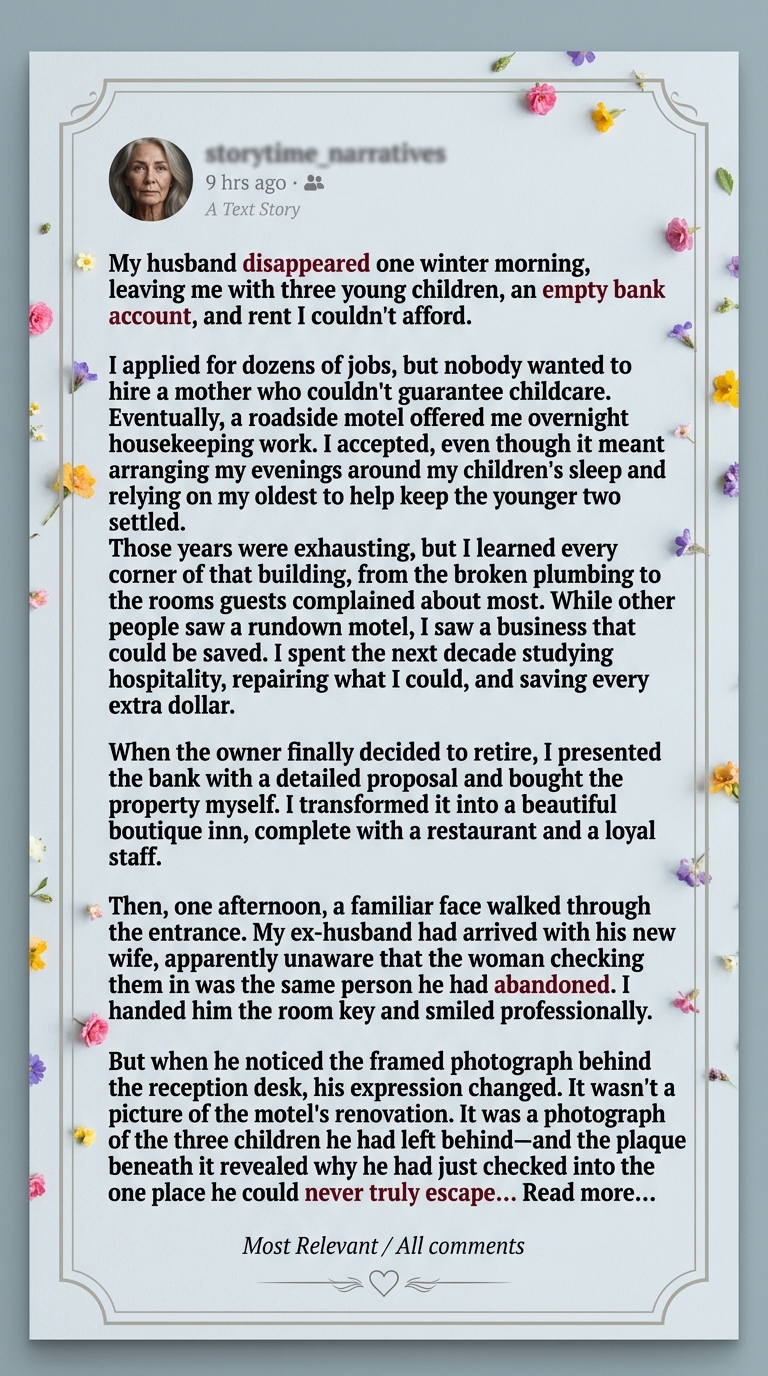
The morning my husband disappeared, he left his coffee cup on the kitchen counter and his wedding ring beside the sink.
There was no argument the night before. No warning. No note explaining where he was going or when he might return. When I called his phone, it went straight to voicemail. By noon, I discovered that our joint bank account had been emptied. By evening, I understood that Daniel had not gone away for a few days. He had left us.
Our children were six, four, and eighteen months old.
I spent the first week calling hospitals, police stations, and every friend who might have heard from him. Eventually, a detective explained that Daniel was an adult and had the right to leave. There was no evidence that he had been harmed, and no way to force him to come home.
I was left with three children, overdue rent, and almost no money.
I applied for every job I could find. Grocery stores, offices, cleaning companies, cafés. Most employers were polite, but the answer was usually the same: they needed someone with flexible availability, and I couldn’t guarantee childcare.
Then I saw a handwritten notice at a roadside motel outside town.
NIGHT HOUSEKEEPER NEEDED. IMMEDIATE START.
The manager, Mr. Bennett, interviewed me in a small office that smelled of coffee and furniture polish. He asked whether I could work from nine in the evening until five in the morning.
I told him I could.
He glanced at my application.
“You have three children?”
“Yes.”
“Who looks after them?”
“My neighbor has agreed to help until I can afford something more reliable.”
He studied me for a moment.
“I don’t need someone who knows everything about hotels,” he said. “I need someone who shows up and does the work.”
I started that Friday.
The arrangement was difficult. I prepared dinner for the children before leaving, put the younger two to bed, and asked my eldest, Sophie, to call our neighbor if either of her siblings woke up. I hated asking so much of a six-year-old, even though she never complained. Whenever I could afford it, I paid a retired woman from our street to stay with them.
I slept in fragments, sometimes only three hours before collecting the children from school or preparing their meals.
The motel was called the Pine Rest. It had thirty-two rooms, a small reception area, a breakfast room, and a parking lot full of potholes. The carpets were faded, the air-conditioning units rattled, and guests frequently complained about the plumbing.
Most employees considered it a temporary job.
I saw something else.
I noticed that rooms facing the highway received the most complaints because of traffic noise. The breakfast room was poorly arranged, so guests crowded around the coffee machine. The laundry schedule wasted electricity, and the maintenance team repeatedly repaired the same faulty pipes without addressing the underlying problem.
I began keeping a notebook.
At first, I recorded practical things: which rooms needed new shower fittings, which mattresses were beyond repair, and which suppliers delivered the best cleaning products for the lowest price.
Then I started studying hospitality.
I borrowed books from the library, watched training videos after the children went to sleep, and eventually enrolled in an online hotel management course. I learned about occupancy rates, operating costs, customer retention, food service, and the small details that made guests feel welcome.
Mr. Bennett noticed my interest.
One night, he found me comparing maintenance expenses.
“Planning to take over my job?” he joked.
I smiled.
“Not your job. Your business.”
He laughed, but I wasn’t joking.
Over the years, I worked my way from housekeeping to supervisor, then assistant manager. I learned how to handle difficult guests without humiliating staff, how to negotiate with suppliers, and how to recognize the difference between an expensive repair and a cheap solution that would fail again in six months.
My children grew up around the motel.
They did their homework in the staff room, celebrated birthdays in the little breakfast area, and learned not to run through the corridors when guests were sleeping. Sophie became especially interested in the business. By the time she was sixteen, she could explain the difference between a booking platform’s commission and the actual cost of acquiring a guest.
I never wanted them to feel that the motel had replaced their childhood. But it gave us something we desperately needed: stability.
Daniel never contacted us.
For the first few years, I checked occasionally to see whether he had sent money through a relative or made any attempt to find the children. Nothing arrived. I eventually pursued child support through the legal system, but Daniel’s employment and whereabouts were difficult to establish. The small payments that were eventually ordered never came regularly.
I stopped building my plans around the possibility that he might return.
Instead, I built them around the work in front of me.
Ten years after I started at Pine Rest, Mr. Bennett announced that he was retiring. He had no children interested in taking over the property, and he was considering selling it to a developer who wanted the land for a storage facility.
I asked him to give me a chance.
He looked surprised.
“You want to buy this place?”
“I do.”
“Clara, it’s a lot of work.”
“I know. I’ve been doing it for ten years.”
He didn’t dismiss me, but he warned me that the purchase price would be substantial. The motel needed major renovations, and the bank would require more than enthusiasm.
I spent three months preparing a business plan.
I included a room-by-room renovation schedule, projected occupancy rates, local tourism research, restaurant operating costs, staffing plans, and conservative revenue forecasts. I had saved for years, and I could contribute a deposit. I also had a record of improving the motel’s performance under Mr. Bennett’s ownership.
The bank manager asked difficult questions.
What would happen during the renovation? How would I compete with larger hotels? What if occupancy dropped during the first year? How much working capital would I have after purchasing the property?
I answered every question with figures rather than promises.
Eventually, the loan was approved.
When Mr. Bennett handed me the keys, he looked around the reception area with a mixture of pride and disbelief.
“I suppose I should have listened when you said you wanted the business.”
I laughed.
“You did listen. You just thought I was dreaming.”
“Maybe I was wrong.”
I didn’t simply repaint the walls and change the name.
I closed the motel in sections, renovated the plumbing, replaced the electrical systems, improved the insulation, and redesigned the rooms. The breakfast area became a proper restaurant with a small kitchen and a seasonal menu. We added a garden terrace, a reading room, and a reception lounge with locally made furniture.
I renamed the property The Willow House.
It took nearly two years to complete the transformation.
Some months were frightening. Construction costs rose, a supplier went bankrupt, and the restaurant struggled during its first winter. I had to reduce my own salary and postpone improvements that I had hoped to complete immediately.
But the business survived.
Guests began returning. Local companies booked rooms for visiting staff. Couples came for weekend breaks, and families appreciated the quiet garden and the restaurant’s simple meals.
I hired several employees who had been with the old motel, including a maintenance worker named Paul who had once helped me repair leaking showers at two in the morning. I made a point of offering staff predictable schedules and proper training because I knew what it meant to work while worrying about your children.
My three children were older by then.
Sophie had completed a business degree and helped with the hotel’s accounts during busy periods. The middle child, Ethan, was studying architecture and occasionally offered suggestions for future renovations. The youngest, Lily, loved the restaurant and worked weekend shifts while finishing school.
The Willow House was not just a building anymore.
It was the result of everything we had survived.
Then, one rainy afternoon, a man walked through the entrance with a woman beside him.
I was reviewing the next week’s staff schedule when I heard the reception bell.
“Good afternoon,” I said, looking up.
The man was older, heavier, and had more gray in his hair, but I recognized him immediately.
Daniel.
For a second, the room seemed to lose all its sound.
He didn’t recognize me. His eyes moved over the polished reception desk, the warm lighting, and the framed photographs of the property before and after renovation.
The woman beside him handed over her identification.
“We have a reservation under Daniel Mercer,” she said.
I looked at the screen.
There it was.
A two-night booking in a premium garden suite.
“Of course,” I replied.
Daniel glanced at me.
“Have we met?”
I smiled politely.
“Not recently.”
He gave a distracted laugh and turned back to his wife.
“This place is beautiful. I didn’t expect something like this out here.”
His wife, a stylish woman named Rebecca, looked around appreciatively.
“I told you we should have booked somewhere smaller. It feels much more personal.”
I completed their check-in and prepared two key cards.
“Breakfast is served from seven until ten. The restaurant is open until nine this evening. If you need anything, reception is staffed around the clock.”
Daniel accepted the keys.
“Thank you. And may I ask who owns the place?”
Before I could answer, his gaze shifted toward the wall behind the reception desk.
A large framed photograph hung there. It showed three children standing in front of the original Pine Rest sign. Sophie was holding Lily’s hand, while Ethan stood between them with a serious expression. Their clothes were ordinary, their shoes were muddy, and all three were smiling.
Beneath the photograph was a brass plaque.
THE WILLOW HOUSE\
Founded on the determination of one mother and the future of three children.\
In honor of Sophie, Ethan, and Lily Mercer, whose childhood began here and whose strength helped build this home.
Daniel stared at it.
His eyes moved from the photograph to the names, then slowly back to me.
“Those are…”
“My children,” I said.
He looked at me properly for the first time.
“Clara?”
“Good afternoon, Daniel.”
His face drained of color.
Rebecca turned toward him.
“You know her?”
He didn’t answer.
I placed the registration form on the desk.
“I’m the owner of The Willow House.”
Daniel looked around again, as though the entire building had suddenly become something different.
“You own this place?”
“I do.”
He glanced at the photograph.
“Those are our children?”
“They’re my children, too,” I replied. “And they’re doing very well.”
Rebecca looked between us.
“Daniel, what’s going on?”
He cleared his throat.
“Clara and I were married a long time ago.”
“Married?” she repeated.
“We have three children.”
Rebecca’s expression changed.
“You told me you had no children.”
Daniel looked down.
I felt a familiar ache, but it was no longer the sharp pain I had carried for years. It was closer to disappointment at seeing the same dishonesty still living in him.
Rebecca stepped away from him.
“You said you had never been married.”
Daniel tried to interrupt.
“Rebecca, let me explain.”
She shook her head.
“Not here.”
She turned to me.
“I’m sorry. I had no idea.”
I nodded.
“You don’t owe me an apology.”
Daniel looked desperate.
“Clara, can we talk privately?”
“There isn’t anything private we need to discuss.”
“Please. I didn’t know you had built all this.”
I held his gaze.
“You didn’t know because you never asked.”
He lowered his voice.
“I’ve thought about the children.”
“Thinking about them isn’t the same as contacting them.”
“I made mistakes.”
“You made a decision. Then you made the same decision every day for fifteen years by staying away.”
He looked toward the photograph again.
“I’d like to see them.”
“That’s not something you arrange through a hotel reservation.”
He shifted uncomfortably.
“I am their father.”
“Then you should have behaved like one.”
Rebecca picked up her handbag.
“I’m going to wait outside,” she told him.
Daniel reached for her arm, but she pulled away.
After she left, he turned back to me.
“Can you at least tell me how they’re doing?”
“They’re healthy. They’re educated. They have work, studies, friends, and lives of their own.”
“Do they hate me?”
“I won’t answer for them.”
He looked at the keys in his hand.
“I came here because Rebecca wanted a quiet weekend. I had no idea this was your place.”
I believed him. His reservation had been made through a travel website, and he had not known the motel had become a boutique inn. But that did not change the fact that he had spent fifteen years avoiding the people whose names were now displayed on its wall.
I completed the check-in.
“Your room is ready. Paul will show you upstairs.”
Daniel didn’t move.
“Clara, don’t you think the children deserve to know I want to come back?”
I considered him for a moment.
“They deserve the truth. Whether they want you in their lives is their decision.”
He finally took the keys and followed Paul toward the stairs.
I watched him go, then returned to my office.
My hands were shaking.
Not because I wanted him back. Not because I regretted the life I had built. But because I had spent so many years imagining what I would do if he ever appeared again, and now that he had, I realized how little power he had over me.
That evening, Sophie came to the hotel after finishing work at her office. She had arranged to review the monthly figures with me and found me sitting in the restaurant after closing.
“You look exhausted,” she said.
“I had an unexpected guest.”
She sat opposite me.
“Who?”
“Your father.”
Her expression went still.
“What?”
“He’s staying here with his wife.”
Sophie looked toward the reception area.
“Does he know?”
“He saw the photograph.”
She sat quietly for a while.
“Did he ask about us?”
“Yes.”
“What did you tell him?”
“That you’re doing well. Nothing more.”
Sophie looked down at the table.
“I used to imagine what I would say if he ever came back.”
“What would you say now?”
She thought about it.
“I don’t know. Maybe that’s the point. I don’t spend much time imagining it anymore.”
I reached across the table and touched her hand.
“You don’t have to see him.”
“I know.”
The next morning, Daniel came down alone.
Rebecca had checked out early. She had told the reception staff that she no longer wished to stay and had arranged transport to the nearest station.
Daniel looked as though he hadn’t slept.
“She left,” he said.
“I’m sorry to hear that.”
He shook his head.
“I suppose I deserved it.”
I didn’t respond.
He asked whether he could leave a message for the children. I told him I would pass along his request, but I couldn’t promise they would accept it.
He wrote a short note and left it in a sealed envelope at reception.
I did not give it to them immediately.
Instead, I called each of my children and told them their father had appeared. I explained that he wanted to reconnect and asked whether they wanted to read his message.
Lily refused.
Ethan said he wasn’t ready.
Sophie asked me to bring it to her after she had time to think.
A week later, she opened it at my kitchen table.
The message was full of regret, but it contained little detail. Daniel wrote that he had been selfish, that he had made a terrible mistake, and that he hoped one day they could speak.
Sophie folded the paper.
“He doesn’t even mention our birthdays,” she said.
I didn’t know what to say.
“Maybe he doesn’t remember,” she added.
I wanted to tell her that she deserved better. But she already knew.
A month passed.
Daniel sent another message through a solicitor, asking whether the children would consider a meeting. This time, he included a more complete account of what had happened after he left.
He had moved away with a woman he had met through work, taken a job in another region, and eventually started a new relationship with Rebecca. He admitted that he had deliberately avoided contact because he feared the financial obligations and the shame of facing what he had done. He had allowed years to pass until returning seemed more difficult than staying away.
His explanation did not excuse him, but at least it was honest.
Ethan eventually agreed to meet him in a public café. Lily decided not to attend. Sophie said she would consider it later.
I did not go with them.
They were adults, and the meeting belonged to them.
Ethan told me afterward that Daniel had cried and apologized. He had asked about school, work, and the years he had missed. Ethan had answered some questions and refused others.
“He kept saying he wanted another chance,” Ethan told me. “I said he could start by learning to respect the fact that we don’t owe him one.”
I was proud of him.
Daniel continued sending occasional messages. Some were thoughtful. Others became impatient when the children did not respond quickly. When that happened, they simply stopped replying.
I made sure no one felt obligated to manage his disappointment.
Meanwhile, The Willow House continued to grow.
We added six new rooms, improved the restaurant, and began hosting small business retreats during the quieter months. Sophie eventually joined the management team full-time. Ethan helped design a new garden building, and Lily studied culinary arts before taking over the restaurant’s breakfast service.
The photograph behind reception remained exactly where it was.
Some guests asked about it. I never gave them the whole story, but I explained that the three children had grown up in the old motel and that the business had become a family project.
One afternoon, a young woman checking in looked at the plaque and smiled.
“That’s lovely,” she said. “It’s nice to see a place built around family.”
I glanced at the photograph.
“Yes,” I replied. “Although family isn’t always defined by who stays. Sometimes it’s defined by who keeps showing up.”
I no longer hated Daniel. Hatred would have required me to keep giving him space in my life.
He had walked into the hotel expecting a comfortable room and an ordinary weekend. Instead, he had encountered the consequences of the morning he left us: three children who had grown up without him, a woman who had built a future without him, and a business that existed because I refused to let his disappearance become the end of our story.
The Willow House was not a monument to what he had taken from us.
It was proof of what we had created after he was gone.
And every morning, when I unlocked the front doors and welcomed the first guests of the day, I knew exactly who had earned the right to stand behind that reception desk.