The Secret My Father Kept for Twenty-One Years
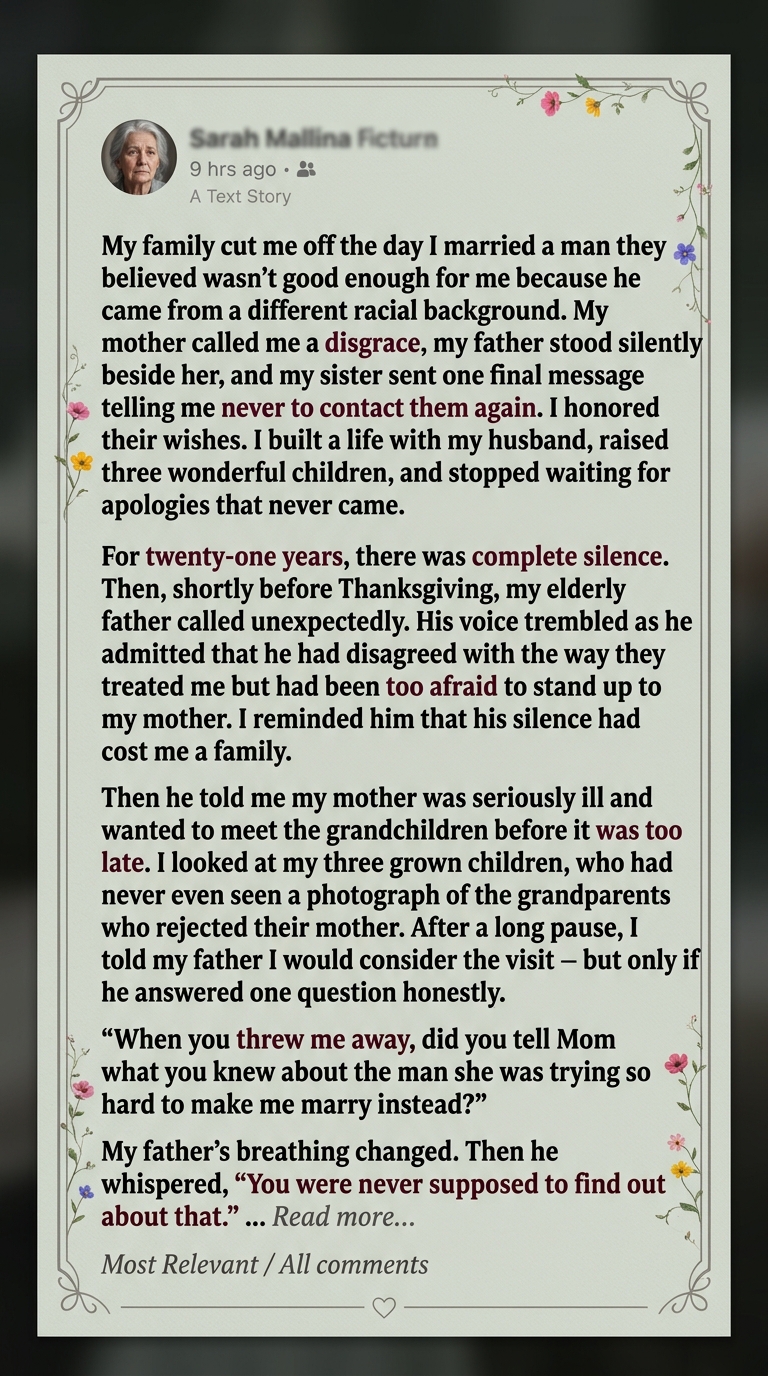
My family disowned me the day I married the man they believed wasn’t good enough for me.
His name was Marcus. He was kind, patient, and the first person who had ever made me feel that I didn’t need to earn someone’s affection by meeting a list of expectations.
But he came from a different racial background, and my mother considered that reason enough to reject him.
The first time I brought him home, she barely acknowledged his presence. She asked about his job, his family, and where he had grown up, but every question carried an unmistakable judgment.
My father, Robert, sat at the dining table and said almost nothing.
My younger sister, Natalie, watched the entire conversation with an uncomfortable expression. I thought she might eventually defend me, but she never did.
When Marcus and I announced our engagement, my mother refused to congratulate us.
“You’re throwing your future away,” she said.
“I’m choosing my future,” I replied.
“You’re choosing a man who will never fit into this family.”
“Then perhaps this family needs to decide what matters more.”
Her face hardened.
“If you marry him, don’t expect us to welcome you back.”
I looked at my father, hoping he would finally say something.
He lowered his eyes.
I married Marcus three months later in a small ceremony attended by friends and his relatives. My parents didn’t come. Natalie sent a message that evening.
Don’t contact us again. You’ve made your choice.
I didn’t answer.
Marcus never asked me to abandon my family. In fact, for years, he encouraged me to leave the door open in case they changed their minds.
But I couldn’t keep reopening a wound just to prove I still wanted them.
We built our own family. We had three children: Sophie, Daniel, and Grace. We moved into a modest house, worked hard, celebrated birthdays, and created traditions that had nothing to do with the people who had rejected me.
Our children knew that I had grown up with parents and a sister, but they had never met them. I had no photographs displayed in the house, and I rarely discussed the past.
Marcus understood why.
Whenever one of the children asked about their grandparents, I simply said, “Sometimes adults make choices that hurt other people. I hope you never have to understand that feeling.”
Twenty-one years passed.
Then, three days before Thanksgiving, my phone rang while I was preparing dinner.
The number was unfamiliar.
“Hello?”
A man’s voice answered.
“Eleanor? It’s Dad.”
I nearly dropped the knife in my hand.
For a moment, I couldn’t speak.
He sounded older than I remembered, his voice thin and uneven.
“I know I have no right to call,” he said. “But I was hoping you might listen.”
I stepped away from the kitchen.
“What do you want?”
“Your mother is very ill.”
I closed my eyes.
He explained that she had been diagnosed with an aggressive illness several months earlier. Treatment had not worked as they had hoped, and her condition had deteriorated quickly.
“She wants to see you,” he said. “She wants to meet the grandchildren before it’s too late.”
I felt anger rising beneath my ribs.
“Twenty-one years, Dad. You haven’t called once.”
“I know.”
“You missed my wedding. You missed every birthday, every graduation, every difficult moment when I needed my parents.”
His breathing became uneven.
“I know, Eleanor.”
“Then why are you calling now?”
He was quiet for several seconds.
“Because I was wrong.”
I almost laughed.
“Wrong about what?”
“About the way we treated you. I disagreed with your mother, but I was afraid of her anger. I thought if I stayed out of it, things would eventually calm down.”
“You stayed out of it by letting her throw me out of your lives.”
“I know.”
“Your silence cost me a family.”
He began to cry.
I didn’t comfort him.
Then he said something I hadn’t expected.
“Your mother wasn’t the only reason things happened the way they did.”
I frowned.
“What does that mean?”
He hesitated.
“She was very determined that you marry someone she considered suitable. She had someone in mind long before you met Marcus.”
I gripped the edge of the counter.
“Who?”
“His name was Peter Lawson.”
I remembered him immediately.
Peter had been the son of one of my mother’s closest friends. He was a few years older than me, worked in finance, and had been invited to our family dinners repeatedly when I was in my twenties.
My mother used to say he was exactly the kind of man I should marry.
I had never been interested in him.
“Why are you bringing him up now?” I asked.
My father swallowed.
“Because I think you deserve to know what happened.”
I looked toward the living room, where my three grown children were helping Marcus prepare the dining table.
“Before I agree to anything, I need you to answer one question honestly.”
“All right.”
“When you threw me away, did you tell Mom what you knew about the man she was trying so hard to make me marry instead?”
My father’s breathing changed.
For several seconds, all I could hear was the faint crackling of the telephone connection.
Then he whispered:
“You were never supposed to find out about that.”
My stomach tightened.
“What did you know?”
He took a shaky breath.
“Peter was already married.”
I stared at the wall.
“What?”
“He had been married for almost two years. Your mother knew his wife had moved out temporarily, but she believed they were going to divorce. Peter told her he intended to end the marriage.”
“And you knew?”
“Yes.”
“How long?”
“Before you ever met him.”
I felt cold.
My mother had spent months telling me Peter was a respectable man from a good family. She had praised his career, his manners, and his financial prospects. She had even suggested that I was being unreasonable for not giving him a chance.
“Why would she want me to marry a married man?”
“She didn’t know everything at first,” my father said. “But she found out more than she admitted.”
He explained that Peter had approached my mother through a family acquaintance. He had been struggling financially and wanted access to a business opportunity involving my mother’s brother, who owned several commercial properties.
Peter had presented himself as a successful investor, but his finances were unstable. His marriage was also in serious trouble.
My mother believed that if I married him, our families would become closely connected, and she could help Peter secure the business arrangement.
“She thought she was arranging a good future for you,” my father said.
“She was arranging a transaction.”
He didn’t disagree.
Then he told me something worse.
A few weeks before my engagement to Marcus, Peter’s wife had contacted my mother directly. She had discovered that Peter was meeting other women while telling her he was working on their marriage.
She had also found documents showing that he had borrowed money using their jointly owned property as security without properly informing her.
My mother dismissed the woman’s concerns as jealousy.
My father had seen copies of the documents.
“Why didn’t you tell me?” I asked.
“I wanted to.”
“Then why didn’t you?”
“Your mother said I would destroy the family’s reputation. She told me Peter’s marriage was already finished and that the financial matter was being handled.”
“And you believed her?”
“I believed what was easier to believe.”
His answer was so painfully honest that I had nothing to say.
He continued.
“When you announced your engagement to Marcus, your mother was furious. She said you were embarrassing her and ruining the arrangement she had worked so hard to establish. I told her Peter wasn’t suitable for you.”
I felt my heart beating faster.
“What did she say?”
“She said you were being manipulated by Marcus and that we had to stop the marriage before it became permanent.”
I gripped the counter harder.
“Did she threaten me?”
“She said if you married him, you would never be welcome in the family again. She wanted me to support her.”
“And you did.”
“I didn’t argue.”
There was another long silence.
Then he added, “A week after your wedding, Peter’s wife filed for divorce. The business arrangement collapsed, and he eventually left town. Your mother never mentioned him again.”
I closed my eyes.
For twenty-one years, I had believed my parents rejected me because they couldn’t accept the man I loved.
Now I understood that my mother had also rejected me because I refused to become part of a plan that benefited her.
And my father had known.
He had watched me leave without telling me the truth.
“Why are you telling me now?” I asked.
“Because your mother wants to see you, and I don’t want you to come believing you owe her forgiveness. You don’t. But she has been asking about you for weeks. I think she finally understands that she might never get another chance.”
I looked at the family photographs on the living room wall.
My children were laughing together. Marcus was trying to balance too many plates in his arms while Grace teased him.
This was the family I had built.
I had no desire to erase it by reopening the past, but I also knew I might regret never hearing what my mother had to say.
“I’ll consider visiting,” I told him. “But I won’t promise forgiveness, and I won’t let anyone blame Marcus for what happened.”
“I understand.”
“And my children will decide for themselves whether they want to come. They aren’t going to be used to make your family feel complete.”
“That’s fair.”
I ended the call and stood alone in the kitchen.
Marcus found me a few minutes later.
“Who was it?”
“My father.”
His expression changed.
“What happened?”
I told him everything.
He listened without interrupting. When I finished, he pulled out a chair and sat beside me.
“Do you want to go?”
“I don’t know.”
“Then you don’t have to decide tonight.”
He reached for my hand.
“Whatever you choose, I won’t stand in your way. But I don’t want you going there because you think you owe anyone something.”
That evening, I spoke to the children.
Sophie, our eldest, was thirty and worked as a nurse. Daniel was twenty-seven and lived nearby. Grace, twenty-four, had recently started her own design business.
They were surprised to learn that their grandfather had called.
“Do they want to meet us because Grandma is sick?” Grace asked.
“Yes.”
Daniel frowned.
“Where were they when we were growing up?”
I had no answer that would make the question easier.
Sophie was quieter.
“Mom, you don’t have to protect us from the truth. We know you didn’t leave them for no reason.”
I told them about Peter, the business arrangement, and my father’s confession.
Grace shook her head.
“So Grandma was willing to throw away her own daughter because she couldn’t control who you married?”
“That’s how it feels,” I said.
Sophie considered it.
“If she’s dying, I would like to meet her. Not because I think she deserves it, but because I want to know who she is.”
Daniel nodded slowly.
“I’ll come too. But I’m not calling her Grandma until I decide whether she has earned that word.”
Grace agreed.
Marcus squeezed my shoulder.
“Then we’ll go together.”
The following Saturday, we drove to my parents’ house.
It looked smaller than I remembered. The front garden was overgrown, and the paint around the windows had begun to peel.
My father opened the door.
He had aged dramatically. His shoulders were rounded, his hair almost entirely white, and he leaned on a walking stick.
For a moment, we simply stared at each other.
Then his eyes moved to Marcus.
“Thank you for coming,” he said.
Marcus nodded politely.
My father stepped aside.
My mother was sitting in the living room beneath a pale blanket. She looked frail, her cheeks hollow and her hands trembling slightly.
When she saw me, her lips parted.
“Eleanor.”
I stood several feet away.
“Hello, Mom.”
Her eyes moved toward my children.
“These are your children?”
I introduced them one by one.
She tried to smile.
“Sophie. Daniel. Grace.”
She repeated their names as though memorizing them.
“They’re beautiful,” she whispered.
“Thank you,” I said.
My mother looked at Marcus.
“I suppose you must be Marcus.”
“I am.”
She lowered her eyes.
“I was very cruel to you.”
Marcus didn’t answer immediately.
“Yes,” he said at last. “You were.”
My mother began to cry.
“I thought I was protecting my daughter.”
“You were protecting your expectations,” I replied.
She looked at me.
“I know that now.”
I sat opposite her.
“Did you know Peter was married?”
Her expression changed.
My father moved toward the window.
My mother looked down at her hands.
“Yes,” she whispered.
The admission hurt more than I expected.
“How long?”
“Before you became engaged to Marcus.”
“Did you know about the money he had borrowed against his house?”
She nodded.
“His wife told me. I thought she was trying to destroy his reputation because their marriage was failing.”
“Did you believe her?”
“I didn’t want to.”
I leaned forward.
“Why did you want me to marry him?”
My mother took a long breath.
“Your uncle had introduced Peter to a group of property investors. I believed Peter would become very successful. I thought he would provide you with security, and I thought our families would benefit from the connection.”
“So you were willing to sacrifice my happiness for a business arrangement.”
She began crying harder.
“I thought I knew what was best.”
“No. You thought you knew what was best for you.”
My father turned around.
“Your mother was wrong, Eleanor. But I was wrong too. I knew about Peter’s marriage. I knew what he had done financially. I should have told you before you made any decisions. Instead, I let your mother convince me that keeping the peace was more important.”
I looked at him.
“You had a choice.”
“I know.”
“You could have stood beside me. You could have told her the truth. You could have opened the door when she threw me out.”
His eyes filled with tears.
“I know.”
For a moment, I felt sixteen again, standing outside in the rain and waiting for someone inside that house to change their mind.
But nobody had.
I looked at my mother.
“Why did you never contact me?”
She struggled to answer.
“At first, I was angry. I thought you would come back when you realized what you had done. Then months passed, and I was ashamed. Your father said we should call, but I told him it was too late.”
My father shook his head.
“I didn’t say it strongly enough.”
My mother continued.
“After a few years, I convinced myself you were happier without us. Every birthday, I thought about calling. Every Christmas, I wondered whether you would answer. But I was afraid you would tell me exactly what I deserved to hear.”
“And now?” I asked.
“Now I’m running out of time.”
Her words settled over the room.
I didn’t feel the satisfaction I had imagined I might feel if she ever apologized. I didn’t feel triumphant or suddenly healed.
I felt sad.
Sad for the daughter who had spent years hoping her mother would choose her. Sad for the grandchildren who had grown up without grandparents. Sad for the woman sitting in front of me, who had finally understood the cost of her decisions when there was very little time left to repair them.
My mother reached toward me.
I looked at her hand but didn’t take it.
“I’m not ready to pretend everything is forgiven,” I said.
“I understand.”
“And I won’t let you tell people that we simply lost touch. You rejected me because of the man I loved, and you knew the truth about Peter. If we’re going to have any relationship now, it has to be honest.”
My mother nodded.
“I will tell them.”
I looked at my children.
They had been quiet throughout the conversation.
Sophie moved closer to the sofa.
“Grandma, I don’t know you,” she said gently. “But I would like to hear about Mom when she was young. If you’re willing to tell us the truth.”
My mother’s face crumpled.
“Yes,” she whispered. “I’d like that.”
For the next hour, we spoke about ordinary things. My mother asked about the children’s work, their homes, and whether they were happy. She listened carefully, sometimes asking questions that revealed how much she had missed.
Before we left, my father walked us to the door.
“I don’t expect you to forgive me,” he said.
“Then don’t ask me to.”
He nodded.
“I won’t.”
I looked at him for a moment.
“You can call me again, but not just because Mom is ill. If you want to know your daughter, you have to be willing to know her when there isn’t a crisis.”
He swallowed.
“I would like that.”
My mother died eleven days later.
The hospital called early in the morning. My father said she had passed peacefully, with him beside her.
I went to the funeral with Marcus and the children.
My mother had requested that I be included in the service. My father honored that request, and I spoke briefly about the woman who had raised me, the years we had lost, and the truth we had finally faced.
I didn’t pretend we had reconciled completely.
I said that regret cannot erase the past, but honesty can give people a chance to face it.
After the funeral, my father approached us.
He looked exhausted.
“Your mother left something for you,” he said.
He handed me a small wooden box.
Inside was a photograph of me at sixteen, taken at a school awards ceremony. I was wearing a blue dress and holding a certificate. I remembered the day clearly. My parents hadn’t attended because my father had been away on business.
Beneath the photograph was a folded sheet of paper in my mother’s handwriting.
Eleanor,
I kept this because it was the last photograph I had of you before you left. I told myself you had embarrassed me, but the truth is that I was embarrassed by the choices I had made. I wanted a daughter who would follow the life I designed for her, and I punished you when you chose your own.
I cannot ask you to forget. I only hope you know that I loved you, even when I behaved in ways that made you feel otherwise.
I should have chosen you when it mattered.
I folded the letter and returned it to the box.
It wasn’t enough to repair twenty-one years.
But it was the first honest thing my mother had given me in a very long time.
My father and I began speaking occasionally after that. At first, our conversations were awkward. We discussed the weather, his appointments, and the children. Gradually, he began asking about my work and Marcus’s life.
He never tried to excuse his silence again.
One afternoon, he came to our house for dinner.
Before sitting down, he approached Marcus.
“I owe you an apology,” he said. “I allowed prejudice and fear to make me a coward. You treated my daughter with more respect than I showed her. I’m sorry.”
Marcus looked at him carefully.
“Thank you for saying that.”
They shook hands.
It wasn’t an instant friendship, but it was a beginning.
My father also began spending time with the grandchildren. He attended Daniel’s small business opening, watched Grace present her first major design project, and took Sophie to lunch after she completed an advanced nursing qualification.
He couldn’t recover the years he had missed, but he stopped pretending those years hadn’t mattered.
As for Natalie, my sister, she never contacted me. My father told me she remained uncomfortable with what had happened and didn’t know how to approach me.
I didn’t chase her.
I had spent enough of my life waiting for people to decide whether I was worthy of their acceptance.
On the Thanksgiving after my mother’s death, we gathered around our own dining table. Marcus carved the turkey while Grace argued playfully with Daniel about the best side dish. Sophie brought dessert, and my father sat near the window, listening to everyone talk.
At one point, he raised his glass.
“To family,” he said quietly.
I looked around the table.
For years, I had thought family meant the people who gave you your name, raised you, and shared your childhood.
Now I understood that family was also the people who stood beside you when standing beside you was difficult.
I raised my glass.
“To the people who choose to stay,” I said.
Everyone lifted theirs.
My father’s eyes met mine, and he nodded.
The past hadn’t disappeared. I still remembered the rejection, the silence, and the years when I wondered why I hadn’t been enough.
But I no longer needed my parents to rewrite that history for me.
I had built a life with a man my mother once considered unworthy, and together we had raised three children who knew that love was never something to be ashamed of.
My parents had lost twenty-one years because they believed their prejudice mattered more than their daughter.
I refused to let that belief shape the rest of my life.