Christmas morning had always been my favorite time of year. I loved the smell of cinnamon, the sound of children tearing wrapping paper, and the excitement of watching people open gifts they hadn’t expected.
But after seven years of marriage to Daniel, I had learned that Christmas at his parents’ house came with an unspoken rule: everyone mattered except me.
That year, I decided I would no longer pretend not to notice.
Daniel and I arrived at his parents’ home shortly before ten. His mother, Linda, had decorated the living room with gold ribbons and an enormous tree covered in expensive ornaments. His father, Richard, was already sitting beside the fireplace. Daniel’s younger brother, Jason, had brought his wife and two children.
The room was crowded with gifts.
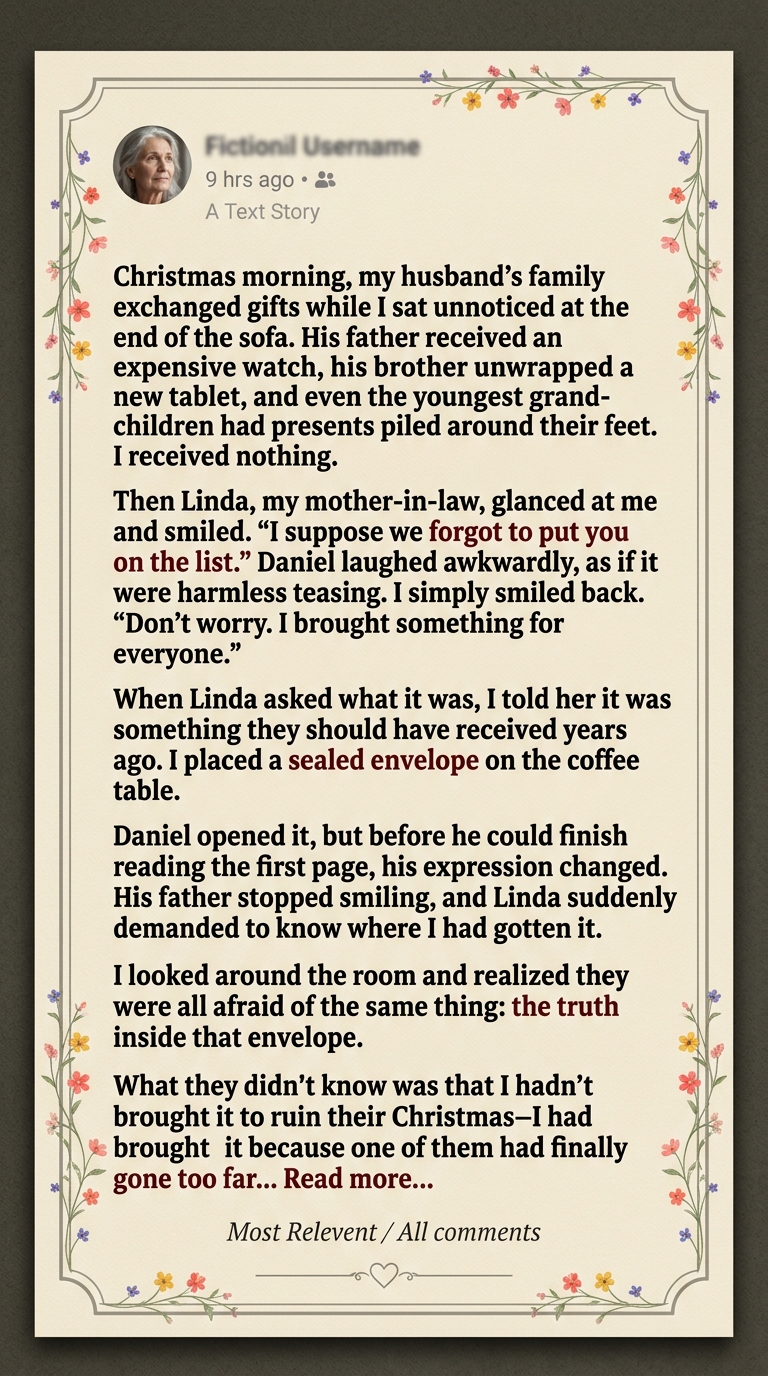
Richard received an expensive watch from Linda. Jason unwrapped a new tablet, and his wife received a designer handbag. Even the grandchildren had several presents waiting for them.
I sat at the end of the sofa, holding a cup of coffee.
Daniel had bought gifts for his parents and brother, but there was nothing with my name on it.
At first, I thought perhaps Linda had placed mine somewhere else.
Then she glanced toward me, smiled, and said, “I suppose we forgot to put you on the list.”
Jason laughed.
His wife looked uncomfortable, but she quickly lowered her eyes.
Daniel gave an awkward chuckle.
“Mom, come on.”
Linda waved a hand dismissively.
“Oh, don’t be so sensitive. She knows we’re only joking.”
I looked at my husband, waiting for him to say something meaningful.
He didn’t.
Instead, he picked up his coffee and changed the subject.
I smiled.
“Don’t worry. I brought something for everyone.”
Linda raised an eyebrow.
“How thoughtful. What is it?”
“Something you should have received years ago.”
I reached into my handbag and placed a sealed envelope on the coffee table.
Daniel looked at it.
“What is this?”
“Open it.”
He removed the papers and began reading the first page.
His expression changed almost immediately.
His father stopped smiling.
Linda leaned forward.
“Where did you get that?”
I looked around the room.
For the first time that morning, nobody was laughing.
The envelope contained copies of financial records, signed agreements, and correspondence relating to a small commercial property Richard and Linda had owned before Daniel and I married.
To understand why those documents mattered, I needed to explain something that had happened seven years earlier.
Shortly before our wedding, Daniel’s parents had approached me with a business opportunity.
They owned a small warehouse on the edge of town. It had been rented to a furniture distributor for years, but the tenant had moved out, leaving the building vacant.
Richard wanted to sell it quickly.
Unfortunately, the property had an outstanding loan, and the bank was demanding repayment. The family couldn’t agree on a sale price, and Richard was worried the bank would take action before he found a buyer.
Daniel asked me to help.
At the time, I worked as an accounts manager for a regional property company. I had some savings, and I understood enough about commercial leases to recognize that the warehouse could become profitable with a few improvements.
I agreed to lend Richard and Linda $68,000 to cover the immediate loan arrears and essential repairs.
In exchange, Richard signed a formal loan agreement acknowledging the amount, the repayment schedule, and the interest-free terms I had offered.
He also signed a separate agreement granting me a registered security interest over the property until the debt was repaid.
Linda witnessed the documents.
Daniel was present when his father signed.
They promised the money would be returned within eighteen months, once the property was leased.
I trusted them.
The warehouse was repaired, a new tenant moved in, and the rental income began arriving regularly.
But when the repayment date came, Richard asked for more time.
Then he asked again.
Eventually, he stopped discussing the loan altogether.
Whenever I brought it up, Linda became offended.
“We’re family,” she would say. “You shouldn’t be keeping accounts like a stranger.”
Daniel always asked me to be patient.
“They’re my parents,” he would remind me. “They wouldn’t deliberately take advantage of you.”
I wanted to believe him.
Over the years, I stopped asking.
Then, eight months before that Christmas, I received a letter from a solicitor representing a property investment company.
The company was interested in purchasing the warehouse.
During its preliminary title search, it discovered my registered security interest and requested confirmation that the debt had been settled.
I was confused.
I had never been paid.
I contacted the solicitor and requested the transaction records. What came back was far more disturbing than a simple missed repayment.
Richard and Linda had signed a declaration claiming the loan had been fully repaid.
Attached to it was a receipt bearing my name.
The signature looked convincing at first glance, but I had never signed it.
Someone had copied my signature onto a document stating that I had received the entire $68,000.
The declaration had been used to support an application to remove my security interest from the property records.
The application had been rejected because the supporting documentation did not meet the required verification standards.
The solicitor wanted to know whether I had authorized the receipt.
I told him I had not.
He advised me to preserve every document and obtain independent legal representation.
I did.
The first thing my solicitor discovered was that the supposed repayment receipt had been prepared by a bookkeeper who worked for Richard’s property business.
The second discovery was more troubling.
Daniel had emailed that bookkeeper six months earlier, asking her to prepare a document showing that the loan had been settled.
In the email, he wrote that his father wanted to sell the warehouse without any complications and that the family would deal with me privately afterward.
I read that email several times.
My husband had known about the false receipt.
He had helped arrange it.
When I confronted him, he didn’t deny it.
“Mom and Dad were under pressure,” he said. “They were trying to complete the sale.”
“By pretending they had paid me?”
“They intended to sort it out.”
“You knew I hadn’t received a penny.”
Daniel rubbed his forehead.
“I thought it would be temporary.”
“How long did you expect me to believe that?”
He had no answer.
I asked whether Linda and Richard knew the document was false.
He said his father had instructed the bookkeeper, and his mother had signed the declaration.
Then he made the mistake that finally changed everything.
“Please don’t turn this into a legal battle. They’re my parents. We can work it out privately.”
I looked at him.
“You helped them use my name on a false document. What exactly do you think we have left to work out?”
He insisted that he would speak to them.
He never did.
Instead, he began telling his family that I was becoming obsessed with money and that my professional background had made me suspicious of ordinary family arrangements.
Linda started making comments about how I was too controlling.
Richard stopped inviting me to business discussions.
And Daniel continued acting as though the entire situation would disappear if nobody mentioned it.
Then, two months before Christmas, the investment company made another offer for the warehouse.
This time, its solicitors requested a formal resolution of the outstanding debt before completion.
My solicitor sent Richard a notice requiring repayment or a legally acceptable settlement.
Richard responded through his lawyer, insisting that the loan had been discharged.
That was when I decided I would no longer allow them to tell two different versions of the same story.
I had the documents independently examined, obtained copies of the relevant correspondence, and prepared a formal statement explaining that the receipt had not been signed by me.
I also filed a complaint with the appropriate authorities concerning the suspected falsification of the financial documents.
I did not know exactly what consequences would follow. That was for the investigators and courts to determine.
But I knew one thing.
I would not allow my name to be used to conceal someone else’s actions.
And now, on Christmas morning, those documents were sitting in front of my husband’s family.
Daniel turned another page.
“Why did you bring this here?” he asked quietly.
“Because I’ve spent seven years being told that I’m part of this family whenever someone needs money, help, or a favor. But apparently, I’m not important enough to remember when Christmas presents are being handed out.”
Linda’s face tightened.
“This is not the time or place to discuss business.”
“You made it business when you used my signature.”
Richard stood up.
“Watch your tone.”
I remained seated.
“You’ve had seven years to return the money. You’ve had months to correct the false declaration. And you’ve had several opportunities to tell the truth. Instead, you decided I was the problem.”
Linda snatched one of the pages from Daniel.
“This is private. You had no right to bring these documents into our home.”
“They are copies of documents concerning money you borrowed from me and a declaration bearing my name. I have every right to discuss them with my husband.”
Richard looked toward Daniel.
“Tell her to stop.”
Daniel didn’t move.
For the first time that morning, he seemed unable to hide behind his usual excuses.
I placed another sheet on the table.
It was a letter from my solicitor confirming that the security interest remained registered and that the disputed receipt had not been accepted as proof of repayment.
“The warehouse cannot be sold free of my claim unless the debt is properly resolved,” I explained. “The buyer has been informed of the dispute. Your solicitor has also received the evidence.”
Richard’s face turned red.
“You’ve ruined the sale.”
“No. The false declaration did that.”
Linda looked at Daniel.
“Did you know she was doing this?”
He nodded.
“She told me she was getting legal advice.”
“And you let her?”
Daniel looked at his mother.
“Mom, we shouldn’t have used that receipt.”
Linda stared at him.
“Your father was trying to protect the property.”
“By pretending she’d been paid?”
Richard slammed his hand against the table.
“I was going to repay her!”
I looked at him.
“When?”
He opened his mouth.
Nothing came out.
Jason had remained silent throughout the conversation. Now he leaned forward.
“Wait. Are you saying Dad used your signature to clear the loan?”
“That’s what the documents indicate,” I replied. “The matter is being investigated.”
Jason looked at his father with disbelief.
“Why didn’t you just tell us you owed her the money?”
Richard turned on him.
“Stay out of this.”
But Jason didn’t retreat.
“You told me the property was debt-free. You told me the buyer was being unreasonable.”
Linda suddenly began gathering the papers.
“We are not discussing this in front of the children.”
I looked at her.
“Then perhaps you should have thought about that before making me the family joke.”
Nobody said anything.
I stood, picked up my handbag, and looked at Daniel.
“I’m going home.”
He followed me into the hallway.
“Eleanor, wait.”
I turned.
“Please don’t leave like this.”
“How would you prefer I leave? Smiling? Pretending you didn’t know?”
He looked toward the living room.
“I know I handled things badly.”
“You didn’t handle them badly, Daniel. You chose to help your parents use a false document against your own wife.”
“I was trying to keep everyone happy.”
“And you were willing to make me pay for it.”
He lowered his head.
I continued.
“I didn’t bring that envelope to ruin Christmas. I brought it because your family has spent years treating my patience as permission. I wanted everyone to hear the same truth at the same time.”
He reached for my hand.
I stepped back.
“Don’t ask me to forget this because it’s Christmas.”
I left.
The investigation continued over the following months.
The bookkeeper provided a statement explaining that Richard had asked her to prepare the repayment receipt using an old copy of my signature. She said Daniel had supplied the wording for the document and had known that no payment had been made.
Richard’s solicitor eventually advised him that continuing to dispute the evidence would be difficult.
The warehouse sale was delayed until the outstanding debt could be resolved.
After further negotiations, Richard agreed to repay the original $68,000, along with the contractual costs and interest that had accumulated under the terms of the agreement. The repayment was secured through the sale proceeds, and the security interest was removed only after the funds had cleared.
The suspected falsification was also referred for formal review. Richard and Daniel had to provide statements, and the bookkeeper cooperated with the investigation.
I didn’t celebrate their embarrassment.
I simply wanted the truth established and my money returned.
But the consequences inside my marriage were harder to resolve.
Daniel apologized repeatedly. At first, his apologies focused on how much pressure his parents had been under. Eventually, after several difficult conversations, he admitted that he had been more afraid of disappointing his father than he had been concerned about betraying me.
That admission hurt more than the money.
We attended marriage counseling, but I refused to make promises simply because Daniel was finally willing to acknowledge what he had done.
For months, I stayed with my sister while we worked through the separation. We had no children, and there were no complicated custody arrangements, but there was a long history of decisions I had never questioned because I believed we were a team.
Eventually, I realized I couldn’t rebuild trust with someone who had helped his family erase my place in their financial records and then expected me to remain silent.
I filed for divorce.
Daniel didn’t fight it.
Linda sent me a message several weeks later.
She wrote that Christmas had been a misunderstanding, that families sometimes made mistakes, and that she hoped we could put the matter behind us.
I replied with one sentence.
“Repayment settled the debt, but it did not erase what you chose to do.”
I never heard from her again.
A year later, I received a small package from Jason. Inside was a handwritten note.
He apologized for laughing when his mother made the joke about forgetting my gift. He admitted that he had known his parents were having financial problems but hadn’t understood that I was the person being asked to carry them.
He also enclosed a Christmas ornament.
It was a simple glass star, with a small handwritten label:
For the person who should never have been left off the list.
I placed it on my own Christmas tree.
That Christmas, I celebrated in my apartment with friends who had become family. There were no expensive watches or designer bags, just good food, silly games, and presents chosen because people genuinely knew one another.
I didn’t receive a gift from Daniel’s family.
But I no longer needed one.
For years, I had believed that being accepted by my husband’s family meant proving I was patient, generous, and willing to overlook their behavior.
That Christmas taught me something different.
Being family should never require someone to surrender their dignity, their money, or the truth.
And sometimes, the most important gift you can give yourself is the decision to stop pretending you don’t deserve a place at the table.