The Woman Who Used My Identity in the Operating Room Was Connected to a Secret My Mother Had Buried for Thirty Years
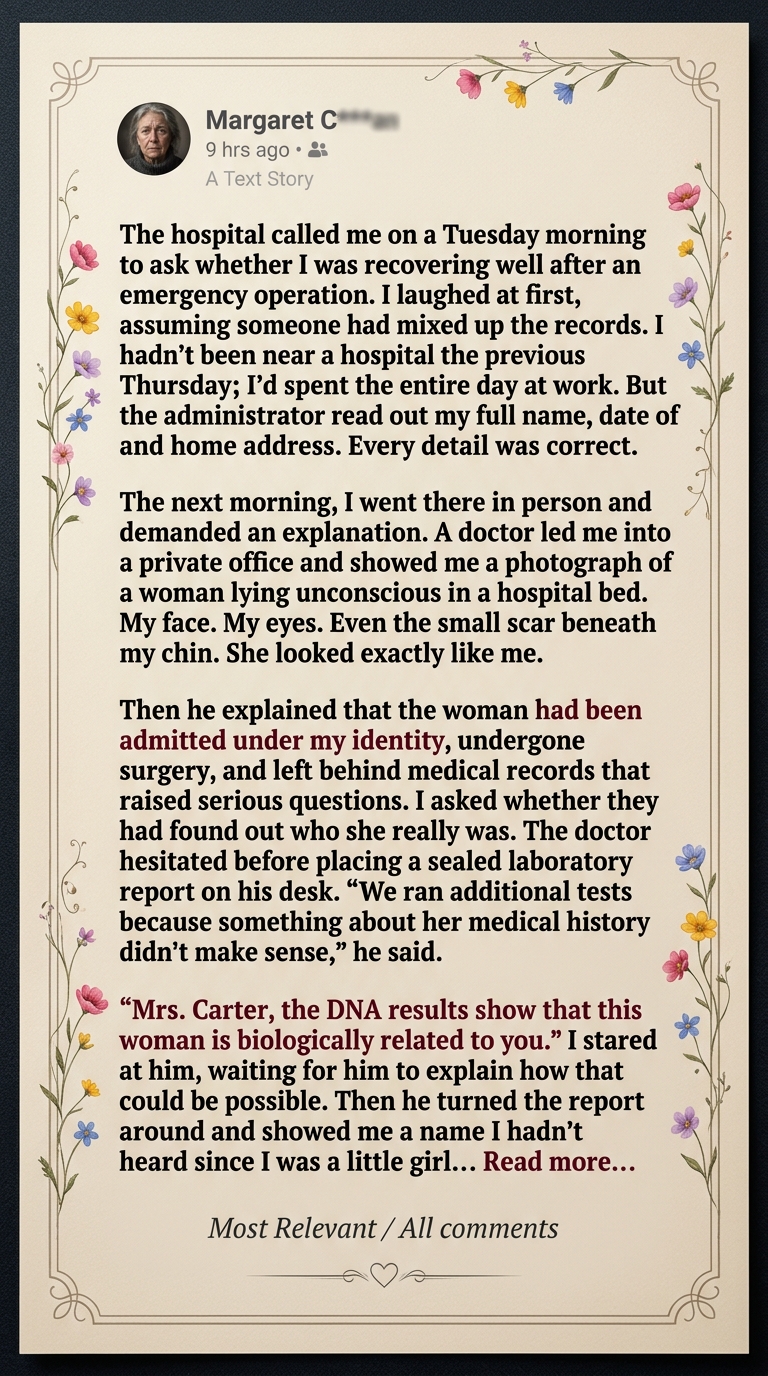
The hospital called me on a Tuesday morning while I was making coffee before work.
“Mrs. Carter? I’m calling from St. Anne’s Medical Center. We wanted to check how you’re recovering after your emergency operation last Thursday.”
I laughed because I thought the woman had the wrong number.
“I’m sorry, but I’ve never had an operation there.”
There was a pause.
“Are you certain? Our records show that you were admitted last Thursday evening and underwent emergency abdominal surgery.”
“I was at work all day Thursday. I haven’t been in a hospital for months.”
The administrator asked me to confirm my full name, date of birth, and home address. I gave her the information, expecting her to discover the mistake.
Instead, her voice became more cautious.
“Those details match our patient records exactly. I’m going to ask our medical records department to review this. Someone will contact you.”
I spent the rest of the morning unsettled. At first, I suspected identity theft, perhaps someone had used my insurance information. But I couldn’t understand how anyone could have received surgery using my identity without my knowledge.
The following morning, I went to St. Anne’s.
A hospital administrator met me at reception and escorted me to a private office. A doctor named Dr. Bennett was waiting.
He didn’t waste time.
“Mrs. Carter, I want to apologize for the confusion. We have reason to believe a patient was admitted using your identity.”
“Who was she?”
“We’re trying to establish that.”
He opened a file and showed me a photograph.
A woman lay unconscious in a hospital bed. Her dark hair was spread across the pillow. Her eyes were closed, but even so, the resemblance was unmistakable.
She had my face.
My nose, my mouth, the slight curve of my left eyebrow, and even the small scar beneath my chin that I’d received falling off a bicycle when I was nine.
I gripped the edge of the desk.
“Who is that?”
“She was brought in by ambulance after collapsing outside an apartment building. She was unconscious when she arrived. The identification she carried had your name and photograph.”
“Did she survive?”
“Yes. The surgery was successful. She regained consciousness the following morning, but she left before our staff could complete the usual discharge process. We later discovered that the contact information in her file was false.”
I stared at the photograph again.
“Why did you say her medical history raised questions?”
Dr. Bennett hesitated before removing another document.
“During treatment, we discovered a discrepancy between the medical history she provided and the results of certain tests. Because of that, additional testing was ordered. One of those tests was a DNA analysis.”
He turned a sealed laboratory report toward me.
“The results show that the woman is biologically related to you.”
I looked at him, unable to understand.
“How closely related?”
He opened the report and pointed to a name listed in the identification section.
Rebecca Hayes.
For several seconds, the room seemed to disappear.
I hadn’t heard that name since I was a little girl.
Rebecca was my older sister.
At least, that was what my mother had told me before she died.
When I was seven, Rebecca had supposedly drowned during a family holiday. My parents had never shown me a photograph of her after that day. There had been no funeral I could remember, only a quiet house, my mother crying behind a closed bedroom door, and my father telling me that we should never upset her by asking questions.
I remembered one other thing.
My mother kept a small silver bracelet in her bedside drawer. It had two tiny engraved initials: R.H.
Whenever I asked about it, she would close the drawer and say, “Some memories are too painful to keep bringing back.”
I had assumed it belonged to my dead sister.
Now a doctor was telling me that Rebecca Hayes was alive.
“How can this be?” I whispered.
Dr. Bennett explained that the DNA testing had established a close biological relationship, but it couldn’t determine our exact family history from the limited sample alone. The hospital had contacted me because my identity had been used and because the woman had listed me as her emergency contact.
“Did she ask for me?” I said.
“Not by name. But before leaving, she asked whether anyone had contacted the person whose identification she used. She seemed frightened when our staff mentioned the possibility of a police report.”
I asked for her last known address.
The hospital couldn’t provide private patient information without proper authorization, but the police had already been notified about the identity misuse. Dr. Bennett suggested I speak with the investigating officer.
I did so that afternoon.
Detective Morgan listened carefully as I explained everything. He confirmed that the woman had left the hospital before her identity could be verified. He also told me that she had been staying in a rented room under an assumed name.
“Do you think she intended to steal my identity?” I asked.
“We don’t know yet. But using another person’s identification to obtain medical treatment is serious. We need to find out why she did it.”
I gave him my old family information and explained what my mother had told me about Rebecca’s supposed death.
The detective wrote down every detail.
Then he asked a question that made my stomach tighten.
“Do you know whether your sister had any medical conditions?”
I shook my head.
“She was only ten when she supposedly drowned.”
He looked at his notes.
“The woman at the hospital had a medical history that suggests she may have been receiving treatment for a hereditary condition. That was one reason the doctors ordered additional testing.”
I thought of my father, who had died when I was twenty-three, and my mother, who had passed away six years later. Both had avoided discussing Rebecca.
For the first time, I wondered whether the story of her death had been a lie.
Two days later, Detective Morgan called.
They had located Rebecca at a small residential building on the edge of the city. She had been living there for several months, moving between temporary jobs and avoiding contact with relatives.
The detective asked whether I wanted to meet her.
I said yes.
When I entered the interview room, a woman was sitting at the table with her hands folded in front of her.
She looked older than I expected, though she was only five years older than me. Her hair was shorter than mine, and there was a pale surgical scar beneath her ribs.
But the resemblance was undeniable.
She stood when she saw me.
For a moment, neither of us spoke.
Then she whispered, “Claire.”
I hadn’t heard anyone say my name that way before.
“Rebecca?”
She nodded, and tears filled her eyes.
I wanted to hug her. I wanted to demand answers. Instead, I remained where I was.
“Why did you use my identity?”
She looked down.
“Because I was afraid they would refuse to treat me.”
“Who?”
“My employer’s insurance company. I had no insurance of my own. I’d been sick for months, and when I collapsed, I panicked. I had an old copy of your identification from a box of family documents. I used it because I knew our faces were almost identical.”
“You had my identification?”
“Not the original. Just a photocopy. I changed the photograph on a card I had made. I know how terrible that sounds.”
“It sounds like you stole my identity.”
“I did.”
She didn’t try to deny it.
I sat across from her.
“Why did our mother tell me you were dead?”
Rebecca’s expression changed. She looked toward Detective Morgan, who had agreed to remain in the room.
“Because she believed it was the only way to protect me.”
That answer made no sense.
Rebecca took a long breath.
When she was ten, she had been diagnosed with a rare inherited heart condition. The doctors told our parents that she would need regular specialist care and that the condition could become dangerous without treatment.
Our father had health insurance through his employer, but it did not cover the specialist treatment Rebecca needed. At the same time, he had been offered a job in another state. The move would have meant losing access to the hospital where Rebecca was being treated.
Our parents argued constantly.
Eventually, our mother took Rebecca to live with her sister, who lived near the specialist hospital. She told our father that she was arranging temporary care.
But when the arrangement became permanent, our parents’ marriage collapsed.
Our father accused our mother of abandoning the family. Our mother accused him of refusing to accept Rebecca’s condition and of wanting to move away regardless of the consequences.
The separation became bitter. Neither parent wanted to surrender custody, and both were exhausted by the financial and emotional demands.
Then something happened that changed everything.
Rebecca’s condition worsened, and she was admitted to the hospital for emergency treatment. Our mother was told that Rebecca might not survive.
She called our father.
He came to the hospital, but by the time he arrived, our mother had already made a decision. She believed he would take Rebecca away if he knew how serious her condition had become. She also feared that he would blame her for every medical complication.
Instead of telling him the truth, she claimed Rebecca had died.
Our father was devastated.
He returned home and told me my sister was gone.
Rebecca survived.
Our mother continued raising her with help from her sister and a small circle of relatives. She changed Rebecca’s surname and avoided any official contact with our father’s side of the family.
“Why didn’t you ever try to find me?” I asked.
Rebecca’s eyes filled again.
“I did. When I was eighteen, I found your name online. I wrote you a letter, but Mom found it before I could send it. She told me you had grown up believing I was dead and that contacting you would destroy your life.”
“So you believed her?”
“I was angry. I thought she was trying to keep control of both of us. I left home, but I didn’t know how to find you without making things worse.”
She paused.
“Then I got sick again. I spent years working and trying to manage the condition. I kept telling myself I would contact you when I was healthy enough to explain everything.”
“And you waited until you needed my identity.”
Her face crumpled.
“Yes. I know how that sounds. I didn’t come looking for you because I wanted a sister. I came looking for a way to get treatment.”
The honesty hurt more than an excuse would have.
Detective Morgan reminded Rebecca that the identity fraud still had to be investigated. She would need to cooperate, provide her true medical information, and answer questions about the false identification.
Rebecca agreed.
I left the station without promising her anything.
Over the next several weeks, the truth became clearer. My mother had concealed Rebecca’s survival from me, but the family conflict had been more complicated than Rebecca initially described. My father had eventually learned that Rebecca was alive through a relative, but he had been told that she wanted no contact with him. He never tried to challenge that claim.
After his death, I found a photograph of Rebecca among his belongings. On the back, he had written her name and the date of her tenth birthday.
He had kept it for the rest of his life.
That discovery made me angry with both my parents. They had each allowed their bitterness to shape the story I grew up believing. They had taken away my chance to know my sister, and they had taken away Rebecca’s chance to know me.
But it also made me understand that Rebecca had grown up inside the same silence, only from the other side.
The hospital arranged for her to receive proper medical evaluation under her real identity. With the help of a patient assistance program, she was connected to a specialist who could manage her condition. She also faced legal consequences for using my identity, but her cooperation and the circumstances surrounding the emergency treatment were taken into account.
I did not pay her bills or pretend that what she had done was acceptable.
I did, however, agree to meet her again.
Our first meeting outside the police station was awkward. We went to a quiet café and sat across from each other for nearly twenty minutes before either of us found something to say.
Finally, Rebecca asked, “Do you remember the summer we built a tent in the backyard?”
I stared at her.
I had a vague memory of a girl with dark hair holding a blanket over two garden chairs. I remembered someone telling me to stay quiet because we were hiding from imaginary soldiers.
“That was you?”
She smiled through her tears.
“You kept stealing the biscuits from our secret supplies.”
I laughed before I could stop myself.
It was a small memory, but it belonged to both of us.
Over the next year, we slowly built a relationship. We exchanged photographs, talked about our parents, and learned the ordinary details that siblings usually know without having to ask.
Rebecca told me about the years of hospital appointments and the jobs she had taken to support herself. I told her about school, my marriage, and the life she had missed.
We didn’t become inseparable overnight. There were difficult conversations, especially about the false identification and the years of silence. I made it clear that trust would take time, and she accepted that.
One afternoon, she brought me the silver bracelet from our mother’s bedside drawer.
It was the same one I remembered from childhood.
She placed it in my palm.
“Mom gave it to me before she died,” she said. “She told me it belonged to the sister I had lost.”
I looked at the initials engraved inside.
R.H.
For years, I had thought the bracelet was a reminder of someone who had died.
Now I understood that it had been a reminder of someone who was still waiting to be found.
I closed my fingers around it.
“You should have come to me sooner,” I said.
“I know.”
“And you should never have used my identity.”
“I know that too.”
We sat quietly for a while.
Then I moved my chair closer.
I couldn’t give Rebecca back the years we had lost, and I couldn’t erase what she had done. But I could choose what happened next.
For the first time in thirty years, I had my sister back—not as the little girl in my mother’s story, but as the complicated, frightened, stubborn woman sitting beside me.
And this time, neither of us had to disappear.