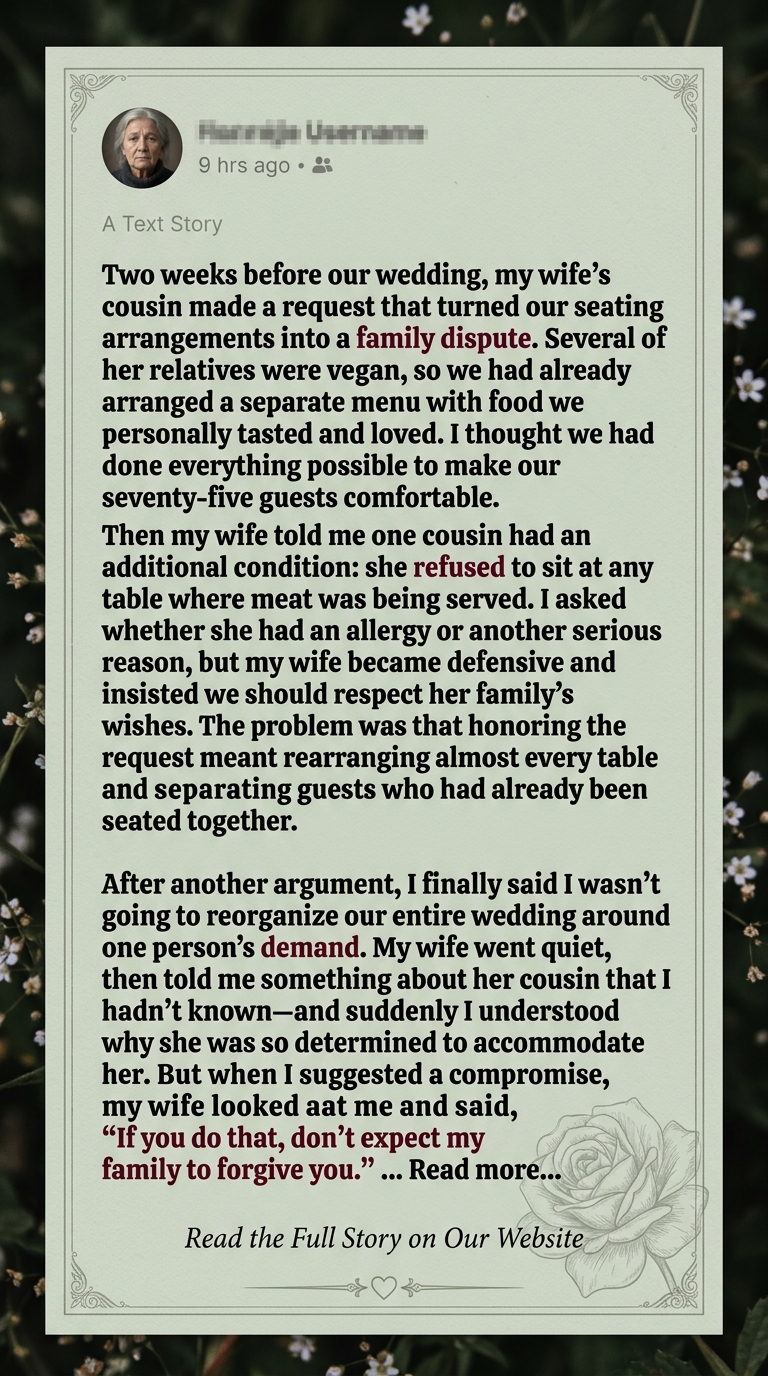
Two weeks before our wedding, I discovered that a seating chart could cause more trouble than choosing a venue, negotiating with vendors, or deciding which relatives deserved an invitation.
My fiancée, Hannah, and I had spent almost a year planning a wedding for seventy-five guests. We wanted something intimate, relaxed, and welcoming. Neither of us cared about impressing people with expensive decorations or elaborate traditions. We simply wanted our families and friends to enjoy the day.
Hannah had several relatives who were vegan, so we had arranged a separate menu with the caterer. It included roasted vegetable parcels, mushroom risotto, lentil pastries, and a rich chocolate dessert made without dairy or eggs.
We had tasted everything ourselves.
Even my brother, who considered a meal incomplete without meat, admitted the mushroom risotto was excellent.
I thought we had handled the dietary arrangements fairly.
Then Hannah came home one evening holding her phone, looking unusually tense.
“There’s a problem with the seating plan,” she said.
I was working on the table assignments at the kitchen counter.
“What now?”
“It’s about Melissa.”
Melissa was Hannah’s cousin. She was thirty-one, vegan, and generally pleasant, although I had only met her a handful of times.
“What about her?”
“She doesn’t want to sit at a table where meat is being served.”
I looked up.
“Does she have an allergy?”
“No.”
“Is there another medical reason?”
Hannah shook her head.
“She says she doesn’t feel comfortable eating around meat.”
I considered that for a moment.
“Then we’ll put her at a table with the other vegan guests. We already have six people who requested vegan meals.”
“That’s not enough.”
“Why?”
“She doesn’t want to sit near meat either. She says even seeing it being served makes her uncomfortable.”
I put down my pen.
“How far does that extend? Does she mean her table, or the entire dining room?”
“She wants to sit in a section where no meat is served.”
I stared at her.
“Hannah, the entire reception is in one dining room.”
“I know.”
“And the caterer is serving different meals at different tables.”
“I know that too.”
I tried to remain calm.
“We’ve already paid the final deposit. We can’t divide the entire room into separate dining areas at this stage.”
Hannah crossed her arms.
“She’s family. I don’t understand why you’re making this difficult.”
“I’m not making anything difficult. I’m asking what exactly she expects us to do.”
“She wants us to rearrange the seating.”
I turned the laptop toward her.
The seating chart had taken days to complete. We had grouped people according to relationships, friendships, and practical considerations. Hannah’s grandmother was seated near her sister because she had difficulty walking. My uncle was beside his longtime friend because he had recently lost his wife. Several guests had requested to sit near relatives they rarely saw.
Changing one section would affect almost every table.
“Look at this,” I said. “If we move Melissa into a separate area, we have to move at least twenty people. Some guests will be separated from their spouses’ families. Your grandmother’s table will need to change, and my uncle will end up sitting alone.”
Hannah barely glanced at the screen.
“You’re acting as if moving chairs is impossible.”
“It’s not the chairs. It’s the people.”
She walked away without answering.
For the next three days, the argument returned repeatedly.
Hannah insisted Melissa’s request was about respect. I insisted that we had already respected her dietary choices by arranging a separate menu. Neither of us could understand why the other refused to compromise.
Then, on Friday evening, Hannah finally told me the part she had been avoiding.
“Melissa has a history with food,” she said quietly.
I put down my cup.
“What kind of history?”
“When she was younger, she had an eating disorder. It became serious enough that she needed treatment.”
I hadn’t known that.
Hannah continued.
“Her recovery was difficult. She started eating vegan food because it helped her rebuild a healthier relationship with meals. She says being around meat makes her feel anxious and reminds her of a period when she had very little control over what she ate.”
My frustration softened.
“Does she have a therapist?”
“She did. She still speaks to someone occasionally.”
“Then I understand why she might need certain arrangements. But why didn’t you tell me this earlier?”
“Because it’s private. Melissa doesn’t want everyone knowing about her past.”
I nodded.
That was fair.
I didn’t need to know the details of someone’s medical history to take their discomfort seriously.
But there was still a practical problem.
“Can we speak to the caterer and find a way to serve the vegan meals first, before the meat dishes arrive? Maybe Melissa could sit at a table with the other vegan guests, and the staff could keep the serving area away from her.”
Hannah looked uncertain.
“She specifically asked not to sit where meat is served.”
“What if we create a separate table near the side entrance and serve only vegan food there?”
“She doesn’t want to feel isolated.”
“Then perhaps we can seat her with her friends in the main room and have the caterers serve those tables differently.”
Hannah shook her head.
“You still don’t understand.”
I took a breath.
“I am trying to understand. But we have seventy-five guests. We cannot promise that no meat will be visible anywhere in the room.”
She stared at me.
“Melissa says she won’t attend unless we accommodate her.”
I leaned back.
“That’s her decision. We can make reasonable arrangements, but we can’t rebuild the entire wedding around one person’s condition.”
Hannah’s expression hardened.
“She’s been through something terrible. The least we can do is make her feel safe.”
“I agree. But safety and complete control over everyone else’s meal aren’t necessarily the same thing.”
Hannah went quiet.
Then she said something that changed the conversation.
“Melissa isn’t the only person involved.”
I waited.
“Her mother, Aunt Caroline, has been struggling with her daughter’s recovery. She believes the family has spent years treating Melissa like a problem instead of supporting her. She told me that if we don’t honor the request, she’ll consider it proof that my side of the family doesn’t care about her.”
I frowned.
“So this isn’t just about Melissa’s seating.”
“It’s about making her feel accepted.”
“Then why does the entire family have to be rearranged?”
Hannah looked down.
“Because Caroline says Melissa has spent her whole life being expected to accommodate everyone else.”
I understood more now. Melissa’s request had become a symbol of something much larger in her family. Her mother wanted a public demonstration that her daughter mattered.
But a wedding reception wasn’t the place to settle years of family resentment.
I suggested one more compromise.
We could reserve a small adjoining room for the vegan guests, serve their complete meal there, and keep the doors open so they could move freely between the spaces. Melissa could choose where she felt comfortable. The other guests would keep their original seats, and nobody would be forced to change tables.
The caterer confirmed it was possible, although it would cost extra.
Hannah listened without interrupting.
When I finished, she shook her head.
“Melissa doesn’t want a separate room.”
“Then what does she want?”
“She wants the entire reception area to be meat-free.”
I stared at her.
“That’s not a compromise. That’s a completely different wedding.”
Hannah’s eyes filled.
“If you do that, don’t expect my family to forgive you.”
The words landed harder than I expected.
I closed the laptop.
“Are you telling me that if I don’t agree, your family will hold it against me?”
“I’m telling you this matters to them.”
“And what about what matters to us?”
She didn’t answer.
For the first time since we had started planning the wedding, I wondered whether we were actually arguing about food.
The following morning, I called Melissa.
I wasn’t trying to challenge her. I wanted to hear directly from the person whose needs were being discussed.
She answered cautiously.
“Hello?”
“Hi, Melissa. It’s Daniel. I hope I’m not catching you at a bad time.”
There was a brief silence.
“Is this about the wedding?”
“Yes. I wanted to talk about the seating arrangements. Hannah explained that being around meat can be difficult for you. I don’t want you to feel uncomfortable at our wedding.”
Her voice softened.
“That’s kind of you.”
“I also want to make sure we’re solving the right problem. Would a vegan table in the main room help, or is it important that meat isn’t served anywhere nearby?”
She hesitated.
“I don’t want to cause trouble.”
“You aren’t causing trouble by explaining what you need.”
Another pause followed.
Then she said something I hadn’t expected.
“I never asked for the whole room to be meat-free.”
I sat upright.
“What?”
“I asked whether there could be a vegan table away from the serving station. I didn’t want the meat platters being passed directly in front of me. I thought that was a reasonable request.”
I was silent.
“Did someone tell you I wanted the entire room changed?” she asked.
“That’s what I was told.”
Melissa sighed.
“My mother has been making it into a much bigger thing. She thinks every family gathering should prove that people support me. I understand why, but I don’t want everyone changing their plans because of me.”
I rubbed my forehead.
“Would you be comfortable with a vegan table near the windows, away from the main serving route?”
“Absolutely. I would be grateful.”
“Then I think we can arrange that.”
She thanked me and said she hoped there would be no hard feelings.
After the call, I sat for several minutes thinking about the conversation.
Hannah had not deliberately invented Melissa’s needs, but she had allowed her aunt’s interpretation to replace the request itself. In trying to protect her cousin, she had stopped listening to what Melissa actually wanted.
I found Hannah in the kitchen.
“I spoke to Melissa.”
She turned sharply.
“You called her?”
“Yes. She told me she never asked for the whole room to be meat-free. She only wanted a vegan table away from the serving station.”
Hannah’s face changed.
“She said that?”
“Yes. She was surprised we thought she wanted the entire reception rearranged.”
Hannah sat down.
“Mom must have misunderstood.”
“Or her mother turned a reasonable request into something bigger.”
She looked upset.
“I didn’t want Melissa to feel rejected.”
“I know. But you were prepared to threaten our wedding over something she hadn’t even asked for.”
Hannah didn’t argue.
After a long silence, she admitted that Aunt Caroline had called her several times. Caroline had described the request as a test of whether Hannah truly supported Melissa. She had also reminded Hannah of every family disagreement in which Melissa had felt excluded.
Hannah had become afraid that refusing Caroline would damage her relationship with the entire family.
“I thought if I didn’t agree, everyone would blame me,” she said.
I pulled out a chair.
“Then we need to stop letting other people decide what our wedding means.”
She looked at me.
“Do you think I was wrong?”
“I think you were trying to protect someone you love. But you forgot that we were supposed to make these decisions together.”
Her eyes filled.
“I’m sorry.”
I reached across the table.
“We can still make Melissa comfortable. We just need to ask her what actually helps.”
That afternoon, we finalized the revised seating arrangement.
Melissa received a vegan table near the windows, away from the main serving route. The caterer agreed to bring her food directly from the kitchen and serve the vegan guests first. We also arranged for a small separate preparation area to prevent cross-contact with animal products.
The rest of the guests kept their original seats.
Aunt Caroline was not pleased.
She called Hannah that evening and accused us of making Melissa feel like an outsider.
Hannah listened, then answered calmly.
“Mom, Melissa told Daniel exactly what she needed. We’ve arranged it. I won’t turn her request into something she didn’t ask for, and I won’t rearrange everyone else’s seats to satisfy an argument you and I are having.”
Caroline became angry.
“You’re choosing him over your family.”
“No,” Hannah replied. “I’m choosing to listen to the person this is supposed to be about.”
The call ended badly, but Hannah didn’t change the arrangements.
On the wedding day, Melissa arrived wearing a pale blue dress and carrying a small gift for us. She found her seat near the windows and thanked the catering manager for the arrangements.
During dinner, she came over to our table.
“I just wanted to say thank you,” she told us. “I know this caused more trouble than it should have.”
Hannah hugged her.
“I’m glad you’re here.”
Melissa smiled.
“Your husband actually listened to me. That’s all I wanted.”
Hannah glanced at me, then nodded.
“I should have listened sooner.”
The evening continued without further problems. Guests enjoyed their meals, the speeches were warm, and my uncle even persuaded three people to join him on the dance floor.
Aunt Caroline remained distant throughout the reception. She left shortly after dessert, offering only a brief goodbye.
I was disappointed, but I understood that not every disagreement could be repaired in a single evening.
Several weeks later, Hannah received a message from Melissa.
She thanked us again and explained that she had spoken with her mother about the pressure she had been placing on family gatherings. She wanted her recovery to be respected, but she didn’t want every event to become a public test of loyalty.
Hannah replied that she understood and that we would always ask her directly about what made her comfortable.
Our marriage had barely begun, but that wedding dispute taught us something important.
We had thought the problem was a seating chart. In reality, it was the difference between supporting someone and deciding on their behalf what support should look like.
Melissa needed consideration, not control over seventy-five other people. Hannah needed to learn that protecting her family didn’t mean agreeing with every demand made in its name. And I needed to remember that a reasonable compromise could only work when everyone involved was allowed to speak for themselves.
The wedding had gone ahead without the dramatic family split Aunt Caroline predicted.
More importantly, Melissa had enjoyed the evening, and nobody had been forced to choose between their meal and their place in the family.
I still have the original seating chart saved on my computer. I keep it because whenever Hannah and I disagree about something, we sometimes joke that we should check whether we’re accidentally trying to rearrange seventy-five people again.
But the lesson behind it is one we take seriously.
A family can make room for someone’s needs without making everyone else disappear.
And sometimes the kindest thing you can do is stop arguing about what someone supposedly wants and simply ask them.