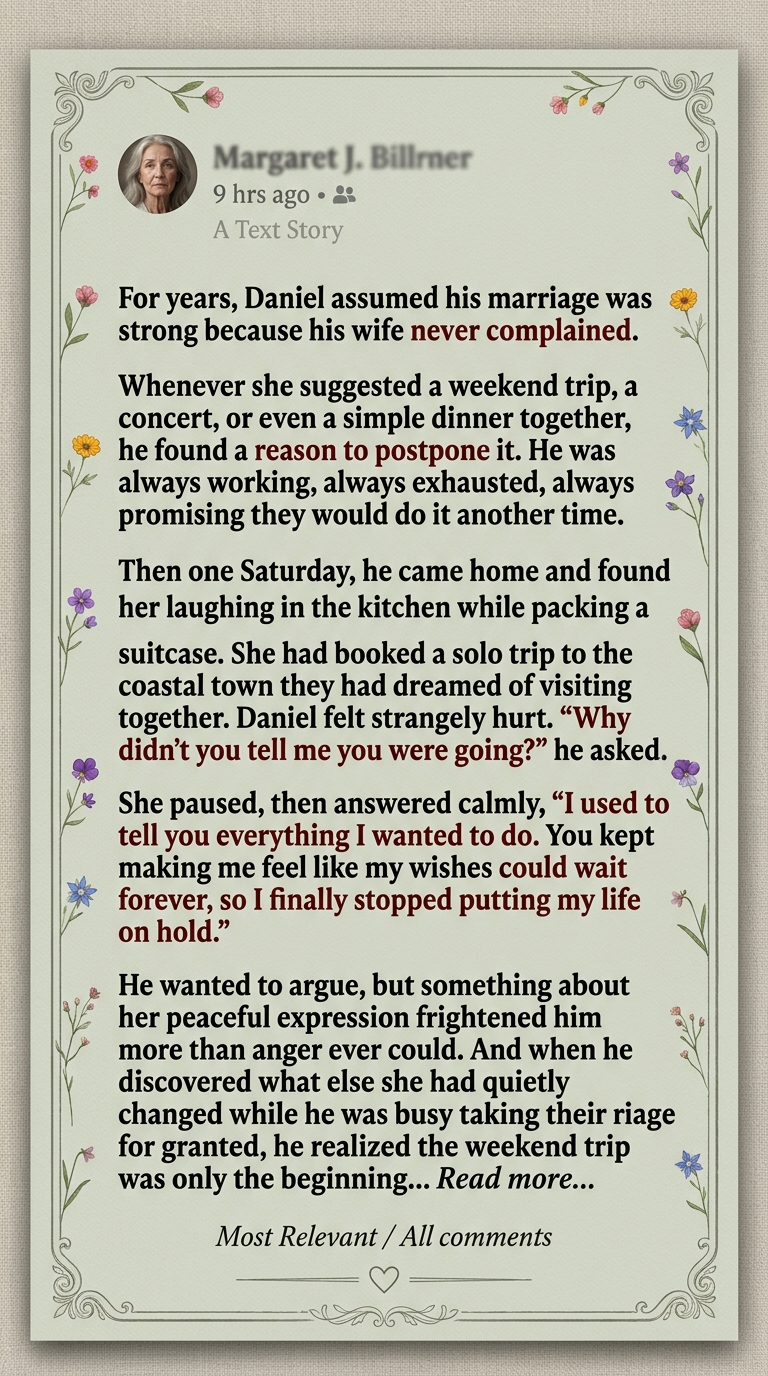
For years, Daniel believed he had a happy marriage because his wife, Claire, rarely complained.
They had been married for eleven years, and from the outside, their life looked comfortable. They owned a modest house, paid their bills on time, and had never experienced the kind of explosive arguments that made friends whisper about divorce. Daniel considered that a sign they were doing well.
What he failed to understand was that silence was not always a sign of happiness.
Claire had never asked for expensive gifts or extravagant vacations. Most of what she wanted was simple. A Saturday afternoon at the farmers’ market. Tickets to a concert. Dinner at the little Italian restaurant they had visited on their second date. Once, she had suggested spending a weekend in Bellhaven, a coastal town with colorful houses, quiet beaches, and a lighthouse they had seen in a travel magazine years earlier.
Daniel always had an excuse.
“Let’s do it next month,” he would say.
Then next month became another deadline, another project, another weekend spent answering emails from his home office.
When Claire asked whether he could take Friday off for her birthday, he promised to make it up to her. When she suggested a short road trip after his promotion, he said he needed to prove himself at work. Even their anniversary dinner had been postponed twice before Claire finally stopped mentioning it.
Daniel never told her that her ideas were unimportant. He simply behaved as though they could wait.
And because Claire rarely argued, he assumed she understood.
The change began quietly.
She started taking evening walks alone. She joined a photography class at the community center and began spending Saturday mornings there. She rearranged the spare room into a small studio, replacing the boxes Daniel had promised to move with a desk, shelves, and framed photographs of places she had visited during her childhood.
Daniel barely noticed.
When he did, he congratulated her for finding hobbies to occupy her free time.
Claire smiled politely.
Then, one Saturday morning, Daniel returned from the office earlier than expected.
He heard laughter coming from the kitchen.
Claire stood beside the counter, folding clothes into an open suitcase. Her phone was propped against a jar, displaying photographs of a seaside hotel. She looked happier than he had seen her in months.
“Going somewhere?” he asked.
“Bellhaven,” she replied.
Daniel stopped.
“Bellhaven? This weekend?”
“Yes. I booked the room last night.”
He stared at the suitcase.
“Why didn’t you tell me you were going?”
Claire paused, then looked at him.
“I used to tell you everything I wanted to do. You kept making me feel like my wishes could wait forever, so I finally stopped putting my life on hold.”
Daniel felt an unexpected sting.
“You could have asked me again.”
“I did. Many times.”
“Well, things have been busy.”
“I know. They’ve been busy for eleven years.”
He wanted to defend himself, but her voice held no anger. That was what unsettled him. She wasn’t trying to punish him. She was simply making plans without expecting him to participate.
“How long will you be gone?” he asked.
“Three nights.”
“Three nights? What about everything here?”
Claire zipped the suitcase.
“Everything here will be fine.”
She kissed his cheek before leaving, and Daniel stood in the kitchen listening to the front door close.
At first, he was irritated.
He spent the afternoon telling himself she was being dramatic. Couples needed independence, and a short trip was hardly a crisis. He even considered calling her to suggest that he join her the following day.
But when he opened their shared calendar to check her hotel details, he noticed something strange.
The calendar had changed.
For years, Claire had entered his work commitments, family birthdays, medical appointments, and household reminders. Now, almost every weekend was blocked off with activities labeled simply as “Claire.”
He clicked through them.
A photography exhibition. A weekend workshop. A visit to her sister. A coastal walking tour. Several dates marked for a project he didn’t recognize.
He called her.
“What’s this project you’re working on?”
There was a brief silence.
“It’s a photography exhibition.”
“Since when?”
“Since January.”
“January? Why didn’t you tell me?”
“I did. You were preparing for your quarterly presentation.”
Daniel rubbed his forehead.
“Claire, I’m not trying to start an argument. I just feel like I’m finding out about your life from a calendar.”
She gave a quiet laugh.
“That’s because you stopped asking about it.”
He had no answer.
After hanging up, Daniel wandered into the spare room. The space looked completely different. A large monitor stood on the desk, surrounded by photographs and folders. On the wall was a calendar filled with deadlines.
He noticed a printed invoice from a photography equipment supplier and a brochure from a local art gallery.
Beneath them sat a small stack of business cards.
Claire Morgan — Photographer.
Daniel picked one up.
He had known she enjoyed taking pictures, but he hadn’t realized she was treating it as anything more than a hobby.
When Claire returned on Tuesday evening, she looked refreshed. She carried a small bag of souvenirs and had a camera hanging from her shoulder.
Daniel helped her with the suitcase.
“Did you have a good time?”
“Wonderful.”
“Did you go to the lighthouse?”
“Twice. The second time, I stayed until sunset.”
He nodded, then hesitated.
“Can we talk?”
Claire placed her camera on the table.
“Of course.”
Daniel had prepared several things to say. He wanted to explain that work had been overwhelming, that he never intended to make her feel neglected, and that he still loved her.
But the words sounded inadequate when he finally spoke.
“I didn’t realize how unhappy you were.”
Claire looked at him for a long moment.
“I wasn’t always unhappy, Daniel. I was lonely. There’s a difference.”
He lowered his eyes.
She continued.
“Do you remember when I wanted us to visit Bellhaven for our tenth anniversary?”
“Yes.”
“I had already researched the hotels, found a little restaurant, and planned a walk along the cliffs. I even asked your assistant whether you could take Friday off because I wanted it to be a surprise.”
Daniel looked up.
“You spoke to my assistant?”
“She told me you had declined the leave request because of a meeting. I understood. But when I asked you about it that evening, you said you hadn’t even looked at the calendar.”
He remembered that conversation vaguely. He had been distracted by a difficult client and had barely listened.
“I thought we would go eventually,” he said.
“I know. But eventually became a place where all my plans went to die.”
The sentence stayed between them.
Then Daniel noticed a folder beside her camera.
“What is that?”
“My application.”
“For what?”
Claire took a breath.
“An eight-month photography residency in Port Mason. It’s a small coastal arts program. They select twelve photographers each year, provide studio space, and arrange exhibitions with local galleries.”
Daniel stared at her.
“You’re leaving for eight months?”
“I’ve been accepted. I leave in six weeks.”
He sat down.
“Why didn’t you discuss this with me before applying?”
“I wanted to know whether I could do it before asking you to approve it.”
“Approve it? I’m your husband.”
“Exactly. I wanted a husband who would be excited about something I had worked hard for. I didn’t want to spend another year convincing you that my dreams deserved a place on your calendar.”
Daniel felt the room shift beneath him.
For the first time, he understood that the weekend trip had not been an impulsive decision. It was evidence of a much larger change.
He looked at the acceptance letter. Her name was printed at the top, followed by the details of the program and the date she was expected to arrive.
“Have you already paid for it?”
“Part of it. I received a small grant, and I’ve been saving from my photography work.”
“Your photography work?”
Claire nodded.
“I’ve been doing portraits, product photography, and small events for nearly a year. Not enough to replace my income, but enough to prove I can support myself while I build the business.”
Daniel had no idea.
He had spent months complaining about his workload while Claire quietly built an entirely separate future.
“Are you planning to leave me?” he asked.
She looked genuinely saddened by the question.
“I haven’t made that decision.”
“Then what does this mean for us?”
“It means I can’t keep living as though my life begins whenever your schedule allows it.”
Daniel tried to explain himself. He told her he had worked so hard because he wanted them to have security. He reminded her of the mortgage, the savings, and the years he had spent building his career.
Claire listened without interrupting.
When he finished, she spoke gently.
“I appreciate what you’ve done for us. But I never asked you to build a life that had everything except time for the people living in it.”
That night, Daniel barely slept.
The following morning, he did something he hadn’t done in years. He called his manager and asked to reduce his weekend commitments. He also requested a meeting to discuss delegating some of the responsibilities he had insisted on keeping.
His manager was surprised.
“You’re the one who always says nobody can handle your accounts as well as you.”
Daniel looked at the long list of pending work.
“Maybe I’ve been using that as an excuse.”
It was not an instant transformation. Some responsibilities took weeks to redistribute, and his first attempts to create free time felt awkward. He had become so accustomed to filling every empty hour that he didn’t know what to do with himself.
But he began making changes.
He stopped answering nonurgent emails during dinner. He took an actual lunch break. He began asking Claire about her photographs and, more importantly, listened to the answers.
He also started attending her exhibitions.
At the first one, he discovered that she had a talent he had never truly appreciated. Her photographs captured ordinary moments with unusual tenderness: an elderly fisherman repairing a net, a child watching rain gather on a window, a woman sitting alone at a bus stop with sunlight falling across her hands.
One photograph stopped him completely.
It showed a couple sitting on opposite ends of a wooden bench overlooking the sea. Their faces were turned away from the camera, and a wide stretch of empty space separated them.
Daniel recognized the place immediately.
Bellhaven.
He read the small description beside it.
The Distance Between Two People.
“Did you take this on your trip?” he asked.
Claire came to stand beside him.
“Yes.”
“Is it about us?”
She considered the question.
“It’s about what happens when two people share a life but stop sharing their time.”
Daniel studied the photograph again.
“I don’t want us to become strangers.”
“Then don’t just tell me that,” Claire replied. “Show me what you’re willing to change.”
He did not ask her to cancel the residency.
Instead, he asked whether they could try something different.
For the next six weeks, they agreed to one evening each week with no work, no phones, and no household discussions. They took walks, cooked together, and sometimes simply sat talking about things they had stopped sharing.
Daniel also began individual counseling, not because Claire demanded it, but because he wanted to understand why he had spent so many years treating work as something that could never wait while treating his marriage as something that always could.
Claire noticed the effort, but she did not promise that it would be enough.
When the day of her departure arrived, Daniel drove her to the station.
He carried her suitcase to the platform and stood beside her while they waited.
“I’ve been thinking,” he said.
Claire looked at him.
“I used to believe that being a good husband meant making sure we never had to worry about money. I didn’t realize I was making sure we never had time for anything else.”
She gave him a small smile.
“You’re finally listening.”
“I know I can’t ask you to give up this opportunity. I won’t.”
The train approached.
Daniel took her hand.
“I’d like to visit you when you’re ready. Not because I want to supervise what you’re doing or bring you home. I want to see the life you’ve built there.”
Claire squeezed his fingers.
“Then come for a visit. But book your own room. I have work to do.”
He laughed, and for the first time in a long while, the sound between them felt natural.
Over the next eight months, their marriage changed in ways neither could have predicted.
They spoke more honestly than they had in years. Sometimes their conversations were uncomfortable. Claire told him about the resentment she still carried. Daniel admitted how frightened he was that his career might lose its importance if he stopped being indispensable.
They learned that loving someone did not automatically mean understanding what they needed.
Daniel visited Port Mason twice. On the first visit, Claire showed him the studio, the galleries, and the harbor where she photographed fishermen before sunrise. On the second, she invited him to the opening of her first solo exhibition.
He arrived early and found her standing in front of a large photograph.
It showed a woman walking along the beach, carrying her shoes in one hand. Behind her, the tide had erased most of her footprints, while the next stretch of sand remained untouched.
The title was simple.
The Life I Didn’t Wait For.
Daniel read it twice.
“That’s beautiful,” he said.
Claire looked at him.
“Thank you.”
He didn’t ask whether it was about him. He understood that it belonged to her, and that was enough.
When the residency ended, Claire returned home for a visit. She had received an offer to continue working with the gallery in Port Mason, and she was considering dividing her time between the two towns.
Daniel had made changes of his own. He had delegated much of his old workload, stopped accepting unnecessary weekend assignments, and started spending time with friends and family without checking his phone every few minutes.
He had also discovered that his life did not fall apart when he wasn’t working.
One evening, they sat at their kitchen table discussing the future.
“I don’t want to return to the way things were,” Claire said.
“Neither do I.”
“I may spend several weeks away each month.”
“Then we’ll plan around that.”
“And I won’t stop taking opportunities because they’re inconvenient.”
“I wouldn’t ask you to.”
She watched him carefully.
“Why are you so sure this can work now?”
Daniel thought before answering.
“Because I finally understand that I can’t earn a marriage by paying the bills and assuming you’ll be there when I get home. If we stay together, I want it to be because we’re both choosing the life we’re building, not because one of us has learned to expect less.”
Claire reached across the table and took his hand.
Their marriage was not magically repaired. There were still difficult conversations ahead, and there would be days when old habits tried to return. But neither of them pretended that love alone would solve everything.
They began planning their weeks together, leaving room for separate ambitions as well as shared experiences.
A month later, Daniel surprised Claire with a reservation at a small restaurant overlooking the river.
She looked at the confirmation on his phone.
“You’re taking me somewhere?”
“Yes.”
“Have you checked your work calendar?”
“I blocked the entire evening.”
Claire smiled.
“Good. Because I have something to tell you.”
He looked concerned.
“What?”
“I found another photography workshop. This one is in the mountains.”
Daniel grinned.
“Then let’s make sure you have enough time to go.”
She leaned across the table and kissed him.
For years, Daniel had believed that a strong marriage was one in which his wife never complained.
Now he understood something much more important.
A strong marriage was not built by one person quietly accepting whatever time the other had left over. It was built when both people made room for each other’s lives, even when doing so required change.
And this time, when Claire told him what she wanted to do, Daniel didn’t ask her to wait.
He opened his calendar, moved what he could, and asked when she wanted to leave.