My brother Andrew arrived at our father’s house the morning after the funeral carrying three empty boxes and a clipboard.
He had already spoken to the estate agent, contacted the bank, and arranged for a removal company to come the following week. According to him, everything needed to be handled quickly. The house was expensive to maintain, the bills were piling up, and neither of us had the time to deal with it.
I was still struggling to accept that our father was gone.
He had died unexpectedly at seventy-four, leaving behind a house full of memories and a lifetime of belongings. I had expected Andrew and me to sort through everything together, perhaps arguing occasionally about who should keep the old dining table or Dad’s collection of fishing equipment.
Instead, Andrew treated the house like a warehouse that needed clearing.
“Don’t worry,” he told me. “I’ll handle the complicated stuff. You can take whatever personal things you want.”
But whenever I asked about something valuable, his answer was the same.
“That’s part of the estate.”
Within three days, he had removed Dad’s antique watches, a collection of vintage cameras, several paintings, and most of the furniture. He said the watches had gone to a specialist dealer for valuation. The cameras were being stored. The paintings had been moved somewhere safe.
I asked where.
He told me I was making things difficult.
When I finally asked to see the estate inventory, he sighed as though I had asked him to perform an unreasonable favor.
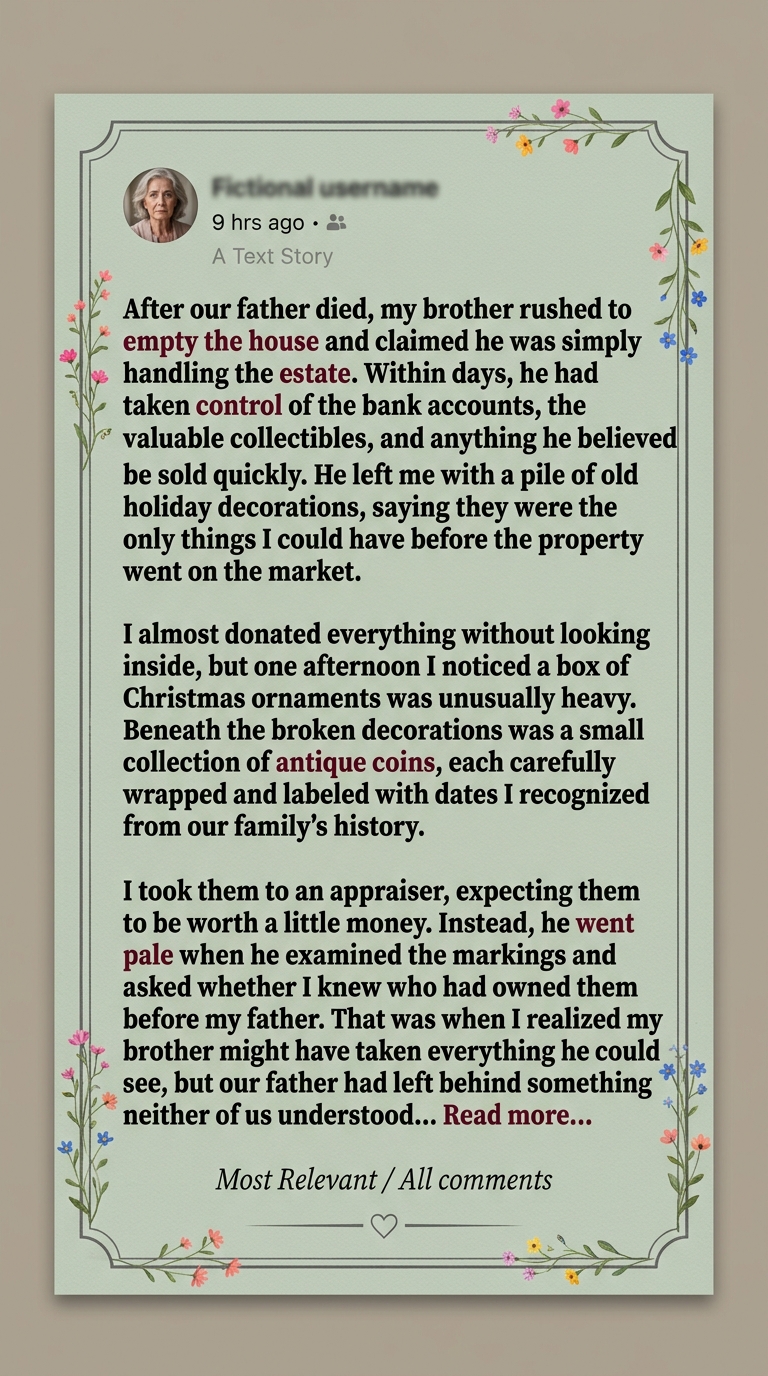
“You’re welcome to the holiday decorations,” he said. “That’s all that’s left that isn’t worth anything.”
He pointed toward the garage, where several plastic containers and cardboard boxes had been stacked against the wall.
I stared at him.
“You’re giving me Christmas decorations?”
“Mom loved decorating the house. Dad kept everything. You can have them if you want.”
Our mother had died eight years earlier, and Christmas had always been her favorite time of year. Every December, she covered the house with lights, wreaths, handmade ornaments, and little wooden figures she collected from craft fairs.
I felt hurt that Andrew had reduced those memories to unwanted clutter.
Still, I loaded the boxes into my car.
I didn’t want to fight with him while I was grieving. I told myself the important things weren’t possessions. I had photographs, memories, and the knowledge that our parents had loved me.
But as I drove away, I couldn’t ignore the feeling that my brother had decided I deserved whatever he didn’t want.
At home, I stacked the boxes in my spare room. For several days, I couldn’t bring myself to open them.
Then, on a rainy Sunday afternoon, I began sorting through the decorations.
Most of the items were exactly as I remembered: tangled strings of lights, cracked ceramic houses, faded stockings, and ornaments wrapped in old newspaper.
One box, however, felt unusually heavy.
It was labeled in our mother’s handwriting: CHRISTMAS TREE — FRAGILE.
I opened it carefully.
Inside were several layers of broken glass ornaments and old tinsel. Beneath them sat a smaller wooden box that I didn’t recognize.
It was heavier than it looked.
When I lifted the lid, I found a collection of antique coins wrapped individually in tissue paper. Each coin had a small handwritten label attached to it.
The dates caught my attention immediately.
Some were from the 1890s. Others dated to the early twentieth century. A few had been minted during years that were important in our family’s history.
One label read: 1912 — Grandfather’s first winter in America.
Another read: 1936 — The year the shop opened.
There were twenty-three coins in total.
I had no idea why my father had hidden them among Christmas decorations.
At first, I assumed they were simply family keepsakes. I knew very little about coins, but their age and condition suggested they might be worth something.
I contacted a reputable antique dealer who specialized in numismatics and arranged an appointment.
The appraiser, a quiet man named Mr. Bennett, examined each coin beneath a magnifying lamp. He wore cotton gloves and made notes in a small leather notebook.
At first, he seemed mildly interested.
Then he picked up the third coin.
He turned it over, examined the edge, and moved it beneath the light.
His expression changed.
“Where did you get these?”
“They belonged to my father.”
“Did he collect coins?”
“Not that I know of.”
Mr. Bennett looked at me.
“Do you know who owned them before your father?”
I shook my head.
He returned to the coin and examined a small marking near the date.
“These aren’t ordinary circulation coins,” he said. “Some are rare, but that’s not the most interesting part.”
He brought out a reference book and opened it to a section about privately issued commemorative pieces from the early twentieth century.
Then he showed me a photograph.
The coin in the picture looked almost identical to one from my father’s collection.
“These were produced for a private historical society,” he explained. “The organization commissioned small batches to commemorate important events and families. Most examples were lost or melted down. The surviving pieces are extremely scarce.”
He pointed to the initials engraved near the rim.
“These initials identify the original owner as Thomas Whitaker.”
My grandfather.
I had heard the name countless times, but I knew little about his life. He had died when I was very young. Our father rarely spoke about him beyond saying that he had been a hardworking man who had built a successful business from nothing.
Mr. Bennett examined the remaining coins.
“Several appear to be part of the same historical collection. Together, they could be worth considerably more than their individual values.”
“How much more?”
He hesitated.
“I would need a specialist auction house to authenticate the complete group, but I would not be surprised if the collection reached six figures.”
I stared at him.
“You’re saying these coins could be worth hundreds of thousands?”
“I’m saying you should not sell them casually. Their historical significance may be greater than their metal content.”
I left his office carrying the wooden box more carefully than I had brought it.
But the coins were only the beginning.
When I returned home, I turned over the wooden box and noticed a narrow strip of paper tucked beneath its lining. I carefully removed it.
It contained a name, an old address, and a short instruction written in my father’s handwriting.
Ask the museum about the winter ledger. They will understand.
I recognized the museum’s name. It was a small local institution that documented the history of our town, including the businesses and families that had helped build it.
I called the following morning.
The curator, a woman named Margaret Ellis, listened patiently as I explained what I had found. When I mentioned the coins and my grandfather’s name, her tone changed.
“Could you bring them in?” she asked. “There is something you should see.”
I arrived that afternoon.
Margaret led me into a research room and placed a large archival photograph on the table. It showed a group of men standing outside a brick building with a painted sign above the entrance.
WHITAKER & SONS — PRINTING AND BOOKBINDING.
I recognized my grandfather immediately from the family photographs.
“Your grandfather wasn’t simply a shop owner,” Margaret explained. “He was one of the founders of the town’s historical preservation society. During the Depression, he organized a group of local business owners who financed the restoration of the old railway station and helped preserve several public buildings.”
She showed me another photograph.
It depicted the same men standing beside a collection of coins arranged in a display case.
“These were commissioned for the society’s twentieth anniversary. Each founding family received a numbered set. Most families donated theirs to the museum decades ago.”
I looked at the photograph more closely.
There were twenty-three coins in the display.
The same number I had found in the Christmas box.
Margaret nodded.
“Your grandfather’s collection was believed to have disappeared after his death.”
“Why would my father hide them?”
She opened a folder containing old correspondence.
“Your grandfather left instructions that the collection should remain with the family until the town completed the restoration of its original railway station. He wanted the coins displayed there permanently, alongside the historical records of the founding families.”
I frowned.
“Did the restoration ever happen?”
“Not entirely. The building was partially renovated, but the project stalled because the original funding arrangement was disputed.”
She showed me a newspaper clipping from thirty years earlier.
My father had been named as the person responsible for representing the Whitaker family in the preservation society. A dispute over the building’s ownership had delayed the project, and the collection had been withdrawn from public display.
“Your father continued attending our meetings for years,” Margaret said. “He was very protective of those records. He believed the restoration should be completed properly, not turned into a commercial development.”
I sat back.
That explained why the coins had been labeled with dates connected to our family’s history. But it didn’t explain why my father had hidden them in Christmas decorations or why Andrew had never mentioned them.
I asked Margaret whether she knew anything about the estate.
She frowned.
“Your father visited us two months ago. He asked about updating the preservation agreement.”
“Did he say why?”
“He mentioned that he wanted to settle the matter before his health deteriorated. He also said he was concerned that his children might not understand the purpose of the collection.”
My stomach tightened.
“Did he mention Andrew?”
Margaret hesitated.
“He asked whether the museum could accept the coins directly if the family could not agree on their future.”
I left the museum with more questions than answers.
That evening, I called Andrew.
“I found something in the Christmas decorations.”
He was silent for a moment.
“What?”
“Grandfather’s coin collection.”
Another silence.
Then he laughed.
“Those old things? I thought Dad had sold them years ago.”
“Did you know they existed?”
“I knew Granddad had some coins. I assumed they were worthless.”
“Why didn’t you tell me?”
“Because I didn’t know they were in the house.”
I told him about the appraiser and the museum.
His tone changed immediately.
“How much are they worth?”
“The appraiser believes they could reach six figures, but they’re historically important. The museum has records about them.”
“Then we need to have them valued properly.”
“They already have been examined.”
“By one appraiser. That’s not enough.”
I could hear papers moving on his desk.
“Listen,” he continued, “I’ll arrange another valuation. We should sell them and divide the money equally. That’s what Dad would have wanted.”
I looked at the wooden box.
“Did Dad tell you that?”
“Don’t start.”
“Andrew, Dad specifically asked the museum about preserving the collection.”
“That doesn’t mean he wanted to give away something worth that much money.”
I was quiet.
Then I asked the question that had been bothering me since the funeral.
“Why did you take the watches, cameras, and paintings before we had an inventory?”
He exhaled sharply.
“I was handling the estate.”
“Where are they?”
“Somewhere safe.”
“Where?”
“You’re turning this into an interrogation.”
I told him I wanted a complete accounting of everything he had removed.
He hung up.
Two days later, an email arrived from the estate agent.
The property sale had been postponed because the solicitor handling the estate had requested additional documentation. Apparently, Andrew had been trying to arrange the sale without providing a complete inventory of the household assets.
I contacted the solicitor directly.
Her name was Helen Price, and she had been appointed by our father to manage the estate. Andrew had presented himself as the family representative, but he had never been given authority to distribute or sell the estate’s belongings independently.
Helen explained that she had requested a full inventory from him shortly after the funeral.
He had not supplied one.
She also told me that our father had left specific instructions concerning the coin collection.
The coins were to be transferred to the local museum under a preservation agreement, with the family retaining ownership and the right to recall the collection under certain conditions. Any future sale would require the agreement of both children and the museum’s approval.
It wasn’t a hidden fortune intended for one child.
It was a responsibility our father had deliberately left to both of us.
The solicitor also confirmed that the remaining assets belonged to the estate and could not be divided according to Andrew’s personal decisions.
I felt relieved, but I wasn’t satisfied.
I still wanted to understand why Andrew had rushed to remove everything.
The answer came when Helen requested that he attend a meeting with us.
He arrived looking exhausted and angry. He placed a folder on the table and avoided my eyes.
Helen began by explaining that the estate needed a complete accounting before any property could be sold or assets distributed.
Andrew interrupted.
“I’ve already handled most of it.”
“Then this should be straightforward,” she replied.
She opened the folder.
The watches had been sold to a dealer. The cameras had been transferred to a private buyer. Two paintings had been removed from the house and were being stored at a warehouse. Andrew had also withdrawn money from our father’s joint household account after his death, claiming it was needed for expenses.
Helen asked for the sale receipts.
Andrew produced some documents, but several transactions had no supporting records.
Then she asked about a bank transfer made three days after the funeral.
Andrew shifted in his chair.
“That was reimbursement.”
“For what?” Helen asked.
“Expenses Dad owed me.”
“Do you have receipts?”
“No.”
“An invoice?”
“No.”
Helen closed the folder.
“Then the transfer cannot be treated as an approved estate expense.”
Andrew’s face reddened.
I watched him carefully.
“Why did you do it?” I asked.
He finally looked at me.
“You think this is easy for me?”
“I think you decided everything before I even had a chance to grieve.”
He leaned forward.
“I was the one who took Dad to appointments. I handled his bills. I dealt with the repairs. You visited when you could, but I was here.”
I felt the accusation land.
He wasn’t entirely wrong.
For the last two years of Dad’s life, Andrew had lived nearby. He had taken him to medical appointments, helped with groceries, and managed many of the household problems. I lived farther away and visited less often than I should have.
But that didn’t give him the right to take control of everything.
“I know you did a lot for him,” I said. “I should have helped more. But you didn’t become the owner of his belongings because you were the one who lived closest.”
Andrew looked down.
For a moment, the anger left his face.
Then he admitted something I hadn’t expected.
He had borrowed money from a friend to cover expenses for his small construction business. A major client had delayed payment, and the debt had become difficult to manage. He had expected to sell some of Dad’s collectibles, settle the loan, and replace the money after his business recovered.
He had convinced himself that the estate would eventually be divided anyway, so selling things early was simply getting ahead of the process.
“I didn’t think it would become a problem,” he said.
Helen’s expression remained firm.
“It became a problem when you disposed of estate property without authority.”
Andrew rubbed his face.
“I was going to make it right.”
I looked at him.
“With what?”
He had no answer.
The meeting ended with Helen arranging an independent valuation of the remaining property, requiring Andrew to provide a full account of every item sold or removed, and instructing him to return anything still in his possession. The unauthorized withdrawals and missing proceeds would be addressed through the estate administration process.
The coins were placed temporarily in secure museum storage, where specialists could authenticate them and complete a formal catalog.
Over the next several weeks, the situation became more complicated than either of us wanted.
Some of the collectibles had been sold below market value. Recovering them was impossible, but the proceeds were accounted for and credited against Andrew’s share of the estate. He also had to repay the unsupported withdrawal.
The house eventually sold, and the estate was distributed according to our father’s will.
Andrew received less than he had expected, but he was not disinherited. He had to face the financial consequences of his decisions, and his construction business survived after he negotiated a repayment arrangement with his lender.
The coin collection, meanwhile, became the center of a different kind of project.
The museum completed its authentication and confirmed that the coins were exceptionally rare as a complete set. Their estimated value was substantial, but the museum’s director recommended preserving them rather than selling them.
Because the family retained ownership under our father’s agreement, Andrew and I had to decide what to do.
I could have demanded that the collection be sold and divided.
Part of me wanted to. After everything that had happened, I felt I deserved something more than a box of decorations.
But I kept thinking about the labels in our mother’s handwriting and the care with which our father had wrapped each coin.
I also remembered what Margaret had said about the old railway station.
My grandfather had helped preserve buildings that might otherwise have disappeared. My father had spent years trying to complete the work.
I didn’t want the coins to become another source of bitterness.
I proposed that we honor the original agreement and place the collection on permanent loan to the museum, with both of us retaining ownership.
Andrew initially resisted.
Then he visited the museum.
He stood in front of the old photograph of our grandfather and studied the men outside the printing shop. He read the historical records and learned how the collection had been commissioned.
For the first time, he saw the coins as something other than money.
When he returned to the car, he was quiet.
“Granddad really did all that?” he asked.
“Yes.”
“I never knew.”
“Neither did I, not until recently.”
He stared through the windshield.
“Dad should have told us more.”
“Maybe he thought he had.”
Andrew nodded slowly.
“I owe you an apology.”
I didn’t answer immediately.
He continued.
“I was so focused on getting everything settled that I forgot you had lost him too. I treated the house like it was mine to empty. I shouldn’t have done that.”
I appreciated the apology, but I didn’t pretend everything was repaired.
“You hurt me, Andrew. And you put Dad’s estate at risk.”
“I know.”
“Trust is going to take longer than one conversation.”
He accepted that.
The following spring, the museum reopened the restored railway station as a community history center. The coin collection was displayed in a secure case alongside photographs of the original founders and a copy of the preservation agreement our father had signed.
At the opening ceremony, Margaret invited Andrew and me to speak.
I wasn’t comfortable standing in front of a crowd, but I accepted.
I told the visitors that the coins had been hidden in a box of Christmas decorations and that I had almost donated them without ever opening it.
People laughed gently.
Then I explained that the collection had survived because three generations of my family had believed certain things were worth protecting.
Not everything valuable could be measured by its price.
After the ceremony, Andrew stood beside me looking at the display.
“Do you think Dad would have liked this?” he asked.
“I think he would have been relieved.”
Andrew gave a small smile.
We didn’t become close overnight. We still had difficult conversations about the estate, and I remained careful about trusting him with financial matters. But he began calling more often, sometimes just to ask how I was doing.
A few months later, he invited me to his house for Christmas.
When I arrived, I saw our mother’s old decorations hanging on his tree. The cracked ceramic house was there, along with the faded stockings and several ornaments I had thought were beyond repair.
On the highest branch sat a small wooden star.
“Mom made that one,” Andrew said. “I found it in the garage.”
I smiled.
“I thought you didn’t want any of the decorations.”
He looked uncomfortable.
“I was wrong about a lot of things.”
We stood together for a moment, looking at the tree.
Then Andrew handed me a small box.
Inside was a photograph of our parents standing outside the old printing shop with our grandfather. I had never seen it before.
“I thought you should have this,” he said.
I thanked him and placed it carefully in my bag.
That Christmas, I finally understood why our father had hidden the coins beneath the broken ornaments.
He hadn’t been trying to hide a fortune from his children. He had been preserving a piece of family history that he feared we might overlook.
Andrew had taken everything he could see because he believed value was something that could be sold.
I had nearly thrown away the one thing our father had trusted us to protect because I thought it was worthless.
Neither of us had understood what we were holding.
And in the end, the most valuable thing we recovered from that old house wasn’t the coin collection, the money, or even the family photograph.
It was the chance to stop treating our father’s death as a contest over what each of us deserved, and begin remembering the family we had both lost.