The Coat She Tried to Take Away
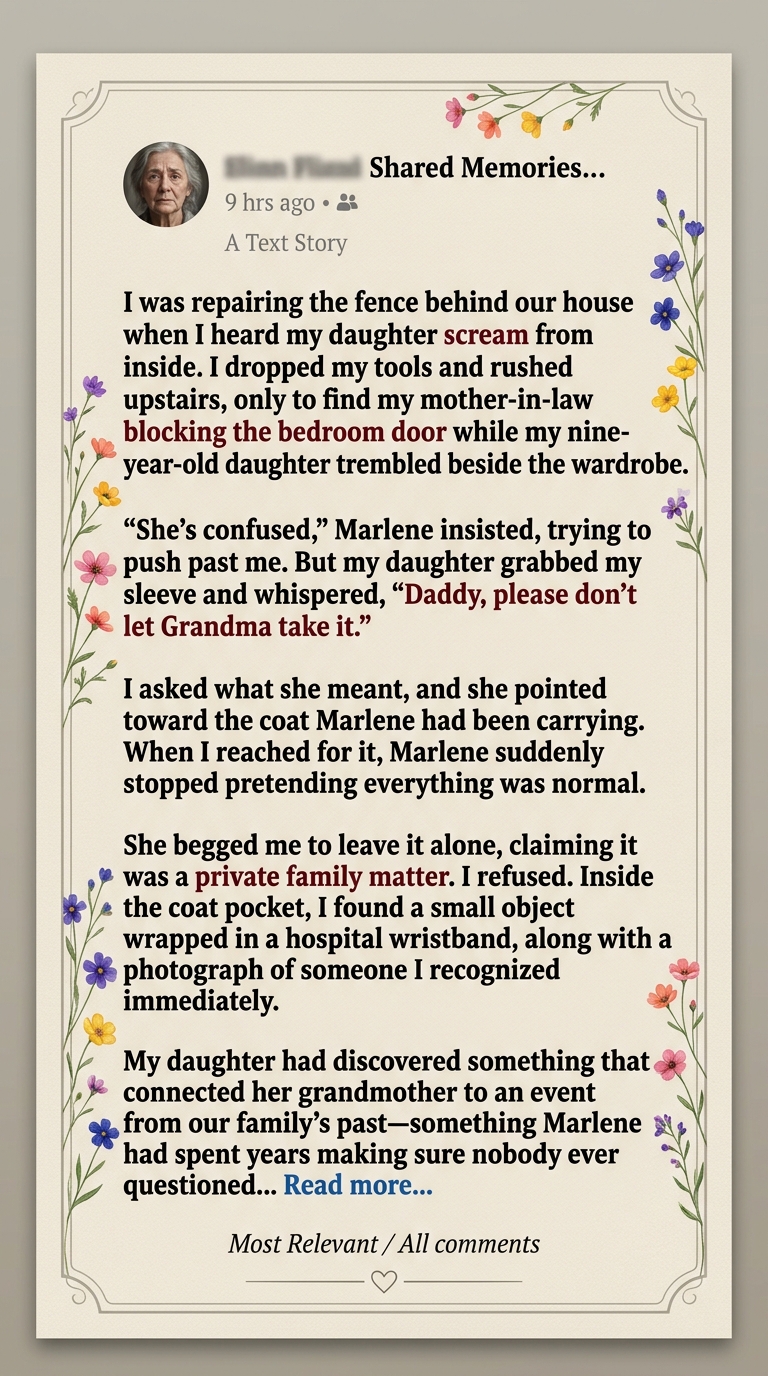
I was halfway through repairing the fence when I heard my daughter scream.
The sound came from upstairs, sharp enough to make me drop the hammer. I ran through the back door, took the stairs two at a time, and reached the hallway just as my mother-in-law, Marlene, stepped out of my daughter’s bedroom.
She was holding a long brown coat.
My nine-year-old daughter, Sophie, stood beside the wardrobe with tears running down her cheeks.
“What’s going on?” I demanded.
Marlene tightened her grip on the coat.
“Nothing. Sophie is confused. She found something she shouldn’t have touched.”
Sophie hurried toward me and grabbed my sleeve.
“Daddy, please don’t let Grandma take it.”
I looked at the coat.
It was old, made of heavy brown wool, with worn cuffs and a missing button near the collar. I’d seen it hanging in the back of our storage closet, but I’d never paid much attention to it.
“Why do you want it?” I asked Marlene.
“It’s a private family matter.”
“Then why are you taking it out of my daughter’s room?”
Marlene’s expression hardened.
“Because children shouldn’t go through other people’s belongings.”
Sophie shook her head.
“I wasn’t looking for it. Grandma was crying, and I heard her talking to Grandpa’s picture. She said she couldn’t let anyone find out what happened.”
Marlene went completely still.
I held out my hand.
“Give me the coat.”
“Please, David. Don’t make this worse.”
That was when I realized she was frightened.
Not angry. Not embarrassed.
Frightened.
I took the coat from her. She didn’t resist, but her eyes followed my hands as I searched the pockets.
The first contained an old receipt and a crumpled tissue. The second held a small object wrapped in a faded hospital wristband.
I carefully unfolded it.
Inside was a tiny silver compass, its glass scratched and its needle frozen in place.
Beneath it was a photograph.
I recognized the people immediately.
The photograph showed my late wife, Rachel, as a teenager, standing beside her younger brother, Michael. They were outside a hospital entrance. Michael wore a striped shirt and held a paper cup. Rachel had one arm around him, smiling at the camera.
But the hospital wristband was what made my stomach tighten.
It bore Michael’s name and a date from twenty-seven years earlier.
Michael had died when he was eleven.
At least, that was the story Rachel had always told me.
I turned toward Marlene.
“Why do you have this?”
She sat down on the edge of the bed.
“Because that coat belonged to Michael.”
I looked at the photograph again.
“And the compass?”
“He carried it everywhere.”
“What happened to him?”
Marlene pressed her hands together.
“You know what happened. He was sick.”
“No. I know what Rachel told me. I want to know why you were trying to take this coat out of my house.”
She stared at the photograph.
“Because Sophie found something else.”
My daughter pointed toward the wardrobe.
“There’s a little pocket inside the lining. Grandma told me not to look in it.”
I examined the coat more carefully. Near the bottom seam, a section of lining had been stitched differently from the rest. I found a loose thread and gently opened the pocket.
Inside was a small folded piece of paper.
It was a hospital discharge document.
The date matched the wristband.
But the words on the paper made no sense.
Michael had not been discharged because he had died.
He had been transferred to a rehabilitation facility.
I read the document twice.
“Why did everyone tell me Michael died?”
Marlene covered her mouth.
For several seconds, the only sound in the room was the ticking clock on the wall.
Then she began to speak.
“Michael wasn’t my biological son.”
I stared at her.
“What?”
“Your wife and Michael had the same father, but different mothers. Rachel’s father died when she was very young. I married him afterward, and Michael was born two years later.”
I knew Rachel had a stepfather in her childhood, but she rarely discussed him. I had assumed he had died before she was old enough to remember much about him.
Marlene continued.
“Michael was born with a serious neurological condition. He had difficulty walking, needed help with everyday tasks, and spent much of his childhood in hospitals. Rachel loved him more than anything. She was the only person who could make him laugh when he was having a difficult day.”
She picked up the photograph.
“The compass was a gift from his father. Michael believed that if he kept it with him, he would always know how to find his way home.”
I looked at the discharge document again.
“Then what happened?”
Marlene took a shaky breath.
“When Michael was eleven, his condition worsened. He needed long-term specialist care. I was overwhelmed. My marriage had already fallen apart, and I was raising two children while working nights. I couldn’t manage his care anymore.”
“Where was Rachel’s father?”
“He had died by then.”
“So what did you do?”
“I signed papers allowing Michael to enter a residential care facility.”
I waited.
She looked at me with red eyes.
“I told Rachel he had died.”
The words seemed to drain the warmth from the room.
“You told your own daughter her brother was dead?”
“She was sixteen. She was already struggling with school and her father’s death. I told myself it was kinder than letting her watch him disappear into a place where she couldn’t visit every day.”
“That wasn’t your decision to make.”
“I know.”
“Did Michael actually die?”
“No.”
The answer came so quietly that I almost missed it.
Marlene explained that Michael had been transferred to a specialist residential center several hours away. Rachel had begged to visit him, but Marlene told her the facility had refused visitors during an outbreak of illness.
Then, months later, Marlene told Rachel that Michael had died from complications.
She had arranged a private memorial without a body, claiming the facility had handled the burial.
Rachel had believed her.
For years, she carried the grief of losing a brother she had never been allowed to say goodbye to.
I felt sick.
“Why didn’t you tell her the truth later?”
Marlene lowered her eyes.
“Because the longer I waited, the harder it became. I was ashamed. I thought if I admitted what I’d done, Rachel would never forgive me.”
“And did Michael die eventually?”
She nodded.
“Three years ago. He developed pneumonia. His health had been fragile for a long time.”
My throat tightened.
“Did Rachel know before he died?”
“No.”
I looked at the hospital wristband.
“Then why keep these things?”
“Because I visited him.”
That was the detail I hadn’t expected.
Marlene explained that after placing Michael in the residential facility, she continued visiting him secretly. She sent money for his care, brought him clothes, and took him outside whenever his health allowed.
The coat had belonged to him. The compass was his most treasured possession.
She had kept them because she couldn’t bring herself to throw away the last things he had touched.
But there was something else.
Marlene reached into her handbag and removed a second photograph.
It showed Michael as an adult, sitting in a wheelchair beside a garden. He looked older, thinner, but his smile was unmistakable.
Beside him stood Marlene.
On the back, in faded handwriting, were the words:
For Mum. Thank you for coming back.
I looked at her.
“You went back to him?”
“Every month. Sometimes more often.”
“Did Rachel ever find out?”
“No. I couldn’t face telling her.”
I thought about my wife.
Rachel had died eighteen months earlier after a sudden brain aneurysm. She had been a loving mother, a devoted sister—or so she believed—and someone who never stopped wondering what her brother might have become.
She used to tell Sophie stories about Michael.
How he collected unusual stones. How he loved maps. How he once insisted that a puddle was an ocean and tried to sail a paper boat across it.
Rachel had kept a small photograph of him beside her bed.
She had spent her entire adult life mourning someone who was still alive for much of it.
I sat down beside Marlene.
“Did Michael know Rachel believed he was dead?”
She nodded.
“He asked about her. I told him she had a family and was happy. I said she was too far away to visit.”
“Did you tell him why?”
“No.”
I looked at the photograph of the adult Michael.
“Did he ever ask you to tell her?”
Marlene’s eyes filled.
“Many times.”
The room became painfully quiet.
Sophie climbed onto the bed beside me.
“Was Uncle Michael real?”
I put my arm around her.
“Yes, sweetheart. He was real. And he loved your mommy very much.”
“Why didn’t Mommy visit him?”
I struggled to find an answer a child could understand.
“Because Grandma told her something that wasn’t true.”
Sophie looked at Marlene.
“Why would Grandma do that?”
Marlene began crying.
“I was wrong, Sophie. I was frightened, and I made a terrible decision. Then I kept making it worse because I didn’t know how to fix it.”
My daughter looked down at the compass.
“Can I keep this?”
Marlene nodded.
“If your father agrees.”
I didn’t answer immediately.
I wanted to be angry. I was angry. But I also knew that this was bigger than a coat, a photograph, or a secret.
A person had spent decades being denied the truth about someone she loved. Another person had spent years living with the consequences of a decision she couldn’t undo.
I wasn’t going to let Marlene walk away as though a confession had settled everything.
But I also wasn’t going to throw away the only remaining pieces of Michael’s life.
“I’m keeping the coat for now,” I said. “And I want every document you have about him.”
Marlene nodded.
“Of course.”
“I also want to know where he was buried.”
She gave me the cemetery name.
“Why?”
“Because Rachel deserves to be remembered beside her brother, even if she never knew where he was.”
Marlene covered her face.
“I can show you.”
The following weekend, we drove to the cemetery together.
Michael’s grave was in a quiet section beneath two maple trees. His name was engraved on a simple stone, along with the dates of his birth and death.
I placed the compass beside the flowers.
Sophie stood close to me, holding my hand.
“Is this where Uncle Michael lives now?”
I knelt beside her.
“His body is here. But the stories about him are still with us.”
She considered that.
“Then we should tell them.”
Marlene stood several steps behind us, unable to approach the grave.
I walked back toward her.
“You should have told Rachel.”
“I know.”
“You should have given her the chance to love her brother while he was still alive.”
“I know.”
“I’m not going to pretend what you did was harmless.”
She nodded, accepting the words without defending herself.
“But I don’t want Sophie growing up believing that secrets are the way families handle painful things. If you’re going to be part of her life, you need to tell the truth from now on.”
“I will.”
“And you need to write down everything you remember about Michael. His childhood, his favorite things, the places you took him. Everything.”
Marlene looked at the grave.
“I can do that.”
Over the following months, she kept her promise.
She brought us photographs, letters, school drawings, and small stories about Michael that Rachel had never heard. Some were funny. Others were heartbreaking. Together, we created a scrapbook for Sophie.
I also contacted the residential facility, which still had archived records and photographs from Michael’s years there. They confirmed the dates of his admission and death and helped us understand the life he had lived.
The hardest part was accepting that Rachel had never been given the truth.
I couldn’t bring her back to tell her about Michael. I couldn’t give her the years she had lost.
But I could make sure her daughter grew up knowing her uncle existed.
On Sophie’s tenth birthday, we planted a small maple tree in our garden.
She insisted on placing the compass beneath it before we covered the roots with soil.
“Now he has somewhere to visit,” she said.
Marlene stood beside us, holding a photograph of Michael as a boy.
For the first time since I had known her, she didn’t try to explain away the past or make herself look better.
She simply watched the tree being planted.
The coat remained in our house, carefully cleaned and hung in Sophie’s room. She sometimes took it down to look at the photograph hidden in its pocket.
I used to think the most frightening family secrets were the ones that could destroy a marriage or take away someone’s home.
Now I understood that some secrets steal something far less visible: the chance to know someone, to say goodbye, and to share a life that can never be recovered.
Marlene had spent years protecting herself from the consequences of one decision.
In the end, it was my daughter who forced the truth into the open—not because she understood the past, but because she knew something important was being taken away.
And she was right.
The coat wasn’t the thing Marlene was afraid of losing.
It was the last place where the truth had been waiting.