The Unexpected Visitor at My Son’s Door
When my husband died, I thought the hardest part would be learning to live without him.
I was wrong.
The hardest part was discovering how differently our three children viewed me once they believed I had nothing left.
Arthur and I had been married for forty-one years. We had raised Michael, Laura, and Daniel in an ordinary family home, driven sensible cars, taken modest holidays, and rarely discussed money.
Our children believed their father had spent his life running a small transport business. They knew he worked hard, but they had no idea how successful the company had eventually become.
Seven years before his death, Arthur sold the business to a national logistics group. The sale made us wealthy enough to live comfortably for the rest of our lives. We invested the money carefully, bought a few properties, and kept our original home.
We agreed not to announce the sale to the children.
Arthur had one particular concern. He had watched friends become trapped in family disputes after their children learned about inheritances. He wanted our children to build independent lives rather than organize their futures around what they might eventually receive.
I agreed.
We never intended to deceive them forever. We simply wanted our money to remain separate from our relationships.
After Arthur’s funeral, however, I found myself wondering what those relationships actually meant.
One afternoon, I made three telephone calls.
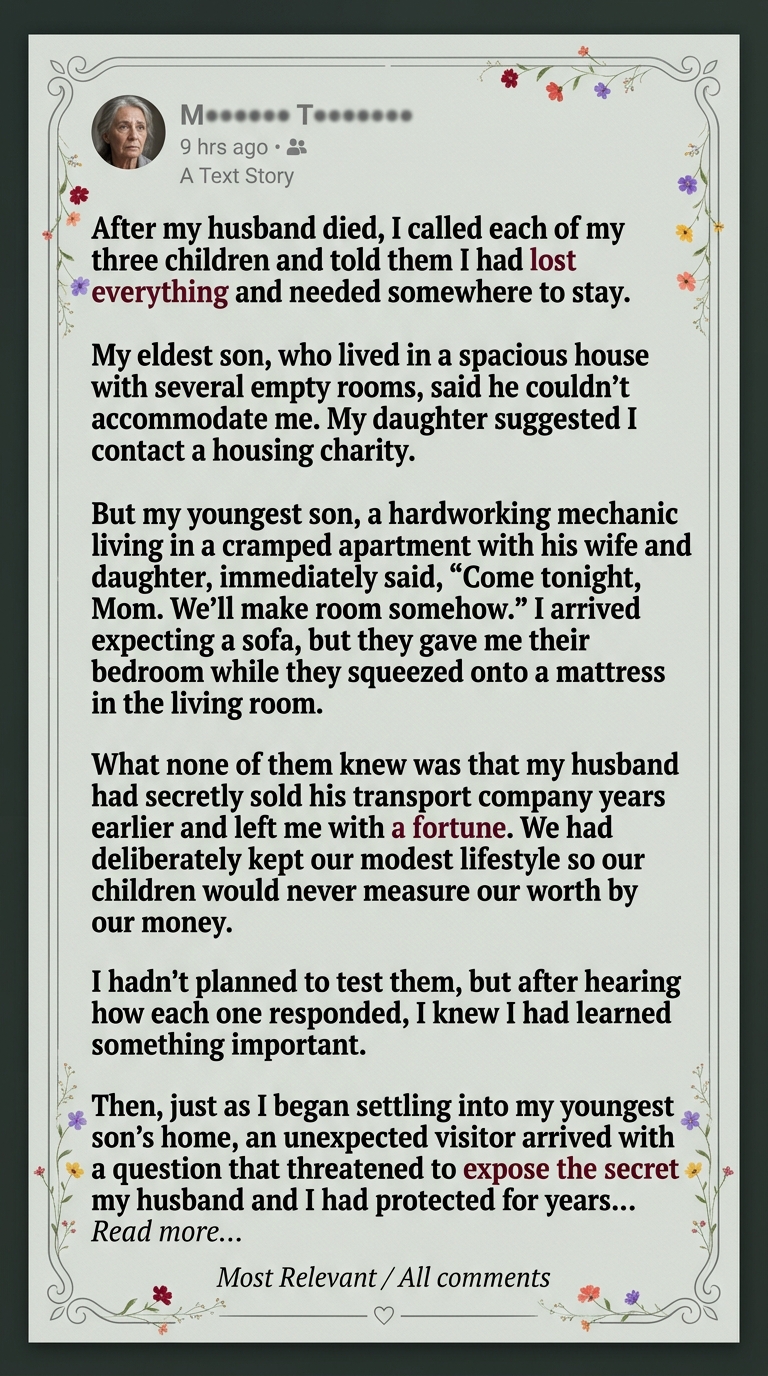
I told each child that I had lost everything after their father’s death and needed somewhere to stay.
Michael, our eldest, answered first. He lived in a large house with four bedrooms, a finished basement, and a guest suite that rarely saw visitors.
“Mom, I’m sorry,” he said. “But the house is already full. The kids have friends staying over, and we’re using the spare rooms for storage.”
I knew that wasn’t true, but I didn’t argue.
“Could I stay for a few weeks?”
He hesitated.
“Maybe you should contact a housing charity. They might have temporary accommodation for someone in your situation.”
I thanked him and ended the call.
Laura, my daughter, was next.
She listened while I explained that I had nowhere to go.
“Oh, Mom. That’s awful. Have you contacted the council?”
“I was hoping I could stay with you.”
She sighed.
“I’m not sure that’s possible. The children need their routines, and my husband works from home. It would be difficult for everyone.”
She promised to call me later.
She never did.
Finally, I called Daniel.
He was our youngest, a mechanic who owned a small repair garage. He lived in a two-bedroom apartment with his wife, Sophie, and their eight-year-old daughter, Lily.
His business had been struggling with rising rent and equipment costs. I knew he was careful with every dollar.
When I explained my situation, he didn’t ask whether I had money or how long I needed to stay.
“Come tonight, Mom.”
“Daniel, I don’t want to cause trouble.”
“You won’t. We’ll make room somehow.”
I arrived just after seven with one suitcase and a handbag.
Daniel opened the door before I knocked.
“Mom, you’re here.”
He hugged me, carried my suitcase inside, and called Sophie from the kitchen.
She came out wiping her hands on a towel.
“I’m glad you came. Dinner’s nearly ready.”
I expected to sleep on the sofa.
Instead, Daniel showed me their bedroom.
“We’ve changed the sheets,” he said. “You can have this room.”
I looked at him.
“Where will you and Sophie sleep?”
He pointed toward the living room.
“We’ve got a mattress. It’ll be fine.”
Sophie smiled.
“Lily has already volunteered to lend you her favorite pillow.”
That night, I lay in their bed listening to the quiet sounds of the apartment.
I could hear Daniel and Sophie whispering in the living room, trying not to wake me. At one point, Lily came to the doorway holding a stuffed rabbit.
“Grandma, you can borrow Mr. Buttons. He helps people sleep.”
I thanked her and hugged her.
For the first time since Arthur’s death, I felt that I had somewhere to belong.
I hadn’t planned to test my children.
The calls had come from genuine fear and loneliness. I wanted to know whether anyone could help me, and their answers had shown me something I could no longer ignore.
The next morning, I offered to make breakfast.
Sophie refused to let me do much.
“You’re our guest. Sit down.”
“I don’t want to be a burden.”
She gave me a puzzled look.
“Margaret, you’re family. You don’t have to earn your place here.”
I smiled, but her words stayed with me.
I was beginning to think I might spend a few months with Daniel’s family while deciding what to do with my own house.
Then someone knocked.
Daniel was already getting ready for work, so I answered the door.
A neatly dressed man in his early sixties stood outside holding a leather document case.
“Good morning,” he said. “I’m looking for Margaret Bennett.”
“That’s me.”
“My name is Peter Lawson. I was your husband’s solicitor for many years.”
I recognized the name immediately.
Arthur had mentioned Peter occasionally, usually when discussing business matters. I hadn’t seen him since the company sale.
“Is something wrong?”
“Not exactly. I was hoping to speak with you privately.”
He glanced toward the living room.
“May I come in?”
I stepped aside.
Peter sat at the small kitchen table and placed his case beside him.
“I’ve been trying to reach you since Arthur’s funeral. Your husband left specific instructions concerning the transfer of several assets, and I need to confirm your wishes before proceeding.”
I felt a sudden chill.
“What assets?”
He opened his case and removed a folder.
“Your husband’s transport company was sold to Northbridge Logistics seven years ago. The proceeds were placed into a private investment structure, and the majority of the assets were transferred into your name.”
I nodded slowly.
“I know about the sale.”
Peter looked surprised.
“Then you know the scale of the estate?”
“I know enough.”
He studied me for a moment.
“Arthur’s instructions were unusual. He asked me to keep the financial details confidential from your children until you decided they should be informed.”
I lowered my voice.
“Please tell me you haven’t contacted them.”
“I haven’t. But there’s an additional matter that requires your attention.”
He opened another section of the folder.
“Your husband established a charitable trust before his death. It owns the former headquarters of his transport company, along with several commercial properties. The trust was designed to fund vocational training and small-business grants.”
I remembered Arthur discussing a project for young people who wanted to learn practical trades.
“He told me he wanted to help mechanics, drivers, and apprentices who couldn’t afford professional training.”
“Exactly. He also named you as the person responsible for overseeing the trust.”
I looked at the papers.
“Why didn’t he tell me this before he died?”
Peter paused.
“He intended to explain everything after his final medical assessment. Unfortunately, his illness progressed more quickly than expected.”
I felt tears gathering in my eyes.
Arthur had known his time might be limited, yet he had spent his final months arranging something that would continue helping people after he was gone.
Peter continued.
“There is one more issue. A person recently contacted my office claiming to represent your family. They requested information about the trust and asked whether any of its properties could be sold.”
My heart began beating faster.
“Who?”
Peter turned a page.
“Your eldest son, Michael.”
I stared at him.
“Michael knows nothing about the company sale.”
“He told my assistant that he believed his father had left an unfinished business arrangement and that he was helping you organize the estate.”
I felt a mixture of anger and disappointment.
“Did you give him anything?”
“No. I explained that I could only discuss the matter with you.”
Peter closed the folder.
“However, I thought you should know that he has made several inquiries. He also asked whether the trust had any connection to your former family home.”
I understood then why he had come to Daniel’s apartment.
Arthur had protected our financial privacy for years, but someone had begun searching for the truth.
I thanked Peter and asked him to arrange another meeting at his office.
Before he left, I asked one question.
“Can anyone access the trust without my permission?”
“No. You are the sole managing trustee during your lifetime. Any major transfer requires your authorization.”
I felt relieved.
But the conversation had left me unsettled.
That afternoon, Michael called.
“Mom, I heard you were staying with Daniel.”
“Yes.”
“Why didn’t you tell me you were having trouble?”
I almost laughed.
“I did tell you.”
He ignored that.
“Anyway, I think we should talk about Dad’s estate. There are some things we need to organize before they become complicated.”
“What things?”
“His old company assets. Some properties. I don’t want you making decisions without understanding the financial consequences.”
I held the phone tightly.
“Who told you there were properties?”
There was a pause.
“I’ve been asking around. Dad had business connections. I’m trying to protect the family.”
“Protect us from what?”
“Mom, don’t make this difficult. I’m the eldest. I should be involved.”
I looked toward the living room, where Daniel was helping Lily with her homework.
“Being the eldest doesn’t give you authority over my affairs.”
Michael’s voice sharpened.
“I’m only trying to help.”
“Then you can start by respecting my decisions.”
I ended the call.
That evening, I told Daniel about Peter’s visit.
He listened carefully.
“Does Michael know how much Dad left?”
“Not yet.”
“Do you think he’s trying to get money?”
“I don’t know. But he seems very interested in something he previously claimed didn’t exist.”
Daniel shook his head.
“That’s not right.”
I watched him for a moment.
“Does it bother you that your father had so much money and never told you?”
He thought about it.
“Not really. He raised us, paid for our education, and helped me start my garage. I never thought he owed me a fortune.”
“What if there is a fortune?”
Daniel smiled faintly.
“Then I hope he left enough to do something useful with it.”
That answer told me more than any promise could have.
A week later, I met Peter at his office.
He showed me the complete estate records, the company sale documents, and the charitable trust agreement. Arthur’s arrangements were straightforward and legally secure.
The trust had enough resources to support its programs for decades.
I also learned that Daniel’s garage had been one of the businesses Arthur quietly supported during its first difficult year. He had arranged for a supplier to extend Daniel’s payment terms without telling him where the assistance came from.
I hadn’t known that.
Arthur had never wanted Daniel to feel indebted to him.
Peter then showed me a letter my husband had written shortly before his final hospitalization.
It was addressed to me.
Margaret, if you’re reading this, I hope you’ve had time to breathe after losing me. I know you’ll be tempted to give the children whatever they ask for because you want to keep everyone happy. Please don’t confuse generosity with surrendering your judgment.
I want them to have good lives. I want them to work, build families, and discover what they’re capable of. The money is only a tool. It should never become the reason they love you or the reason they stay away.
If one of them opens a door when they believe you have nothing, remember that. But don’t punish the others forever. People sometimes need to face their own choices before they understand them.
I read the letter twice.
Arthur had understood our children better than I had.
He hadn’t asked me to reward Daniel or disown Michael and Laura. He had asked me to make decisions without allowing money to become the measure of love.
When I returned to Daniel’s apartment, I found Sophie preparing dinner.
I told them I wanted to help with their living arrangements.
Daniel immediately shook his head.
“Mom, we’ve already made room. You don’t have to pay us.”
“I know. But I don’t want you and Sophie sleeping on the living-room floor indefinitely.”
“We’ll move the mattress back into our room once you’re settled somewhere else.”
I smiled.
“I haven’t decided whether I want to leave yet.”
Sophie looked at me.
“You can stay as long as you need.”
I told them about Arthur’s charitable trust and asked whether Daniel would consider helping me develop its vocational training program.
He was silent for a moment.
“You mean helping other mechanics?”
“And young people who want to become mechanics, electricians, drivers, and skilled workers.”
His expression changed.
“Mom, I know people who would benefit from that. My garage could even offer apprenticeships.”
“That is exactly what your father hoped for.”
Daniel looked down at the table.
“I’d like to help.”
Over the following months, we began organizing the program. Daniel helped identify local workshops willing to train apprentices. Sophie managed the applications, and I worked with Peter to establish transparent funding rules.
We didn’t give Daniel special treatment. His garage had to meet the same standards as every other participating business.
He didn’t object.
Meanwhile, Michael continued asking questions about the estate. When I finally met him and Laura at my solicitor’s office, I explained the company sale, the investment funds, and the charitable trust.
Michael looked stunned.
“You were wealthy this whole time?”
“We were financially comfortable, yes.”
“And you never told us?”
“Your father and I wanted you to build your own lives.”
Laura looked hurt.
“Why did you tell us you had lost everything?”
“I wanted somewhere safe to stay after your father’s death. I asked each of you for help. You made your decisions based on what you believed I had.”
Michael leaned forward.
“So this was a test?”
“No. I didn’t plan the calls as an experiment. I was grieving and needed help. But I won’t pretend your answers didn’t change how I see things.”
Laura began crying.
“Mom, I thought you wanted a permanent place. I didn’t know what to do.”
“I wasn’t asking you to buy me a house or support me forever. I needed somewhere to sleep.”
Michael remained silent.
Then I addressed the matter Peter had told me about.
“I also know you contacted his office asking about the trust.”
Michael shifted in his chair.
“I was trying to understand Dad’s business affairs.”
“Without telling me?”
“I thought I could help.”
“You asked whether properties could be sold. You didn’t ask whether I needed assistance or what your father intended to do with them.”
He looked away.
I didn’t accuse him of trying to steal anything. I didn’t know his true motives, and I wasn’t going to invent them.
But I made one thing clear.
“The trust is not an inheritance waiting to be divided. It exists to help people build their futures. I will not sell its assets to provide anyone with a private payout.”
Neither child argued.
I didn’t disinherit them or promise them equal portions of my estate. I told them that any future inheritance would be handled according to my own plans, not negotiated through pressure or guilt.
After the meeting, Laura began visiting more regularly. She apologized for suggesting housing assistance instead of offering her spare room. Michael took longer to acknowledge his part, but eventually he admitted that he had been more concerned about the family’s financial position than about my immediate needs.
I accepted their apologies cautiously.
Forgiveness, I learned, did not require pretending nothing had happened.
A year after Arthur’s death, the vocational trust opened its first training center in the building that had once served as his transport company’s headquarters.
Daniel stood beside me at the opening ceremony. Several young apprentices wore work uniforms, and their families filled the small auditorium.
On the wall behind the stage was a photograph of Arthur standing beside his first delivery truck.
I looked at it and smiled.
He had spent years building a company, but his final achievement was something much more meaningful.
He had left us a way to help people who needed a chance.
That evening, I returned to Daniel’s apartment. Sophie had prepared dinner, and Lily had drawn a picture of all of us standing beside the training center.
She handed it to me.
“Grandma, I put Grandpa in the picture too.”
I studied the drawing.
Arthur was standing beside us, holding a little red truck.
“That’s beautiful, sweetheart.”
Lily smiled.
“Now nobody is missing.”
I hugged her.
For a long time, I had believed that losing my husband meant losing the foundation of my life. Then I discovered that the people I expected to support me weren’t always willing to make room.
But Daniel’s small apartment had taught me something I would never forget.
A home is not measured by the number of bedrooms, the size of the bank account, or the value of the furniture.
Sometimes the greatest wealth in a family is found in the person who moves a mattress onto the living-room floor without asking what you can give in return.