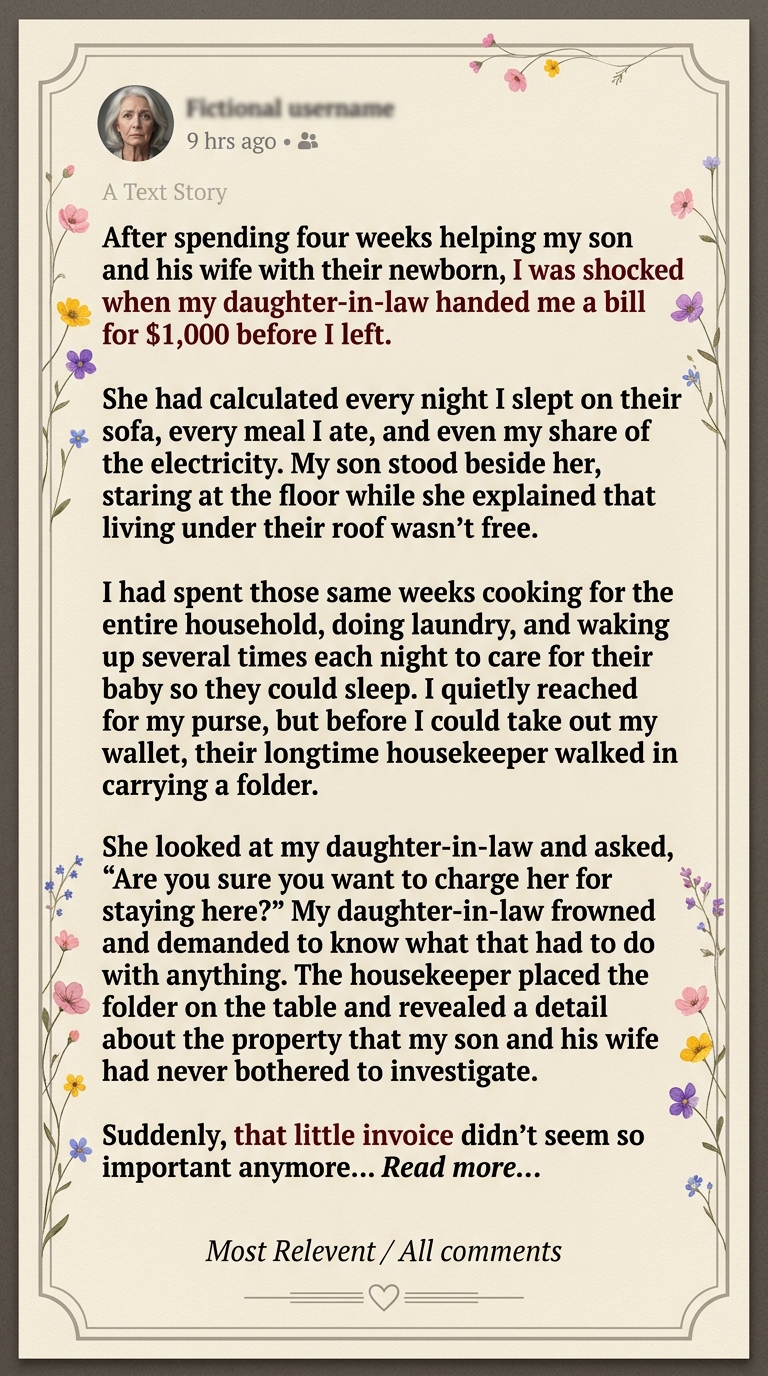
The bill was waiting beside my suitcase.
I had just finished folding the last of my clothes when my daughter-in-law, Vanessa, walked into the guest room holding a sheet of paper. She placed it on top of my bag with the careful precision of someone delivering an important business document.
“Before you leave, we need to settle something,” she said.
I looked at the paper.
At the top, in bold letters, was the word EXPENSES.
Below it was a list.
Four weeks of accommodation: $560.
Meals: $280.
Electricity and water: $95.
Laundry and household supplies: $65.
Total: $1,000.
I read it twice, convinced I had misunderstood.
“Vanessa, what is this?”
“Your share of the household expenses,” she replied. “We thought it was fair to calculate everything rather than just guess.”
My son, Ethan, stood behind her. He was holding his newborn daughter, Olivia, against his chest, but he wouldn’t look at me.
I felt something tighten in my chest.
“I came here because you needed help.”
“And we’re grateful,” Vanessa said, although her expression suggested otherwise. “But staying here for four weeks isn’t free.”
I looked at Ethan.
“Did you know about this?”
He shifted the baby in his arms.
“Mom, Vanessa handles the household budget. We just thought it would be better to make things clear.”
I had spent the previous four weeks sleeping on their sofa because their apartment had only two bedrooms and they wanted the nursery kept quiet. I had cooked breakfast, prepared lunches, washed clothes, cleaned the kitchen, and shopped for groceries.
When Olivia woke at two in the morning, I often took her so Ethan and Vanessa could get a few uninterrupted hours of sleep.
I had never asked them for a penny.
In fact, before arriving, I had bought several boxes of diapers, baby clothes, and a new stroller because Ethan mentioned they were struggling with expenses.
Now they were charging me for electricity.
I looked at Vanessa.
“Did you include the nights I stayed awake with Olivia?”
She frowned.
“That’s not relevant. We didn’t ask you to do that.”
I almost laughed.
“Your son called me because you were both exhausted.”
“That’s different.”
I reached for my purse.
I had enough money to pay the bill. That wasn’t the point. I didn’t want a family argument, especially with a newborn in the room.
But before I could open my wallet, someone appeared in the doorway.
It was Margaret, the family’s longtime housekeeper.
She had worked for Ethan’s father before he died and had continued helping with the household after Ethan remarried. She was a quiet woman in her late sixties, rarely involving herself in family disagreements.
That morning, however, she was holding a thick blue folder.
She looked at the invoice, then at Vanessa.
“Are you sure you want to charge her for staying here?”
Vanessa frowned.
“What does that have to do with anything?”
Margaret walked into the room and placed the folder on the table.
“Because I don’t think you understand whose property this is.”
Vanessa gave a short, irritated laugh.
“Of course we understand. This is our home.”
Margaret opened the folder.
“No, dear. It isn’t.”
The room became silent.
Ethan finally looked up.
“What are you talking about?”
Margaret removed a document and placed it in front of him.
“This property belonged to your father. When he passed away, the ownership arrangement changed. Your mother was granted the right to live here, and the property was placed under a family occupancy agreement.”
I stared at her.
I knew my late husband had arranged for me to keep the house after his death. I had been told the property would eventually pass to Ethan, but I had never understood the details. At the time, I was grieving and had trusted the professionals handling the estate.
Margaret continued.
“The agreement allows your son and his family to live here while you choose to share the home with them. But it doesn’t give them ownership, and it doesn’t allow them to charge you rent or accommodation expenses.”
Vanessa’s face changed.
“That’s impossible. Ethan told me the house was his.”
Ethan took the document and began reading.
His father had established the arrangement years earlier, after watching several friends lose their homes during family disputes. The house was legally held through a residential trust, with me as the lifetime occupant and primary beneficiary of its use.
Ethan had permission to live there with his family, but that permission came with conditions.
He couldn’t sell the property, mortgage it, or charge another authorized resident for occupying it.
More importantly, the agreement required everyone living in the house to respect my right to decide how the household operated.
I looked at Margaret.
“How did you get this folder?”
She lowered her voice.
“Your husband gave me a copy before he died. He asked me to keep it safe and make sure you knew where it was.”
I felt tears prick my eyes.
“Why didn’t you tell me before?”
“I tried once, but you were overwhelmed after his funeral. Then you moved into the smaller apartment, and Ethan told me you preferred not to discuss the property. I didn’t want to interfere unless it became necessary.”
Vanessa snatched the document from Ethan.
“This is ridiculous. We pay for maintenance. We pay the bills. We take care of everything.”
Margaret nodded.
“You do contribute to the household expenses, as the agreement requires. But that doesn’t make you the owner.”
Vanessa looked at me.
“So you’re saying we can’t ask anyone to contribute?”
“No,” Margaret replied. “I’m saying you cannot charge the woman who owns the right to occupy this home for sleeping on her own sofa.”
The words hung in the air.
I glanced at the invoice again.
Suddenly, the thousand dollars seemed very small compared with what the document had revealed.
But I wasn’t interested in punishing anyone.
I wanted to understand how my son had allowed this to happen.
“Ethan, did you know about the agreement?”
He looked ashamed.
“I knew Dad had arranged something. I thought it was temporary. Vanessa and I assumed the house would become mine eventually.”
“Your father made sure you would always have a place to live,” I said. “He didn’t give you permission to treat me like a tenant.”
Ethan looked down at Olivia.
Vanessa folded her arms.
“We’re not bad people. We just wanted boundaries. Your mother has been here for a month, and the household has been under pressure.”
I looked at her.
“Boundaries are reasonable. Charging me for the electricity while I was getting up at night to feed your baby is not.”
She opened her mouth, but no answer came.
Margaret quietly collected the papers and placed them back into the folder.
“There is something else you should know,” she said.
Vanessa rolled her eyes.
“What now?”
Margaret turned to Ethan.
“Your father left instructions about the house because he knew you would eventually want a family of your own. He wanted you to have security, but he also wanted your mother to remain independent.”
Ethan’s expression changed.
“Did Dad say anything about me?”
Margaret hesitated.
“He said you were a good son when you remembered that being family meant looking after each other. He hoped you would never mistake an inheritance for ownership of someone else’s life.”
Ethan looked as though he had been struck.
For a moment, nobody spoke.
Then Olivia began crying.
Ethan instinctively rocked her, but the baby continued fussing.
I almost stepped forward out of habit.
Then I stopped.
Vanessa noticed.
“Could you take her for a minute?”
I looked at her.
“Not right now.”
She blinked.
“What?”
“I’ve spent four weeks helping you both. I’m leaving today, and I need you to understand that I’m not obligated to keep doing everything just because I’m her grandmother.”
Ethan looked at me.
“Mom, please. Don’t make this worse.”
“I’m not making anything worse, sweetheart. I’m finally being honest.”
I closed my suitcase.
Before leaving, I placed the thousand-dollar invoice on the table.
“Keep this,” I said. “It may remind you both to think carefully before sending another bill to someone who came here out of love.”
Then I walked out.
I spent the next few days at my own apartment, enjoying the quiet. For the first time in a month, I slept through the night without listening for a baby crying.
Ethan called twice. I didn’t answer immediately.
On the third day, he came to see me alone.
He looked tired.
“Mom, I’m sorry.”
I invited him inside but didn’t offer to solve his problems.
He sat at the kitchen table and stared at his hands.
“I didn’t know Vanessa had calculated everything. She said we should make a list because we were spending more than usual. I thought it was just an argument about expenses.”
“Why didn’t you defend me?”
He swallowed.
“Because I didn’t want another fight. Vanessa and I have been arguing about money since Olivia was born. I thought if I stayed quiet, it would pass.”
I looked at him.
“Your silence didn’t make it pass. It made me feel like I was a stranger in the home where you grew up.”
His eyes filled.
“I know.”
We talked for a long time. He admitted that Vanessa had been overwhelmed by the demands of motherhood and that he had been avoiding difficult conversations rather than supporting her properly.
He also admitted that he had never bothered to read the documents his father left behind.
“I assumed the house would be mine,” he said. “I never thought about what Dad actually arranged.”
“Your father wanted you to have a home,” I replied. “He also wanted me to have a life.”
Ethan nodded.
“I understand that now.”
I didn’t immediately agree to return.
Instead, I told him that if they wanted me to visit, they needed to treat me as family rather than unpaid help or an additional household expense.
I would help with Olivia when I wanted to, not because anyone expected it. I would not be assigned chores, charged for meals, or made to feel guilty for needing a place to rest.
And if Vanessa had a problem with that, she could speak to me directly.
A week later, she called.
Her apology was awkward and carefully worded, but it was genuine enough to begin a conversation.
She admitted that she had felt overwhelmed and had convinced herself that making a bill would establish control over the household. She had not considered how insulting it would be after everything I had done.
I told her I understood the exhaustion of caring for a newborn, but that exhaustion did not give her permission to humiliate someone who had come to help.
She listened.
When I visited two weeks later, there was no invoice waiting beside my bag.
Vanessa met me at the door holding Olivia.
“We could use an extra pair of hands,” she said. Then she paused. “Only if you want to stay.”
I smiled.
“I’d love to see my granddaughter. But I’m sleeping in the guest bedroom this time.”
She nodded.
“Of course.”
Ethan carried my suitcase upstairs.
That evening, Margaret served dinner, and we all sat around the same table. The atmosphere wasn’t perfect, but it was honest.
Before I went to bed, I stopped beside the old photograph of my husband in the hallway.
He had always believed a home was more than walls and a roof. It was a place where people should feel safe, respected, and welcome.
I finally understood why he had arranged the property that way.
He hadn’t wanted to give our son a house.
He had wanted to give our family a place where nobody could use ownership, money, or authority to make another person feel unwanted.
And after that thousand-dollar invoice, I knew one thing for certain.
My son and his wife were welcome to share my home.
But nobody would ever again make me pay for belonging in it.