For eleven years, my mother kept the porch light on every Sunday night.
She said it was because my sister hated coming home to a dark house. Even after the search ended, even after the police stopped calling, even after the newspapers moved on to other tragedies, Mom continued turning on that light at sunset.
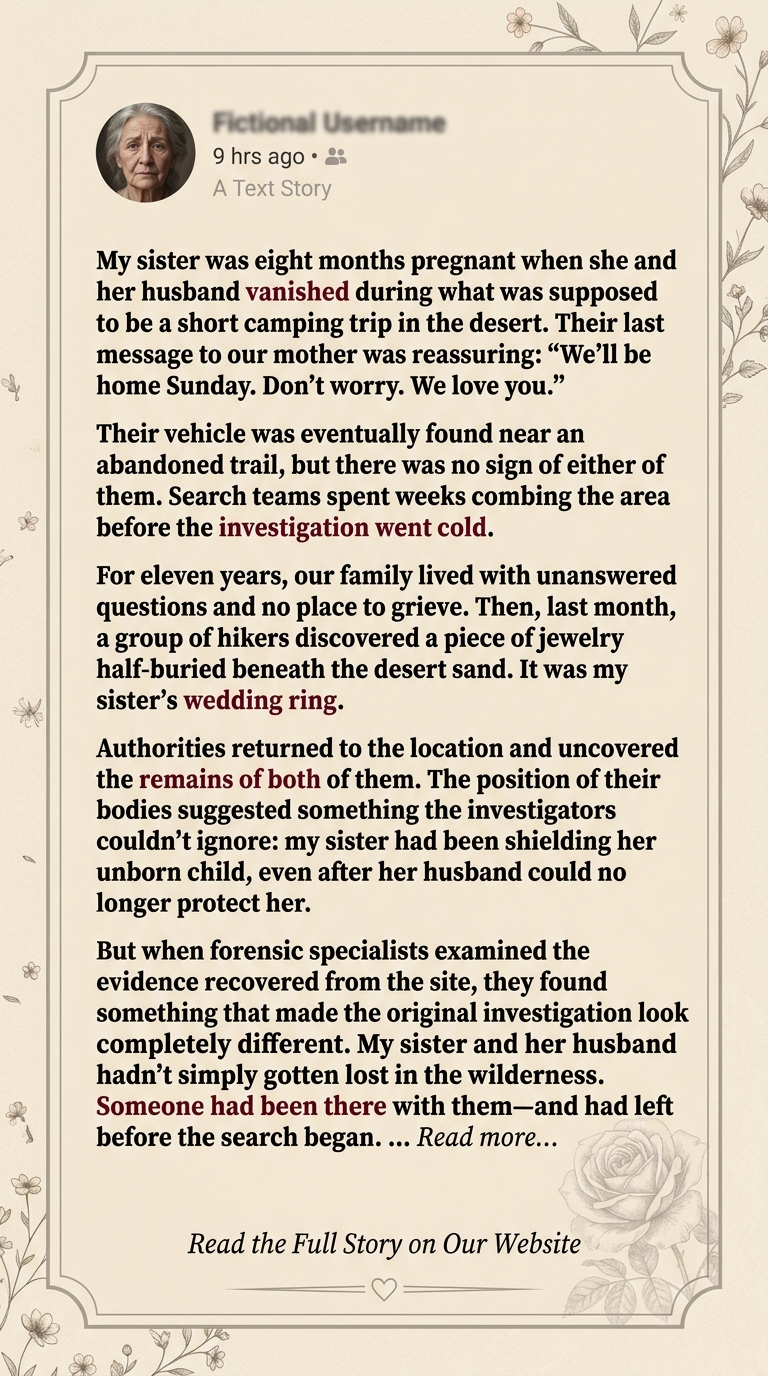
My sister, Rachel, had been eight months pregnant when she and her husband, Mark, disappeared during a camping trip in the Redstone Desert. They had planned to spend two nights exploring an area of sandstone canyons and dry riverbeds before returning home on Sunday.
Their final message arrived on Saturday evening.
We’ll be home Sunday. Don’t worry. We love you.
On Sunday, they never came.
When their vehicle was discovered near an abandoned trail, its doors were unlocked. Their camping equipment was inside, along with a half-empty water container and Rachel’s jacket. There was no sign of a struggle, no footprints leading clearly away from the vehicle, and no explanation for why they would have left it behind.
Search teams worked for weeks. Helicopters circled the ridges, volunteers searched the dry washes, and dogs followed trails that eventually disappeared into the hard desert ground.
Nothing.
The investigation eventually went cold.
My mother never accepted that they were dead. She kept Rachel’s bedroom untouched, and she refused to give away the baby clothes she had bought for her first grandchild.
I was twenty-six when they disappeared. By the time eleven years had passed, I had stopped expecting answers, though I never stopped wanting them.
Then, last month, everything changed.
A group of hikers found a gold ring partly buried beneath a patch of windblown sand. One of them recognized the inscription inside: R + M, Always.
It was Rachel’s wedding ring.
The hikers reported the discovery, and authorities returned to the area with forensic specialists. A second search uncovered a shallow depression beneath a collapsed rock shelf, where the remains of Rachel and Mark were found.
The position of the remains suggested that Rachel had been shielding her abdomen. Her body had been turned toward Mark, with one arm drawn across her stomach and the other extended in his direction.
There was no evidence that she had given birth.
The discovery devastated my mother. For eleven years, she had imagined Rachel somewhere alive, perhaps unable to contact us. Now she had to face the loss she had never allowed herself to accept.
But the investigators soon found something else.
A metal camping cup lay several yards from the remains. It wasn’t one of the items listed in the original inventory of Rachel and Mark’s equipment. It had a different manufacturer’s mark and a small dent near the rim.
Inside it, forensic specialists detected traces of a chemical compound that had no reason to be there.
The cup was sent for further testing.
A few days later, Detective Alvarez called me.
“We’ve found evidence that suggests another person was at the campsite,” she said. “We need to ask you about someone your sister knew.”
She mentioned a name.
Gavin Mercer.
I remembered him immediately.
Gavin had been an experienced desert guide who worked for an outdoor adventure company. He had taken Rachel and Mark on a short training trip two years earlier, when they were learning how to navigate remote trails safely.
After that, he and Mark had occasionally exchanged messages about equipment and routes.
“Why are you asking about him?” I said.
“His name appears in an old message recovered from your sister’s cloud account. She wrote to a friend that she was uncomfortable with his behavior.”
I sat down.
“What kind of behavior?”
“She said he had been contacting her repeatedly, even after she asked him to stop.”
I remembered something Rachel had told me shortly before her disappearance. She had mentioned that a former guide had become irritating, sending her unsolicited advice about pregnancy and repeatedly asking whether she and Mark were planning another trip.
At the time, I had thought she was simply annoyed.
The detective continued.
“We also discovered that Gavin’s vehicle was recorded entering a service road near the Redstone area on the same weekend your sister and her husband disappeared.”
“Wasn’t he interviewed during the original investigation?”
“He was. He told investigators he had been working at a different location.”
“Did they verify that?”
“Not thoroughly. The company records available at the time were incomplete.”
I felt my throat tighten.
“What are you saying?”
“We believe he may have been at the campsite.”
The forensic examination eventually established that the traces in the metal cup were consistent with a sedative that could have caused severe confusion and impaired coordination. It wasn’t enough by itself to establish what had happened, but it changed the investigation.
The investigators also found a partial boot impression beneath a layer of hardened sediment near the rock shelf. Its tread pattern was consistent with a discontinued model of hiking boot that Gavin had purchased shortly before the disappearance.
More importantly, the recovered cup contained a partial fingerprint.
It matched Gavin.
When police questioned him again, he denied having any involvement.
He claimed he had visited the area earlier that week but had never seen Rachel or Mark during their trip. He suggested that the cup could have been left behind by another visitor.
The detective asked him why his fingerprint was on an object recovered beside the remains of two missing people.
He had no convincing answer.
Investigators obtained a warrant to search his former storage unit, which he had continued renting despite moving to another state. Inside, they found old maps of the Redstone Desert, photographs from previous guided trips, and a notebook containing handwritten route descriptions.
One page had a date matching the weekend Rachel and Mark disappeared.
Beside the date was a short note:
Ridge access. Water point. Weather turning.
There was also a sentence written beneath it.
They won’t make it back before dark.
The investigators didn’t consider the notebook proof of murder, but it gave them a reason to examine Gavin’s movements more closely.
They discovered that he had been dismissed from the adventure company several months after Rachel’s disappearance. The official reason had been repeated complaints about aggressive behavior toward customers.
One former employee remembered an argument between Gavin and Mark shortly before the camping trip.
According to the employee, Mark had accused Gavin of sending inappropriate messages to Rachel. Gavin had responded by telling him that he was making a mistake by trusting someone who didn’t understand the desert.
The employee hadn’t reported the argument because neither man had made a formal complaint.
I began to understand that the camping trip might not have been as ordinary as we had believed.
The detective later reconstructed the most likely sequence of events using the physical evidence, the weather records, and the information recovered from Gavin’s devices.
Gavin had followed Rachel and Mark into the desert.
He had approached their campsite, claiming he had noticed a dangerous weather change and wanted to warn them about a safer route. Because they knew him, they had allowed him to sit with them.
At some point, he had given them water from the metal cup.
The substance inside it had impaired their judgment and coordination. When Mark realized something was wrong, he confronted Gavin.
A struggle followed.
The investigators found traces of Mark’s blood on a rock several yards from the remains, along with damage to the strap of his backpack. It appeared he had tried to reach their vehicle, possibly to get help or escape.
But the weather had turned.
A sudden desert storm had reduced visibility, and temperatures dropped sharply after sunset. The trail became difficult to follow, even for experienced hikers.
Gavin had left the area.
He had not called for help.
He had not reported seeing them.
He had simply driven away and allowed the search to begin without telling investigators that he had been there.
The evidence suggested that Rachel and Mark had attempted to reach a sheltered area after the confrontation. Mark had been badly injured, and Rachel, heavily pregnant, had struggled to move across the uneven ground.
The final position of their remains indicated that she had stayed beside him, protecting her unborn child as long as she could.
The medical examination could not determine every moment of their final hours. It couldn’t tell us their last words or whether Rachel understood that no one was coming.
But it established that neither of them had died in a simple accident.
Gavin was arrested several weeks later.
During questioning, he initially maintained that he had only tried to help them. When confronted with the fingerprint, the vehicle records, and the recovered notebook, his account began to change.
He admitted following them into the desert.
He said he wanted to frighten Mark and make him understand that Rachel should not be traveling with someone who ignored his advice. He claimed he had brought the sedative to make them sleep through the night so he could take their vehicle and force them to leave the area.
He insisted he had never intended to kill anyone.
But when Mark confronted him, Gavin panicked. A physical fight followed, and Mark was injured. Gavin left before the storm arrived, telling himself they would find their way back.
He never contacted emergency services because he knew his presence would expose what he had done.
The prosecution later established that Gavin’s actions had deliberately placed the couple in danger, and his decision to abandon them had contributed to their deaths. He was convicted on charges arising from the assault and their deaths, and received a lengthy prison sentence.
For my family, the conviction brought no real comfort.
My mother attended the sentencing hearing. She sat quietly throughout the proceedings, holding a photograph of Rachel and Mark from their wedding day.
When the judge asked whether she wished to make a statement, she stood with the photograph in her hands.
“My daughter was going to have a baby,” she said. “She had already chosen a name. She had painted a little room and bought tiny shoes. She believed she and her husband were going away for two nights and coming home to us.”
Her voice broke.
“You didn’t just take two people from this family. You took every ordinary day they should have had. You took birthdays, school mornings, arguments over dinner, and the chance to watch their child grow up. I hope you understand that there was nothing temporary about what you did.”
She sat down before she began crying.
After the hearing, we finally arranged a funeral.
For eleven years, we had lived without graves to visit or a place to say goodbye. Now Rachel and Mark were laid to rest together, beneath a simple stone bearing their names.
My mother placed a small pair of knitted baby shoes beside the flowers.
They had been made by her own hands before the disappearance.
She never had the chance to give them to her grandchild.
A few weeks later, I helped her clear Rachel’s bedroom. We didn’t throw everything away. We kept the photographs, the painted wooden letters she had chosen for the nursery, and a small stack of books about raising a child.
But we opened the curtains, aired the room, and allowed sunlight to reach the walls for the first time in years.
As we worked, Mom found the final message Rachel had sent before the trip.
We’ll be home Sunday. Don’t worry. We love you.
She read it aloud, then placed the phone on the dresser.
“I kept waiting for Sunday,” she said.
I put my arm around her.
“I know.”
For eleven years, we had imagined Rachel and Mark disappearing into an unforgiving wilderness. The truth was more terrible: someone they had trusted had followed them, deceived them, and abandoned them when they needed help most.
We could never give Rachel the life she had been preparing for, or give my mother the grandchild she had spent eleven years hoping to meet.
But at last, we knew what had happened.
And on the first Sunday after the funeral, my mother turned off the porch light.
For the first time in eleven years, she no longer had to leave it burning for people who would never come home.

