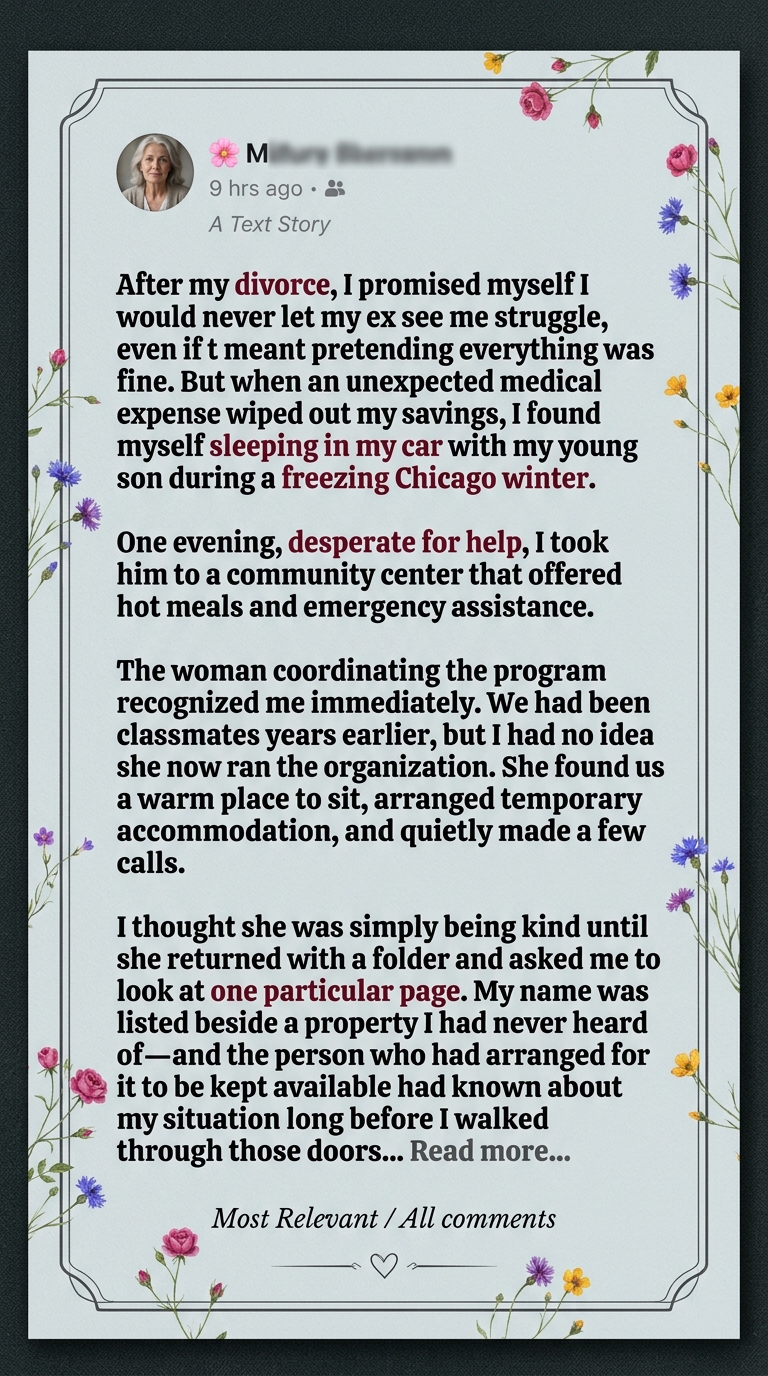
The first night my son and I slept in the car, I told him we were having an adventure.
It was a ridiculous thing to say, even by my own standards, but I couldn’t bear to tell a six-year-old that his mother had run out of money and had nowhere else to take him.
His name was Oliver. He was wearing his winter coat, a knitted hat, and two pairs of socks. I had wrapped him in every blanket I could find in the trunk, then turned the engine on whenever the cold became unbearable.
Outside, Chicago was covered in snow.
Inside, I kept smiling.
“Are we camping, Mommy?” he asked.
“Something like that.”
“Can we make pancakes tomorrow?”
I swallowed.
“Of course, sweetheart.”
I had no idea how I was going to buy breakfast.
My divorce had been finalized eight months earlier. I had promised myself that I would rebuild my life without asking my ex-husband, Mark, for anything. During our marriage, he had often reminded me that I depended on him financially. After we separated, I wanted nothing more than to prove that I could manage on my own.
For a while, I did.
I found a small apartment, worked extra shifts at a medical billing office, and carefully planned every dollar. Oliver adjusted better than I expected. He missed his father sometimes, but he enjoyed having his own room and being able to choose the bedtime stories we read.
Then came the medical emergency.
Oliver developed a serious infection that required hospitalization and several follow-up treatments. My insurance covered part of the expenses, but a series of bills arrived within weeks. I used my savings, borrowed what I could from a friend, and fell behind on rent.
When the landlord refused another extension, I had nowhere to go.
I sold some furniture, stored the rest with a former coworker, and moved what remained into my car.
I didn’t tell Mark.
I knew he would offer to take Oliver temporarily, and perhaps that would have been the sensible choice. But I was afraid that if I admitted how badly things had gone, he would use it as proof that I had never been capable of raising our son independently.
So I kept pretending.
Until the temperature dropped below freezing and Oliver began coughing at night.
That evening, I drove around looking for somewhere warm. A notice at a gas station mentioned a community center offering hot meals and emergency assistance.
I followed the address.
The building was an old brick community center on the west side of the city. Warm light spilled through its windows, and several families were entering through the main doors.
I parked nearby and sat for several minutes, trying to gather the courage to go inside.
Oliver touched my arm.
“Mommy, I’m hungry.”
That was enough.
I took his hand and walked in.
The room smelled of soup, fresh bread, and coffee. Volunteers were arranging chairs while families waited near a serving counter. A woman with short dark hair stood behind a folding table, speaking to a volunteer about emergency accommodation.
She looked up when we approached.
Then she froze.
“Emily?”
I stared at her.
For a moment, I couldn’t place the face.
Then recognition came.
“Rachel?”
Rachel Morgan had been my classmate in high school. We hadn’t been close friends, but we had shared several classes and once worked together on a school fundraiser. She had been quiet, organized, and the sort of person teachers trusted with everything.
I hadn’t seen her in almost fifteen years.
She came around the table and hugged me.
“What happened? Are you all right?”
I immediately tried to smile.
“I’m fine. We just needed somewhere to eat.”
Rachel looked at Oliver, then back at me.
She didn’t challenge my answer.
Instead, she crouched to his level.
“Hello. I’m Rachel. Have you had dinner?”
Oliver shook his head.
“Would you like some chicken soup and bread?”
He nodded.
She arranged a meal for him, then brought us to a quieter corner of the room.
I expected her to ask questions, but she didn’t. She simply made sure Oliver had enough to eat and brought me a cup of tea.
When I finally explained that we had been sleeping in the car, her expression changed.
“How long?”
“Four nights.”
“Emily, why didn’t you come somewhere sooner?”
I looked down.
“I thought I could fix it.”
Rachel reached across the table and held my hand.
“You don’t have to fix everything tonight.”
She arranged for Oliver and me to stay in a small emergency family unit operated by the center. It was a clean, furnished apartment with two beds, a kitchenette, and a bathroom. The accommodation was temporary, but it was warm.
Oliver fell asleep almost immediately.
I sat beside him, listening to the heating system hum.
For the first time in weeks, I didn’t have to worry about the cold.
Rachel returned the next morning with breakfast and a folder.
“I made a few calls last night,” she said. “There’s something I want you to look at.”
I assumed it was paperwork for housing assistance.
She placed the folder on the table and opened it to a page near the back.
My name was printed beside an address.
I read it twice.
“What’s this?”
“A property in the neighborhood of Oak Park.”
I looked at her.
“Why is my name on it?”
Rachel pulled out another sheet.
The property was a small two-bedroom house with a modest garden and a detached garage. It wasn’t luxurious, but it looked well maintained.
According to the document, the house had been purchased several years earlier through a charitable housing initiative. It was being held for a family who met certain eligibility conditions.
And my name was listed as the intended resident.
I felt confused.
“I’ve never heard of this place.”
Rachel sat opposite me.
“Your former husband arranged for it to be kept available.”
My stomach tightened.
“Mark?”
She nodded.
I immediately pushed the folder away.
“I don’t want anything from him.”
“Emily, please hear me out.”
“I told you, I don’t want him controlling my life again.”
Rachel waited until I had calmed down.
Then she explained.
Three years earlier, before my divorce, Mark had contacted the community center. At the time, Rachel had been working there as a housing coordinator, helping families who were at risk of losing their homes.
Mark had asked about establishing a private housing arrangement for a woman who might one day need a safe place to live with her child.
He hadn’t wanted his name publicly connected to it.
Rachel had assumed it was for someone he knew through his work.
When he provided my full name and Oliver’s details, she realized the arrangement was personal.
“Did he tell you why?” I asked.
“He said he wanted to make sure you and Oliver would have somewhere to go if circumstances changed.”
I stared at the page.
“Why would he do that before we divorced?”
Rachel opened another section of the folder.
The property had been purchased through a community housing partnership. Mark had funded the purchase, but the organization retained control of the property. It wasn’t an asset he could sell or use to influence me. The arrangement provided temporary housing for a named family, with an option to extend the stay if the household continued to meet the program’s requirements.
He had also paid for the initial maintenance and set aside funds for repairs.
I couldn’t understand it.
Mark had been difficult during our marriage. He was proud, controlling, and often more concerned with winning an argument than resolving it. Our divorce had been bitter because he believed I was making a mistake by leaving.
Yet he had arranged something that could protect us even after we separated.
“Does he know we’re here?” I asked.
Rachel shook her head.
“He hasn’t contacted us recently. The arrangement was made years ago, and the organization has kept the property available. I only recognized your name when I checked our records after you arrived.”
“Why didn’t you tell me sooner?”
“Because I didn’t know what had happened between you and Mark. I didn’t want to make assumptions. I also needed to confirm that the arrangement was still valid.”
I looked at the address again.
“Why would he do this and never tell me?”
Rachel hesitated.
“I think that question is better answered by him.”
I spent the rest of the day thinking about the property.
I didn’t want to owe Mark anything. I didn’t want him believing he could step back into my life simply because he had helped us. But the thought of Oliver having a warm bedroom and a place to do his homework was difficult to ignore.
That evening, I called my former husband.
He answered after the second ring.
“Emily?”
I hadn’t spoken to him in almost two months.
“Did you arrange a house through Rachel Morgan’s organization?”
There was silence.
Then he sighed.
“I was wondering when you’d find out.”
My chest tightened.
“You knew I might need it?”
“No. I hoped you wouldn’t.”
“Then why arrange it?”
He was quiet for several seconds.
“Do you remember when we first got married and you wanted to work at the children’s hospital?”
I frowned.
“Yes.”
“You gave it up when I was transferred to another city. Then you took a job that paid less because it allowed you to pick Oliver up from school.”
I didn’t understand where he was going.
He continued.
“When we divorced, I kept thinking about how much of your life you had put aside for our family. I knew you wouldn’t ask me for help, even if you needed it. I also knew I wasn’t always easy to live with.”
I sat down.
“Mark, you don’t get to decide what I need.”
“I know.”
“Then why didn’t you tell me?”
“Because I didn’t want it to become another argument. The house was arranged through an independent organization. I made sure you wouldn’t have to deal with me to use it.”
I looked toward Oliver’s bed.
“Why didn’t you give me the money instead?”
“Because money disappears. A place to live gives you time to figure things out.”
His voice became quieter.
“I didn’t do it because I expected you to come back. I did it because Oliver is my son, and because I know what happens when people run out of options.”
I didn’t know what to say.
Mark had never been good at expressing concern. He usually tried to solve problems by making decisions, and that had been one of the reasons our marriage had failed.
But this time, he had created something without asking for recognition.
I asked him one question.
“Would you have told me if I hadn’t found it?”
He answered honestly.
“Probably not.”
That answer frustrated me more than I expected.
“Then you still haven’t learned to talk to me.”
“I suppose I haven’t.”
We ended the call without arguing.
The next morning, Rachel took me to see the house.
It was smaller than the apartment I had lost, but it was bright and clean. There were two bedrooms upstairs, a little kitchen, and a fenced backyard where Oliver could play.
The previous family had moved out several weeks earlier. The house had been inspected and prepared for another resident.
Oliver walked through the rooms with wide eyes.
“Is this our house?”
I knelt beside him.
“It might be, sweetheart.”
“Can I have the room with the window?”
I smiled.
“Yes.”
He ran upstairs before I could say anything else.
I stood in the doorway, looking at the empty living room.
For months, I had been measuring my success by how well I could hide my problems. I had believed that asking for help would mean surrendering the independence I had fought so hard to regain.
But I was beginning to understand that accepting help didn’t have to mean giving someone control.
Rachel explained every condition of the housing arrangement. I would sign a standard occupancy agreement with the organization, not with Mark. My eligibility would be reviewed periodically, and I could remain there while working toward permanent housing.
I signed.
The move took place the following week.
I found a secondhand dining table, borrowed a sofa from a former coworker, and bought Oliver a small desk. The first night, we ate pasta on the floor because we hadn’t unpacked the kitchen chairs.
Oliver looked around the room.
“Mommy, this feels like home.”
I hugged him.
“It does.”
Over the next few months, I found a better-paying position at a nearby clinic. Rachel connected me with a career program that helped women returning to full-time work after family disruptions. I also began attending financial counseling sessions offered by the center.
I didn’t become wealthy, and I didn’t suddenly solve every problem.
But I stopped living one emergency away from losing everything.
Mark and I eventually began communicating more respectfully. We agreed on a clearer parenting schedule, and he became more consistent about Oliver’s school activities and medical appointments.
I never moved back in with him. The divorce remained final.
One afternoon, while Oliver was playing in the backyard, Mark came to drop off a box of his school supplies.
He stood near the gate, looking at the house.
“How is it working out?” he asked.
“Good. We’re grateful.”
He nodded.
“I was hoping you’d be all right here.”
I looked at him.
“You should have told me about it.”
“I know.”
“You could have trusted me to decide whether to accept it.”
He lowered his eyes.
“You’re right.”
For a moment, neither of us spoke.
Then Oliver ran over.
“Dad! Come see my room!”
Mark smiled and followed him inside.
I watched them climb the stairs together.
There was no dramatic reconciliation, no promise that we would become a family again. We had made too many mistakes for that, and I had no desire to return to the marriage we once had.
But I no longer felt that accepting his help made me weak.
A year after that freezing night at the community center, I returned to the building with two large boxes of winter coats and children’s shoes.
Rachel was coordinating the evening meal when I walked in.
She recognized me immediately.
“Look at you,” she said, smiling. “You came back.”
“I did.”
I placed the boxes beside the donation table.
Then I asked whether I could volunteer one evening each week.
Rachel looked genuinely pleased.
“Are you sure?”
I nodded.
“I remember what it felt like to walk through that door and hope nobody would recognize how desperate I was. I want to make that first step easier for someone else.”
That night, I helped serve soup to a mother sitting with her little boy. He wore a thin jacket and kept rubbing his hands together.
I brought them extra blankets and showed the woman where she could speak with the housing coordinator.
She thanked me quietly.
I recognized the expression on her face. It was the same one I had worn when I first arrived.
As I watched her settle beside her son, I finally understood why Rachel had been so careful with me.
She hadn’t tried to rescue me by taking over my life. She had given me warmth, information, and a chance to make my own decisions.
And the house Mark had arranged was not a second chance at our marriage.
It was a second chance for me and my son to build a life without fear.
For the first time since the divorce, I no longer needed to pretend everything was fine.
I was finally learning how to make it fine.

