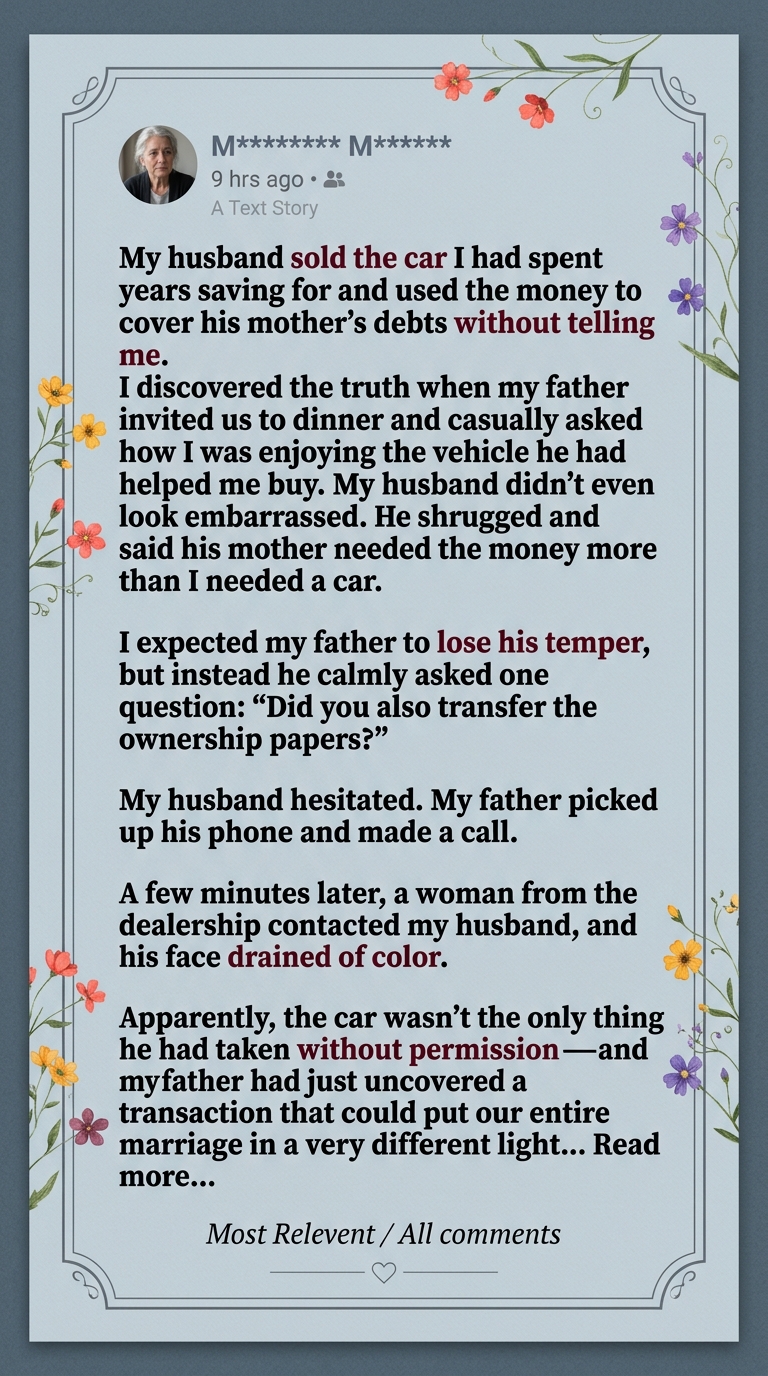
For five years, I saved for a car.
Every birthday, every holiday, and every extra shift at work brought me a little closer to the vehicle I had dreamed of owning. I skipped vacations, stopped buying expensive clothes, and packed lunch instead of eating out.
My husband, Kevin, knew how much it meant to me.
He watched me transfer money into a separate savings account every payday. He knew I had chosen the model, researched the insurance costs, and visited three dealerships before finding the one I wanted.
When I finally bought it, I cried sitting behind the steering wheel.
It wasn’t a luxury car, but it was mine. I had earned every dollar that paid for it.
My father helped me negotiate the final price, and we completed the purchase using my savings. The registration was handled through the dealership, and I kept the purchase documents in a folder at home.
For the first few months, everything was wonderful.
Then, one Tuesday morning, I went outside and found the parking space empty.
I called Kevin immediately.
“Where’s my car?”
He didn’t sound surprised.
“I’ll explain when I get home.”
“Where is it, Kevin?”
“I had to take care of something. Don’t start worrying.”
He ended the call.
I spent the next several hours imagining every possible explanation. Perhaps it had been stolen. Perhaps he had borrowed it and forgotten to tell me.
When he finally came home, he admitted that he had sold it.
I stared at him.
“You did what?”
“My mother had some urgent debts. She was getting calls from creditors, and I couldn’t let her lose everything.”
“You sold my car?”
He shrugged.
“It was just a car. My mother needed the money more than you needed another vehicle.”
I couldn’t speak.
He explained that his mother, Denise, had accumulated debts from unpaid credit cards and a personal loan. She had been struggling for months, and Kevin had decided that selling my car was the quickest way to help her.
He said he had already given her the money.
“You didn’t ask me,” I finally managed.
“I knew you’d say no.”
That answer hurt more than the sale itself.
He hadn’t made a mistake. He had deliberately avoided asking because he knew I would refuse.
I demanded to know how he had managed to sell it.
He told me that he had taken care of the paperwork and that the dealership had paid him directly.
I asked whether he had transferred the ownership documents.
He said everything was handled.
I didn’t believe him, but before I could question him further, my father called.
He had invited us to dinner that evening.
I almost canceled. I didn’t feel like pretending everything was normal, but Kevin insisted we go.
“Your father doesn’t need to know about every disagreement we have,” he said.
I looked at him.
“This isn’t a disagreement.”
He ignored me.
At dinner, my father, Robert, was unusually cheerful. He had spent years working in vehicle sales and still enjoyed discussing cars.
After we sat down, he asked me how I was enjoying my new vehicle.
I froze.
Kevin reached for his glass.
My father continued.
“The color looks excellent on you. Have you taken it on any long drives yet?”
I looked at him.
“Dad, I don’t have the car anymore.”
His smile disappeared.
“What do you mean?”
Kevin answered before I could.
“I sold it. My mother needed help with some debts.”
He said it casually, as though he were explaining why he had bought groceries instead of taking us to a restaurant.
My father put down his fork.
“You sold her car?”
Kevin shrugged.
“She wasn’t using it every day. Mom had a serious financial problem.”
My father remained quiet for several seconds.
Then he asked one question.
“Did you also transfer the ownership papers?”
Kevin hesitated.
“Yes. I handled everything.”
My father looked directly at him.
“Are you certain?”
Kevin frowned.
“Why are you asking?”
My father picked up his phone.
“Because I know the woman who handled the purchase.”
He stepped into the hallway and made a call.
I sat there, confused. Kevin looked irritated.
“What’s this supposed to be?”
I didn’t answer.
A few minutes later, my father’s phone rang.
He returned to the table, listened briefly, and then placed the call on speaker.
A woman’s voice came through.
“Mr. Harris, I checked the transaction you asked about. The vehicle was originally purchased under your daughter’s name, and the dealership has no record of her authorizing a sale or signing a transfer.”
Kevin’s face changed.
My father leaned forward.
“Could you explain exactly what happened?”
The woman, whose name was Laura, worked in the dealership’s finance department. She explained that Kevin had contacted the dealership several days earlier, claiming he was acting on my behalf because I was unavailable.
He had presented a document that appeared to authorize him to complete the sale.
However, the dealership had noticed that the signature didn’t match the one on the original purchase agreement. The manager had refused to finalize the transfer without speaking to me directly.
Kevin had then taken the vehicle to an independent buyer and completed a separate transaction.
The dealership had reported the attempted authorization because the paperwork appeared suspicious.
I stared at my husband.
“You told me everything was handled.”
He looked away.
My father asked Laura one more question.
“Did you find anything else connected to the transaction?”
There was a pause.
“Yes. We noticed a second application submitted using the same authorization document. It involved a financing inquiry for another vehicle.”
My stomach tightened.
“What financing inquiry?” I asked.
Laura explained that someone had used my personal information to apply for a loan through the dealership’s finance network. The application listed me as a co-borrower on a vehicle I had never seen.
It had been rejected because the income information couldn’t be verified.
I looked at Kevin.
He didn’t move.
My father slowly ended the call.
Then he turned toward my husband.
“How many times have you used my daughter’s information without her permission?”
Kevin rubbed his forehead.
“You’re making this sound worse than it is.”
“Answer the question,” I said.
He sighed.
“Your mother-in-law needed help. I was trying to solve several problems at once.”
“By putting debt in my name?”
“I wasn’t going to let anything happen to you.”
I felt a cold wave pass through me.
“Then why did you use my information?”
He finally admitted that his mother had been facing more than ordinary credit-card debt. She had missed payments on a loan secured against her house, and the lender had started legal proceedings to recover the money.
Kevin had promised to help her avoid losing the property.
He had sold my car to raise some of the funds, but the amount hadn’t been enough. He then tried to arrange additional financing using my credit history.
He believed that if the application succeeded, he could use the money to clear his mother’s most urgent obligations and make the monthly payments himself.
He had never discussed any of it with me.
My father listened without interrupting.
When Kevin finished, he asked, “Does your mother know you used your wife’s identity?”
Kevin nodded reluctantly.
“She knows I was trying to arrange some financing.”
“Does she know it was in your wife’s name?”
He didn’t answer.
That silence told me enough.
I stood up.
“I want you to call her.”
Kevin looked alarmed.
“Why?”
“Because I want to hear whether she knew what you were doing.”
He refused at first, but my father insisted that if Kevin wanted to explain his actions, he should do it honestly.
Finally, Kevin called Denise.
She answered cheerfully.
“Hello, sweetheart. Did you manage to sort everything out?”
I took the phone.
“Denise, this is Emily.”
Her tone changed.
“Hello, dear. Is something wrong?”
“Did you know Kevin sold my car to pay your debts?”
There was a pause.
“Well, he said he was arranging some money.”
“Did you know he used my personal information to apply for a loan?”
Another pause.
Then she said something I would never forget.
“Your husband was only doing what a good son should do. You have a stable job. You can buy another car. I was about to lose my home.”
I closed my eyes.
“So you knew he was using my money and my identity?”
“I didn’t tell him to steal anything.”
“But you accepted the money.”
She became defensive.
“I never asked him to sell your car.”
Kevin took the phone from me.
“Mom, stop.”
But Denise continued.
“You promised me you would take care of it. Don’t turn this into my fault now.”
Kevin ended the call.
For the first time that evening, he looked genuinely frightened.
My father stood.
“Emily, we’re going to make sure your identity and finances are protected. You don’t have to decide anything about your marriage tonight.”
I nodded.
Kevin followed me into the hallway.
“Please don’t do this. I was trying to help my mother. I never intended to hurt you.”
I turned toward him.
“You knew exactly how much that car meant to me. You watched me save for years. You knew I would never agree to sell it, so you did it behind my back. Then you tried to borrow money using my name.”
“I was going to pay it back.”
“With what? Money you hadn’t earned? A loan I never agreed to?”
He had no answer.
My father drove me home that night. Kevin stayed behind, claiming he needed to think.
The next morning, I contacted the dealership and asked for copies of every document connected to the attempted sale and financing application.
I also contacted my bank and the credit-reporting agencies to place protective alerts on my accounts. My father helped me arrange a consultation with a lawyer who specialized in unauthorized financial transactions.
The investigation revealed that Kevin had used my personal information to submit the financing application and had provided an electronic signature that wasn’t mine.
The independent buyer who purchased the car cooperated with the investigation. He had believed Kevin was the rightful owner because Kevin showed him a set of documents that appeared legitimate.
The car was eventually recovered while the ownership dispute was resolved.
It had some minor damage, but nothing that couldn’t be repaired.
The financing application was formally withdrawn, and the bank placed restrictions on further credit activity involving my identity.
Kevin’s actions were reported to the appropriate authorities. He eventually admitted that he had submitted the application without my consent. The matter proceeded separately from our divorce, and he was required to address the financial consequences of his actions.
But recovering my car wasn’t the hardest part.
The hardest part was realizing that my husband had been willing to gamble with my financial future because he believed his mother’s problems mattered more than my right to make decisions about my own property.
I moved into a small apartment a few weeks later.
Kevin begged me to reconsider. He said his mother had pressured him, that he had panicked, and that he had never intended for the situation to become so serious.
I told him that helping his mother wasn’t the betrayal.
Making decisions with my money, selling my property, and using my identity without permission were the betrayal.
Our marriage had survived arguments, financial difficulties, and years of family interference. It couldn’t survive the realization that I had been treated as a resource rather than a partner.
I filed for divorce.
Denise never apologized. She continued telling relatives that I had abandoned Kevin during a difficult period, conveniently leaving out how he had created that difficulty by taking what wasn’t his.
I stopped trying to correct her version of events.
Several months later, my car was returned to me after the ownership matter was settled. I had it inspected, repaired, and cleaned.
The first time I drove it again, I parked outside my father’s house.
He came out and looked at the vehicle.
“Still like the color?” he asked.
I smiled.
“More than ever.”
He opened the passenger door.
“Then let’s go for a drive.”
We drove along the lakefront, watching the winter sunlight reflect off the water. I thought about the five years I had spent saving for that car and how close I had come to losing it because someone believed my sacrifices could be spent without my permission.
My father hadn’t needed to shout at dinner or threaten my husband.
He had simply asked the right question and made one phone call.
But the most important thing he gave me that evening wasn’t the chance to recover my car.
It was the reminder that being married to someone never gives them ownership of your choices, your savings, or your future.
And I would never again confuse keeping the peace with allowing someone to take what I had worked so hard to earn.

