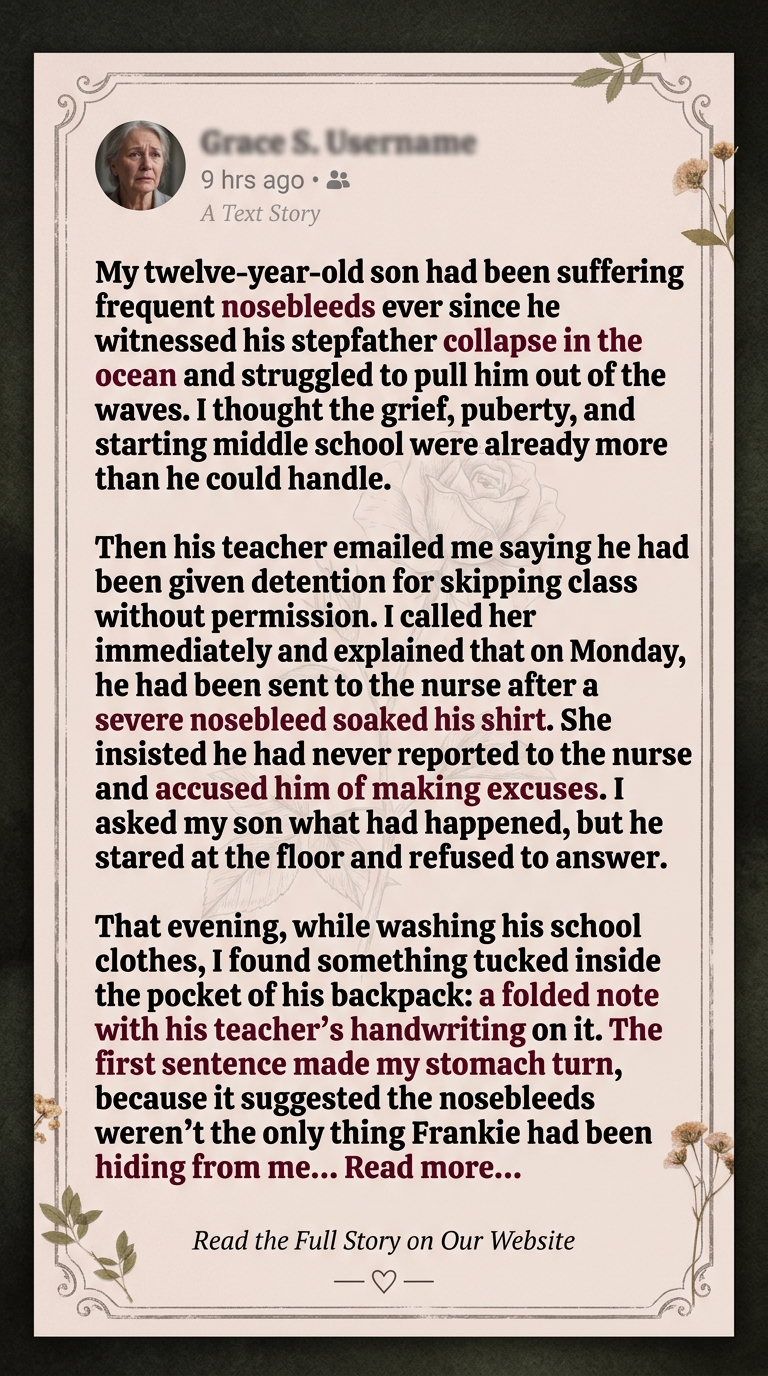
The first time Frankie came home with blood on his shirt, he told me it was nothing.
He was twelve, old enough to insist he could handle things himself, but young enough that I still noticed every change in his expression.
The nosebleeds had started about six weeks earlier. Sometimes they happened in the morning. Sometimes during dinner. Once, he woke up in the middle of the night with blood running over his upper lip.
I initially blamed the dry weather, but the doctor wanted to investigate further. Frankie had been under enormous emotional strain since his stepfather, Mark, collapsed in the ocean during a family trip.
Frankie had been the one who noticed him struggling.
He had run into the water, grabbed Mark’s arm, and tried desperately to pull him toward the shore. By the time other people reached them, Mark had already drowned.
Frankie had survived physically, but something inside him had changed.
He stopped swimming. He stopped talking about the beach. He began waking from nightmares, and the smallest arguments could make him shut down completely.
On top of that, he had started middle school, where everything seemed unfamiliar and overwhelming.
I thought grief explained most of it.
I didn’t realize how much else he was carrying.
The trouble with his teacher began on a Monday.
At 4:15 that afternoon, I received an email from his homeroom teacher, Mrs. Hargrove.
She informed me that Frankie had skipped his afternoon mathematics class without permission and had been assigned detention.
I was confused.
Frankie had never been a troublemaker. He wasn’t perfect, but he had always followed school rules.
I called the school immediately.
Mrs. Hargrove answered.
“I received your email about Frankie,” I said. “I wanted to understand what happened.”
“He left class without permission,” she replied. “When I questioned him, he refused to explain himself.”
“Wasn’t he sent to the nurse that day? He had a serious nosebleed.”
There was a pause.
“What nosebleed?”
“He came home with blood all over his shirt. He told me he had been in the nurse’s office.”
“That’s not true. He never reported to the nurse.”
I stared at the phone.
“Are you certain?”
“I’m responsible for knowing where my students are. Frankie was absent from my classroom, and he didn’t have permission to leave.”
I explained that he had been bleeding heavily and that I was concerned about his health.
Mrs. Hargrove sounded impatient.
“Children sometimes exaggerate when they want to avoid consequences. He still has to learn accountability.”
I ended the call feeling unsettled.
When Frankie came downstairs, I asked him what had happened.
He was wearing his school sweatshirt, even though the house was warm.
“Your teacher says you skipped class.”
He stared at the floor.
“Did you go to the nurse on Monday?”
He nodded.
“Then why does she say you didn’t?”
He shrugged.
“Frankie, I need you to tell me the truth.”
His fingers tightened around the sleeve of his sweatshirt.
“I don’t want to talk about school.”
I wanted to press him, but I remembered how frightened he had become whenever anyone raised their voice.
So I told him we would talk later.
That evening, I collected his school clothes and backpack from the hallway. As I was sorting through everything, I noticed a folded piece of paper inside the small front pocket.
It was tucked behind an old permission slip.
I unfolded it.
The handwriting belonged to Mrs. Hargrove.
The note began:
Frankie, this is the third time you’ve used your personal situation to avoid completing your work. I cannot keep sending you to the nurse whenever you feel uncomfortable. If you leave my classroom again without permission, I will record it as truancy and contact your mother.
My stomach tightened.
I read the note again.
Then I noticed a second paragraph.
You are not the only student who has problems at home. Other children manage to attend class without making their private lives everyone’s responsibility.
I felt sick.
But it was the final sentence that made my hands tremble.
And please stop telling people what happened in the ocean. You are making the other students uncomfortable.
I sat on the edge of the bed.
What had Frankie been telling people?
And why had his teacher written something like that?
I looked through the backpack again and found a small notebook hidden beneath his mathematics folder.
It wasn’t a diary. It was a collection of short sentences, written in uneven handwriting.
Some were dates. Others were reminders.
One entry read:
Monday. Don’t tell Mom.
Another said:
Tuesday. Don’t bleed on the floor.
Then, on a page near the back:
If I tell, she’ll say I’m making trouble again.
I heard footsteps in the hallway.
Frankie appeared in the doorway.
He saw the notebook in my hands and went completely still.
“Where did you get that?”
“From your backpack.”
He looked frightened.
I put the notebook down.
“Frankie, sweetheart, I’m not angry. But I need to understand what’s happening.”
He shook his head.
“Nothing.”
I moved closer.
“Your teacher wrote that you shouldn’t talk about what happened to Mark. Why would she say that?”
His eyes filled with tears.
“Because everyone thinks I’m lying.”
“About what?”
He began crying so hard that he could barely speak.
Finally, he whispered, “I didn’t skip class because I wanted to.”
I waited.
“On Monday, my nose started bleeding during mathematics. I raised my hand, but Mrs. Hargrove told me to wait until she finished explaining the lesson.”
He wiped his face.
“Then it got worse. I could taste the blood, and I didn’t want everyone looking at me.”
“What did you do?”
“I asked to go to the nurse.”
“And she refused?”
He nodded.
“She said I was trying to get out of the assignment. Then she told everyone to stop paying attention to me.”
My chest tightened.
“What happened after that?”
“I started feeling dizzy. I got up because I thought I was going to fall. She told me to sit down, but I couldn’t.”
He took a shaky breath.
“I went into the hallway and asked another teacher to help me. She took me to the nurse.”
I closed my eyes.
“Why didn’t you tell me?”
“Mrs. Hargrove said she would call you if I kept making excuses. She said you’d think I was being difficult.”
I pulled him into my arms.
“Oh, Frankie.”
He buried his face against my shoulder.
Then he told me something I hadn’t expected.
After the accident, several students had started asking him questions about Mark’s death. At first, they had been curious. Then some began making jokes.
One boy had asked whether Frankie had been strong enough to save Mark.
Another had said that if Frankie had reached him sooner, Mark might still be alive.
Frankie had tried to ignore them.
But when he told Mrs. Hargrove, she said he needed to stop discussing the accident because it was upsetting other students.
“She told me people were tired of hearing about it,” he whispered.
I felt anger rising, but I kept my voice calm.
“Did she say that in front of the class?”
He nodded.
“She said I couldn’t keep using Mark’s death to get special treatment.”
That was when I understood why he had started hiding his nosebleeds.
He wasn’t simply afraid of getting in trouble.
He had begun believing that asking for help made him a burden.
The next morning, I took Frankie to his doctor.
The physician examined him, reviewed his symptoms, and ordered blood tests. He explained that frequent nosebleeds in children could have several causes, including irritation, allergies, or problems with blood clotting. Because Frankie’s episodes were recurring and sometimes heavy, he wanted a more thorough evaluation.
He also recommended that Frankie receive support from a child trauma specialist.
I agreed.
Afterward, I contacted the school principal and requested an urgent meeting.
I brought the teacher’s note, Frankie’s notebook, and the medical documentation.
The principal, Mr. Lawson, listened carefully while I explained what had happened.
He looked troubled.
“Mrs. Hargrove has been teaching here for eleven years,” he said. “I have never received a complaint quite like this.”
“Then perhaps you haven’t been hearing what happens when parents aren’t in the room.”
He nodded slowly.
“I understand.”
I asked whether the school had records of Frankie’s visit to the nurse.
The principal checked the attendance and health records.
There it was.
A nurse’s entry from Monday afternoon.
Student arrived with active nosebleed. Shirt visibly stained. Appeared pale and anxious. Provided first aid and contacted parent.
The time was recorded at 1:47 p.m.
I pointed to it.
“He wasn’t skipping class. He was receiving medical attention.”
Mr. Lawson looked at the note again.
“You’re right.”
He called the school nurse, who confirmed that Frankie had arrived without an escort and had told her he had left class because his teacher wouldn’t allow him to seek help.
She had not known that he had already been accused of skipping.
The principal then asked for the hallway camera footage.
The recording showed Frankie leaving the classroom with one hand pressed beneath his nose. He walked unsteadily toward the nurse’s office before stopping to ask a passing teacher for help.
There was no sign of misbehavior.
But the principal didn’t stop there.
He requested statements from several students who had been present when Mrs. Hargrove made comments about the accident.
Three students independently confirmed that she had told Frankie to stop bringing his family tragedy into the classroom.
One girl added that she had seen Mrs. Hargrove take a folded note from Frankie’s desk and tear it up.
“What note?” I asked.
The girl explained that Frankie had written a message asking to visit the nurse. Mrs. Hargrove had torn it in half and told him to concentrate.
The school opened a formal investigation.
Mrs. Hargrove was placed on temporary leave while the administration reviewed the evidence.
When she was interviewed, she claimed she had been trying to maintain classroom discipline and that Frankie had become increasingly difficult since the accident.
She also insisted that her comments had been misunderstood.
But the written note, the nurse’s record, the hallway footage, and the students’ accounts told a different story.
The principal later informed me that the school had found sufficient evidence of misconduct and a failure to follow its medical-response procedures.
Mrs. Hargrove was removed from her teaching position pending further disciplinary review. The school also revised its procedures so students could report urgent medical symptoms directly to the nurse without needing a teacher’s permission.
I was relieved, but I knew removing one teacher wouldn’t immediately repair what had happened to Frankie.
The medical tests revealed that his nosebleeds were being aggravated by fragile blood vessels inside his nose, worsened by irritation and repeated rubbing. The doctor treated the affected area and gave us instructions for managing future episodes. He also explained which symptoms would require urgent medical attention.
Fortunately, the tests did not reveal a serious blood disorder.
Frankie began seeing a child trauma counselor named Dr. Patel.
At first, he barely spoke during their sessions. But Dr. Patel didn’t force him to explain the accident. She let him draw, play, and talk at his own pace.
One afternoon, after several weeks, Frankie told me something he had never said aloud before.
“I keep thinking I should have pulled Mark harder.”
I sat beside him on the sofa.
“Why do you think that?”
“Because I was holding his arm, and then he slipped away.”
I took his hands.
“Frankie, you were twelve. You were a child in dangerous water. You tried to help someone you loved. The accident was not your fault.”
He looked at me.
“But I was there.”
“Yes. You were there, and you did everything a child could possibly do. The adults who were responsible for keeping everyone safe were the ones who should have protected you.”
He leaned against me.
For the first time, he didn’t argue.
The school arranged for him to move into another homeroom. His new teacher, Mr. Bennett, made sure he knew where to find the nurse and gave him a quiet place to go when he felt overwhelmed.
The teasing from other students was addressed too. The principal spoke with the children involved and made it clear that blaming Frankie for Mark’s death was unacceptable.
It took months for Frankie to feel comfortable again.
He still had difficult mornings. He still avoided the beach. And occasionally, a sudden nosebleed would bring back the fear he had been trying to escape.
But he began telling me when something was wrong.
One afternoon, he came home, dropped his backpack beside the door, and said, “Mom, I think I need to talk to Dr. Patel tomorrow.”
I looked up from the kitchen.
“Of course. Do you want to tell me why?”
He considered it.
“Not yet.”
I smiled.
“That’s okay.”
He went upstairs, then returned a few minutes later.
“Mom?”
“Yes?”
“Thanks for believing me.”
I put down what I was holding and opened my arms.
He walked into them.
I wished he had never needed to hide his pain. I wished his teacher had recognized a frightened child instead of seeing a disciplinary problem. Most of all, I wished Frankie had never been forced to carry the belief that he was responsible for someone else’s death.
But I was grateful that he had finally trusted me enough to tell the truth.
That folded note had revealed more than a teacher’s cruelty.
It had shown me how quietly a child could begin to disappear when the adults around him stopped listening.
And I promised myself that Frankie would never have to earn the right to be heard in his own home.

