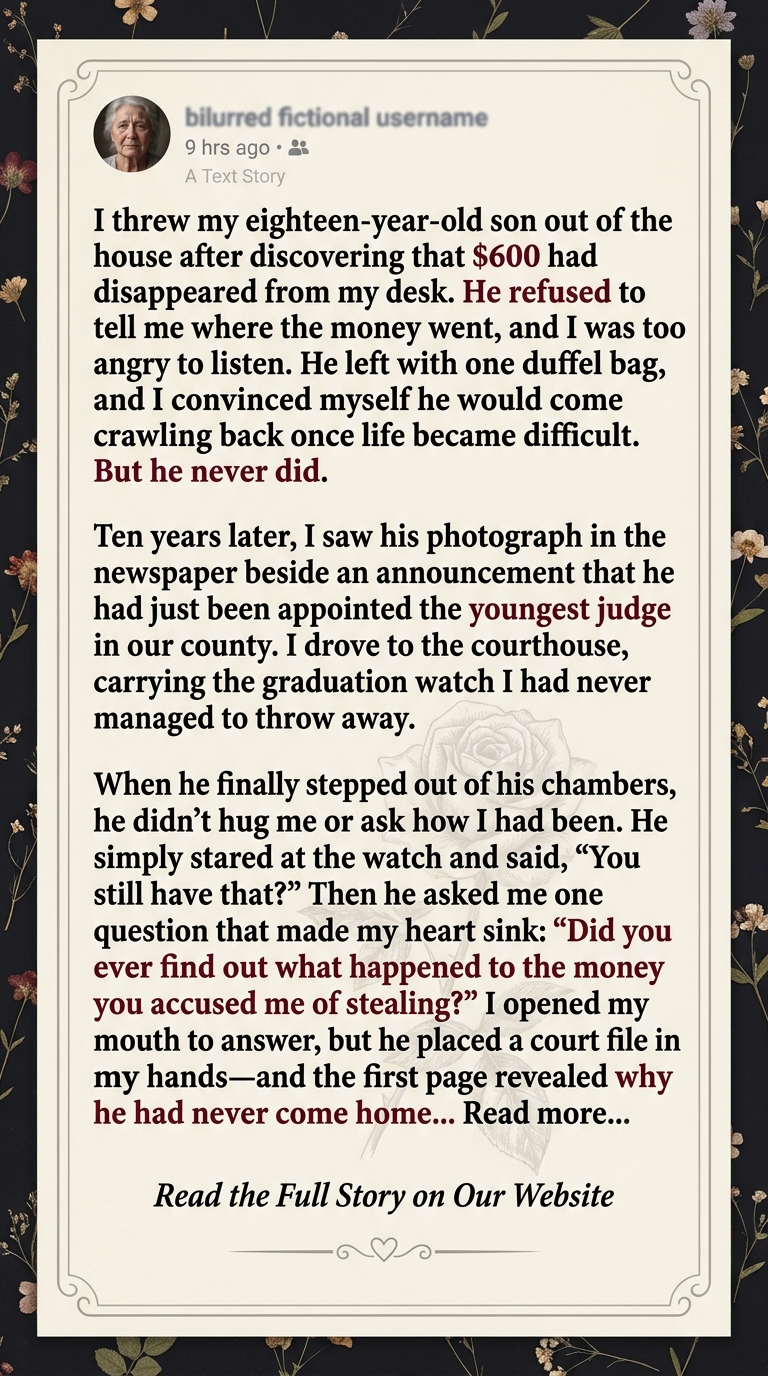
The day I threw my son out of the house, he was wearing the same blue sweatshirt he had worn to his high school graduation.
I remember that because I had bought it for him the previous Christmas, and I remember thinking, as he stood in the doorway with a duffel bag, that he hadn’t even bothered to change before leaving.
His name was Nathan. He was eighteen, stubborn, and usually honest to a fault.
But six hundred dollars had disappeared from my desk, and I was convinced he had taken it.
I had been saving that money to repair the roof before winter. It was inside an envelope in the bottom drawer, beneath a stack of old utility bills. On Thursday morning, I checked the drawer and found the envelope empty.
Nathan had been home that afternoon.
When I confronted him, he was sitting at the kitchen table, working on a college application.
“Did you take the money from my desk?”
He looked up.
“What money?”
“The six hundred dollars in the envelope.”
His expression changed, but he didn’t answer immediately.
“Mom, I can’t explain it.”
I heard only the words I can’t explain it.
“Then you took it.”
“No. That’s not what I said.”
“Where is it, Nathan?”
He closed his laptop.
“Please, just give me a little time.”
That made me angrier.
“You expect me to believe you took money from your own mother and now need time to explain?”
He stood up.
“I didn’t steal it.”
“Then tell me where it went!”
He stared at me for several seconds. There was something desperate in his expression, but I was too furious to recognize it.
Finally, he said, “If I tell you, it could make things worse for someone.”
I took that as another excuse.
I told him that if he couldn’t be honest under my roof, he could find somewhere else to live.
He looked at me as though I had slapped him.
“You’re throwing me out over six hundred dollars?”
“I’m throwing you out because you stole from me and refuse to admit it.”
He went upstairs, packed a few clothes, took his school documents, and returned with one duffel bag.
At the door, he stopped.
“One day, you’ll understand why I couldn’t tell you.”
I folded my arms.
“Don’t expect me to chase after you.”
He nodded once and left.
I expected him to return within a few days.
He didn’t.
I expected a phone call asking for money.
It never came.
At first, I told relatives that Nathan was being difficult and needed to learn responsibility. When people asked whether I had heard from him, I said he was probably embarrassed about what he had done.
Then months became years.
His phone number stopped working. His old friends said they rarely saw him. I sent two letters to the last address I had for him, but both came back.
I told myself that if he wanted a relationship, he knew where to find me.
Ten years passed.
By then, I had learned to live with his absence, although I never stopped noticing it.
I kept his graduation photograph on the bookshelf. I also kept the silver watch I had given him that day. It was a simple watch with a dark leather strap and a small engraving on the back:
For every new beginning. Love, Mom.
I had almost thrown it away several times.
I never did.
Then, one Tuesday morning, I saw his photograph in the newspaper.
The headline read:
LOCAL ATTORNEY, 28, APPOINTED YOUNGEST JUDGE IN COUNTY HISTORY.
I nearly dropped my coffee.
The photograph showed Nathan standing outside the courthouse in a dark suit, holding a folder beneath one arm.
He looked older, naturally, but I recognized the shape of his smile immediately.
I read the article three times.
He had graduated from university with honors, attended law school on scholarships, worked as a public defender, and developed a reputation for handling difficult juvenile cases with unusual patience.
Now he had been appointed a county judge.
My son had become a judge.
And I had missed every moment that had brought him there.
I cut out the article and placed it beside his graduation photograph.
For two days, I argued with myself about whether I should visit him.
What if he refused to see me?
What if he was angry?
What if he had built a new life and wanted nothing to do with the woman who had thrown him out?
But eventually, I took the silver watch from its box and drove to the courthouse.
The receptionist looked at me cautiously when I asked to see Judge Nathan Hale.
“Do you have an appointment?”
“I’m his mother.”
She checked the schedule, made a phone call, and asked me to wait.
Twenty minutes later, a young clerk escorted me upstairs.
Nathan’s chambers were spacious but modest. There were law books along one wall, several framed certificates, and a small photograph of an older woman standing beside a teenage boy.
I didn’t recognize the woman.
Nathan stood behind his desk.
For a moment, neither of us spoke.
Then he looked at the watch in my hand.
“You still have that?”
His voice was calm, almost formal.
“I never threw it away.”
He gestured toward the chair.
I sat down, holding the watch tightly.
“You’ve done very well,” I said. “I’m proud of you.”
“Thank you.”
I waited for him to ask how I was. I waited for him to smile or come around the desk.
He did neither.
Instead, he opened a drawer and removed a thick court file.
He placed it in front of me.
“Did you ever find out what happened to the money you accused me of stealing?”
My mouth went dry.
“No,” I whispered. “I always thought—”
“You always thought I took it.”
He opened the file.
The first page was a copy of a police report dated the day before I had confronted him.
I stared at the date.
Nathan pointed to the next page.
It was a statement from a hospital social worker.
Then came a series of medical bills, bank records, and a letter from a woman named Elaine Porter.
I looked up.
“Who is she?”
Nathan leaned back.
“Elaine was our neighbor. She lived three houses down from us. Her son, Caleb, was in my class.”
I remembered Caleb. He had been a quiet boy who sometimes came over to borrow school supplies.
“What does he have to do with the money?”
Nathan looked at the file.
“His father had left them years earlier. Elaine was raising him alone, working nights at the laundry. When Caleb was seventeen, he developed a serious heart condition. He needed an urgent procedure, and the family couldn’t afford the travel and treatment costs.”
I felt a chill.
“Why didn’t they ask for help?”
“They did. They applied for assistance, but the hospital needed an initial payment before the transfer could be arranged.”
Nathan turned another page.
“Caleb collapsed at school. I was there when the ambulance came. Elaine called me that evening because she couldn’t reach anyone else.”
I remembered Nathan leaving the house that Thursday afternoon.
He had said he was going to study at the library.
He had actually gone to the hospital.
“She told me the transfer would be canceled unless she paid the deposit by the following morning,” he continued. “She had already borrowed money from relatives and sold most of what she owned. She was short six hundred dollars.”
I looked at the file.
“And you took it?”
“No.”
He said it so firmly that I looked up.
“I didn’t take the money from your desk. I had been saving my own money from weekend work. I had six hundred and twenty dollars in my savings account.”
I stared at him.
“Then why didn’t you tell me?”
He looked at me for a long moment.
“Because I had promised Elaine I wouldn’t tell anyone what was happening to Caleb. He was terrified that people at school would find out about his condition. He didn’t want to be treated differently.”
“But you could have told me without telling everyone.”
“I was eighteen, Mom. I thought I could protect his privacy and still help him. I should have found another way to explain it, but I didn’t know how.”
He paused.
“After I refused to admit stealing the money, you told me to leave. I was angry, but I also knew that if I explained, I would break my promise to a boy who was already frightened enough.”
I looked down at the documents.
There was a bank withdrawal receipt for $600, dated the same afternoon the money disappeared from my desk.
But the account number wasn’t mine.
It belonged to Nathan.
I felt my face grow hot.
“Why did you let me believe you had stolen it?”
“I didn’t let you. I told you I hadn’t.”
His answer was quiet, but it hurt more than shouting would have.
I turned the pages.
There was a receipt showing the hospital had received the payment. Another document confirmed that Caleb had undergone the procedure and recovered.
The final pages contained Elaine’s statement.
She explained that Nathan had arrived at her house with the money and told her it was his savings. He had refused to accept repayment, even when she offered.
She had kept the receipts because she wanted Caleb to know, when he was older, who had helped him.
I reached the final page and saw a handwritten note.
Nathan asked me not to tell his mother. He said she had worked hard to save that money, and he didn’t want her to feel she had to choose between helping us and protecting her own household. I tried to convince him to explain, but he was determined to keep Caleb’s medical situation private.
I put the page down.
For ten years, I had believed my son had stolen from me.
In reality, he had used his own savings to help save another boy’s life.
And I had punished him for it.
“Why didn’t you contact me after you left?” I asked.
Nathan’s expression softened slightly, but he didn’t look away.
“I did.”
I shook my head.
“What?”
“I called the next morning. You didn’t answer. I sent a letter a few weeks later.”
“I never received it.”
“I know. It came back.”
He opened another section of the file and showed me a copy.
The letter was addressed to me.
I recognized the handwriting immediately.
It said:
Mom, I know you’re angry. I wish I could explain everything without breaking my promise to someone who trusted me. I didn’t steal from you. I love you, and I hope one day you’ll believe me.
I covered my mouth.
“I never saw this.”
“I believe you.”
He closed the file.
“After that, I stayed with Elaine for a few weeks. She helped me contact a scholarship adviser. I eventually found a room near the university and worked two jobs while studying.”
I looked at the photograph on his shelf.
The woman beside him was older than I was.
“Is that Elaine?”
He nodded.
“She came to my law school graduation. She was the first person who told me I could become a lawyer.”
I stared at him.
“You put her photograph in your chambers.”
“She believed in me when I didn’t have anyone else.”
His words were not meant to hurt me, but they did.
I had spent ten years imagining that my son was stubbornly refusing to return.
I had never considered that he might have found somewhere else to belong.
I reached across the desk.
“Nathan, I’m sorry.”
He looked at my hand but didn’t take it.
“I know.”
“I should have listened.”
“Yes.”
“I should never have thrown you out.”
“No, you shouldn’t have.”
His honesty left me with nowhere to hide.
I began crying.
“I thought you would come back.”
“I was eighteen. I had one bag, a little money, and nowhere permanent to go. I wasn’t in a position to prove anything to you.”
I lowered my head.
He waited until I stopped crying.
Then he said something I hadn’t expected.
“I don’t hate you, Mom. But I need you to understand that I built my life without you because I had to. I can’t pretend those years didn’t happen just because you’ve finally learned the truth.”
I nodded.
“I understand.”
He looked at the watch again.
“Why did you bring it?”
“I wanted you to have it. I thought perhaps you’d remember your graduation.”
He picked it up and turned it over, reading the engraving.
For the first time, his expression changed.
“I remember that day,” he said. “You told me you wanted me to have a life where I could make my own decisions.”
I nodded through my tears.
“I meant it.”
“I know. I just wish you’d trusted me enough to let me make one difficult decision without assuming the worst.”
He placed the watch on his desk.
Then he asked whether I had ever heard from Elaine.
I admitted I hadn’t.
He explained that she had moved away after Caleb recovered. Nathan had remained in contact with them, and Caleb had eventually become a paramedic.
“He’s doing well,” Nathan said. “He still says the money you thought I stole was the reason he got a second chance.”
I closed my eyes.
The irony was almost unbearable.
The six hundred dollars I had accused my son of taking had never left my family. It had simply come from a different account, earned through his own work, and gone toward saving someone else’s child.
Before I left, Nathan stood.
“I can give you Elaine’s address if you want to write to her.”
“I would like that.”
He handed me a card with her current contact details.
Then he walked me to the door.
I turned back.
“Will I see you again?”
He considered the question.
“If you want to, we can start with lunch. Not as if nothing happened. Just lunch.”
I nodded.
“That would mean a lot to me.”
We agreed to meet the following Saturday.
When I arrived, Nathan was already seated at a small restaurant near the courthouse. He had chosen a quiet table by the window.
We didn’t suddenly become close. We didn’t erase ten years over one meal. There were awkward silences and questions neither of us knew how to answer.
But he told me about his work, and I told him about the years I had spent wondering where he was.
At the end, he asked whether I still had the old graduation photographs.
I told him I did.
“Bring one next time,” he said.
I smiled.
“I will.”
On the drive home, I thought about the young man who had walked out of my house carrying a single duffel bag. I had believed he was leaving because he was guilty.
He had actually been leaving because he had tried to do something decent, and the person whose trust mattered most to him had refused to believe him.
I couldn’t recover the years we had lost.
But I could stop defending the mistake that had taken them from us.
And that Saturday, for the first time in a decade, my son had given me another chance—not to become the mother I had been, but to begin becoming the mother he needed.

