For thirty-four years, I worked at St. Catherine’s Hospital. I never wore a white coat, never performed surgery, and never appeared in the photographs celebrating successful operations. My office was on the third floor, behind a door marked Patient Records and Clinical Coordination. Most people assumed I spent my days filing paperwork.
My younger sister, Vanessa, was one of them.
At family gatherings, she introduced me as “the hospital secretary,” although I had corrected her countless times. When she became a successful real estate agent, she started treating my career as something I had done because I lacked ambition.
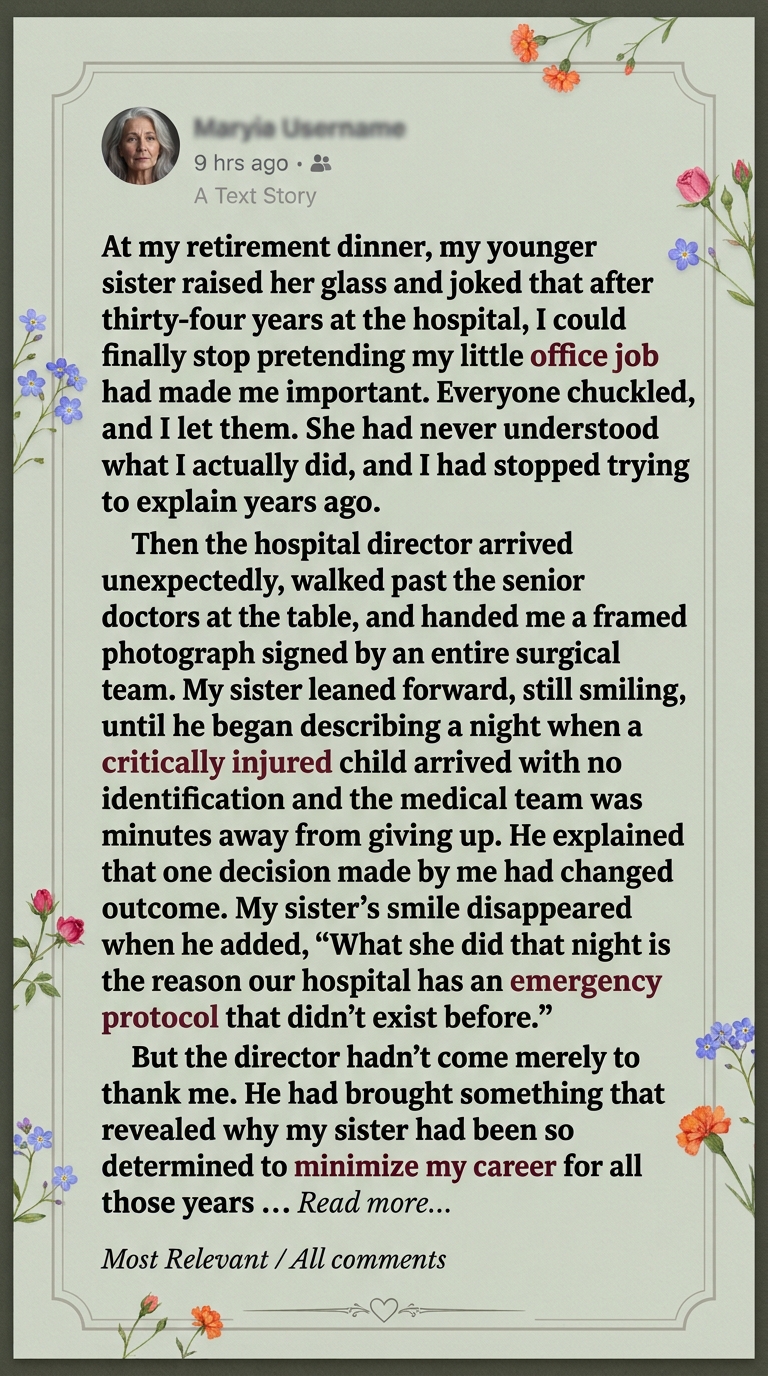
So when she raised her glass during my retirement dinner and joked that I could finally stop pretending my little office job had made me important, I simply smiled.
Everyone laughed.
I had learned that explaining myself to Vanessa was usually a waste of breath.
My husband, Peter, squeezed my hand beneath the table. He knew how much the job had meant to me, even when I came home exhausted and couldn’t discuss what had happened during my shift.
I was about to thank everyone for coming when the restaurant manager approached our table.
“Excuse me, Margaret. Someone from the hospital is here to see you.”
I turned around.
Dr. Samuel Reed, the hospital director, was walking toward us. Behind him were three senior surgeons and the head of emergency medicine.
I hadn’t expected any of them.
“Samuel?” I said, standing. “What are you doing here?”
He smiled.
“We couldn’t let you retire without saying goodbye properly.”
He carried a large framed photograph. It showed a surgical team standing outside the operating department, with their signatures written around the edges.
He placed it in my hands.
“Thirty-four years,” he said. “And there are people in this hospital who owe you more than they will ever be able to express.”
Vanessa leaned forward.
“Well, that’s lovely,” she said, still wearing her amused smile. “I suppose even the filing department deserves a celebration.”
Dr. Reed looked at her, then back at me.
“Actually, I came because I wanted everyone here to understand what Margaret did for this hospital.”
He turned toward the guests.
“Twenty-two years ago, on a freezing November night, an ambulance brought us a child who had been struck by a vehicle. The child was unconscious, had severe internal injuries, and arrived without identification. Nobody knew her name, her blood type, or whether she had any medical conditions.”
He paused.
“Our emergency team was preparing to take her into surgery when a serious problem emerged. The child’s blood type was rare, and the available hospital supply was dangerously low. The blood bank had received an incorrect inventory report earlier that evening. The team believed we had no compatible units available.”
I remembered that night immediately.
I had been working late because a new electronic records system was being installed. The emergency department called our office after discovering that the child’s registration had been entered under a temporary identification number that didn’t match the blood bank’s system.
At the time, I was responsible for coordinating patient records across several departments.
I had noticed something unusual.
The child’s blood sample had been entered twice, under two different temporary numbers. The first result had been marked incomplete, while the second had been attached to the wrong patient profile.
When I checked the original paperwork, I realized the blood bank’s inventory system had excluded several compatible units because an earlier transfer had never been recorded correctly.
I called the blood bank supervisor.
He told me the computer showed nothing available.
I asked him to check the physical storage records.
He initially refused. The department was overwhelmed, and he believed I was delaying the emergency team.
But I insisted.
I found the transfer sheet, identified the missing units, and contacted the laboratory to verify them. Within minutes, the blood bank confirmed that compatible blood was available.
The child went into surgery.
She survived.
I had never considered myself a hero. I had done what I was trained to do: question a record that didn’t make sense and refuse to accept a computer screen as the final authority when someone’s life depended on it.
Dr. Reed continued.
“That child recovered. She eventually became a doctor herself. But the incident exposed a dangerous weakness in our emergency procedures. We had been relying too heavily on temporary records and automated inventory reports. Margaret recognized the problem before anyone else did.”
He looked directly at me.
“After that night, she helped design a verification system requiring independent confirmation of blood availability whenever a patient arrives without reliable identification. She also developed a procedure for reconciling temporary patient records across emergency, laboratory, and blood bank departments.”
The restaurant had become completely silent.
“That procedure eventually became hospital policy,” he said. “Other medical centers adopted similar safeguards. What Margaret did that night changed the way we handle unidentified emergency patients.”
Vanessa’s smile had disappeared.
She stared at me as though she had never seen me before.
I lowered my eyes toward the photograph.
“Samuel, I didn’t do it alone. The laboratory staff and emergency team worked incredibly hard.”
“Of course,” he replied. “But you were the person who refused to let the incorrect record become the final answer.”
Then he reached into his jacket and removed a second envelope.
“This is why I came tonight as well.”
I opened it.
Inside was a formal letter from the hospital board announcing the establishment of the Margaret Ellis Emergency Records Fellowship. It would provide annual training for clinical coordinators, records specialists, and laboratory staff who worked to prevent errors in emergency patient identification.
I read the letter twice.
“You’re naming a fellowship after me?”
“We are,” Dr. Reed said. “And the board wanted to offer you something else.”
He handed me another document.
It was a copy of the original incident review from twenty-two years earlier. I had seen it before, but this version included an additional section that had been sealed from general staff access.
The final page contained the names of everyone involved in the hospital’s original inventory failure.
One name made my stomach tighten.
Vanessa Ellis.
My sister’s name.
I looked up.
“Why is your name here?”
Vanessa had gone pale.
Dr. Reed glanced at her.
“Perhaps Margaret should explain what she remembers.”
I turned the page.
The report stated that the hospital’s blood inventory discrepancy had originated with an outside administrative contractor responsible for updating supply transfers. That contractor had submitted a falsified confirmation indicating that several units had been moved to another facility when they had actually remained in storage.
The contractor’s employee responsible for the submission had been Vanessa.
I looked at my sister.
“That was you?”
She shook her head quickly.
“I didn’t know what happened. I was only working there temporarily.”
It was true that Vanessa had worked for a hospital supply contractor before becoming a real estate agent. But I had never known the details of her departure.
Dr. Reed spoke carefully.
“The original investigation found that the transfer had been entered without the required confirmation. The contractor dismissed the employee responsible. The hospital also reviewed its procedures. We have no evidence that Vanessa knew a child would be affected, and the hospital has no intention of reopening an employment matter from twenty-two years ago tonight.”
I stared at the document.
“Why wasn’t I told?”
“Because the report was confidential,” he answered. “And because your sister’s involvement was unrelated to the work you performed afterward. You were never responsible for her actions.”
Vanessa finally spoke.
“I made a mistake. It was an office error. I was twenty-four years old.”
I remembered her laughter at family dinners. The way she called my job insignificant. The way she described hospital administration as a place where people pushed papers around.
I suddenly understood that her contempt had never been entirely about my position.
She had spent years dismissing the work I did because acknowledging its importance might have forced her to remember what happened when she worked in that same system.
But the director wasn’t finished.
He placed another document beside the photograph.
“This is a statement from the patient who survived that night. She is now Dr. Hannah Lewis, one of our pediatric surgeons. She asked me to read her words because she couldn’t attend tonight.”
He unfolded the page.
“To Margaret Ellis: I don’t remember the accident, the ambulance, or the operating room. I was too young and too badly injured. But I know that someone noticed an error when everyone else trusted the system. That person gave my doctors the chance to save me. I have spent my career trying to give other children the same chance you gave me. Thank you for refusing to look away.”
I felt tears gathering in my eyes.
Peter put his arm around me.
For several seconds, I couldn’t speak.
Then Vanessa stood.
“Well, congratulations,” she said stiffly. “I didn’t realize this dinner was going to turn into an investigation of my entire life.”
Nobody answered.
She picked up her handbag.
“I think I’ll go.”
I watched her walk toward the exit.
Part of me wanted to call her back. We were sisters, and I knew she had carried embarrassment about her old job for years. But I also knew that embarrassment did not excuse decades of belittling someone else’s work.
I let her leave.
After the guests had returned to their conversations, Dr. Reed sat beside me.
“I’m sorry that report came as a surprise,” he said. “I didn’t bring it here to embarrass your sister. But I thought you deserved to know the full history of that night.”
“Did the child really survive because I found those units?”
He nodded.
“The surgical team still says the delay would probably have been fatal.”
I looked at the framed photograph again.
For thirty-four years, I had believed my contribution was invisible because I worked behind a desk. I had spent holidays checking records, stayed late correcting mistakes, and taken calls from doctors who needed information immediately.
I never expected applause.
But I had sometimes wondered whether any of it mattered.
That evening answered the question.
Vanessa didn’t speak to me for nearly three months.
When she finally called, she sounded different.
“I owe you an apology,” she said.
I waited.
“I knew you were good at your job. I just never wanted to talk about what happened when I worked at the hospital. Every time you mentioned your department, I remembered that night. I felt ashamed, and instead of admitting it, I made your work sound unimportant.”
I was quiet for a moment.
“Why didn’t you tell me?”
“Because I thought you’d judge me.”
“You spent years judging me instead.”
“I know.”
Her voice broke.
“I was wrong, Margaret.”
I didn’t immediately forgive her. An apology could not erase decades of small humiliations, but I accepted that she had finally told the truth.
We agreed to meet for lunch.
She asked questions about the fellowship, the new emergency procedures, and the people I had worked with. For the first time in years, she listened without making a joke.
I told her that the child from that November night had become a pediatric surgeon.
Vanessa lowered her eyes.
“I’m glad she survived.”
“So am I.”
A year later, I attended the first fellowship ceremony at St. Catherine’s Hospital. Dr. Hannah Lewis was there, standing beside the new group of trainees.
She recognized me immediately.
“Margaret,” she said, taking my hands. “I wanted to meet you properly.”
I smiled.
“You already thanked me.”
“That wasn’t enough.”
She introduced me to the young staff members who would be learning the emergency verification procedures. Then she explained how the system had helped prevent several dangerous identification and blood inventory errors over the previous year.
I listened, feeling a quiet pride I had never allowed myself to claim.
When I returned home, the signed photograph was waiting on the mantelpiece.
I placed the fellowship letter beside it.
For years, my sister had thought importance meant having an impressive title, a large office, or people who stood when you entered a room.
I had learned something different.
Sometimes the most important person in a hospital is the one who notices a mistake before anyone else realizes there is a mistake to find.
And sometimes, the work that saves a life happens far from the operating table.

