The Anniversary Guest He Never Expected
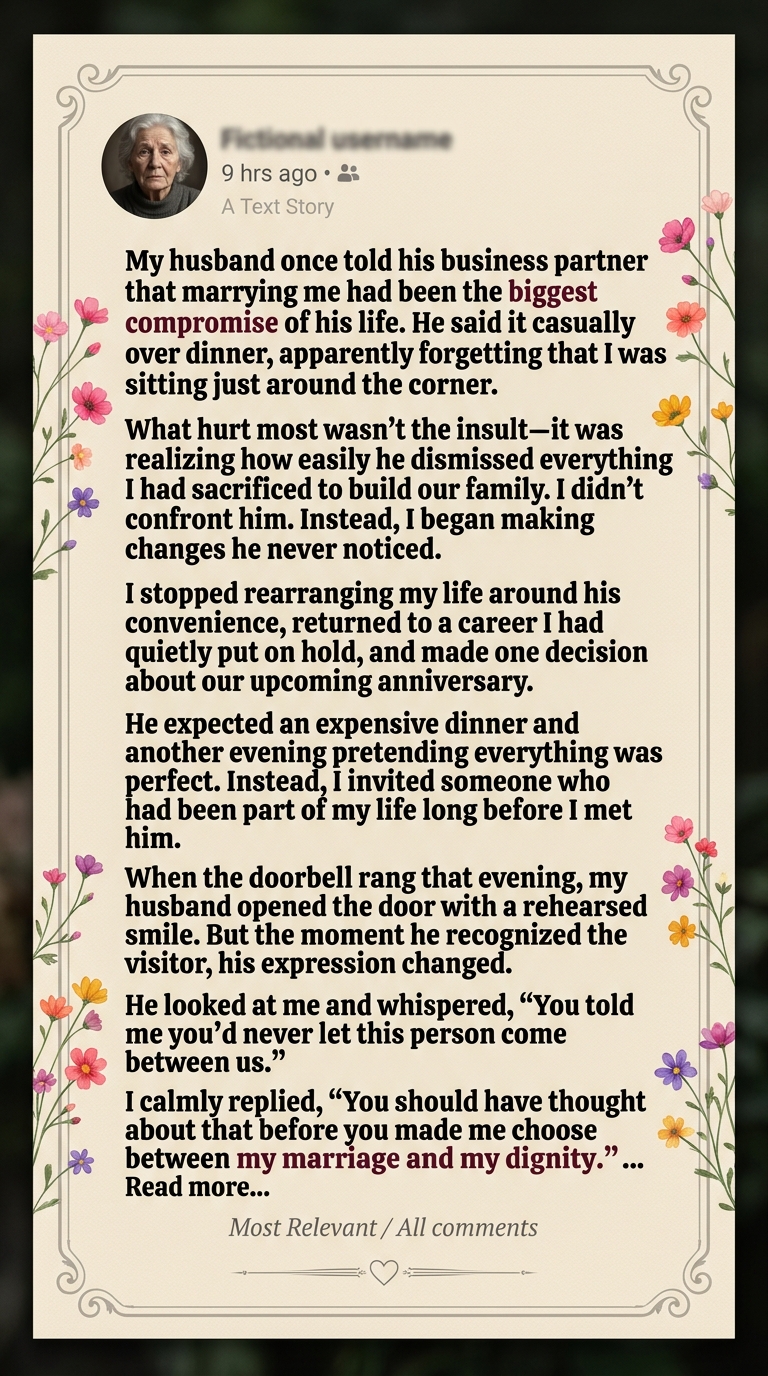
I heard my husband describe our marriage as the biggest compromise of his life while I was standing in the hallway holding a bowl of freshly cut fruit.
He was having dinner with his business partner, Martin, in our dining room. I had finished cooking and stepped into the kitchen to bring out dessert when their conversation drifted toward marriage.
“Honestly, I never imagined I’d end up with someone like Claire,” Daniel said with a short laugh. “Marrying her was the biggest compromise of my life.”
Martin chuckled uneasily.
“Come on. You two have been together for twenty-three years.”
“Exactly. Twenty-three years of putting my ambitions on hold. I could have married someone who understood the world I work in. Instead, I came home to school schedules, grocery lists, and conversations about whose turn it was to pick up the dry cleaning.”
I stood motionless.
Daniel continued.
“Don’t get me wrong. She’s a good woman. But I sacrificed a lot to make this marriage work.”
I looked down at the fruit bowl in my hands.
I had given up a promising career in architectural design when our daughter was born prematurely. Daniel’s business was struggling at the time, and we couldn’t afford childcare and the long hours my position required. I had taken a temporary break, telling myself I would return once things became easier.
Then his company expanded. His travel increased. His responsibilities grew. Our daughter started school, then developed a learning difficulty that required years of appointments and extra support.
Every time I considered returning to work, there was another reason to wait.
I never regretted caring for our daughter. I regretted allowing Daniel to believe that my sacrifices had cost him nothing.
I quietly returned the fruit bowl to the kitchen and went upstairs.
I didn’t confront him that night.
Something told me that if I spoke while the hurt was still fresh, he would apologize, explain that he had been joking, and somehow make me feel unreasonable for taking his words seriously.
Instead, I began paying attention to how our marriage actually worked.
The following morning, Daniel asked whether I could reschedule my dentist appointment because he had a business call and needed me to drive him to the airport.
“I can’t,” I replied.
He looked surprised.
“Why not?”
“Because I have an appointment.”
He stared at me as though I had forgotten an important responsibility.
“Can’t you move it?”
“No.”
I took my car keys and left.
It was a small thing, but it was the first time in years I had refused to rearrange my life simply because Daniel expected me to.
Over the next few weeks, I made other changes.
I contacted a former colleague, Sofia, who had become a partner at an architectural firm. She remembered my work and invited me to discuss a part-time position.
At first, I hesitated. I hadn’t worked professionally in years. The software had changed, the industry had moved forward, and I worried that my old skills would no longer be enough.
Sofia listened patiently.
“Claire, you weren’t an inexperienced graduate when you left. You had already designed several successful projects. We don’t need you to start from zero.”
She offered me a position reviewing residential plans and mentoring younger designers.
I accepted.
When I told Daniel, he barely looked up from his phone.
“That’s nice. Just make sure it doesn’t interfere with the anniversary plans.”
“What plans?”
“Our anniversary dinner. I want somewhere expensive this year. Martin recommended a place downtown.”
I nodded.
“I’ll remember.”
But I had already decided that our anniversary would be different.
There was someone I wanted Daniel to meet again.
Someone who had been part of my life long before he entered it.
His name was Thomas Reed.
Thomas and I had met during our final year at university. We studied architecture together and spent nearly every day working on projects in the same studio. We were close friends, and for a time, our families assumed we would eventually marry.
We did not.
Thomas received an opportunity to study abroad, while I remained home to help my mother after she underwent surgery. Our lives moved in different directions, and we gradually lost contact.
Years later, I met Daniel at a professional conference. He was charming, ambitious, and attentive. I fell in love with him, and Thomas became a memory from another chapter of my life.
But there was something Daniel had never forgiven.
Shortly before our wedding, Thomas had returned to town. He attended a university reunion and asked me to meet him for coffee. We talked about our careers, our old friends, and the years we had lost touch.
Daniel learned about the meeting and became jealous.
He accused Thomas of trying to interfere with our relationship. I explained that we were simply old friends, but Daniel demanded that I choose between maintaining contact with Thomas and marrying him.
I chose Daniel.
I told Thomas that we shouldn’t meet again.
He accepted my decision without argument, although I could hear the disappointment in his voice.
That was the last time we spoke.
For years, Daniel occasionally referred to him whenever we argued.
“At least I don’t have to compete with your old university boyfriend,” he would say.
I eventually stopped mentioning Thomas altogether.
Now, after twenty-three years, I wanted to see him again.
Not because I wanted an affair or intended to replace my husband with an old memory. I wanted to reconnect with someone who had known me before I became the woman who organized everyone else’s life.
I found Thomas through the alumni association and sent him a message.
He replied the following afternoon.
“Claire? I thought you had disappeared from the planet.”
I laughed when I read it.
We spoke on the phone for nearly an hour. He was now a senior architect, had two grown children, and had recently returned to our city after working overseas for several years.
When I told him I had accepted a position at Sofia’s firm, he sounded genuinely pleased.
“That’s wonderful. You were always better at the work than you gave yourself credit for.”
I invited him to our anniversary dinner.
He hesitated.
“Are you sure your husband would be comfortable with that?”
“He knows who you are.”
“That’s not quite what I asked.”
I smiled sadly.
“I want you to come because I no longer want to treat an old friendship as something shameful.”
Thomas agreed, but he made one condition.
“I won’t participate in an argument between you and Daniel. If he wants me to leave, I’ll leave.”
“That’s fair.”
The anniversary arrived on a Saturday evening.
Daniel had spent the afternoon choosing a suit and arranging a bottle of expensive champagne. He seemed pleased with himself.
“I booked the restaurant for eight,” he announced. “We should leave at seven-thirty.”
“I invited someone to dinner,” I replied.
He frowned.
“Who?”
“An old friend.”
“Which friend?”
“You’ll recognize him.”
Daniel looked irritated but returned to adjusting his cufflinks.
At seven, the doorbell rang.
Daniel went downstairs with a rehearsed smile, probably expecting one of our neighbors or a business acquaintance.
He opened the door.
Thomas stood on the porch holding a modest bouquet of flowers.
For several seconds, neither man spoke.
Then Daniel’s expression changed.
“Thomas?”
“Hello, Daniel.”
Daniel looked past him, toward me.
“You invited him?”
I walked down the stairs.
“Yes.”
He stared at me.
“You told me you’d never let this person come between us.”
I stopped beside Thomas.
“You should have thought about that before you made me choose between my marriage and my dignity.”
Daniel’s face tightened.
“Are you trying to humiliate me?”
“No. I’m refusing to be ashamed of someone I once knew.”
Thomas placed the flowers on the entry table.
“Daniel, I didn’t come here to cause trouble. Claire invited me because we haven’t spoken in years. If my presence is going to make this evening unpleasant, I’ll go.”
Daniel ignored him.
“Claire, we have an anniversary dinner planned. This is ridiculous.”
I looked at my husband.
“Do you remember what you said about me to Martin?”
His expression shifted.
“What?”
“That marrying me was the biggest compromise of your life.”
He glanced toward Thomas, then back at me.
“You heard that?”
“Every word.”
Daniel rubbed his forehead.
“That was a private conversation. I was venting.”
“You weren’t venting about a difficult week. You were describing our entire marriage as something you had settled for.”
“That’s not what I meant.”
“Then what did you mean?”
He looked uncomfortable.
“I was talking about the pressure of running a business. You know how demanding my life has been.”
I nodded.
“Yes. I know. I spent twenty-three years making sure your demanding life could function. I gave up my career when our daughter needed me. I handled the house, the appointments, the school meetings, and everything else that allowed you to build your company. I never asked you to give up your ambitions. I simply expected you to respect mine.”
Daniel opened his mouth.
I continued.
“And when I finally started rebuilding my own career, you were more concerned about whether it would interfere with your anniversary dinner.”
He looked toward Thomas.
“So this is about him?”
“No. Thomas is here because I invited an old friend. He isn’t the reason our marriage is in trouble. Your words are.”
Daniel’s voice became quieter.
“You’re making a huge mistake over something I said.”
“Perhaps. But I didn’t make this decision because of one sentence. I made it because that sentence finally showed me how little you thought about everything I had given up.”
Thomas stepped toward the door.
“Claire, I think I should leave.”
I appreciated that he was trying to protect me from another argument, but I shook my head.
“You haven’t done anything wrong.”
Daniel laughed bitterly.
“So now you’re choosing him?”
I looked directly at my husband.
“No. I’m choosing myself.”
For the first time that evening, Daniel had nothing to say.
I asked Thomas to join me in the dining room. Daniel remained in the hallway for several minutes before following us.
The dinner was uncomfortable, but not because Thomas behaved inappropriately. He was polite, spoke about his children, and asked Daniel about his business without hostility.
What unsettled Daniel was how naturally Thomas and I spoke about architecture.
We discussed buildings we had studied at university, the changes in residential design, and a project I had recently been assigned at Sofia’s firm.
Daniel had never asked about my new work.
Thomas did.
When Daniel finally interrupted to ask why I had invited him, I answered honestly.
“Because I wanted to remember what it felt like to be around someone who saw my professional abilities without treating them as a threat.”
Thomas looked uncomfortable.
“Claire, I don’t want to be used as a comparison.”
“You’re not,” I said. “I’m responsible for my choices, and Daniel is responsible for his.”
The conversation moved on, but the evening had changed.
After dinner, Thomas thanked me and left.
Before he stepped outside, he turned toward Daniel.
“I hope you both find a way forward. Whatever happens, Claire deserves to be respected.”
Then he walked down the driveway.
Daniel watched him leave before closing the door.
“You enjoyed that,” he said.
“No, Daniel. I enjoyed being treated like a person with a life of her own.”
He sat down heavily on the sofa.
“Are you planning to leave me?”
I considered the question.
For years, I had imagined that the end of our marriage would arrive through some dramatic betrayal. An affair, a financial scandal, or a devastating argument.
Instead, it had arrived quietly, through the realization that I had become an accessory to someone else’s life.
“I don’t know yet,” I answered. “But I know things cannot continue the way they have.”
Daniel looked at the anniversary table.
“What do you want me to do?”
“Start by understanding that I am not asking you to approve of my career, my friendships, or my decisions. I’m asking you to respect them.”
He nodded, although I couldn’t tell whether he truly understood.
The following weeks were difficult.
Daniel tried to return to our old routine. He began asking me to handle errands and rearrange appointments, then seemed offended when I told him I had work.
I continued at the architectural firm.
My first major assignment was a renovation of an aging public library. The building had structural problems, but I saw possibilities in its original design. I spent evenings studying the plans and mornings discussing solutions with the engineering team.
For the first time in years, I felt intellectually alive.
Daniel initially treated my work as a temporary distraction. But when a local newspaper published an article about the library project and mentioned my role as the lead design consultant, his attitude changed.
He clipped the article and placed it on the kitchen counter.
“I didn’t realize you were doing something this important,” he said.
I looked at him.
“You never asked.”
He lowered his eyes.
A few days later, he asked whether we could talk without distractions.
We sat at the kitchen table, the same place where I had spent countless evenings reviewing our daughter’s schoolwork while Daniel answered business calls.
He apologized.
Not the careless apology he had offered after arguments in the past, but something more difficult.
“I think I got used to believing that everything in our life happened because I worked hard,” he said. “I didn’t understand how much of your life had been arranged around mine.”
I listened.
“I told Martin that marrying you was a compromise because I wanted him to think I had made sacrifices too. It was arrogant, and it was cruel. I knew you had given up your career, but I stopped thinking about what that meant for you.”
“Why?”
He took a long breath.
“Because I was comfortable. You made everything work, and I mistook that for you being satisfied.”
I didn’t forgive him immediately.
But I appreciated that he had finally stopped defending the sentence and started examining the behavior behind it.
We began marriage counseling. I continued working, and Daniel gradually learned that my schedule was not something he could rearrange whenever his business required convenience.
He also stopped making jokes about my former career.
Our marriage did not return to what it had been, because I no longer wanted the version of it that required me to disappear.
Months later, I received an invitation to present the completed library renovation to the city council. Daniel attended, sitting quietly near the back.
Afterward, he approached me with flowers.
“You were wonderful,” he said.
“Thank you.”
He hesitated.
“I’m proud of you.”
I looked at him carefully.
This time, I believed he meant it.
As we walked to the car, he asked whether I would consider having dinner together the following weekend.
“Just us?”
“Just us,” he replied.
I agreed.
Not because everything had been repaired, but because I wanted to see whether we could build something different.
The next morning, I found the anniversary photograph on the mantelpiece. It showed Daniel and me smiling beside the restaurant’s entrance, taken shortly before Thomas arrived.
For years, I had thought a successful marriage meant staying together no matter how much of yourself you had to surrender.
Now I understood that a marriage could survive disappointment, mistakes, and even years of neglect—but only if both people were willing to recognize each other as equals.
I had not invited Thomas to destroy my marriage.
I had invited him because I was finally ready to stop living as though my husband’s approval was the price of my own dignity.
And that was the compromise I would never make again.

