The Calls My Father Was Never Allowed to Make
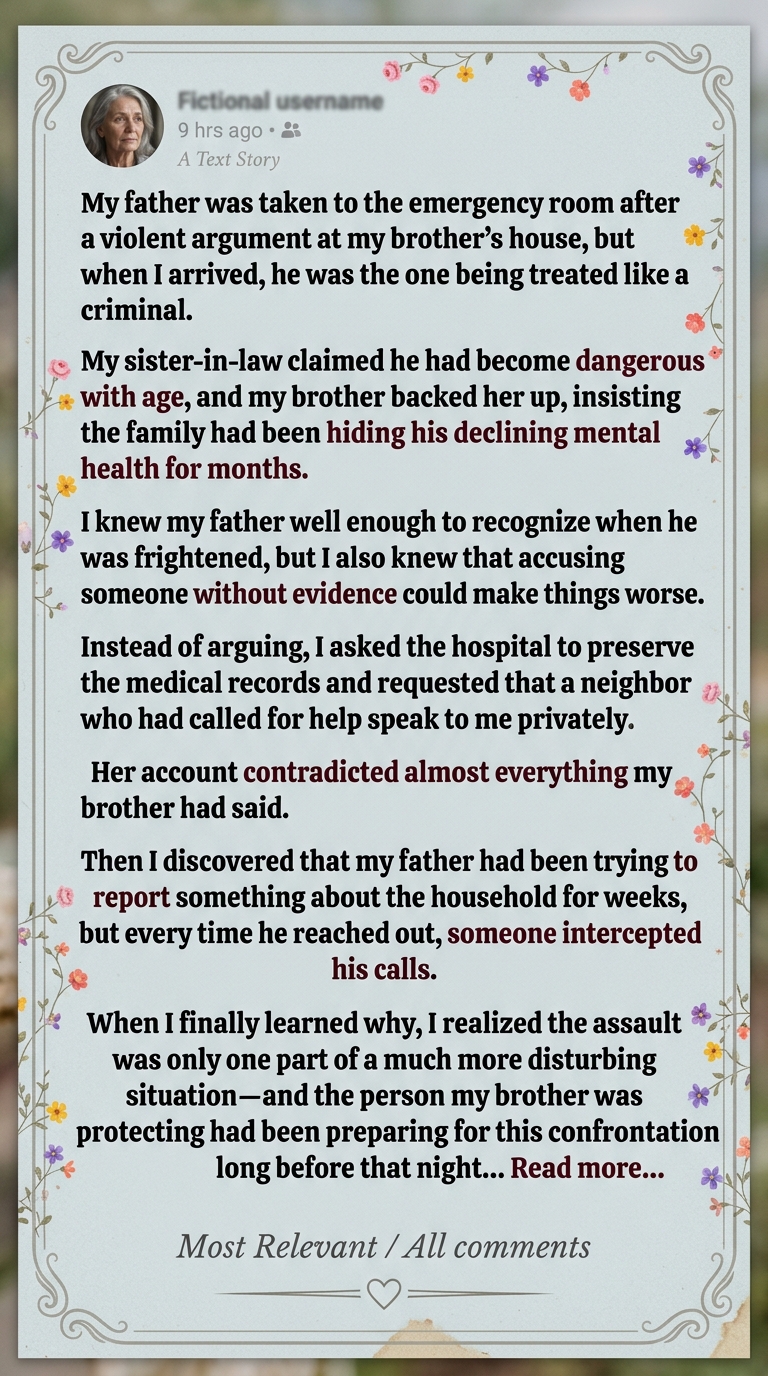
The first thing I noticed when I entered the emergency department was the bruise beneath my father’s left eye.
The second was the security guard standing beside his bed.
My father, Walter, was seventy-eight years old. He had spent most of his life repairing electrical equipment, raising two sons, and avoiding unnecessary arguments. Even after retiring, he remained independent, stubborn, and proud of doing things himself.
Yet that evening, he was sitting on a hospital bed with a hospital gown hanging loosely around his shoulders while my brother, Kevin, and his wife, Brenda, stood nearby explaining why he had supposedly become dangerous.
“He attacked Kevin without warning,” Brenda told the nurse. “We’ve been dealing with his behavior for months. He gets confused, becomes aggressive, and sometimes doesn’t recognize what’s happening around him.”
Kevin nodded solemnly.
“We didn’t want to bring him here, but we couldn’t keep pretending everything was fine.”
I looked at my father.
He wasn’t confused. He was frightened.
“Can I speak with him alone?” I asked.
Brenda immediately objected.
“That isn’t a good idea. He gets worked up when people disagree with him.”
I turned toward the nurse.
“I’d like to speak with the attending physician and understand what has been documented. My father deserves an opportunity to explain what happened without everyone answering for him.”
The nurse nodded and asked Kevin and Brenda to wait outside.
As soon as they left, my father reached for my hand.
“Don’t let them send me back there,” he whispered.
“What happened, Dad?”
He glanced toward the door.
“I tried to tell someone.”
“Tell me now.”
He swallowed.
“Your brother knows.”
Before he could say more, the physician entered. She introduced herself as Dr. Patel and explained that my father had a fractured wrist, several bruises, and a small cut near his hairline. His examination hadn’t revealed an immediate medical emergency beyond those injuries, but she wanted to investigate his account of the incident and evaluate his general health.
Brenda had already told the staff that he might have dementia.
I asked whether there was any medical evidence supporting that claim.
“Not at this point,” Dr. Patel replied. “A family member’s description isn’t a diagnosis. We’ll assess him properly.”
I appreciated her answer.
I also requested that the hospital preserve the complete medical documentation, including the initial examination, photographs of his injuries, and any notes concerning the circumstances of his arrival.
I wasn’t trying to prove anyone guilty before understanding what had happened. I simply didn’t want important information disappearing because the family had already decided which version of events to believe.
The argument, according to Kevin and Brenda, had begun when my father became confused and struck my brother with a heavy object.
But something about that explanation didn’t fit.
My father had a fractured wrist. Kevin had no visible injuries.
I asked the nurse whether anyone had accompanied my father in the ambulance.
She gave me the name of a neighbor listed in the emergency report.
Her name was Mrs. Collins.
I found her number and called.
At first, she sounded hesitant.
“I don’t want trouble with your brother,” she said.
“I understand. I’m not asking you to take sides. I just want to know what you witnessed.”
She was silent for a moment.
Then she agreed to meet me outside the hospital.
Mrs. Collins arrived about twenty minutes later. She was a retired schoolteacher who had lived beside Kevin and Brenda for almost six years.
“I heard shouting that evening,” she began. “At first, I thought it was an ordinary family argument. Then I heard something crash.”
“What happened when you went outside?”
“I saw your father standing near the front steps. He was holding his wrist and asking someone to call an ambulance.”
“Was Kevin injured?”
“No. He was standing in the doorway, shouting at your father to stop pretending.”
Her account contradicted the story my brother had given the hospital.
Mrs. Collins explained that Brenda had been standing behind Kevin, holding a folder. When my father asked for his telephone, she refused to give it to him.
Then Kevin grabbed his arm.
My father tried to pull away, lost his balance, and fell against the edge of the porch.
“Did you see Kevin strike him?” I asked.
“I saw him grab your father. I didn’t see what happened before I came outside. But I heard your father say, ‘You can’t keep doing this.'”
Mrs. Collins looked down at her hands.
“There was something else. Your father had been trying to contact people for weeks. He asked me once whether I knew how to reach a social worker without going through your brother.”
My stomach tightened.
“Why?”
“He said someone in the house was using his name to make decisions he hadn’t agreed to. He was frightened that if he complained, they would say he was losing his mind.”
I thanked her and asked whether she would be willing to provide a formal statement.
She agreed.
I returned to my father’s room.
He was awake, staring at the ceiling.
“Dad, Mrs. Collins told me you’ve been trying to contact someone.”
His eyes filled.
“I tried calling you.”
I frowned.
“When?”
“Three times last month. Brenda said you were busy. Then Kevin told me you had asked him to handle my calls because I was becoming confused.”
I felt a cold anger rising inside me.
“I never asked him to do that.”
“I know that now.”
He explained that Kevin and Brenda had persuaded him to move into their house after he suffered a minor fall the previous winter. They said they wanted to help him with meals, transportation, and household maintenance.
At first, their assistance had been welcome.
But gradually, they began controlling more of his daily life.
Kevin took his bank statements, claiming he needed to organize his bills. Brenda started answering his telephone because she said he received too many unwanted calls. They insisted that he no longer drive, even though his physician had never restricted him from doing so.
When he objected, they accused him of being forgetful and unreasonable.
“They kept telling me I had agreed to things I never agreed to,” he said.
“What things?”
He looked toward the door.
“Your brother wanted me to sign papers.”
“What papers?”
“I don’t know. He said they were for managing the house and making sure everything was paid. I asked to read them first. Brenda became angry and told me I was embarrassing everyone.”
I sat beside him.
“Did you sign anything?”
“One page. I thought it was permission for Kevin to collect my mail.”
“Do you have a copy?”
He shook his head.
“They kept the papers.”
I asked Dr. Patel whether my father could be interviewed privately by a hospital social worker.
She arranged it.
During the interview, my father explained that he had been trying to report financial and personal restrictions imposed by his son and daughter-in-law. He also described several incidents in which his medication had been withheld because Brenda believed he was taking too many pills.
The hospital social worker took the allegations seriously and arranged for an independent assessment before any discharge decision was made.
Meanwhile, I contacted an attorney who handled elder financial exploitation and property matters.
The attorney advised me not to confront Kevin until we understood what documents had been signed.
The next morning, we obtained my father’s recent banking statements through the proper channels, with his consent.
There were several withdrawals he couldn’t explain.
Some were small transfers to a company called Northfield Residential Services. Others were larger payments made to an account belonging to Brenda.
I recognized the company name.
It was the business Kevin had started two years earlier.
When I asked my father about it, he looked confused.
“He said it was for repairs to the house.”
“What repairs?”
“I don’t know. They never showed me the invoices.”
The attorney requested the relevant transaction records and checked the property registry.
That was when we discovered the real reason Brenda had been so determined to portray my father as mentally incapable.
Six weeks earlier, an application had been submitted to register a transfer of my father’s house into a company controlled by Kevin.
The application included a document claiming that my father had voluntarily agreed to transfer ownership in exchange for lifetime accommodation and financial support.
The signature looked like his.
But the date on the document was one of the days my father had been in hospital for a medical procedure.
He had not been home to sign it.
I stared at the copy.
“Can someone verify this?”
The attorney examined the signature carefully.
“We’ll need a proper handwriting assessment, but the date alone raises serious questions. We also need to determine whether the document was properly witnessed and whether your father understood what he was supposedly agreeing to.”
My father was devastated when we showed him.
“I never agreed to give them my house,” he said. “Kevin told me it was only paperwork to protect me.”
I felt sick.
The house had been built by my parents. My father had spent nearly forty years maintaining it. My mother had died there, and every room contained memories of our family.
Kevin knew how much it meant to him.
The attorney contacted the relevant authorities and requested that any pending property transfer be reviewed. We also reported the unexplained financial transactions.
But the most disturbing discovery came from an old telephone account.
My father had previously used a landline in the house. Kevin had arranged to have it transferred into his own name, claiming the change would simplify the bills.
The account records showed that several calls from my father to my mobile number had been redirected to a different line.
That line belonged to Brenda.
She had been receiving his calls before deciding whether to let them reach me.
There were also repeated calls to a local elder-support organization, none of which had been completed.
I finally understood why my father had seemed so desperate when I entered the emergency department.
He had not simply been trying to tell someone about a family argument.
He had been trying to escape a situation in which the people controlling his home, money, and telephone were also controlling the story everyone heard about him.
Kevin had made sure that every attempt to complain could be presented as another example of his supposed confusion.
The assault was not an isolated argument.
It was the moment my father refused to sign the final paperwork.
The hospital social worker arranged temporary accommodation for him while the investigation continued. He was relieved to leave Kevin’s house, but he was also heartbroken.
“I raised him better than this,” he said one afternoon.
I didn’t know how to answer.
A week later, Kevin came to my home.
He looked tired and angry.
“You’ve turned this into a criminal investigation,” he said.
“I didn’t transfer Dad’s house into a company without his consent.”
“He agreed to the arrangements.”
“Then why was he in hospital on the date the document says he signed?”
Kevin’s expression changed.
“That paperwork was handled by Brenda.”
“Did you know about it?”
He hesitated.
“She was trying to protect our financial position.”
I stared at him.
“By taking Dad’s house?”
“He was going to need care eventually. We were making arrangements.”
“Without showing him the documents?”
“He doesn’t understand these things anymore.”
“His doctors haven’t diagnosed him with dementia.”
Kevin raised his voice.
“You weren’t there! You don’t know what it was like living with him.”
I took a breath.
“You’re right. I wasn’t there every day. But I know what it means when an elderly man asks a neighbor to call an ambulance because his own family won’t let him use the telephone.”
Kevin looked away.
Then he said something I hadn’t expected.
“Brenda told me he was going to make accusations against us. She said if he got outside help, we’d lose everything we’d put into the house.”
“What did she mean?”
He rubbed his forehead.
“She had been using his money to cover business expenses. She said she’d repay it when the company recovered.”
The confession explained some of the transactions, but it did not excuse them.
I asked whether Kevin had known about the withdrawals.
He admitted that he had discovered them several months earlier. Instead of stopping them, he had agreed to let Brenda handle the accounts because he feared the business would collapse if the money disappeared.
He had chosen to protect his wife and business rather than protect his father.
“Did you know she was intercepting his calls?” I asked.
He didn’t answer.
That silence told me enough.
The investigation continued for several months. Financial records established that money had been transferred from my father’s accounts without proper authorization. The attempted property transfer was challenged, and an independent examination found serious inconsistencies in the signature and supporting documents.
Brenda eventually admitted that she had arranged the transfer paperwork and used my father’s money to cover company expenses. She claimed she had intended to repay everything, but the records showed that she had also used some of the funds for personal purchases.
Kevin was investigated separately for his involvement in the financial arrangements and for his role in the incident that caused my father’s injuries.
The authorities handled the matter through the appropriate legal process. My father did not have to confront them alone. A support worker accompanied him to interviews, and the hospital provided the medical documentation he had requested.
The property transfer was stopped.
The financial losses were reviewed, and the people responsible were required to address the money taken from his accounts. Brenda faced formal consequences for her actions, while Kevin had to answer for what he had known and done.
My father moved back into his own house after the necessary safety arrangements were made. I helped organize his bills, but I made sure every decision remained his.
We installed a telephone he could use privately, arranged regular visits from an independent support worker, and gave him the contact details of people who could help if he ever felt pressured again.
He also began seeing a counselor. The experience had left him anxious, particularly whenever someone raised their voice.
One afternoon, while we were sitting on his back porch, he asked whether Kevin would ever visit again.
“I don’t know, Dad.”
“He is still my son.”
“I know.”
My father looked toward the garden.
“I don’t want him to suffer. I just don’t want to be afraid of him.”
I took his hand.
“You don’t have to choose between loving him and protecting yourself.”
Several months later, Kevin sent a letter. He admitted that he had allowed Brenda to control the situation because he was afraid of losing his business and the life they had built. He apologized for not believing his father and for helping silence him.
My father read the letter twice.
He didn’t immediately invite Kevin back.
Instead, he wrote a short reply saying that he was willing to meet in a public place with a support worker present. He made it clear that reconciliation would depend on honesty, patience, and respect for his independence.
Their first meeting lasted less than an hour.
There were no dramatic embraces or instant forgiveness. Kevin apologized, and my father listened. Then he told his son that trust would have to be rebuilt through actions, not promises.
When I drove Dad home, he seemed lighter.
“I thought I had lost my voice,” he said.
I glanced at him.
“You never lost it.”
He looked out the window.
“They just made me believe nobody would listen.”
That sentence stayed with me.
For months, my brother and sister-in-law had tried to turn my father’s fear into evidence against him. They had hoped that if everyone believed he was confused, nobody would question the decisions being made in his name.
But the truth had not come from one dramatic confession or a mysterious discovery.
It came from listening carefully, preserving ordinary records, and allowing my father to speak without someone answering for him.
He still has difficult days. His wrist healed, but he sometimes hesitates before asking for help. He no longer lives with Kevin, and he controls his own telephone, finances, and decisions.
The house remains his.
And whenever he calls me now, I make sure he knows I am listening.

