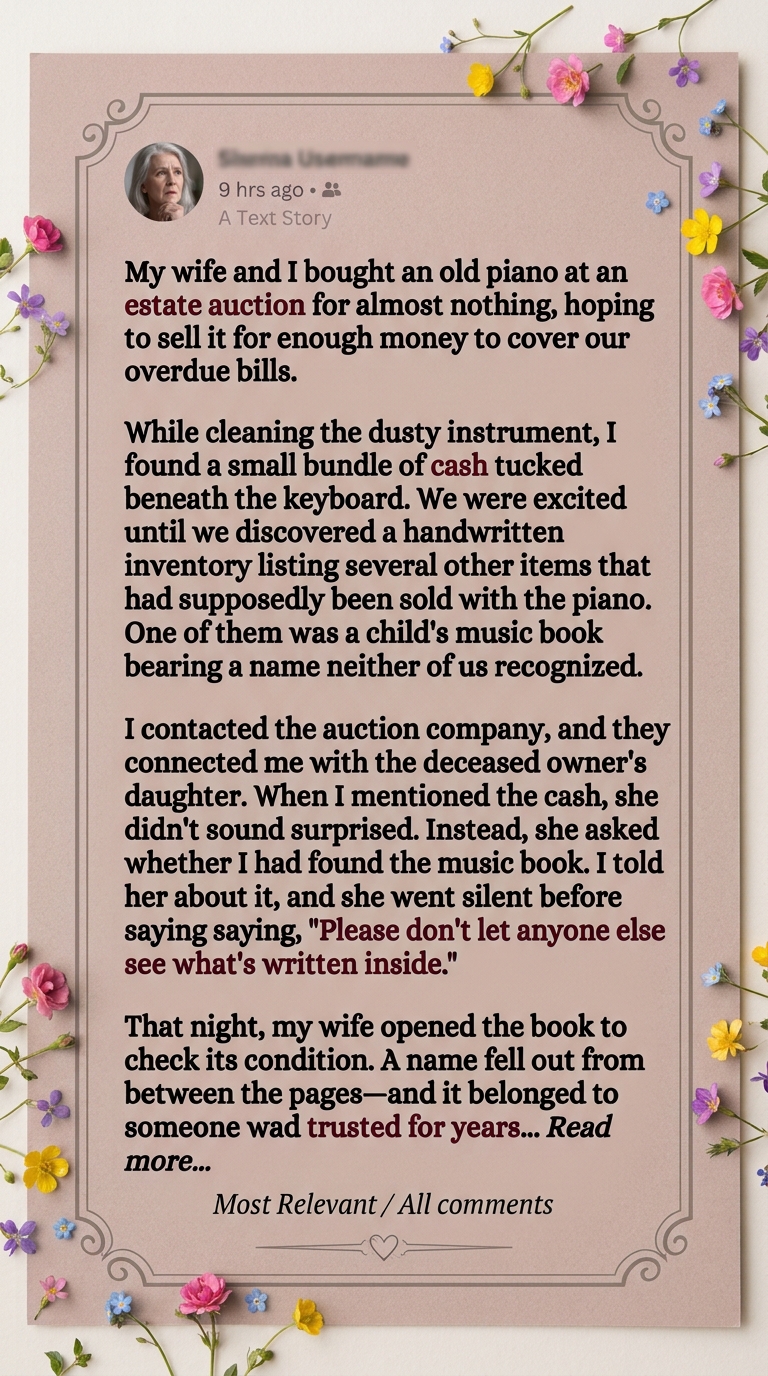
The Name Hidden in the Piano
When my wife, Laura, and I bought the old piano at an estate auction, we weren’t looking for a piece of history. We were looking for a way to keep our electricity from being disconnected.
The instrument had been sitting in a dusty corner of the auction warehouse, its dark wooden case scratched and its ivory-colored keys yellowed with age. Nobody seemed interested in it. The auctioneer mentioned that it had belonged to a woman who had recently died, but there were no details about her family or the piano’s history.
We won it for $180.
Laura thought we could clean it, take a few photographs, and sell it to someone who appreciated antiques. Even if we made only a few hundred dollars, it would cover the overdue bills piling up on our kitchen counter.
“We’re not piano people,” she reminded me as we struggled to move it into our garage.
“We don’t have to be,” I said. “We just have to make it look worth buying.”
For two days, we polished the wood, cleaned the keys, and removed years of dust from the corners. The piano was surprisingly well made. Its soundboard was intact, the pedals worked, and most of the keys still produced clear notes.
Then, while removing a narrow wooden panel beneath the keyboard, I noticed something wedged between the inner frame and the bottom casing.
It was a small bundle wrapped in faded brown paper.
Inside were several envelopes containing cash. We counted $3,400.
Laura stared at the money, then at me.
“That’s more than enough to clear everything.”
I couldn’t help smiling. For the first time in weeks, the pressure in my chest eased. We could pay the electricity bill, catch up on rent, and finally stop borrowing from friends.
But beneath the last envelope was a folded sheet of paper.
It was a handwritten inventory, dated twenty-six years earlier. The list included the piano, a child’s music book, a wooden metronome, and a small collection of handwritten compositions.
Beside each item was a short note indicating that it had been stored together.
The music book was listed under a name neither of us recognized: Daniel Mercer.
There was something unusual about the inventory. Several items had been crossed out, but the music book had a sentence written beside it in darker ink:
Must remain with the piano. Do not separate.
I called the auction company the following morning.
The clerk checked the estate records and explained that the piano had belonged to a woman named Evelyn Mercer, who had died at eighty-seven. Her daughter, Helen, had handled the estate.
When I mentioned finding the cash and the inventory, the clerk asked me to wait.
A few minutes later, she returned with Helen’s telephone number.
I called immediately.
Helen answered after the third ring. She sounded elderly but alert.
I explained who I was and told her what we had discovered.
When I mentioned the cash, she didn’t seem surprised.
“I wondered whether Mother had left it there,” she said quietly.
“You knew about it?”
“I knew she kept money in that piano. I didn’t know how much remained.”
I hesitated before mentioning the music book.
“There’s also an inventory. It lists a child’s music book belonging to Daniel Mercer.”
The silence on the other end lasted so long that I checked whether the call had disconnected.
Then Helen spoke.
“Did you find the book?”
“Not yet. We only found the inventory.”
Her voice changed.
“Please don’t let anyone else see what’s written inside.”
I asked what she meant.
She took a shaky breath.
“That book explains something my mother spent most of her life trying to keep buried. If you find it, I need you to call me before you show it to anyone.”
I promised I would.
That evening, Laura and I searched the piano again. We removed the music stand, inspected the storage compartment, and carefully examined the back panel.
Behind a thin piece of decorative wood, Laura discovered a narrow space.
Inside was a small blue music book.
Its cover was worn, and the corners had been softened by years of handling. On the first page, a child’s handwriting read:
Daniel Mercer, Age Nine.
Laura opened it carefully.
The first pages contained simple piano exercises. Farther inside were short melodies, notes about practice, and occasional comments written in a different hand.
Then a folded piece of paper slipped from between two pages and landed on the floor.
Laura picked it up.
Her expression changed immediately.
“Michael?”
I looked over her shoulder.
The name written on the paper was Michael Reed.
Michael had been our closest friend for almost fifteen years.
He had helped us move into our first apartment, stood beside me at my father’s funeral, and lent us money when Laura lost her job. He was the person who had recommended the estate auction in the first place.
I felt a strange chill.
“Why would his name be in there?”
Laura unfolded the paper.
It was a letter, written in a child’s uneven handwriting.
Dear Mr. Michael,
Grandma says I shouldn’t tell anyone where I go on Saturdays. She says you will help me learn the songs Daddy wrote. I wish Daddy could hear me play them. I don’t know why everyone says he left when he promised he would come back.
Please don’t tell Grandma I still ask about him.
Daniel.
Neither of us spoke for several seconds.
Michael had never mentioned knowing anyone named Daniel Mercer.
The following morning, I called Helen again and read the letter to her.
She began crying before I finished.
“That was my brother,” she whispered. “Daniel was my mother’s son. My little brother.”
I sat down.
Helen explained that Daniel had disappeared when he was nine years old. Their mother, Evelyn, had told everyone that he had been sent to live with distant relatives after developing serious behavioral problems. She said he was difficult, dishonest, and impossible to manage.
But Helen had never believed the story.
She remembered her brother as a quiet child who loved music. Their father had taught him to play the piano, and Daniel had been especially attached to a melody their father composed before dying.
After their father’s death, Evelyn became increasingly controlling. She didn’t want Daniel asking questions about his father or playing the old compositions.
One Saturday, Helen returned home to find Daniel gone.
Their mother said he had been taken away.
Helen was only fourteen. She begged to know where he had gone, but Evelyn refused to tell her. Eventually, she was warned that continuing to ask questions would result in her being sent away too.
Years later, Helen discovered that her mother had paid a man named Michael Reed to arrange Daniel’s placement with another family.
“Michael wasn’t a stranger,” Helen said. “He was our mother’s nephew. He had been helping her with household matters since our father died.”
I felt my stomach tighten.
“Are you saying our friend Michael is the same man?”
“I don’t know whether he’s the same person,” she replied. “But the name is uncommon enough that I would like to find out.”
She asked me to send her a photograph of the letter.
I did.
Two hours later, she called back.
“It is him,” she said. “The handwriting matches the name in my mother’s old correspondence. Michael Reed was the person who took Daniel away.”
I struggled to understand how the man who had helped us through so many difficult years could be connected to something so terrible.
But Helen wasn’t finished.
She told me that Daniel had not been sent to distant relatives.
He had been placed in a children’s home under a different surname.
Evelyn had arranged the paperwork through a family acquaintance and instructed Michael to tell Daniel that his sister had died in an accident. She believed that separating the children completely would prevent Daniel from trying to return home.
Helen had spent years searching, but the records were incomplete. By the time she found the children’s home, Daniel had already been transferred elsewhere.
She never found him.
“Why would your mother keep the music book?” Laura asked.
Helen’s answer was barely audible.
“Because Daniel left something in it.”
I looked at the book again.
“What?”
“A melody. Our father wrote it for him. Daniel used to say he would finish it when he grew up. Mother couldn’t bring herself to throw the book away, but she couldn’t bear to look at it either.”
Helen asked us to turn to the final pages.
There, beneath a series of unfinished musical notes, was a message written in a child’s handwriting.
If I ever find my sister, I want her to know I didn’t leave because I stopped loving her.
Laura covered her mouth.
For the first time, the piano stopped looking like something we could sell to pay our bills.
It had become the only surviving connection between two children who had been separated by an adult’s decision.
I asked Helen whether she had ever confronted Michael.
“Once,” she said. “Years ago. I found him through a relative and asked what happened to Daniel. He told me the boy had been adopted and that I should stop searching. He said my mother had done what was best.”
“Did he ever tell you where Daniel went?”
“No. And when I asked whether he had kept in touch, he refused to answer.”
I told Helen I would speak to Michael.
She immediately warned me not to accuse him without understanding what had happened.
“Whatever he did, he was still a young man at the time. I don’t know whether he followed my mother’s instructions willingly or whether he knows where Daniel is now.”
That evening, Michael came over for dinner.
He noticed the piano immediately.
“Looks better than I expected,” he said, running his hand over the polished wood. “You might get a decent price for it.”
I placed the blue music book on the table.
His smile disappeared.
For a moment, he looked as though he had seen someone standing behind me.
“Where did you get that?”
“Inside the piano.”
He stared at the cover.
Then he looked at the name.
“Daniel Mercer.”
I watched his face.
“You know him?”
Michael pulled out a chair but didn’t sit down.
“Who told you about that?”
“His sister.”
He closed his eyes.
“After all these years.”
Laura stood beside me, holding the letter.
“Why did you take him away?”
Michael lowered his head.
He didn’t deny it.
Instead, he told us that he had been twenty-three when Evelyn approached him. She claimed Daniel was becoming uncontrollable and had threatened to hurt himself. She said the boy needed a fresh start away from the family.
Michael had recently lost his job and was struggling financially. Evelyn offered him money to help arrange Daniel’s placement through a children’s organization.
He accepted.
At first, he believed Daniel would be placed with a suitable family nearby. But when he delivered the boy, he learned that Evelyn had instructed the organization to keep the placement confidential.
Daniel cried the entire journey.
He begged Michael not to leave him.
Michael said he had almost turned around twice.
“But you didn’t,” I said.
“No.”
He told us that after dropping Daniel off, he received another payment from Evelyn and promised not to contact the boy. He had told himself that Daniel would eventually be adopted and forget the family.
For years, he tried not to think about it.
Then, nearly a decade later, he learned that Daniel had never been adopted. He had moved through several placements before becoming a young adult.
Michael had eventually located him through an old contact.
“Did you speak to him?” Laura asked.
Michael nodded.
“He was nineteen. He recognized me immediately.”
“What did he say?”
Michael’s voice broke.
“He asked whether his sister had ever looked for him.”
Laura gripped the edge of the table.
“What did you tell him?”
“I told him the truth about his mother. I said Helen hadn’t forgotten him. I gave him her last known address.”
“Did you contact Helen?”
“No. I was ashamed. I thought Daniel would do it himself.”
I felt anger rising in my chest.
“You’ve known where he was all these years?”
“I knew where he was then. He moved later. We exchanged a few letters, but eventually he stopped responding.”
Michael reached into his jacket and removed a folded piece of paper.
“I kept this.”
It was a recent letter addressed to him.
The handwriting was older and steadier than the writing in the music book.
Michael placed it on the table.
“I received it three years ago. I never answered.”
I unfolded it.
Michael,
I have a family now. I have two daughters, and one of them has started learning piano. She asked me whether I knew anyone who could teach her the song my father wrote.
I told her I once had a sister who might remember it.
If you ever speak to Helen, tell her I never stopped looking for her. I don’t blame her for what happened. I only wish someone had told me the truth sooner.
Daniel.
At the bottom was an address in another town.
The letter had been sent from a return address that was still legible.
Michael had kept it for three years without telling Helen.
I looked at him.
“Why didn’t you give this to her?”
He couldn’t answer.
I called Helen that night and read the letter aloud.
She wept openly.
For the first time in decades, she knew her brother was alive.
The following morning, she contacted the address on the letter. It took several attempts, but eventually a woman answered.
She was Daniel’s wife.
When Helen introduced herself, the woman became silent.
Then she said, “He has talked about you his entire life.”
Daniel was at work, but his wife promised to tell him.
Two days later, Helen received a telephone call.
Her brother was on the line.
Neither knew what to say at first.
Finally, Daniel spoke.
“Is that really you, Helen?”
She began crying.
“Yes. It’s me.”
“I thought you were gone.”
“I thought you were gone too.”
They spoke for nearly an hour. They remembered their father, the old house, the garden, and the piano. Daniel told her about his wife and daughters. Helen told him about the years she had spent searching.
When they finally agreed to meet, Helen asked whether he still remembered the melody.
Daniel laughed softly.
“I never forgot it.”
A week later, Daniel and his family drove to our house.
He was forty-two years old, with a gentle face and silver beginning to show at his temples. When he entered the garage and saw the piano, he stopped walking.
His eyes filled with tears.
“That’s Dad’s piano,” he whispered.
Helen, who had arrived shortly before him, stepped forward.
For several seconds, they simply looked at each other.
Then she reached for his hand.
Daniel held it tightly.
They sat together at the piano. Daniel opened the blue music book and turned to the unfinished melody.
His daughter, Sophie, sat beside him.
“Is this the song Grandpa wrote?” she asked.
Daniel nodded.
“Yes. And I think it’s time we finished it.”
He placed his fingers on the keys.
The first notes were hesitant, but the melody gradually became familiar. Helen began humming along, remembering the tune from their childhood.
When Daniel reached the unfinished section, he paused.
Then he played a new ending.
It was simple, warm, and beautiful.
Helen smiled through her tears.
“You finished it.”
Daniel looked at her.
“I promised I would.”
We never sold the piano.
Daniel asked whether he could take it home, but I told him it belonged with the family that had been separated from it. Helen insisted that he keep it because his daughters could learn on it.
In the end, we agreed that the piano would go to Daniel’s house, where it would be played regularly rather than stored away.
As for the money, Helen told us it had been saved by her mother over many years. She had known Evelyn intended to leave it with the piano, but she had never known the exact amount.
She insisted we keep it.
At first, I refused.
But Helen explained that her mother had left the money without instructions, and she wanted it to become something useful rather than another source of conflict.
We used part of it to pay our overdue bills. The rest went toward repairing the piano before Daniel collected it.
Michael eventually contacted Helen and asked to apologize.
She agreed to meet him once.
She listened to everything he had to say, but she didn’t pretend his actions had been harmless. She told him that his decision had taken away years neither of them could recover.
Michael accepted that.
Daniel also agreed to see him, though he made it clear that forgiveness would take time.
When the piano was delivered to Daniel’s home, he placed the blue music book on the stand.
His younger daughter began practicing the opening notes of her grandfather’s melody.
For the first time, the music that had once marked a separation became something shared by three generations.
Laura and I had bought an old piano because we needed money.
We never expected to find a family hidden inside it.
And we certainly never expected that the man we had trusted for fifteen years would be the person who had once helped tear that family apart.
But the greatest discovery wasn’t the cash or even the music book.
It was that a promise made by a nine-year-old boy had survived decades of silence.
And this time, when the final notes were played, nobody was left waiting for someone to come home.

