The Loan They Tried to Take in My Name
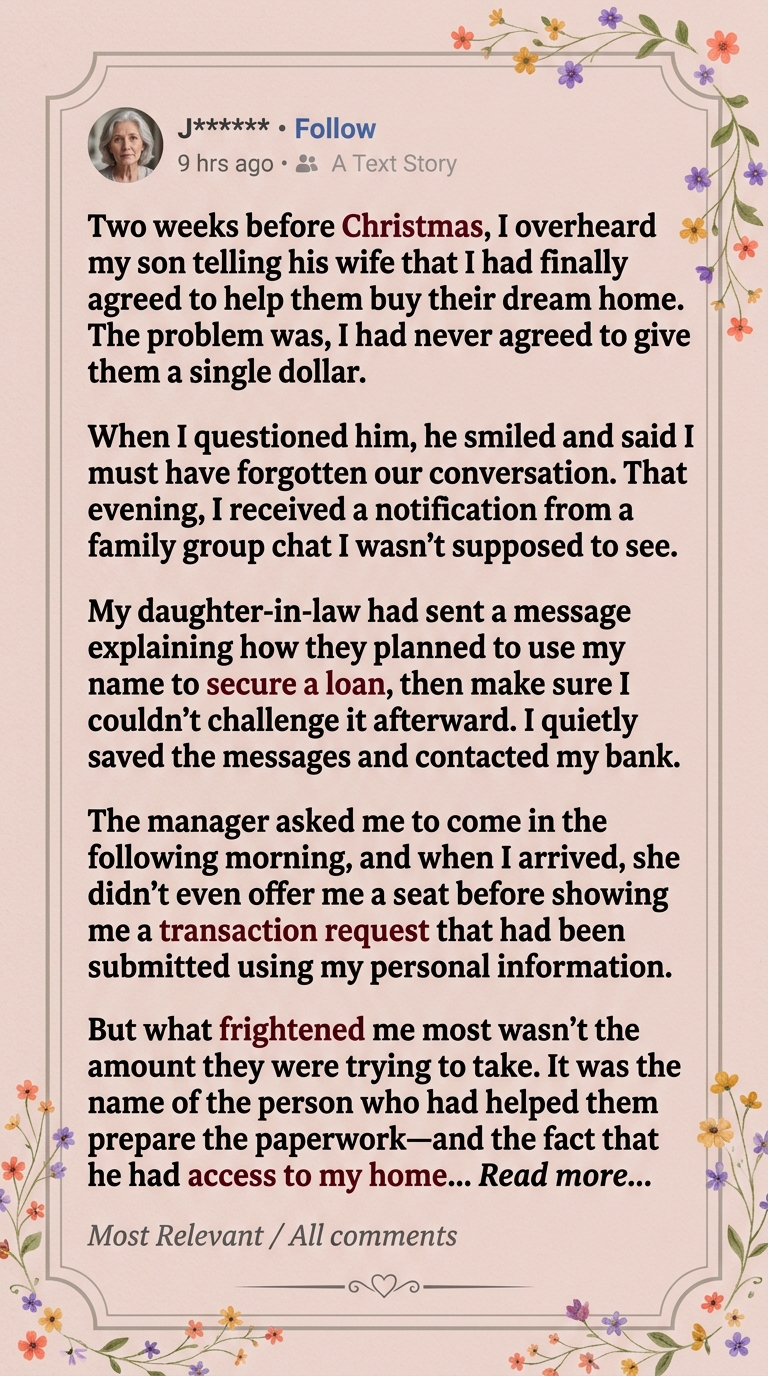
Two weeks before Christmas, I overheard my son telling his wife that I had finally agreed to help them buy their dream home.
I was standing in the hallway with a basket of clean laundry when I heard him speaking from the kitchen.
“Once the bank approves everything, we can put down the deposit,” Daniel said. “Dad won’t have to worry about a thing. We’ll handle the payments.”
His wife, Vanessa, laughed softly.
“Your father has more than enough. He’s lived in that big house alone for years. It’s time he helped us build a future.”
I stepped into the kitchen.
“What exactly have I agreed to?”
They both turned toward me.
Daniel recovered first. He smiled, as though I had interrupted an ordinary conversation.
“We talked about it last month, Dad. You said you’d help us with the house.”
“No, I didn’t.”
He shook his head sympathetically.
“You must have forgotten. We discussed it after dinner.”
I stared at him.
I was seventy-one years old, but my memory was perfectly sound. I remembered every conversation involving money, especially since my retirement income had to cover the maintenance of my home and the occasional expenses of my late wife’s care before she passed away.
I had never promised Daniel a deposit, a loan, or even a small gift.
“Listen carefully,” I said. “I am not financing your house.”
Vanessa placed her hand on his arm.
“There’s no need to get upset. We can talk about it later.”
Daniel walked me to the door.
“Dad, don’t make this into something it isn’t. We have everything under control.”
His confidence bothered me more than his words.
That evening, I received a notification from a family group chat I wasn’t supposed to see.
I had been added accidentally, apparently because someone had changed the group’s settings. Before I could leave, a series of messages appeared.
Vanessa had written:
The application is almost ready. Once the bank accepts his details, the money can be transferred before he realizes what happened.
Daniel replied:
What if he calls the bank?
Vanessa answered:
By then, the paperwork will show he agreed. We just need him to stop interfering until the loan is finalized.
Then another message appeared.
Uncle Peter has already prepared the authorization. He knows exactly how to make it look legitimate.
I read that sentence several times.
Uncle Peter was Peter Lawson, my late wife’s younger brother.
For nearly twenty years, Peter had been one of the people I trusted most. He had a spare key to my house, helped me with repairs, collected my mail when I traveled, and occasionally handled paperwork I found confusing.
He had even accompanied me to the bank when I renewed some of my retirement accounts.
I had never imagined he might use that trust against me.
I took screenshots of every message, saved copies to a separate account, and wrote down the time they had been sent.
Then I called my bank.
The employee who answered transferred me to the fraud department. After I explained what I had discovered, she placed a security restriction on my profile and arranged an appointment with the branch manager for the following morning.
I barely slept.
At nine o’clock, I arrived at the bank and asked for Mrs. Collins, the manager who had helped me with my wife’s accounts years earlier.
She came out of her office holding a folder.
She didn’t offer me a seat.
“Mr. Harris,” she said, “we need to discuss an application submitted using your personal information.”
My stomach tightened.
She opened the folder and showed me a transaction request for $186,000.
It was a proposed secured loan against my house.
The application included my full name, date of birth, account details, property information, and a scanned copy of my signature.
I recognized the signature immediately.
It looked almost exactly like mine.
But I had never signed that document.
Mrs. Collins pointed to the section listing the authorized representative.
The name was Peter Lawson.
I felt the room tilt slightly.
“How did he get this information?”
“According to the application, he was acting under a power of attorney dated six months ago.”
I shook my head.
“I never gave him power of attorney.”
She turned the page.
The document included a copy of my identification and a witness declaration confirming that I had signed it voluntarily.
The witness was Peter’s neighbor, a man I had met only twice.
I looked at Mrs. Collins.
“Has the money been transferred?”
“No. The application triggered an additional verification review because the signature did not match the specimen we have on file closely enough. We also noticed an unusual change request involving your contact details.”
She showed me another page.
Someone had attempted to replace my telephone number with Daniel’s.
That explained why the family group messages had mentioned making sure I couldn’t challenge the transaction.
They weren’t merely hoping I would forget.
They were trying to make sure the bank couldn’t reach me directly.
Mrs. Collins closed the folder.
“We have frozen the application. I strongly recommend that you contact a solicitor and report the suspected fraud. We will preserve all the submitted documents and the associated records.”
I thanked her and left the bank.
Before calling the police, I contacted a solicitor named Elaine Porter, who had helped my wife and me prepare our wills several years earlier.
She listened carefully, reviewed the screenshots, and asked me to bring every document I could find relating to Peter’s access to my home and finances.
One detail concerned her more than the others.
“Does Peter still have a key?”
“Yes.”
“Then change the locks today.”
I returned home and called a locksmith.
While he was working, I checked the desk in my study. Peter had occasionally used it when helping me organize household records.
The top drawer was slightly open.
Inside, I found a folder containing photocopies of my identification, property documents, old bank statements, and several forms I didn’t recognize.
One was a draft authorization allowing Peter to communicate with financial institutions on my behalf.
Another was a list of my monthly income and expenses.
At the bottom was a handwritten note.
December: complete application before family visit. Avoid direct conversation with Harold.
I recognized Peter’s handwriting.
My hands began to shake.
I photographed everything and placed the documents in a bag for Elaine.
That afternoon, I reported the attempted loan and the suspected forgery.
The investigating officer asked whether I had recently allowed anyone to use my identification documents.
I told him that Peter had helped me complete a home insurance renewal earlier in the year. He had taken photographs of my documents because the insurer needed updated information.
The officer made a note.
“That may explain how he obtained the copies. It doesn’t explain the authority he claimed to have.”
Elaine later confirmed that no valid power of attorney had ever been registered or executed. The document submitted to the bank was not only unauthorized; the witness declaration contained an address that did not match the witness’s official records.
The investigation was underway, but I still had one question.
Why would Peter risk his relationship with me for Daniel and Vanessa?
The answer came from a conversation with Daniel’s former business partner.
I had known the man for years. His name was Martin, and he called me after hearing that police had contacted Daniel.
He told me that Daniel’s construction company had been struggling for almost a year.
Several projects had fallen behind schedule, suppliers were demanding payment, and Daniel had personally guaranteed debts he could no longer afford.
The house Vanessa wanted wasn’t simply a dream purchase.
It was part of a plan to move their remaining money into a property before Daniel’s creditors could reach it.
The loan against my house would provide the deposit, while the new property would be registered in Daniel and Vanessa’s names.
They had intended to leave me responsible for the debt.
I sat quietly after Martin finished speaking.
I had spent years helping Daniel whenever he needed advice. I had paid for his education, supported his first business, and helped him through his divorce from his first wife.
I had never expected repayment.
But I had expected honesty.
Three days before Christmas, Daniel called.
“Dad, we need to talk.”
“About the house?”
He sighed.
“Vanessa says you’ve been speaking to the bank. I don’t know why you would do that without talking to me first.”
“Because someone submitted a loan application using my identity.”
“You misunderstood the paperwork.”
“I didn’t sign it.”
“Uncle Peter said it was just a temporary authorization.”
“Then why did the application include a forged power of attorney?”
Daniel was silent.
I continued.
“Why did someone try to change my telephone number to yours?”
He didn’t answer.
Finally, he said, “Dad, things have been difficult. We were going to make the payments.”
“With what money?”
“We would have figured it out.”
“You were borrowing against my home without permission. That isn’t figuring something out.”
His voice became sharper.
“You’re acting as though we’re strangers. We’re your family.”
I looked at the framed photograph of my late wife on the mantel.
“Your mother used to say that family should be the people you never have to protect yourself from.”
Daniel said nothing.
“She would be ashamed of what you’ve done.”
He hung up.
The following morning, Peter appeared at my front door.
He tried his old key, discovered it no longer worked, and knocked.
I opened the door but kept the chain in place.
“Harold, we need to clear up a misunderstanding.”
“There is no misunderstanding.”
He looked over my shoulder.
“Can I come in?”
“No.”
He lowered his voice.
“I was only trying to help Daniel. He’s in serious trouble.”
“You prepared a false power of attorney.”
“I thought you would approve it once everything was explained.”
“Then why didn’t you ask me?”
Peter rubbed his forehead.
“Because you would have refused.”
That answer told me everything.
I asked him why he had copied my identification and collected my financial information without my permission.
He said Daniel had approached him months earlier, desperate to prevent his business from collapsing. Vanessa had suggested using my house as security, and Peter had agreed to prepare the paperwork.
He claimed he believed I would eventually accept the arrangement.
“Did you know they planned to change my contact information?” I asked.
He looked away.
“I didn’t think it would come to that.”
“Did you know they wanted to make sure I couldn’t challenge the loan?”
Peter swallowed.
“I didn’t write those messages.”
“But you prepared the documents.”
He nodded.
I removed the chain slightly and handed him a sealed envelope containing a copy of the solicitor’s letter.
It instructed him not to contact my bank, access my property records, or enter my home without permission. It also informed him that the suspected forgery had been reported.
His face changed.
“You’re reporting me?”
“You made that decision when you used my name.”
He stood on the doorstep for several seconds.
Then he said something that surprised me.
“Your wife would never have wanted this.”
I looked directly at him.
“Don’t use my wife’s memory to excuse what you did.”
He left without another word.
The investigation continued into the new year. The bank provided the application records, and the police obtained copies of the messages and the documents Peter had prepared.
Daniel eventually admitted that he knew the loan application had been submitted without my consent. He claimed he had expected to persuade me to approve it before the bank released any money.
Vanessa had been the person who proposed changing my contact details, while Peter had supplied the documents and falsely presented himself as my authorized representative.
All three were interviewed.
The attempted loan was canceled, the forged authorization was formally rejected, and my bank permanently removed Peter’s access to my financial profile. The authorities pursued the forgery and attempted financial fraud through the proper process.
Daniel’s business eventually entered insolvency proceedings. Vanessa and Daniel had to abandon the house purchase, and their financial problems became public within their circle of friends.
I did not pay their debts.
I also did not allow them to use my home as collateral for anything.
Months later, Daniel came to see me alone.
He looked older than I remembered.
“Dad, I know I can’t undo what happened.”
I waited.
“I was desperate. I thought if we could get the house, everything else would fall into place.”
“You wanted to solve your problems by making them mine.”
He nodded.
“Yes.”
He apologized, but I didn’t immediately invite him back into my life as though nothing had happened.
I told him that rebuilding trust would require more than an apology. He would have to accept that I controlled my own finances, my own home, and my own decisions.
He agreed.
Peter never returned to my house. Vanessa sent one message accusing me of destroying their future, but I didn’t respond.
That Christmas had been quieter than any I could remember.
I spent the day with a neighbor and his family. We shared a simple meal, watched an old movie, and laughed more than I expected.
Before dinner, I checked the locks on my front door.
The new keys sat beside my late wife’s photograph.
For years, I had believed that trusting family meant never questioning their intentions.
Now I understood something different.
Trust is not permission to take what belongs to someone else. And love does not require an elderly parent to surrender his independence to prove that he cares.
My son had wanted a house for Christmas.
Instead, he learned that my home was not his to mortgage, my signature was not his to borrow, and my future was not something he could arrange without me.

