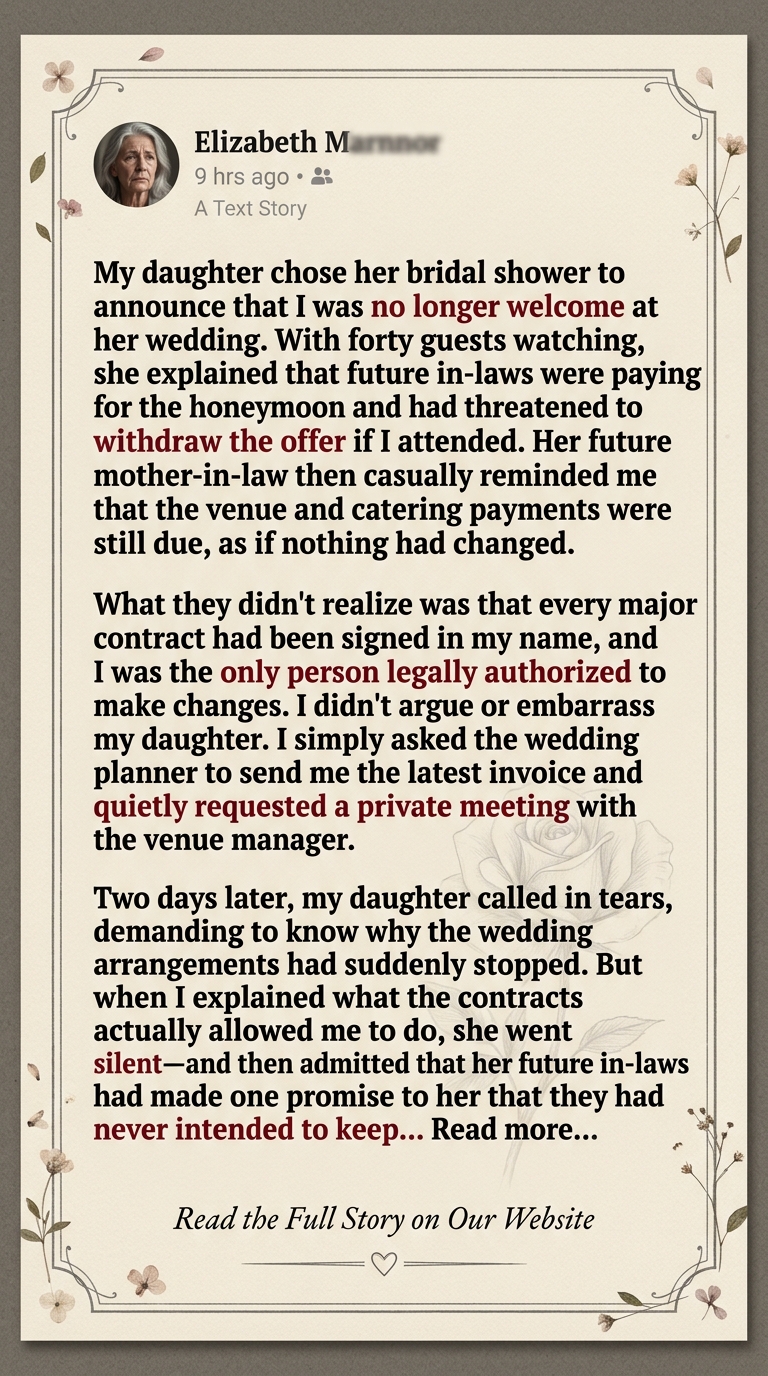
My daughter announced that I was no longer welcome at her wedding while standing beneath a flower-covered arch at her bridal shower.
There were forty guests in the room, including relatives, childhood friends, and several members of her future husband’s family. I had spent the previous three months helping organize the celebration, paying deposits, answering vendors’ questions, and making sure every detail matched the elegant wedding my daughter, Emily, had always dreamed of.
I had even paid for the bridal shower.
So when Emily lifted her glass and asked everyone for their attention, I expected a toast.
Instead, she looked directly at me.
“Mom, there’s something we need to discuss. I’ve decided it would be better if you didn’t attend the wedding.”
For a moment, I thought I had misunderstood.
“What?”
Her fiancé, Nathan, stared at the floor.
Emily continued, speaking quickly as though she had rehearsed the announcement.
“His parents are paying for our honeymoon. They’ve offered us two weeks in Italy, but they’ve made it clear that they don’t want any tension at the wedding. They think your presence might create problems, and they said they’ll withdraw the honeymoon if you come.”
I looked at Nathan.
He still wouldn’t meet my eyes.
Then his mother, Victoria, stepped forward with a sympathetic expression that didn’t reach her eyes.
“I know this is difficult, Margaret, but we’re trying to give the children a wonderful beginning. Surely you can understand that.”
I glanced around the room. Nobody spoke. Some guests looked uncomfortable. Others suddenly became fascinated by their drinks.
Victoria adjusted the bracelet on her wrist.
“Of course, we still need to settle the remaining venue and catering invoices. The planner said those payments are due next week. I assume you’ll be taking care of those as planned?”
That was when I understood the arrangement.
They wanted my money, my organizational work, and my signature on the contracts.
They simply didn’t want me at the wedding.
I had raised Emily alone after her father died. I had worked long hours, missed vacations, and postponed my own plans to make sure she had opportunities I never had. I had never expected her to repay me for any of that.
But I had never imagined she would stand in front of forty people and treat my presence as an inconvenience while expecting me to continue financing her celebration.
I didn’t argue.
I didn’t cry.
I simply placed my glass on the table and turned to the wedding planner.
“Could you send me the latest invoices and a complete copy of the current vendor agreements?”
She looked confused.
“Of course, Margaret.”
Then I turned to Victoria.
“I’ll review everything and get back to you.”
She smiled, apparently satisfied.
I collected my coat and left.
On the drive home, I kept thinking about one detail.
Every major wedding contract had been signed in my name.
The venue, the catering company, the photographer, the florist, and the transportation service had all required a financially responsible contracting party. Emily and Nathan had been unable to meet some of the vendors’ payment requirements, so I had agreed to sign the agreements and pay the deposits.
I hadn’t done it because I wanted control over their wedding.
I had done it because I wanted to help.
But signing those contracts made me legally responsible for the obligations they contained. It also meant that any amendments, cancellations, or changes had to be authorized by me.
I wasn’t going to use that authority to punish my daughter.
I simply wasn’t going to keep accepting financial responsibility for an event from which I had been deliberately excluded.
The following morning, I read every agreement carefully.
The venue contract allowed changes to the guest arrangements, but only through the named contracting party. The catering agreement required final confirmation of the guest count before the balance became payable. The photographer’s agreement permitted cancellation within a specified period, subject to a reasonable administrative fee.
The florist had already purchased some materials, so canceling that agreement would have created unnecessary costs.
I wasn’t interested in causing damage just to make a point.
I called Elaine, the solicitor who had handled my property documents for years. She reviewed the agreements and explained exactly which obligations I could change, which payments I remained responsible for, and what would happen if I withdrew from the arrangements.
Her advice was straightforward.
“Don’t send any angry messages. Don’t make threats. Decide whether you’re willing to remain financially responsible for a wedding where the couple has excluded you. If not, follow the contract procedures precisely.”
That afternoon, I requested a private meeting with the venue manager.
His name was Robert, and he had been professional throughout the planning process.
I explained what had happened and showed him the contracts.
“I’m not asking you to cancel the wedding,” I said. “I want to understand what happens if I withdraw as the financially responsible party and the couple cannot provide a replacement.”
Robert reviewed the file.
“Under this agreement, you’re the contracting client. We can’t simply transfer your obligations to someone else without your written consent and our approval. If you withdraw, the couple would need to enter a new agreement, subject to availability and payment requirements.”
“Would the date remain reserved?”
“Only if the new agreement is completed within the required period.”
I nodded.
“Then please don’t make any changes today. I want the couple informed that they need to arrange a replacement contracting party if they wish to retain the current arrangements.”
Robert agreed to send the notice.
I also contacted the other vendors and asked them to provide updated account statements and explain their amendment procedures. I made it clear that I would honor any payments already due under the existing agreements and would not authorize new expenses without a signed amendment.
I wasn’t going to leave suppliers unpaid because of my daughter’s decision.
But I wasn’t going to finance new commitments either.
Two days later, my phone rang.
It was Emily.
“Mom, what have you done?”
Her voice was trembling.
“What do you mean?”
“The venue says our agreement is no longer guaranteed. The catering company says they need a new financial contact. The photographer won’t accept the changes Nathan sent them. Why are you doing this two weeks before the wedding?”
I took a breath.
“I haven’t canceled your wedding.”
“Then why is everything stopping?”
“Because I am no longer willing to sign new agreements or accept additional financial responsibility for an event I am not permitted to attend.”
There was silence.
Then she said, “But you already agreed to pay.”
“I agreed to help you plan your wedding. I did not agree to finance it after being publicly excluded.”
“You’re my mother!”
“And you are my daughter. That’s why I expected you to speak to me privately rather than announce in front of forty people that I wasn’t welcome.”
Emily began crying.
“His parents said they would pay for everything else. They promised us the honeymoon, the venue balance, and the remaining expenses. They said we wouldn’t have to worry about anything.”
I closed my eyes.
“Then why are they asking me to settle the invoices?”
She didn’t answer.
“Emily, did they actually promise to pay the remaining wedding costs, or did they only promise the honeymoon?”
Her breathing became uneven.
“Victoria said they would help. Nathan told me his father had agreed to cover whatever was left.”
“Did you see anything in writing?”
Another silence.
“No.”
I leaned back in my chair.
“Then you need to ask them directly.”
She said she would call me back.
That evening, she arrived at my house without Nathan.
Her makeup was smudged, and she looked exhausted.
“Mom, I need to tell you something.”
I invited her inside.
She sat at the kitchen table, the same place where she had done her homework as a child.
Then she explained what had happened.
For months, Victoria had been criticizing my involvement in the wedding. She complained that I had too much influence over the guest list, the ceremony schedule, and the choice of venue.
At first, Emily defended me.
But Victoria gradually changed the conversation.
She told Emily that Nathan’s family had a particular social standing and that the wedding needed to reflect it. She suggested that my modest income and ordinary background might make certain guests uncomfortable.
Emily had dismissed those comments until Victoria introduced the honeymoon offer.
She promised to pay for the couple’s entire trip to Italy, including flights, hotels, and private tours.
Then she added a condition.
She wanted the wedding to be a celebration hosted by Nathan’s family, without my involvement.
Emily said she had protested.
Victoria replied that she was only asking for a small compromise.
Nathan eventually told Emily that if she wanted the honeymoon, she needed to accept his mother’s conditions.
But the promise went further.
Victoria had also told Emily that Nathan’s parents would cover the remaining wedding costs once I was removed from the arrangements.
“She said you would understand eventually,” Emily whispered. “She said you had already done enough.”
I looked at my daughter.
“And what did Nathan say?”
Emily lowered her eyes.
“He said it was easier if I just agreed. He promised his parents would pay you back for anything you had already spent.”
“Did he say that in writing?”
“No.”
I let the silence settle.
“Emily, you didn’t just ask me not to attend. You allowed them to make my place at your wedding conditional on whether I was useful to them financially.”
She began crying again.
“I know.”
I didn’t comfort her immediately.
I needed her to understand that an apology would not erase what had happened.
“Have you spoken to Nathan about the money?”
She nodded.
“He called his father. His father said the honeymoon was the only thing they had offered to pay for. He said the wedding expenses were never part of the agreement.”
“And Victoria?”
“She said I misunderstood her.”
I looked at her.
“Did she also tell you that they would withdraw the honeymoon if I attended?”
Emily nodded.
“She said they would cancel it.”
“Then you have your answer.”
She covered her face.
“I think they wanted me to believe I was choosing between you and a better future.”
I reached across the table.
“No one should have to choose between a parent and a honeymoon.”
For the first time since the bridal shower, Emily looked directly at me.
“Can you help me fix the wedding?”
I considered her question carefully.
“I can help you understand your options. But I’m not going to sign another contract or pay another invoice just to make everyone happy. If you want to marry Nathan, the two of you must decide what kind of marriage you’re entering.”
She nodded slowly.
The next morning, Emily and Nathan met with the venue manager.
They learned that they could retain the date by signing a new agreement and providing the required deposit within the specified period. The venue would not simply transfer my existing obligations to them.
Nathan’s father refused to contribute.
Victoria said the couple should postpone the wedding if they couldn’t afford it.
That was when Emily finally saw the difference between a generous offer and a promise designed to control her.
She and Nathan argued for hours.
He accused her of making his parents look bad. She accused him of allowing his mother to dictate their wedding and using my money while excluding me.
Eventually, Nathan admitted that he had known his parents never intended to cover the remaining expenses.
He had hoped I would continue paying because I had already invested so much.
That confession changed everything.
Emily called me that evening.
“I’m postponing the wedding,” she said.
I didn’t try to persuade her either way.
“Are you sure?”
“Yes. I can’t start a marriage by pretending I didn’t see what happened.”
She and Nathan returned the engagement gifts that had been purchased by his parents and informed the guests that the wedding would not proceed as planned.
The honeymoon reservation was canceled.
I honored the existing vendor obligations for work already completed and settled the legitimate cancellation charges under the agreements. The venue returned the refundable portion of the deposit according to its terms.
I lost some money, but I refused to turn the situation into a fight with people who had simply provided services.
Emily moved out of the apartment she shared with Nathan and stayed with a friend while she considered what she wanted.
For several months, we spoke cautiously.
She apologized more than once, but I told her that I needed time to trust her decisions again.
Nathan eventually sent me a letter. He admitted that he had allowed his parents to make financial promises he knew they could not fulfill. He also acknowledged that he had let Emily believe I was the obstacle when he was too afraid to challenge his family.
I accepted his apology without promising forgiveness or a future relationship.
Nearly a year later, Emily came to my house on a Sunday afternoon.
She told me that she and Nathan had ended their engagement.
“He kept saying his mother was only trying to protect him,” she said. “But every decision we made had to satisfy her. I realized I wasn’t marrying just Nathan. I was marrying into a family where I would always have to earn permission to make my own choices.”
I listened.
Then she reached into her bag and handed me an envelope.
Inside was a check.
It covered the amount I had spent on the wedding preparations, including the nonrefundable deposits and cancellation charges.
“Where did you get this?” I asked.
“I’ve been saving. I know you didn’t ask for it, but I needed to repay you.”
I looked at her for a long moment.
“You don’t have to buy your way back into my life.”
“I know,” she said. “I just don’t want money to be another thing I owe you without acknowledging it.”
I accepted the check.
Then I stood and hugged her.
It wasn’t a complete return to the relationship we had before. Trust takes longer to rebuild than it takes to break.
But it was a beginning.
The following Christmas, Emily and I had dinner together at my house. There was no expensive honeymoon, no elaborate venue, and no forty-person celebration.
There were only two places set at the kitchen table, a small tree by the window, and the daughter I had raised sitting across from me.
At one point, she reached over and squeezed my hand.
“Mom, I’m sorry I made you feel like you didn’t belong at my wedding.”
I smiled gently.
“Emily, the important thing is that you finally understood who was asking you to prove your love by excluding someone else.”
She nodded.
And for the first time in a long while, I felt that my daughter was listening rather than simply waiting for me to agree.

