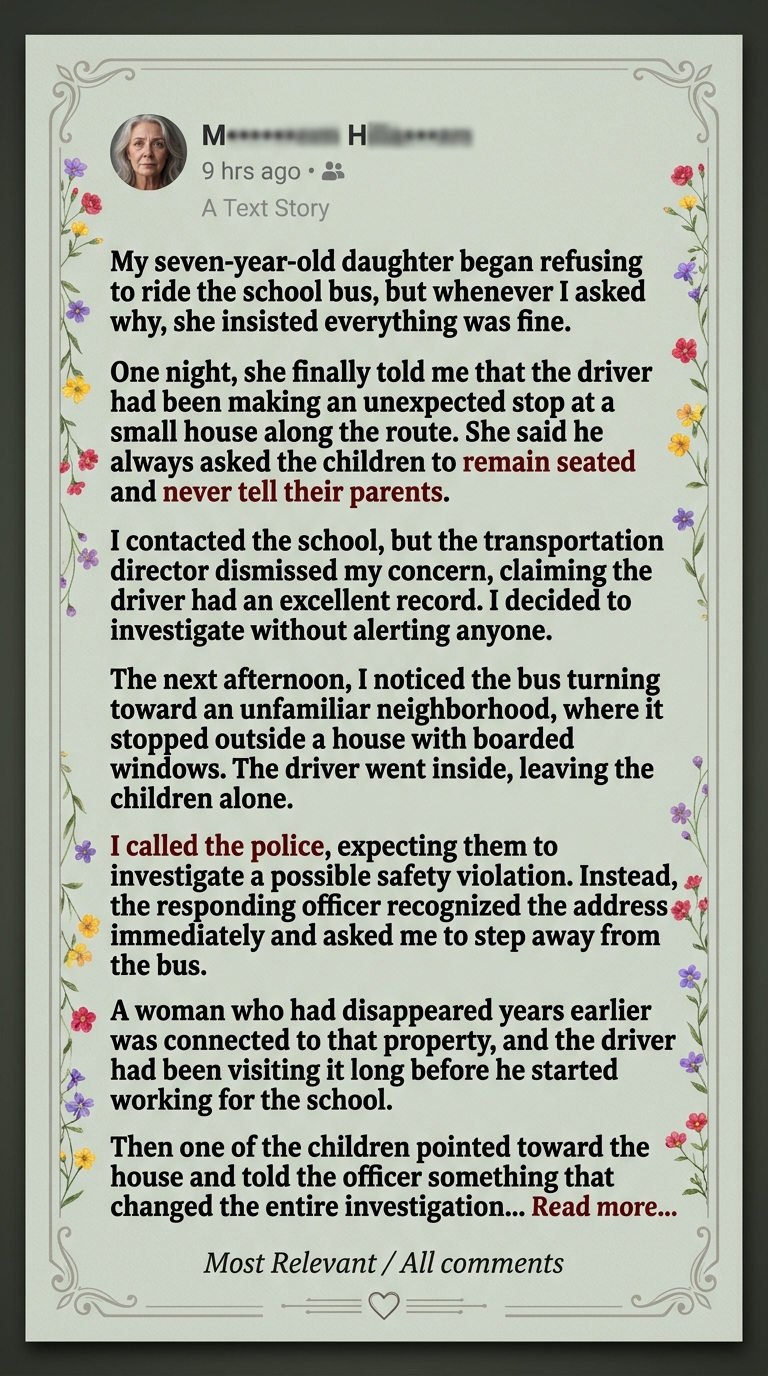
The House at the End of the Bus Route
The first time my daughter asked me not to make her ride the school bus, I assumed she was having trouble with another child.
Sophie was seven, usually cheerful, and had never complained about school transportation. She loved sitting beside her best friend, drawing pictures during the ride, and telling me which houses had the funniest decorations.
But one Monday morning, she stood beside the front door with her backpack hanging from one shoulder.
“Can you drive me today, Mom?”
I checked the clock. I was already late for work.
“What happened, sweetheart?”
“Nothing.”
“Did someone say something unkind?”
She shook her head.
“Are you feeling sick?”
“No.”
“Then why don’t you want to ride?”
She stared at the floor.
“I just don’t like the bus anymore.”
I arranged for a neighbor to drive her that morning. I thought a day away from the bus might help.
It didn’t.
Over the following week, Sophie asked to be driven to school every morning. Whenever I questioned her, she insisted everything was fine. She became unusually quiet whenever I mentioned the driver, Mr. Harlan, a man who had worked for the school district for nearly twelve years.
I knew him well enough to recognize his voice. He always greeted the children by name and had once helped Sophie find a lost mitten.
Nothing about him had ever seemed threatening.
Then, one Thursday night, I found Sophie sitting on the floor beside her bed, arranging her stuffed animals in a line.
“Are these going on a bus?” I asked.
She nodded.
“Who’s driving?”
She pointed to a small toy figure at the front.
“Mr. Harlan.”
I sat beside her.
“Sweetheart, you can tell me anything. You won’t get anyone in trouble just because you tell the truth.”
She moved one of the stuffed animals away from the others.
“Mr. Harlan stops at a house.”
I waited.
“Every day?”
“Not every day. Sometimes.”
“Where?”
“I don’t know. It’s not near school. There’s a broken fence and the windows have wood over them.”
My attention sharpened.
“What happens when he stops?”
“He tells us to stay in our seats. Then he gets off the bus and goes inside.”
“How long is he gone?”
“Sometimes a little. Sometimes longer.”
“Does another adult stay with you?”
She shook her head.
“Does he explain why he’s going inside?”
“He says it’s private. He says we’re not supposed to tell our parents because they might get confused and make him lose his job.”
I felt a chill move through me.
“Did he say that to all the children?”
Sophie nodded.
“Some kids think it’s funny. But I don’t like being alone.”
I pulled her close.
“You did exactly the right thing by telling me.”
The next morning, I contacted the school transportation director, a man named Peter Walsh. I explained what Sophie had told me and asked whether the driver had permission to leave the bus during his route.
Peter sounded irritated.
“Mr. Harlan has an excellent employment record. He’s been with us for years.”
“I’m not questioning his entire career. I’m asking why he’s leaving children unattended.”
“I’ll speak with him.”
“Please don’t tell him which child reported it.”
There was a pause.
“Mrs. Bennett, I think you’re getting ahead of yourself. These routes sometimes require adjustments. There may be a perfectly reasonable explanation.”
“Then it should be easy to explain.”
He promised to investigate and ended the call.
By the afternoon, Sophie told me that Mr. Harlan had asked the children whether anyone had been talking about the stop at home.
He hadn’t mentioned her name, but he had warned them that rumors could get people into trouble.
That was enough for me.
I called the transportation office again. Peter said the driver had denied leaving the bus and that no further action was necessary.
I didn’t believe him.
The following day, I took time off work and waited near the road where Sophie’s bus usually passed. I knew the approximate schedule, and I had asked another parent to collect her from school so she wouldn’t be expecting me.
At 3:18 p.m., the yellow bus appeared.
I followed at a distance.
For the first fifteen minutes, it stayed on its normal route. Then, instead of turning toward the main road, it entered a neighborhood of older houses and narrow streets.
I had never seen a school bus travel through that area.
The vehicle slowed beside a neglected property with boarded windows, an overgrown garden, and a rusted metal gate.
The driver pulled over.
I watched him turn off the engine, open the door, and tell the children to remain seated.
Then he stepped down and walked toward the house.
He unlocked the front door with a key.
I took out my phone and called emergency services.
I gave the dispatcher the address and explained that a school bus driver had left several young children unattended inside a vehicle while entering a boarded-up property.
The dispatcher asked whether anyone appeared injured.
“I can’t see that from here,” I said. “But there are children on the bus, and the driver has been going inside this house during the route.”
A patrol car arrived within minutes.
The officer who stepped out was in his forties, with a broad face and a name badge reading HARRIS.
He approached me first.
“Are you the person who called?”
“Yes.”
“What exactly did you observe?”
I explained.
He looked toward the house.
The moment he saw the address, his expression changed.
“Did you say the driver entered that property?”
“Yes. He used a key.”
Officer Harris immediately spoke into his radio.
“Request another unit. I need someone to secure the bus.”
He turned back to me.
“Ma’am, I need you to move away from the vehicle and stay here.”
“Why? What’s wrong with that house?”
He hesitated.
“That address is connected to an old missing-person investigation.”
My mouth went dry.
“What person?”
“A woman named Evelyn Price disappeared eleven years ago. Her vehicle was found near this property, but she was never located.”
I stared at the boarded windows.
“Was she connected to the driver?”
“That’s what we’re going to determine.”
Before I could ask another question, one of the children opened the bus door.
Officer Harris immediately approached.
“Stay where you are, buddy. Is everyone okay?”
A little boy, perhaps eight years old, stepped down despite the driver’s instructions.
His name was Noah. I recognized him from Sophie’s class.
He looked terrified.
“Officer,” he said, “that’s not where Mr. Harlan keeps the lady.”
Officer Harris crouched.
“What lady?”
Noah pointed toward the back of the house.
“The lady in the basement. He says she’s his sister, but she isn’t.”
The officer’s expression hardened.
“What do you mean?”
Noah swallowed.
“He told us not to look through the windows. But one day the back door was open. I saw a woman inside. She was holding a little boy’s hand.”
Officer Harris looked toward the house again.
“Have you seen them today?”
Noah nodded.
“The little boy was at the window. He made a sign.”
“What kind of sign?”
Noah raised both hands and pressed his palms together, then slowly opened them.
“He does this whenever the driver leaves. I think he wants us to tell someone.”
Officer Harris immediately radioed for additional assistance.
Within minutes, three more officers arrived. One approached the bus while another accompanied Officer Harris toward the house.
I was instructed to remain beside the patrol car.
I watched the officers knock.
There was no answer.
They knocked again.
Then a voice came from inside.
“Go away, Arthur.”
Officer Harris looked at his partner.
“Police department. Open the door.”
A second later, something crashed inside.
The officers moved toward the side entrance.
I couldn’t see what happened next. I could only hear shouting, followed by the sound of a door being forced open.
A woman screamed.
Then an officer called for medical assistance.
The scene changed instantly.
An ambulance arrived. Another police vehicle blocked the street. The children were moved to a safe location and kept together while officers spoke with them individually.
The driver, Arthur Harlan, was arrested as he came out of the house.
He wasn’t shouting or struggling. He looked strangely calm.
As officers led him past the bus, he glanced toward the children.
“Don’t believe everything they tell you,” he said.
Officer Harris ordered him to keep walking.
I stood frozen until a female officer approached me.
“Mrs. Bennett?”
“Yes.”
“We found two people inside the property. An adult woman and a young boy. They’re alive.”
I covered my mouth.
“Who are they?”
“The woman has identified herself as Evelyn Price.”
The name sounded familiar because Officer Harris had just mentioned it.
“The missing woman?”
The officer nodded.
“And the boy?”
“Her son. His name is Caleb.”
I felt my knees weaken.
Evelyn had disappeared eleven years earlier, when she was twenty-nine. At the time, she had been living with her young son and working as a nurse at a rehabilitation center.
Her disappearance had attracted attention because she had left behind her handbag, car, and personal belongings. Her family had insisted she would never abandon her child.
But the investigation had stalled.
Her former partner, Arthur Harlan, had told police that she had left voluntarily after an argument. He claimed he hadn’t seen her again.
The officers had eventually treated the case as a suspected voluntary disappearance, although her family never accepted that explanation.
Now the woman was alive in the same house.
And the driver of my daughter’s school bus was the man who had once been questioned about her disappearance.
The female officer explained that Arthur had been using the property under a false rental arrangement. He had kept Evelyn and Caleb inside a locked section of the house, controlling their contact with the outside world.
Evelyn had been allowed to move around certain rooms, but she had no telephone, no access to the front door, and no reliable way to seek help. Arthur had threatened to hurt Caleb if she tried to escape.
The boy had grown up believing that the outside world was dangerous and that his mother would be taken away if he spoke to anyone.
Arthur had occasionally brought groceries and supplies after finishing his bus route. He had also told Evelyn that the police had stopped searching for her years ago.
But the most disturbing discovery was that Arthur had been visiting the property long before he became a school bus driver.
He had used his position to establish a routine that allowed him to leave the children unattended while he checked on the house. He had chosen the route because the school district rarely monitored the exact location of its vehicles between scheduled stops.
He had never intended for the children to see what was happening.
But Noah had noticed the boy at the window.
And he had understood that the small hand gestures weren’t games.
The officers later learned that Noah had been trying to tell other children about the woman and boy for several weeks. Arthur had dismissed their questions and warned them not to invent stories.
One child had even told his mother about seeing someone at the house, but she assumed he had mistaken a shadow for a person.
Sophie had seen the same little boy.
She had told me that she thought he looked lonely.
I felt sick remembering how close we had come to dismissing the children’s observations.
The following day, Officer Harris called me.
He explained that Evelyn had been taken to the hospital for evaluation. Caleb was also receiving medical attention and support from a specialist team.
“Is she really the woman who disappeared eleven years ago?” I asked.
“Yes. Her family has been notified.”
“Why didn’t she escape?”
He was quiet for a moment.
“Fear can become a prison of its own. Arthur had convinced her that nobody would believe her and that her son would be taken away if she tried to leave.”
I thought about the boarded windows.
About the children sitting on the bus, waiting for their driver to return.
And about a little boy who had found a way to ask for help without making a sound.
Arthur was charged with multiple serious offenses, including unlawful confinement, kidnapping, and child endangerment. Investigators also reopened the original missing-person case to establish exactly how Evelyn had been taken and held for so long.
The school district suspended the transportation director pending an investigation into his failure to respond appropriately to the complaint. Records later showed that Peter Walsh had received an earlier report about the unusual route but had never checked the vehicle’s location.
He had relied entirely on Arthur’s explanation.
That decision cost him his position.
The district also reviewed every bus route, introduced location monitoring, and required drivers to report all unscheduled stops. Parents received updated safety procedures, including a direct number for transportation complaints.
But the most important changes happened away from the school.
Evelyn was reunited with her mother and sister after eleven years. Her family had never stopped searching, even when the official investigation went quiet.
Caleb was introduced to relatives he barely remembered. He was frightened at first and struggled to understand why so many people wanted to hug him.
His grandmother didn’t force him.
She sat beside him and showed him photographs of the family garden, the dog they had owned, and the bedroom that had remained untouched since he disappeared.
“You don’t have to remember everything today,” she told him. “We’re just happy you’re here.”
Evelyn’s recovery would take time. She had lost years of freedom, and her son had spent much of his childhood inside a house where every ordinary sound could signal danger.
The family moved slowly, with professional support, and began rebuilding their lives one day at a time.
As for Sophie, she refused to ride the school bus for several weeks.
I didn’t force her.
We drove together every morning until she felt ready. The school arranged for a different driver, and the children who had been on Arthur’s route received support from a counselor.
One evening, Sophie asked me whether the little boy would ever go to school.
“I think he will,” I told her. “When he’s ready.”
“Will he have friends?”
“I hope so.”
She considered that.
“Maybe he can sit with me.”
I smiled and brushed her hair away from her face.
“Maybe one day.”
Several months later, the school held a small safety event for families. The principal invited parents to discuss the new transportation procedures, and Noah’s mother attended with him.
Afterward, she approached me.
“I wanted to thank you,” she said. “Noah told me he was scared when he spoke to the officer. He thought he might get into trouble.”
I looked at her son.
“You did something very brave,” I told him.
He shrugged, embarrassed.
“I just thought the little boy needed help.”
I knelt to his height.
“Sometimes that’s exactly what bravery looks like.”
On the drive home, Sophie was unusually quiet.
Then she asked, “Mom, did the police find the house because I told you?”
I glanced at her in the mirror.
“You helped us understand that something was wrong. And because you told me, I was able to get help.”
She looked out the window.
“I was scared Mr. Harlan would be angry.”
“I know, sweetheart. But adults should never ask children to keep secrets that make them feel unsafe.”
She nodded.
That night, I tucked her into bed and kissed her forehead.
For weeks, I had wondered why my daughter was afraid of a bus ride she once loved. I had nearly accepted the transportation director’s reassurance because the driver had a good record and the school had trusted him for years.
But a good record is not proof that nothing is wrong.
And a child’s fear is not something to dismiss simply because an adult has an explanation.
Arthur had believed that the children would stay silent because he told them to.
He had forgotten that children notice things adults overlook.
A boarded window. An unfamiliar stop. A little boy’s hands moving behind the glass.
And sometimes, one child telling the truth is enough to bring an entire hidden world into the light.

