The Bicycle My Son Never Bought
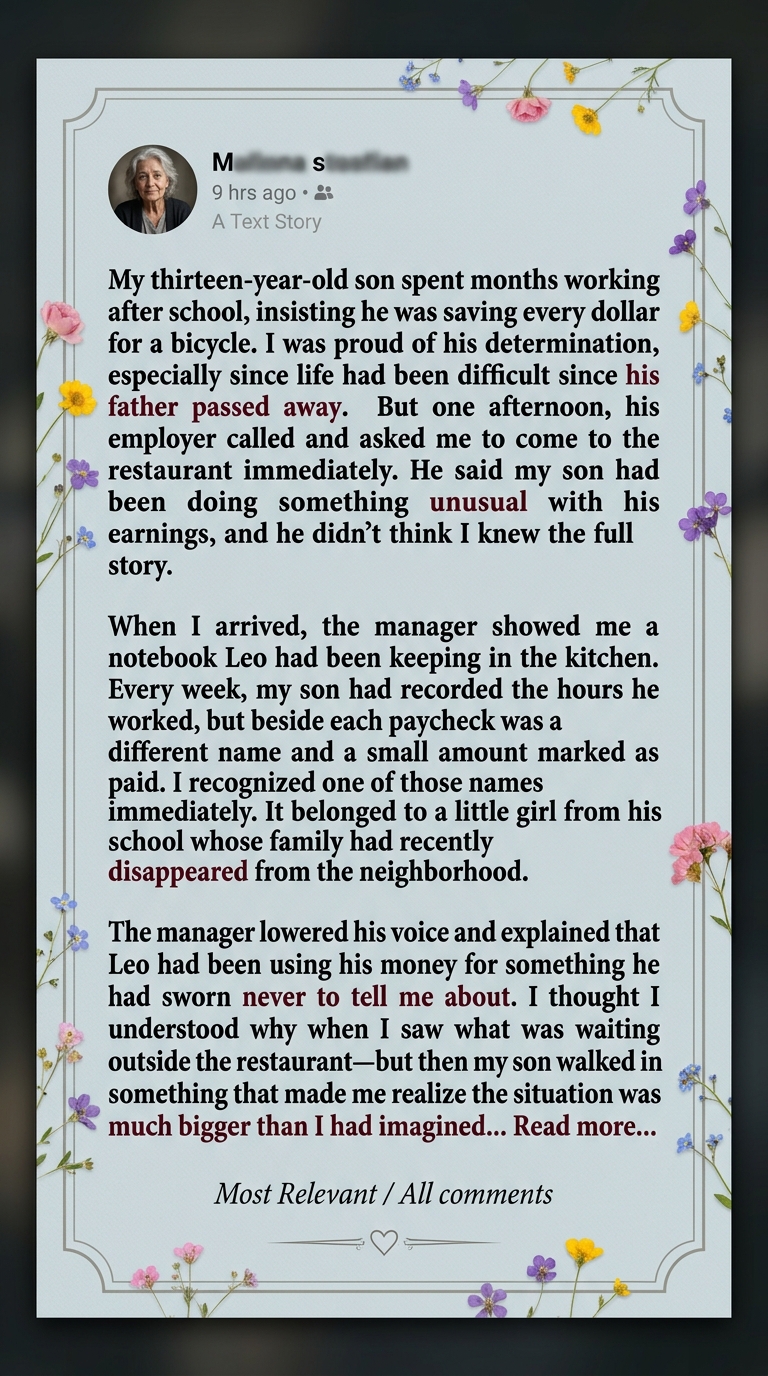
I first noticed something was wrong when Leo came home one Friday afternoon and placed his paycheck inside an old biscuit tin instead of his usual savings jar.
He was thirteen, and for the past four months, he had been working a few afternoons each week at a small restaurant called Miller’s Corner. The owner, Mr. Alvarez, had hired him to wash vegetables, fold napkins, clean tables, and help with simple kitchen tasks. I had agreed because Leo was responsible, the restaurant was close to home, and he wanted to save for a bicycle.
His father, Michael, had died two years earlier after a sudden medical emergency. Since then, Leo had become unusually independent. He rarely asked for anything, even when I knew he wanted something badly.
The bicycle had been his idea.
He had found a secondhand mountain bike in a shop window and calculated how many weeks he would need to save for it. He showed me the price written on a piece of paper and promised he wouldn’t spend a single dollar until he had enough.
I admired his determination.
So when Mr. Alvarez called me one afternoon and asked me to come to the restaurant, I assumed Leo had accidentally broken something.
His voice sounded troubled.
“Mrs. Bennett, I need you to come in. It’s about Leo.”
“Is he hurt?”
“No, he’s fine. But there’s something he’s been doing with his wages. I don’t think you know about it.”
I left work immediately.
When I arrived, Mr. Alvarez was waiting near the kitchen entrance. He led me to a small office behind the storage room and closed the door.
On his desk lay a blue notebook.
“Leo keeps this with him,” he explained. “I found it when he left his backpack here yesterday.”
I opened it.
The first few pages contained neatly written work hours, dates, and amounts earned. Beside each paycheck, Leo had written another name and a smaller amount.
Maya — $18.
Mrs. Collins — $25.
Ben — $12.
Sophie — $30.
I recognized Maya immediately. She was a little girl from Leo’s school whose family had recently disappeared from our neighborhood.
Her mother, Rachel, had worked at a grocery store nearby. She and Maya had lived in a small rented apartment until about a month earlier, when the landlord told neighbors they had left suddenly.
I had heard people speculate that they had moved away because of unpaid rent.
“Why is my son paying these people?” I asked.
Mr. Alvarez pulled out a chair.
“That’s what I wanted you to understand.”
He explained that Leo had asked him to divide his wages into two portions. He wanted most of the money recorded as savings, but he requested a smaller amount in cash every week.
At first, Mr. Alvarez assumed Leo was buying snacks or paying for something at school.
Then he noticed the names.
“One afternoon, I saw him putting groceries into a paper bag,” the manager said. “He told me they weren’t for him. He asked if I could let him leave a little early so he could deliver them.”
“Where?”
“An apartment building on the east side.”
I stared at the notebook.
“Why didn’t he tell me?”
Mr. Alvarez sighed.
“That’s what I asked him. He said he had promised someone he wouldn’t.”
I turned another page.
The names weren’t random. Some appeared repeatedly. Beside several were short notes: medicine, bus fare, bread, school lunch, laundry.
My eyes stopped at Maya’s name.
“What does this mean?”
Mr. Alvarez looked toward the kitchen.
“There’s something outside I think you should see.”
He led me through the back door.
A small white delivery van was parked beside the restaurant. An elderly woman sat in the passenger seat, holding a paper bag against her chest. Beside her was a little girl with dark hair tied in two uneven ponytails.
Maya.
She looked thinner than I remembered.
When she saw me, she immediately climbed out of the van.
“Where’s Leo?”
I looked at her.
“He’s not here right now, sweetheart. Why are you waiting for him?”
She lowered her eyes.
“He’s bringing my school shoes.”
I felt my chest tighten.
Before I could ask anything else, the restaurant’s back door opened.
Leo stepped outside carrying a large cardboard box. When he saw me, he stopped so suddenly that the box nearly slipped from his hands.
“Mom?”
I looked at the box.
Inside were groceries, notebooks, children’s socks, and a small pair of black shoes.
“Leo, what is going on?”
He glanced at Mr. Alvarez, then at Maya.
His face turned red.
“I was going to tell you.”
“When?”
He looked down.
“I don’t know.”
I wanted to be angry, but I was too worried to raise my voice.
“Why are you spending your money on other people?”
He placed the box on the ground.
“Because they don’t have enough.”
Maya stood beside the van, clutching the straps of her jacket.
Leo took a breath.
“Her mom lost her job. Then the apartment owner changed the locks because they were behind on rent. They were sleeping in their car.”
I looked at Maya.
“Is that true, sweetheart?”
She nodded.
“My mom said we were going to stay with Auntie Denise, but Auntie Denise’s apartment is too small. We stayed in the car for a while.”
The elderly woman in the van opened her door and stepped out.
She introduced herself as Mrs. Porter, a retired teacher who lived near the restaurant. She had found Rachel and Maya sleeping in their vehicle behind a closed supermarket almost three weeks earlier.
Rachel had been trying to find work and temporary accommodation. Mrs. Porter had helped them with food and allowed them to use her bathroom, but she couldn’t provide a permanent home.
Leo had met Maya one afternoon when he was walking home from school.
He recognized her because she had been in his class the previous year. She had transferred schools after her family moved across town.
At first, he had simply offered her his sandwich.
Then he learned that she and her mother had nowhere stable to stay.
“He asked if I could help him find them,” Mr. Alvarez explained. “I knew Mrs. Porter, so I put them in touch. Leo started bringing food whenever he could.”
I turned to my son.
“You’ve been giving away your wages for weeks?”
He nodded.
“Not all of them.”
“Leo, you were saving for your bicycle.”
“I know.”
“Then why didn’t you tell me?”
His eyes filled.
“Because you already have so much to worry about.”
That sentence hurt more than anything else.
I knelt in front of him.
“You are thirteen years old. You are allowed to need things. You are allowed to want a bicycle. You are not supposed to carry every problem you see.”
He wiped his cheek with his sleeve.
“I didn’t want Maya to think nobody cared.”
Maya stepped closer.
“He helped us when nobody else did.”
I looked at the little girl, then back at my son.
The notebook suddenly made more sense.
But I still didn’t understand why Leo had kept everything secret or why Mr. Alvarez seemed so concerned.
Then he explained the part I hadn’t seen.
Rachel hadn’t simply lost her job.
She had been working for a catering company when its owner suddenly closed the business and disappeared, leaving several employees without their final wages. Rachel had been owed nearly six weeks of pay. She had used her remaining savings to cover rent and food, expecting the money to arrive soon.
It never did.
Her landlord had started eviction proceedings, and she and Maya had been forced out of the apartment.
Rachel had tried to contact the catering company, but the business had been dissolved. She was now searching for employment while staying wherever friends could accommodate them.
Mrs. Porter had helped, but she was living on a fixed income and could only do so much.
Leo had learned about the unpaid wages from Maya. He had asked Mr. Alvarez whether he could work extra hours, then quietly started using his earnings to buy groceries, school supplies, and transportation vouchers.
He had also been saving the names of people who had helped Maya’s mother.
The names in the notebook weren’t all recipients.
Some were people Leo had paid back.
I turned to the last pages.
There were entries for Mrs. Porter, a neighbor who had lent Rachel money for a prescription, and a local mechanic who had allowed them to keep their belongings in his storage room.
Beside each name, Leo had written the amount Rachel hoped to repay.
I looked at my son.
“You’ve been keeping track of what everyone owes?”
He nodded.
“Maya’s mom said she would pay people back when she got work. I didn’t want anyone to forget.”
I felt tears gathering in my eyes.
Then I noticed another entry.
A name I didn’t recognize.
Daniel Reed — $140 — van repair.
“Who’s Daniel Reed?”
Mr. Alvarez answered before Leo could.
“He’s the mechanic who has been helping them. Their van broke down last week. He repaired it cheaply, but Rachel couldn’t pay the full amount. Leo offered him part of his savings.”
I looked at the delivery van.
Its front bumper was damaged, and one headlight was cloudy.
“Why was the van outside?”
Leo hesitated.
“Because Maya and her mom were going to leave.”
My stomach tightened.
“Leave where?”
He looked toward the girl.
“They got a message from someone in another town. A woman said she might have a room for them, but they needed to travel there today. They didn’t have enough money for the bus, so Mr. Alvarez said he would ask Daniel to help fix the van.”
Mrs. Porter stepped closer.
“Rachel was afraid she’d lose the opportunity if she waited.”
I looked at Maya.
“Where is your mother now?”
“She’s at a job interview,” she said. “She told me to wait with Mrs. Porter.”
I understood why Leo had been so determined to keep the arrangement secret. He had been trying to help a friend without making her feel like a charity case.
But he had also been making decisions far beyond what a child should have to handle.
I took a slow breath.
“Leo, I am proud that you wanted to help Maya. But you should have come to me. We could have helped together.”
He looked worried.
“Would you have let me?”
I took his hands.
“I would have listened. And I would have helped you find a safer way.”
He finally began to cry.
I hugged him while Maya watched quietly.
Then I turned to Mr. Alvarez.
“How much has he spent?”
The manager opened the notebook and showed me the total.
It was $486.
Nearly all the money Leo had earned during the previous two months.
I looked at the figure for a long time.
Then I noticed something else.
At the very bottom of the final page, in Leo’s handwriting, were the words:
Bicycle money left: $312.
I swallowed.
“You still have some saved?”
He nodded.
“I didn’t spend everything.”
I smiled through my tears.
“Good. Because you’re still getting that bicycle.”
His face lifted.
“But Maya—”
“We’re going to help Maya and her mother without taking away everything you’ve worked for.”
I turned to Mrs. Porter.
“Would you mind giving me Rachel’s number?”
She nodded.
I called Rachel and explained that I was Leo’s mother. At first, she sounded embarrassed and repeatedly apologized for accepting help from a child.
I stopped her gently.
“Your daughter has a good friend. That’s all this is. But I would like to speak with you about finding a more stable arrangement.”
She agreed to meet us at the restaurant.
When she arrived, she looked exhausted. Her clothes were clean but worn, and she kept apologizing for the trouble her situation had caused.
I asked about the job interview.
She told me it was for a position at a medical supply warehouse. The pay wasn’t exceptional, but it offered regular hours and benefits. She had completed the interview and was waiting to hear back.
I also asked about the room in the other town.
Rachel explained that it belonged to an acquaintance of Mrs. Porter’s. It was only temporary, and she wasn’t sure whether it would be available for more than a few weeks.
I suggested that before making a long journey, we contact the local family support center. They could help her understand her housing options, emergency assistance, and employment rights.
Rachel looked doubtful.
“I’ve already asked for help. I don’t want to keep depending on people.”
“I understand,” I said. “But asking for support isn’t the same as refusing to take responsibility. You lost your job because someone failed to pay you. You don’t have to solve every consequence alone.”
Mr. Alvarez offered to provide a reference for her because he knew several local businesses. Mrs. Porter agreed to accompany Rachel to the support center the following morning.
I also contacted a community organization that helped families facing temporary homelessness. They arranged an assessment and found a short-term family accommodation placement while Rachel waited for the result of her interview.
It wasn’t a permanent solution, but it gave them a safe place to sleep and a chance to make decisions without worrying about where they would spend the next night.
Rachel received the warehouse job four days later.
The employer confirmed her hours, and she began work the following Monday. The family support center helped her apply for a longer-term rental program, and she was eventually able to secure a modest apartment.
Maya returned to school.
She and Leo became close friends again, although she often reminded him that he wasn’t allowed to buy her things without asking.
I also made one rule clear to my son: he could help others, but he could never secretly give away money he needed for his own essentials or put himself in a dangerous situation trying to rescue someone.
He agreed.
A week after Maya and her mother moved into their temporary accommodation, I took Leo to the bicycle shop.
He stood in front of the mountain bike he had originally chosen.
It was still there.
“Are you sure?” he asked.
I smiled.
“You earned that money. You worked hard for it. You deserve to enjoy what you saved.”
He looked at the price tag, then at me.
“I don’t want to spend all of it.”
“Then we’ll find a way to cover the difference.”
He thought about it and finally nodded.
When we brought the bicycle home, he rode it up and down the driveway until the sky began to darken.
I stood at the front door watching him, remembering how he had first described the bike months earlier.
For the first time since his father died, he looked completely carefree.
A few weeks later, Rachel invited us to dinner at her new apartment. It was small, but the kitchen was warm, the windows were clean, and Maya had decorated the refrigerator with drawings.
After dinner, Rachel handed Leo a folded piece of paper.
Inside was a list of the money she had managed to save since starting her new job.
At the bottom, she had written:
I know you never asked me to repay you. But I want you to know that your kindness helped us get through the hardest month of our lives.
Leo read it silently.
Then he folded the paper and gave it back.
“You don’t have to pay me,” he said.
Rachel smiled.
“I know. But I wanted you to see that we’re doing better.”
Maya ran into the room carrying a small cardboard box.
“I made something for you.”
Inside was a handmade bicycle keychain with a tiny blue paper wheel.
Leo laughed.
“That’s not a real bicycle.”
“It’s better,” she said. “This one never gets a flat tire.”
Everyone laughed.
On the way home, Leo rode beside me, his new bicycle light blinking in the evening air.
After a while, he asked, “Mom, do you think Dad would have been proud?”
I glanced at him.
“Of course he would.”
“Even though I didn’t save all my money?”
I smiled.
“Especially because you understood that money can help people. But I think he’d also want you to remember that you’re allowed to take care of yourself.”
Leo nodded and continued riding.
I thought about his notebook, the carefully recorded names, and the small amounts he had given away without expecting anything in return.
He had spent months believing he was saving for a bicycle.
In reality, he had been trying to make sure another child didn’t feel forgotten.
And while I was proud of the kindness he had shown, I was even more grateful that he had finally learned something important: helping someone doesn’t mean carrying their entire burden alone.
Sometimes the greatest thing a child can do is remind the adults around him that compassion should never be left to children to provide by themselves.

