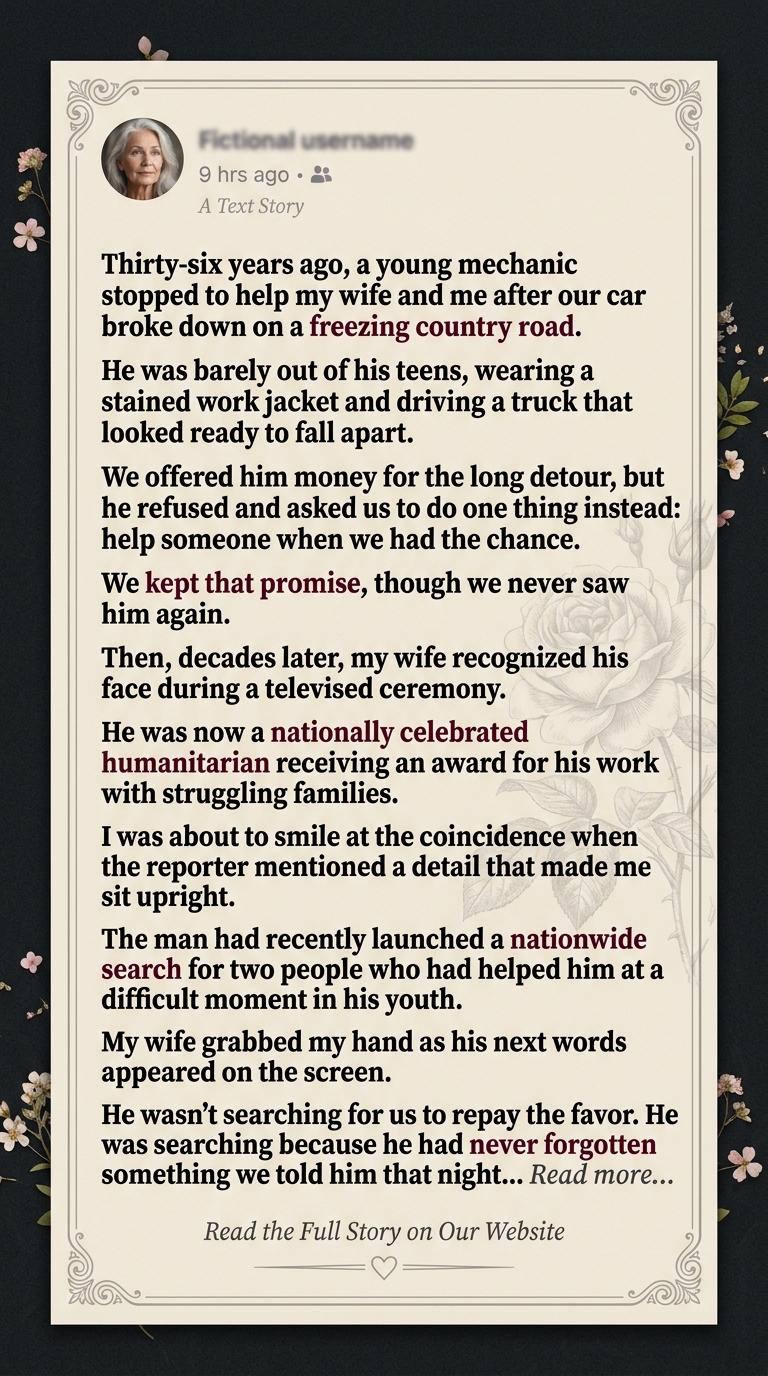
The night we met the young mechanic, the temperature had dropped below freezing, and my wife was beginning to cry.
Our car had broken down on a country road nearly forty miles from the nearest town. The engine had made a strange knocking sound before dying completely. I tried restarting it several times, but the battery was too weak, and the headlights were fading.
It was 1989. We had no mobile phones, no roadside assistance, and no passing traffic.
My wife, Margaret, was six months pregnant with our first child. She sat in the passenger seat with her coat wrapped tightly around her while I stood outside, waving at the occasional vehicle that passed without slowing down.
After nearly an hour, an old pickup truck finally pulled over.
The driver was a young man, perhaps nineteen or twenty. He wore a stained work jacket, heavy boots, and a wool hat with a hole near the edge. His truck rattled so loudly that I wondered how it had made it up the hill.
He climbed out and looked at our car.
“Engine trouble?”
“That’s what I’m afraid of,” I replied.
He opened the hood, examined the engine, and asked me to try the ignition. After listening for a few seconds, he shook his head.
“Your fuel line’s frozen. There’s moisture in it, and the cold has turned it into a problem.”
He introduced himself as Daniel.
He didn’t have much equipment, but he carried a small toolbox behind his seat. He spent nearly forty minutes working under the hood, warming the fuel line and clearing the blockage.
When he finally told me to try again, the engine started.
Margaret actually laughed.
I thanked him repeatedly and offered him fifty dollars. It was a substantial amount for us at the time, especially considering that he had probably gone out of his way to help.
He refused.
“Keep it,” he said.
“At least let me pay for your time.”
He shook his head.
“I wasn’t doing it for money.”
I insisted, but he closed his toolbox and leaned against his truck.
“All right,” he said. “If you really want to do something for me, help somebody when you get the chance. Someone who can’t pay you back.”
I looked at him.
“That’s all?”
“That’s enough.”
Margaret reached into her handbag and gave him a small paper packet containing two sandwiches and an apple. He accepted those, smiled, and wished us a safe journey.
Before he climbed into his truck, he noticed the small hospital bag on the back seat.
“First baby?” he asked.
I nodded.
“Then I hope everything goes well.”
We watched his truck disappear into the darkness.
We never saw him again.
But we remembered his request.
A few years later, when a young woman at my workplace was struggling to keep her children fed after her husband left, Margaret and I helped her find a small apartment and paid the deposit. We didn’t tell anyone.
Later, I helped an elderly neighbor repair his roof after a storm. Margaret began volunteering at a community kitchen. When our daughter grew up, we encouraged her to offer practical help rather than simply telling people to be grateful for what they had.
We never called it charity.
We called it keeping a promise.
Thirty-six years passed.
Our daughter, Emily, had children of her own. I retired from my job as a railway maintenance supervisor, and Margaret developed arthritis that made long walks difficult.
Our lives became quieter, filled with gardening, grandchildren, and the occasional argument about whether the television was too loud.
Then, one evening, we were watching a national awards ceremony.
A distinguished-looking man in his mid-fifties stood onstage beneath a large screen displaying the name of his organization: The Open Door Initiative.
He had spent decades developing emergency housing, family support centers, and practical assistance programs for people facing sudden financial hardship.
The presenter described how his organization had helped thousands of families avoid eviction, supported young people leaving foster care, and provided temporary accommodation for parents escaping dangerous situations.
Margaret suddenly leaned forward.
“Thomas, look at him.”
“What?”
“His face.”
I studied the screen.
The man had silver beginning to show at his temples, but there was something familiar about his expression.
Margaret grabbed my arm.
“It’s him.”
I frowned.
“Who?”
“The young mechanic.”
I stared at the television again.
Then I remembered the wool hat, the stained jacket, and the battered pickup truck.
“Daniel?”
Margaret nodded.
“That’s Daniel.”
I smiled.
It was remarkable to see someone we had met for less than an hour become such an accomplished humanitarian.
Then the presenter mentioned something that made me sit upright.
“Mr. Mercer recently announced a nationwide search for two strangers who helped shape his life during a difficult period in his youth. Despite years of searching, he has been unable to identify them.”
Margaret took my hand.
The camera returned to Daniel.
He stepped toward the microphone.
“I’ve spent a large part of my life trying to find two people I met on a freezing road in 1989,” he began. “They probably remember me as a young mechanic with an unreliable truck. I remember them as the first people who made me believe I might still have a future.”
My mouth went dry.
Daniel continued.
“That night, they offered me money for helping them. I refused. I asked them to help someone else when they had the chance.”
Margaret began crying.
Then he said something neither of us expected.
“But that’s not the reason I’m searching for them. I want to find them because, before they drove away, the husband said something to me that I have carried for thirty-six years.”
I looked at Margaret.
“What did I say?”
Daniel paused.
The words appeared beneath his face as he spoke.
“You told me, ‘A person can be having the worst night of his life and still be the reason somebody else’s night gets better. Don’t forget that about yourself.'”
I felt the air leave my lungs.
I remembered saying those words.
Not because I thought they were particularly wise, but because Daniel had seemed unusually sad when he mentioned that he wasn’t doing the work for money.
At the time, I assumed he was simply a generous young man.
Now I wondered what had happened to him before we met.
The presenter asked whether Daniel could explain why those words mattered so much.
He took a breath.
“I was seventeen when my mother died. My father had left years earlier, and I was suddenly responsible for my younger sister, Sophie. I had dropped out of school and was working in a garage whenever the owner needed an extra pair of hands.”
His voice became quieter.
“That winter, the garage closed. I had been sleeping in the back of my truck because the landlord had changed the locks on our rented room after we fell behind. My sister was staying with a family friend, and I was trying to save enough money to get us somewhere permanent.”
Margaret covered her mouth.
Daniel explained that on the evening we met, he had been driving to collect a small amount of money from a customer who owed him for repairing a tractor.
He had planned to buy food and pay for one more week in the room where Sophie was staying.
Instead, he had spent nearly an hour helping two strangers.
When he finally reached the customer, the man had already left.
Daniel returned to his truck with no money and no idea what he would do next.
“I remember sitting beside the road afterward,” he said. “I was angry with myself. I thought I had wasted the only chance I had that evening.”
He looked down.
“Then I remembered what the man had said. That I could still be the reason somebody else’s night got better, even when mine was falling apart.”
He paused.
“I decided that if I couldn’t fix my own life that night, I could at least make sure somebody else got home safely.”
He began taking odd jobs, repairing vehicles, and doing small maintenance work for people who couldn’t afford regular garage prices.
One of those customers was a retired schoolteacher named Mrs. Alden, who noticed that he was sleeping in his truck.
She offered him a room in exchange for repairing her property and helping with errands.
Daniel accepted.
He eventually found a stable job, completed his mechanical training, and persuaded the family friend caring for Sophie to let his sister move in with him.
He later opened a small repair shop.
But his experiences had changed the way he viewed hardship.
He began helping people who came into his garage with broken cars and no money. Sometimes he repaired vehicles for free. Other times, he arranged payment plans or connected customers with employers who needed reliable workers.
Years later, he expanded those efforts into a community program.
That program eventually became the Open Door Initiative.
The presenter asked how the search for us had begun.
Daniel explained that he had spent years trying to identify the couple from the country road.
He remembered our first names, but nothing else. He had no registration number, no address, and no photograph.
A few years earlier, while preparing a documentary about the organization’s origins, he had told the story publicly.
A retired journalist suggested that he launch a nationwide appeal.
He had since received hundreds of messages, many from people claiming to remember a similar incident.
Most were impossible to verify.
Then Daniel looked directly into the camera.
“If you’re watching this, and you remember helping a young mechanic beside a country road in 1989, I’d be grateful if you’d contact the Open Door Initiative. I don’t owe you money. I don’t want to put you on a stage or make you feel you have to accept anything.”
His eyes glistened.
“I just want to tell you something I should have told you that night. Your words helped me stay alive long enough to build the life I have today.”
Margaret began sobbing.
I sat motionless.
For several minutes, neither of us spoke.
Then Margaret turned toward me.
“We have to contact him.”
I nodded.
The next morning, I called the number displayed on the organization’s website.
The receptionist took my details and asked me to explain how I knew Daniel.
I told her about the broken fuel line, the freezing road, the sandwiches, and the sentence I had spoken before we left.
She went quiet.
“Could you hold for a moment, please?”
A few minutes later, another voice came on the line.
“Is this Thomas Bennett?”
I recognized Daniel immediately.
“Yes.”
There was a pause.
Then he said, “I think I’ve found you.”
Margaret took the phone from my hand.
“Daniel, it’s Margaret. I was the pregnant woman in the car.”
He laughed softly, and I heard him take a shaky breath.
“Mrs. Bennett?”
“Yes, sweetheart.”
He didn’t answer immediately.
Then he said, “I remember you gave me sandwiches.”
Margaret smiled through her tears.
“I remember you refusing fifty dollars.”
“I should have taken it,” he joked. “I could have used the money.”
We all laughed, and somehow that laughter made the moment even more emotional.
Daniel asked whether he could visit.
We agreed.
Two weeks later, a dark blue car pulled into our driveway.
A tall man stepped out carrying a small wooden box.
He looked older than the young mechanic in our memory, but his eyes were the same.
Margaret opened the door before he reached the porch.
For a moment, they simply looked at each other.
Then she hugged him.
Daniel held her carefully, as though he were afraid she might break.
When I stepped forward, he shook my hand.
“Mr. Bennett,” he said.
“Thomas is fine.”
He smiled.
“I’ve imagined this meeting so many times.”
We invited him inside.
Over coffee, he told us more about his life. His sister Sophie had become a teacher and now worked with children who had experienced housing instability. She had two children of her own and lived nearby.
Daniel had never married, although he had been in a long relationship. He explained that he had spent so much of his early adulthood building the organization that he had neglected parts of his personal life.
He didn’t say it bitterly.
He seemed at peace with his choices.
Then he opened the wooden box.
Inside was an old photograph.
It showed a young man standing beside a battered pickup truck. His jacket was stained, his hair was untidy, and his expression was serious.
On the back, someone had written:
The night I decided not to give up.
I looked at the photograph for a long time.
“Who took this?”
“My sister. A few days after I moved into Mrs. Alden’s spare room.”
He turned it toward us.
“I kept it because I wanted to remember how close I came to believing there was no way forward.”
Margaret reached across the table.
“Daniel, we didn’t do anything extraordinary.”
He shook his head.
“Maybe not to you. But you stopped when everyone else drove past. You accepted help from a stranger, offered him food, and treated him like a person rather than someone who needed to prove he deserved kindness.”
He looked at me.
“And you gave me a sentence I could hold onto when I had nothing else.”
I felt embarrassed by the attention.
“You did the hard work yourself.”
“I know,” he said. “I’m not giving you credit for my life. I’m telling you that you helped me believe it was worth continuing.”
He then explained why he had brought the box.
Inside was a small brass key attached to a tag bearing the words Workshop One.
Daniel had recently opened a training center where young adults facing housing insecurity could learn practical trades. Mechanics, electrical repair, carpentry, and maintenance.
The first workshop was named after his mother.
He wanted to name the second one after the couple who had stopped beside the road.
We both protested.
“Please don’t put our names on a building,” Margaret said. “We don’t need that.”
Daniel nodded.
“I expected you might say that.”
He reached into the box again and removed a small metal plaque.
It read:
THE BENNETT WORKSHOP
For those who need a chance to begin again.
Underneath were the words:
Help someone when you have the chance.
I stared at it.
“You really didn’t have to do this.”
“I know.”
He smiled.
“But I wanted the people who walk into that room to understand that it began with an ordinary act of kindness. Not a wealthy donor, not a government program, and not a famous person. Just two people who stopped their car because someone needed help.”
Margaret touched the plaque.
“Then promise us something.”
“Anything.”
“Don’t let people think they have to become successful before they deserve help.”
Daniel’s smile faded into a thoughtful expression.
“I promise.”
Before he left, we asked about Sophie.
He told us she had heard the story of the couple from the road many times. She remembered the winter he had nearly lost hope, and she had always wanted to meet the people who helped him keep going.
A month later, Sophie visited us too.
She brought a photograph of herself as a little girl, standing beside Daniel’s truck. She was holding a blanket and smiling.
“That was the first night I knew we weren’t going to lose everything,” she said.
Margaret hugged her.
We eventually visited the training center.
It wasn’t a glamorous building. It had concrete floors, old workbenches, shelves of donated tools, and a small classroom where students learned basic mathematics and workplace skills.
But it was full of life.
Young people who had left school early worked beside instructors who treated them with patience. Some were learning to repair engines. Others were rebuilding bicycles for children in temporary housing.
Daniel showed us a group of students working on an old delivery van.
One young man approached him, holding a wrench.
“Mr. Mercer, we got the engine running.”
Daniel grinned.
“Then you did better than I did on my first attempt.”
The boy laughed.
As we walked through the building, I realized something.
Thirty-six years earlier, I had believed I was helping a struggling young mechanic by offering him money.
But the truth was that he had helped us, too.
He had given us a simple instruction that quietly shaped the way we lived. We had helped neighbors, strangers, and families without expecting recognition. Those small acts had become part of our marriage and our understanding of what mattered.
And now, through Daniel, we could see how one difficult night had traveled much farther than any of us could have imagined.
When we said goodbye, Daniel hugged Margaret and shook my hand.
“Thank you for stopping,” he said.
I smiled.
“Thank you for remembering.”
On the drive home, Margaret rested her hand on mine.
“Do you think we’ll ever understand how something so small became all of this?”
I looked out at the road ahead.
“Maybe that’s the point. We never know how far a kindness travels.”
That evening, I placed the photograph Daniel had given us on the mantelpiece.
Beside it, Margaret put the small brass key.
We had spent thirty-six years believing we were simply keeping a promise to a young man whose name we might never hear again.
Now we knew that he had been keeping one too.
And somewhere across the country, in a workshop filled with the sound of engines starting and young people laughing, our promise was still being carried forward.

