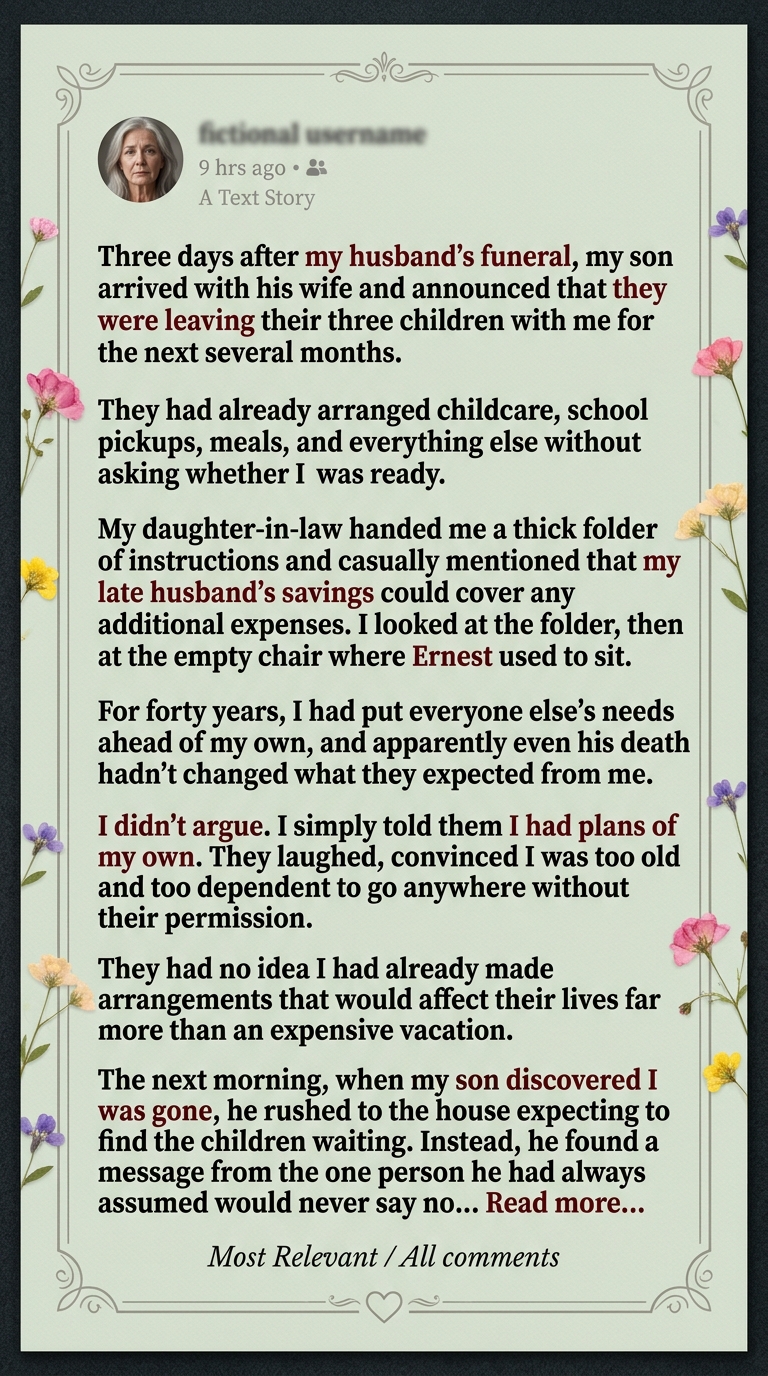
Three days after my husband’s funeral, my son arrived at my house with his wife and three children, carrying enough luggage to suggest they were moving in permanently.
I was still wearing the black dress I had worn to the cemetery. The flowers from Ernest’s funeral were beginning to wilt on the dining-room table, and his reading glasses remained beside the newspaper he had never finished.
Daniel walked into the kitchen as if nothing unusual had happened.
“Mom, we need to talk about the children.”
His wife, Vanessa, placed a thick folder on the table.
“We’ve arranged everything,” she said. “Their school schedules, meals, medical information, bedtime routines. It’s all in here.”
I looked at the folder without touching it.
“Arranged what?”
Daniel glanced at his wife before answering.
“We need you to look after the children for a while. Probably four or five months.”
His children were eight, six, and four. They were good children, but looking after three young grandchildren was not a small responsibility, particularly for a woman who had just buried her husband.
“Why?” I asked.
Vanessa answered before Daniel could.
“Daniel has an opportunity to expand his business. We need to travel for a few months to get everything established. It wouldn’t make sense to take the children out of school, and you already know their routines.”
I looked at my son.
“You’ve decided this without speaking to me?”
“Mom, you’re their grandmother. Who else would we ask?”
“I don’t know. Perhaps someone you actually consulted.”
Vanessa gave a little laugh.
“Please don’t make this difficult. We know you’re lonely now that Ernest is gone. Having the children here will give you something to do.”
Something to do.
I looked at the empty chair where my husband used to sit.
Forty years of marriage had ended only three days earlier. I was still waking up expecting to hear Ernest moving around upstairs. I hadn’t even found the courage to put his slippers away.
And my son had decided that my grief was an inconvenience he could solve by leaving three children in my care.
Daniel opened the folder.
“We’ve written down everything. School starts at eight. Emma needs her lunch packed without nuts. Oliver has football on Wednesdays. Sophie usually wakes up during the night, so you’ll need to keep the hallway light on.”
Vanessa pointed to another page.
“We’ve also included the monthly expenses. Your husband’s savings should cover anything extra. We don’t want you worrying about money.”
I finally looked directly at her.
“My husband’s savings?”
She nodded.
“Well, they’re family savings, aren’t they? Daniel is his son.”
Ernest had worked for decades as an electrical engineer. He had saved carefully, avoided unnecessary debt, and planned his retirement down to the smallest detail. We had never been wealthy, but we had enough to live comfortably.
Those savings were not a family account for everyone to use whenever they wanted.
They were meant to support the two of us through our remaining years.
Now Ernest was gone, and apparently his money had become another resource Daniel felt entitled to manage.
I closed the folder.
“I have plans of my own.”
Daniel laughed.
“Mom, what plans?”
“I’ll be away tomorrow.”
Vanessa exchanged an amused look with him.
“Where are you going?”
“Somewhere I need to be.”
Daniel shook his head.
“Don’t be ridiculous. You can’t leave three children here and expect us to manage everything from another country.”
I stared at him.
“You’ve just told me you’re leaving them here for several months.”
“That’s different.”
“How?”
He didn’t answer.
Vanessa gathered the folder and pushed it toward me again.
“Just read it before you make an emotional decision.”
I didn’t take it.
They left shortly afterward, convinced I would eventually agree.
They had spent their entire lives believing that I would always adjust, always forgive, and always find room for one more responsibility.
They had mistaken my patience for permission.
What they didn’t know was that Ernest and I had discussed this possibility long before he died.
Six months earlier, he had suffered a minor stroke. He recovered well, but the experience forced us to discuss things we had always postponed.
We reviewed our finances, updated our wills, and made sure neither of us would be left dependent on our children if the other died.
During one conversation, Ernest had said something I never forgot.
“Margaret, promise me you won’t spend the rest of your life looking after everyone except yourself.”
I had laughed.
“What else am I supposed to do?”
“Whatever you want. You’ve earned that right.”
At the time, I thought he was talking about taking a holiday.
But we had done something more important. We had established an independent estate plan, with clear instructions about our savings, property, and personal responsibilities.
Our solicitor, Helen Foster, had explained that after Ernest’s death, I would retain control of my own assets and receive the benefits intended for me under his will.
Daniel had been informed that he would receive an inheritance in due course, but he had no authority over my money.
I had also made arrangements with a family support organization that Ernest and I had quietly supported for years. They operated a temporary childcare residence for children whose parents needed assistance during serious family difficulties.
I had volunteered there occasionally, helping with reading lessons and preparing meals.
A few weeks before Ernest died, the director, Susan, had asked whether I would consider joining their residential support program after retirement.
I had agreed to discuss it.
After the funeral, I called Susan and told her I was ready.
She offered me a position helping coordinate the children’s evening activities and mentoring older children who struggled with reading. The organization also provided a small apartment on its grounds for residential volunteers.
I wasn’t running away from my family.
I was choosing a life that belonged to me.
The following morning, I woke before sunrise.
I packed two suitcases, watered Ernest’s plants, and placed his photograph beside the window. I left the house clean and locked the doors.
Before leaving, I wrote a letter to Daniel.
I placed it on the kitchen table beside the folder Vanessa had brought.
Then I called a taxi and left.
I didn’t tell Daniel exactly where I was going because I wanted him to read my message before trying to change my mind.
At 8:15, my phone began ringing.
I let it ring.
At 8:27, Daniel called again.
Then Vanessa.
Then Daniel again.
Finally, I answered.
“Where are you?” he demanded.
“I’m safe.”
“Where are the children supposed to go? We were bringing them over this morning!”
I looked through the window of the small apartment Susan had arranged for me. A row of trees stood beyond the courtyard, and sunlight was falling across the kitchen table.
“Daniel, I told you yesterday that I had plans.”
“You can’t just disappear!”
“I haven’t disappeared. I’ve made arrangements for myself.”
“What about your grandchildren?”
“They are your children.”
He went quiet.
Then he said, “Mom, this isn’t funny. We have flights booked.”
I took a breath.
“Then perhaps you should have arranged childcare before booking your flights.”
He began speaking more loudly.
“You know we can’t afford a private nanny for months. That’s why we came to you.”
“And I never agreed.”
“Dad would never have refused.”
That sentence hurt more than I expected.
I looked at Ernest’s photograph on the shelf.
“Your father loved those children,” I said. “But he also understood that love doesn’t mean someone can make decisions for you.”
Daniel hung up.
A few minutes later, he sent a message.
You need to come home. We have already made commitments.
I didn’t reply.
Instead, I opened the letter I had kept a copy of.
I had written it carefully because I knew Daniel would try to turn the situation into an argument about my grief.
The message was simple.
I explained that I was staying with the support organization for the next several months. I had accepted a volunteer position and arranged my own accommodation. I was not available for full-time childcare, and I had not authorized anyone to use Ernest’s savings.
I also told him that Helen, our solicitor, had been instructed to communicate directly with him about any questions concerning the estate.
Finally, I wrote that the house was mine, the financial decisions were mine, and nobody had permission to move into it or store belongings there without my agreement.
I had asked Helen to arrange an inventory of the property and update the access arrangements. Daniel and Vanessa had keys because we had trusted them with emergencies. That trust did not give them permanent permission to use the house.
I ended the letter with one sentence.
I love you, Daniel, but I am no longer available to be volunteered for a life I did not choose.
That afternoon, Helen called.
“Your son contacted me,” she said.
“I expected he would.”
“He seems to believe that he has some authority over the savings.”
“He doesn’t.”
“I explained that. I also reminded him that the estate process is being handled according to the will and that your personal accounts remain under your control.”
“Did he understand?”
“He understood the words. Whether he accepts them is another matter.”
I thanked her.
Then she told me something I hadn’t expected.
Daniel had already contacted the bank to ask whether he could access Ernest’s savings to cover the children’s expenses.
The bank had refused to discuss the accounts with him.
He had also asked whether the house could be used as security for a business loan.
Helen informed him that he had no authority to do that either.
I felt a familiar sadness settle over me.
I had known Daniel could be selfish. I had not realized how far he was willing to go when he believed I would not resist.
That evening, I received a message from Vanessa.
The children keep asking why Grandma isn’t coming. I hope you’re happy.
I read it twice.
Then I called Daniel.
“Put the children on the phone, please.”
He hesitated.
“Why?”
“Because I want to speak to my grandchildren.”
A moment later, I heard Emma’s voice.
“Grandma?”
“Hello, sweetheart.”
“Daddy says you’re on holiday.”
I smiled.
“I’m helping some children at a special place. I’ll tell you all about it when I see you.”
“Are you coming back?”
“Yes. I just won’t be looking after you every day.”
She was quiet.
“Did we do something wrong?”
My heart tightened.
“No, darling. Not one thing. This is an adult decision, and it has nothing to do with you.”
I spoke to the other two children before ending the call.
I made sure they understood that I loved them and that I would still visit.
I wasn’t going to let Daniel and Vanessa turn my boundary into a punishment for the children.
Over the next few weeks, I settled into my new routine.
The work was more demanding than I expected. I helped children with homework, organized evening activities, and listened when they needed someone patient enough to hear the whole story.
One girl, eleven-year-old Lucy, refused to read aloud because she was embarrassed by her mistakes.
I sat beside her one afternoon.
“When I was your age,” I told her, “I was afraid of reading in front of my class too.”
She looked surprised.
“Really?”
“Absolutely. I once read an entire paragraph with the wrong name because I was too nervous to stop.”
She laughed.
By the end of the week, she was reading to the other children.
I began to understand what Ernest had meant. I still had something to give, but I could choose how to give it.
I was not required to sacrifice my health, my peace, or my independence to prove that I loved someone.
Daniel and Vanessa’s plans, meanwhile, began to unravel.
They had expected to spend months abroad while I handled everything at home. Their childcare arrangements had consisted of assuming I would say yes.
Once that assumption disappeared, they had to make real decisions.
Daniel eventually postponed the business expansion. Vanessa returned to work earlier than planned, and they hired a part-time caregiver to help with school pickups.
It wasn’t easy for them, but they managed.
A month after I left, Daniel visited the support residence.
He arrived carrying a bag of groceries and looked uncomfortable when he saw me sitting with Lucy in the common room.
“Can we talk?” he asked.
I finished helping Lucy with her reading before joining him outside.
He looked tired.
“I didn’t realize how much we were asking.”
I waited.
“We thought you’d be happy to have the children. We thought it would help you after Dad.”
“Did you ask me?”
He looked down.
“No.”
“Did you ask whether I was ready to look after three children immediately after burying your father?”
“No.”
“Did you consider that I might need someone to look after me for once?”
He swallowed.
“I suppose we didn’t.”
I looked at him.
“Daniel, I love being their grandmother. I love having them visit. But I am not a childcare arrangement you can activate whenever your plans become inconvenient.”
He nodded slowly.
“I know.”
I wasn’t certain he did, but it was the first time he had admitted that he had made a decision without considering me.
He asked whether I would come home.
I told him I wasn’t ready.
“I’ll visit,” I said. “I’ll spend time with the children. But I intend to finish the commitment I made here.”
He looked disappointed, then nodded.
Before he left, he asked about Ernest.
I told him about the final weeks, the conversations we had shared, and how his father had encouraged me to live without waiting for someone else’s permission.
Daniel listened quietly.
Then he said, “I wish Dad had told me how he felt about all this.”
“He did, in his own way. But you would have had to listen.”
For the first time, Daniel didn’t argue.
Several months later, I returned home for a weekend visit.
The house was exactly as I had left it. Ernest’s photograph still stood beside the window, and his reading glasses remained in the drawer where I had placed them.
Daniel brought the children over on Saturday.
They ran through the front door and wrapped their arms around me.
Emma showed me a drawing she had made. Oliver told me about football. Sophie climbed onto my lap and asked whether I could read her a story.
I did.
But when Daniel mentioned that Vanessa had a work trip coming up and asked whether I could keep the children for ten days, I answered calmly.
“I’m available for Saturday afternoon. I won’t be able to take responsibility for the full ten days.”
He looked as though he wanted to protest.
Then he stopped.
“Okay. We’ll make other arrangements.”
It was a small answer, but it meant more to me than a grand apology.
That evening, after they had gone, I sat in Ernest’s old chair and looked around the quiet room.
I missed him terribly.
But I no longer felt that my life had ended when his did.
I had spent forty years being a wife, a mother, and the person everyone called when something needed fixing. Those roles had mattered deeply to me.
They still did.
But they were not the only things I was allowed to be.
The next morning, I returned to the support residence.
Lucy was waiting with a book in her hands.
“I finished it,” she announced proudly.
I smiled and took the book.
“Then I think it’s time you chose the next one.”
For the first time in a long while, I felt that I was exactly where I had chosen to be.
And when Daniel called later that week, he didn’t ask me to solve a problem.
He simply asked how I was doing.
That was a beginning I could accept.

