For seven months after my husband died, I kept setting two cups on the kitchen table.
It became such an automatic habit that I sometimes didn’t notice until I had poured the second cup of coffee. Then I would stand there, staring at the empty chair where Martin used to sit, wondering how a person could disappear from a house without taking the smallest things with him.
His reading glasses were still in the drawer beside the sofa. His gardening gloves hung behind the kitchen door. And his old recipe notebook remained on the shelf above the refrigerator, its corners darkened from years of flour-covered fingers.
Martin had never been a professional cook, but he loved preparing meals for people he cared about. His notebook contained recipes collected from his mother, handwritten adjustments, and little comments about which dishes were worth making when someone had a difficult day.
His son, Caleb, had been sixteen when Martin died.
Caleb wasn’t my biological child, but I had helped raise him since he was eight. His mother, Diane, lived in another town, and Martin and I had shared custody arrangements that gradually became less formal as Caleb grew older.
We had never pretended to be a perfect family. Diane and I had our disagreements, and Caleb occasionally reminded me that I wasn’t his mother. I never argued with him. I knew my place in his life, and I loved him without needing him to call me anything special.
When Martin died unexpectedly from a heart attack, Caleb was devastated.
At the funeral, he barely spoke. He stood beside his father’s coffin with his hands buried in his jacket pockets, looking as though he had forgotten how to move.
Two days later, Diane came to collect him.
“I think he needs to be with me for a while,” she said quietly.
I understood.
Caleb needed his mother. He needed familiar surroundings and time away from the house where every room reminded him of his father.
I hugged him before he left.
“You don’t have to worry about me,” I told him. “You can come back whenever you want.”
He nodded without looking at me.
For the first few weeks, we exchanged messages.
I asked how school was going. He sent short replies. I told him I had found one of his old photographs. He said I could keep it.
Then the replies became less frequent.
Eventually, he stopped answering altogether.
I tried calling twice. Diane answered once and said Caleb was having a difficult time and didn’t want to talk.
I told her I understood.
I didn’t want him to feel responsible for comforting me when he was struggling with his own grief.
Still, the silence hurt.
Christmas passed without him. His birthday came and went. I sent a card, but I never received a response.
I continued living in the house, though I gradually changed some things. I moved Martin’s clothes into storage, donated his old work equipment, and repainted the small bedroom Caleb had used before moving to his mother’s.
I couldn’t bring myself to touch the recipe notebook.
It remained exactly where Martin had left it.
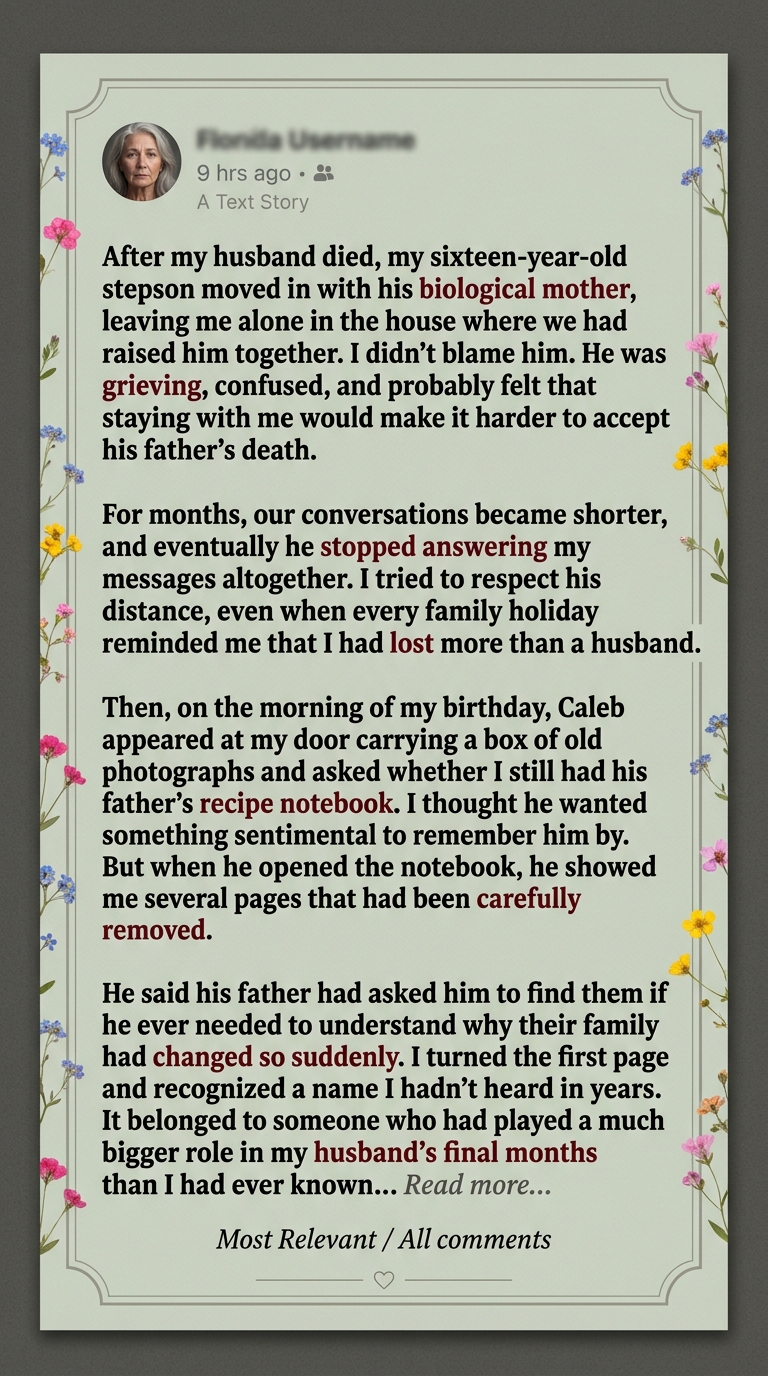
On my birthday, I woke to rain tapping against the bedroom window.
I was sixty-one that year.
I made breakfast, watered the plants, and tried not to think about how Martin used to bring me flowers every birthday, even when he claimed he had forgotten the date.
At eleven fifteen, someone knocked.
When I opened the door, Caleb was standing on the porch.
He looked taller than I remembered, though his shoulders seemed tense. His hair was longer, and he had a small cardboard box tucked beneath one arm.
For a moment, neither of us spoke.
Then he said, “Happy birthday.”
I felt my throat tighten.
“Thank you, sweetheart.”
He glanced past me into the house.
“Can I come in?”
“Of course.”
He stepped inside and placed the box on the dining-room table.
“I brought something.”
I looked inside.
It contained old photographs of Martin, Caleb, and me. Some were from holidays, others from ordinary weekends. One showed Martin teaching Caleb how to ride a bicycle. Another showed the three of us standing beside a badly decorated birthday cake that Caleb had made when he was ten.
I smiled.
“I remember this one. Your father insisted the cake was supposed to look like a football.”
“It looked more like a broken shoe,” Caleb said.
We both laughed, and for the first time in months, the house didn’t feel quite so empty.
Then Caleb looked toward the kitchen.
“Do you still have Dad’s recipe notebook?”
I nodded.
“It’s on the shelf. Why?”
“Can I see it?”
I brought it down and placed it in front of him.
He turned through the pages carefully, stopping at the recipes he recognized.
Then he opened the notebook near the middle.
Several pages had been removed.
Not torn accidentally. The edges were clean, as though someone had used a sharp blade to cut them out.
I frowned.
“That’s strange.”
Caleb looked at me.
“Dad removed them.”
“How do you know?”
“Because he told me.”
I sat down.
“When?”
“About two weeks before he died.”
I stared at him.
“What did he tell you?”
Caleb ran his thumb along the edge of the missing pages.
“He said that if anything happened to him and I ever needed to understand why things had changed in our family, I should look for these pages. He said you would know the name when you saw it.”
He reached into the cardboard box and removed a folded sheet of paper.
“I found this in my desk after I moved to Mom’s. I didn’t understand it at first.”
He unfolded it.
It was a handwritten note from Martin.
Caleb, if you are reading this, it means I wasn’t able to explain everything myself. Don’t assume that the people who were quiet were hiding something bad, and don’t assume that the person who tells you the most is telling you the truth. Find the missing recipes. Start with the name written beside the apple cake. Then speak to Eleanor before making any decisions.
I read the note twice.
“Eleanor?”
Caleb nodded.
I recognized the name immediately.
Eleanor Price had been Martin’s older sister.
I hadn’t heard from her in nearly three years.
Martin and Eleanor had been close when they were young, but their relationship had broken down after their father’s death. They disagreed over the family home, their father’s belongings, and the way his final years had been handled.
The argument became so bitter that they stopped speaking.
Martin rarely discussed it. When I asked, he always said that some family disagreements were too old to repair.
I had assumed Eleanor was simply another painful chapter in his past.
“Why would your father ask you to speak to her?” I asked.
Caleb opened the notebook again.
“Because Mom told me Dad had been planning to leave you.”
I felt the room tilt slightly.
“What?”
“She said he’d been unhappy. She said you two were arguing about money and that he wanted to move out. She said he was going to tell you after Christmas.”
I looked at him in disbelief.
“Your father and I weren’t planning to separate.”
“I know that now.”
“What made you believe it?”
Caleb lowered his eyes.
“Mom showed me messages.”
I waited.
“She said Dad had been talking to someone about finding a new place. She said he was tired of being responsible for everyone and wanted to start over.”
I remembered Martin’s final months. He had been tired, certainly. His business had been struggling, and he had spent many evenings dealing with paperwork. But he had never suggested leaving our marriage.
“Did she show you the actual messages?” I asked.
“Some screenshots.”
“Do you still have them?”
He nodded.
“On my old tablet.”
I took a breath.
“Caleb, I need you to understand something. Your father and I had disagreements, like every couple. But he never told me he wanted to leave.”
Caleb looked miserable.
“I believed her. I was angry with you. I thought you’d been pretending everything was fine.”
“Why didn’t you ask me?”
“Because I thought you would lie.”
His honesty hurt, but I couldn’t blame him for being sixteen and caught between two adults.
I reached across the table.
“Your father loved you very much. Whatever happened between the adults in your life, you were never responsible for choosing sides.”
Caleb nodded, but his eyes had begun to fill.
I pointed to the notebook.
“Let’s find out what he wanted you to know.”
The apple cake recipe was near the back.
Beside it, Martin had written a name in small letters.
Eleanor Price.
Underneath it was a telephone number.
I recognized the handwriting immediately.
Martin had written it only a few years earlier.
Caleb took out his phone.
“I called her last night.”
I looked at him.
“What did she say?”
“She said she would meet us if you wanted to come.”
I wasn’t sure I was ready to see Eleanor.
But Martin had specifically mentioned her, and Caleb had carried that instruction for months.
So I agreed.
We drove to a small café on the edge of town that afternoon.
Eleanor was waiting near the window.
She was seventy-two, with short silver hair and a walking stick resting against her chair. When she saw us, she stood slowly.
For a moment, she looked at Caleb.
Then she looked at me.
“I wondered when Martin’s note would find its way to you,” she said.
I sat opposite her.
“Why did he remove those pages?”
Eleanor folded her hands.
“Because he didn’t trust himself to explain what happened without making things worse.”
She told us that three years earlier, Martin had discovered something troubling about his father’s estate.
Their father had owned a small commercial property and several investments. After his death, Eleanor had been appointed to help administer the estate, while Martin handled the business records.
They had discovered that their younger cousin, Peter, had been withdrawing money from an account that was supposed to pay the estate’s expenses.
At first, the amounts were small.
Then the withdrawals became larger.
Eleanor confronted Peter, but he insisted that the money had been approved by Martin.
Martin denied it.
The disagreement became a family argument, and Peter accused Eleanor of trying to control the inheritance.
Martin eventually discovered that the withdrawals had been made using an authorization document that appeared to carry his signature.
He knew he hadn’t signed it.
But before he could gather enough evidence, Peter presented a different explanation to the family. He claimed Eleanor had been using the account for personal expenses and that Martin was protecting her.
Their father had been dead for months, and the family had become suspicious of one another.
Martin and Eleanor stopped speaking.
I listened carefully.
“What does this have to do with Caleb’s mother?”
Eleanor’s expression changed.
“That is where the story becomes more difficult.”
She explained that Peter had approached Diane about four months before Martin died.
Diane had been working part-time for a small property management company. Peter offered her money to help organize some old financial records and contact information.
She accepted.
At first, she believed it was ordinary administrative work.
Then she discovered that Peter wanted her to locate Martin’s personal documents and obtain copies of records connected to the old estate.
Diane knew Martin kept important papers at home. She also knew that Caleb sometimes used his father’s computer.
Eleanor had learned this because Diane had contacted her several times, asking questions about Martin’s relationship with his father and the old inheritance dispute.
“Did Diane tell you she was trying to get information from Martin?” I asked.
“Not directly. But she asked questions she had no reason to ask.”
Eleanor explained that she had warned Martin.
He became worried that Peter was trying to use Caleb to reach him.
That was why Martin had written the note.
He wanted Caleb to understand that the conflict between the adults was not what it appeared to be.
But there was another part.
Eleanor reached into her handbag and removed a thin folder.
Inside were copies of financial records, emails, and a document bearing Martin’s name.
“This is the authorization Peter used,” she said. “The signature was supposed to be Martin’s.”
I studied it.
It looked convincing, but something about the signature seemed wrong.
Eleanor explained that an independent handwriting examiner had compared it with Martin’s genuine signatures and found significant differences.
Peter had used the document to transfer money from the estate account into a company he controlled.
The total amount was substantial.
“Was he arrested?” Caleb asked.
“Not yet,” Eleanor replied. “The estate’s solicitor referred the matter for investigation, but Peter has been claiming that the transfers were legitimate business expenses.”
She looked at me.
“Martin was preparing a statement when he died. He had gathered enough evidence to challenge Peter’s explanation, but he hadn’t finished.”
I thought about the recipe notebook.
“Why put this information in a cooking book?”
Eleanor gave a sad smile.
“Because Peter knew Martin kept financial papers in his study. He had access to that room during a family visit. Martin suspected someone had been looking through his files.”
The recipe notebook was different.
It was personal, ordinary, and rarely touched by anyone except Martin.
He had removed the relevant pages and placed copies of important information between them before giving the notebook back its familiar appearance.
He had used the notebook because he believed it was the one place nobody would think to search.
Caleb looked down.
“Did Dad know he was going to die?”
Eleanor shook her head.
“No. He was worried about Peter, not his health. He simply wanted to make sure the truth didn’t disappear if he couldn’t finish what he’d started.”
I felt a deep sadness settle over me.
Martin had been carrying this burden while I thought his distance came from ordinary work stress.
He had never told me because he didn’t want the dispute to reach Caleb.
But the silence had allowed someone else to fill the space with lies.
I turned to Eleanor.
“Why didn’t you tell me any of this?”
She looked down at her hands.
“Because I had spent years believing Martin had chosen you over his family. I was angry, and I thought you had encouraged him to cut us off. I didn’t know what he had discovered until much later.”
She paused.
“By the time I understood, he was already ill. I tried calling him, but he wouldn’t answer.”
I remembered Martin’s last weeks. He had mentioned receiving calls from an unknown number, but he never told me who was calling.
Perhaps he had known it was Eleanor.
Perhaps he had been afraid that reopening the argument would make things worse.
I couldn’t know.
But I could see that both siblings had spent years protecting themselves from a misunderstanding neither had been willing to confront.
Caleb looked at his aunt.
“Did you ever hate Dad?”
Eleanor’s eyes filled.
“No. I was angry with him. That isn’t the same thing.”
She reached across the table and touched his hand.
“I should have tried harder to speak to him.”
We spent the next hour reviewing the documents.
Eleanor gave us the name of the solicitor handling the estate investigation. I agreed to provide the notebook and Martin’s original papers for examination.
Before we left, Caleb asked whether Eleanor would come to visit us sometime.
She smiled.
“I would like that very much.”
Over the following weeks, the matter was handled through the proper channels.
The solicitor obtained the original account records and arranged for the questionable authorization to be examined. Diane was contacted because her name appeared in several emails connected to Peter’s requests for information.
At first, she denied knowing anything about the transfers.
But the messages recovered from her work account showed that Peter had paid her for obtaining copies of documents and contacting Martin’s family.
She had not created the false authorization, and investigators found no evidence that she had received money from the estate itself. However, she had knowingly helped Peter obtain private information that he used to support his false claims.
Diane eventually admitted what she had done.
She told Caleb that Peter had convinced her Martin was hiding money from his father’s estate and that the information would help protect Caleb’s future inheritance.
She also admitted that she had shown Caleb altered messages suggesting Martin intended to leave me.
The messages were not genuine.
Some were taken out of context. Others had been edited to make ordinary conversations look like discussions about separation.
Diane had wanted Caleb to move permanently into her home. She believed he would be happier away from me and that Martin’s death would make the transition easier.
She had used the estate dispute to influence him.
When Caleb confronted her, she cried and said she had only wanted to protect him.
He answered quietly.
“You didn’t protect me. You made me think Dad had lied to me and that she had taken him away from us.”
Diane had no answer.
The investigation eventually established that Peter had diverted money from the estate through unauthorized transactions. He was charged with fraud and falsifying financial records. The estate recovered a significant portion of the money through legal proceedings, while the remaining amount was addressed through the settlement of his assets.
Diane cooperated with the investigation and accepted responsibility for her role in obtaining private information. She and Caleb began family counseling, though their relationship remained strained for some time.
I didn’t celebrate any of it.
The truth had been necessary, but it couldn’t return the years that had been lost or bring Martin back.
What mattered most was that Caleb had stopped believing he needed to choose between his father and me.
He began visiting on weekends.
At first, he stayed only an hour. Then he started coming for dinner. Eventually, he asked whether he could help me sort through Martin’s belongings.
We found old photographs, gardening tools, and a collection of handwritten recipes.
One Saturday, Caleb pulled the recipe notebook from the shelf.
“Can we make Dad’s apple cake?”
I smiled.
“Of course.”
We followed the instructions carefully, though Caleb insisted on adding more cinnamon than Martin had recommended.
While the cake baked, he told me about school, his friends, and the possibility of studying engineering.
“Do you think Dad would have wanted me to do that?” he asked.
I looked at him.
“Your father would have wanted you to choose something you loved. He wouldn’t have cared whether it was engineering, cooking, or repairing bicycles.”
Caleb laughed.
“He always said I was terrible at repairing bicycles.”
“He said you were impatient. He thought you could learn.”
When the cake was ready, we sat at the kitchen table.
For the first time in nearly a year, Caleb reached across and took my hand without hesitation.
“I’m sorry I stopped talking to you,” he said.
I squeezed his fingers.
“You were grieving. You believed something that wasn’t true. I wish you had asked me, but I understand why you didn’t.”
“I should have trusted you.”
“Trust takes time. We can build it again.”
He nodded.
A few weeks later, Eleanor came to visit.
She brought a photograph of Martin as a young man, standing beside their father outside the old family house. We placed it in a frame and put it on the shelf beside the recipe notebook.
The siblings had never fully repaired their relationship before Martin died, but Eleanor began visiting Caleb regularly. They spoke about his father, shared family stories, and slowly rebuilt the connection that had been lost.
On my next birthday, Caleb arrived carrying a cake.
It wasn’t particularly attractive. The icing leaned to one side, and the writing across the top was uneven.
But it was the best birthday cake I had received in years.
He placed it on the table and grinned.
“Don’t judge it by how it looks. Dad said the important part is what happens when people sit down together.”
I laughed.
For a moment, I could almost hear Martin saying the same thing.
That evening, after Eleanor and Caleb had gone, I opened the recipe notebook once more.
The missing pages had been returned after the investigation was completed. I placed them carefully between the original recipes, restoring the notebook to the way Martin had intended it to be.
I finally understood why he had chosen those pages, that name, and that particular recipe.
He hadn’t been trying to leave us a mystery.
He had been trying to give his son a way back to the truth.
And the truth had brought Caleb home—not to the house where his father had died, but to the people who still loved him.
I no longer set two cups on the kitchen table out of habit.
Some mornings, I set three.
Not because I expected Martin to return, but because his son had found his way back, and there was still room for family at the table.

