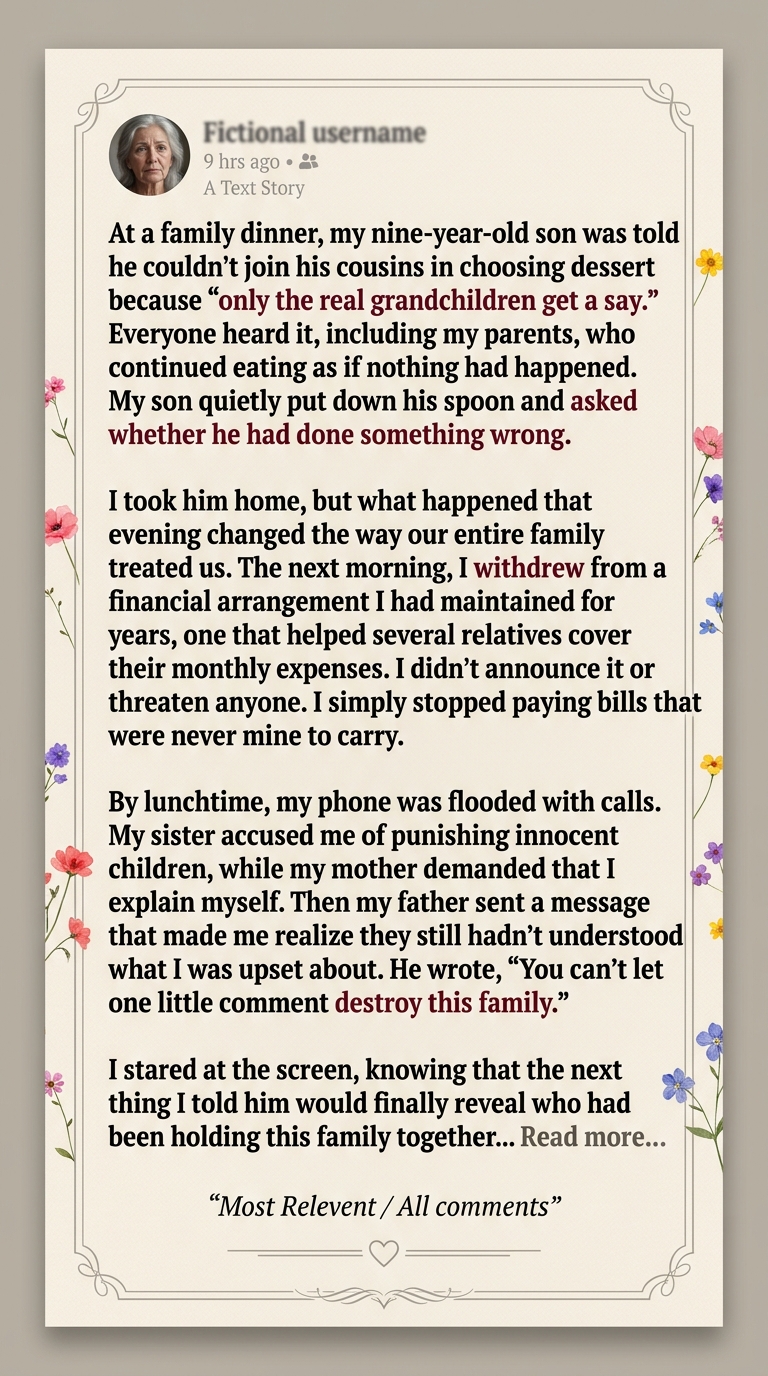
The comment was made over dessert, but my son remembered it long after everyone else had forgotten the meal.
We were having Sunday dinner at my parents’ house. My sister, Vanessa, had brought her two children, my brother had arrived with his wife, and my parents had prepared enough food for what they called a proper family gathering.
My nine-year-old son, Ethan, was excited.
He had spent the afternoon talking about which dessert he hoped Grandma would serve. My parents usually let the grandchildren choose between chocolate cake, apple pie, or ice cream, and Ethan had been looking forward to it all week.
He was adopted when he was two, after years of fertility treatments had left me and my husband, Mark, with little hope of having a child. From the beginning, we had been honest with him about his adoption in simple, loving ways. He knew he had been chosen, wanted, and deeply loved.
Most of our relatives had accepted him.
My parents, however, had never been as enthusiastic as they pretended.
They bought him birthday presents and remembered his school events, but there was always a subtle difference in how they treated him compared with my sister’s children. They called Vanessa’s children their “real grandchildren” when speaking among themselves, then quickly changed the subject if I entered the room.
I had confronted them once, years earlier.
My mother had dismissed it as an unfortunate choice of words.
“He’s your son, so he’s our grandson,” she had said. “You shouldn’t be so sensitive.”
I wanted to believe her.
That Sunday, after dinner, my mother brought out three desserts. The children gathered around the kitchen island while she placed the plates on the counter.
“All right,” she announced. “You can decide what you want.”
Ethan stepped forward.
“Can I have the chocolate cake?”
Vanessa’s daughter, Sophie, reached for the same plate.
Vanessa laughed and said, “Let the real grandchildren choose first, sweetheart.”
The room went quiet.
Ethan looked at her.
“What does that mean?”
Vanessa didn’t seem embarrassed.
“It means Sophie and Lucas are Grandma and Grandpa’s real grandchildren. You’re adopted, remember?”
My sister said it casually, almost as though she were explaining why one child had a different bedtime.
I looked at my parents.
My mother continued arranging the plates.
My father took another sip of tea.
Neither said a word.
Ethan slowly put down his spoon.
“Did I do something wrong?” he asked.
Nobody answered.
I felt something tighten in my chest.
“No, sweetheart,” I said. “You haven’t done anything wrong.”
I took his hand and collected our coats.
Vanessa called after us.
“Oh, come on. It was just a joke.”
I turned around.
“Then explain why nobody is laughing.”
She rolled her eyes.
My mother finally spoke.
“Please don’t turn a family dinner into an argument.”
I looked at her.
“You heard what she said.”
“She’s a child herself. She didn’t mean anything by it.”
“Vanessa is thirty-eight years old.”
My father put down his cup.
“That’s enough. You’re making everyone uncomfortable.”
I looked around the table.
My son had been told he wasn’t a real grandchild, and somehow I was the person making everyone uncomfortable.
I didn’t argue further.
I took Ethan home.
During the drive, he stared out the window.
After several minutes, he asked, “Mom, if I’m adopted, does that mean Grandma and Grandpa don’t have to love me?”
I pulled into a quiet parking area and turned toward him.
“Listen to me carefully. You are my son. You are Mark’s son. Nothing about your adoption makes you less part of this family. You never have to earn your place with anyone.”
He nodded, but his eyes were wet.
“Then why did Aunt Vanessa say that?”
I didn’t want to give him a dishonest answer.
“Because sometimes adults say cruel things when they haven’t learned how to treat people properly. That is their failure, not yours.”
He leaned across the seat and hugged me.
When we reached home, Mark was waiting.
He saw Ethan’s face and immediately knew something had happened.
I explained everything.
Mark listened without interrupting. Then he sat beside Ethan and asked whether he wanted to help choose a movie.
Ethan nodded.
Before going upstairs, he asked one more question.
“Are we still going to Grandma’s next Sunday?”
Mark looked at me.
I answered gently.
“Not next Sunday, sweetheart. We’ll decide about another visit when we know everyone understands how they should treat you.”
Ethan accepted that and went upstairs.
Mark remained in the kitchen with me.
“How long are you going to keep covering their expenses?” he asked.
I knew exactly what he meant.
For nearly six years, I had been helping my parents and two siblings with a financial arrangement I had created after my father’s business closed.
My parents had struggled to keep up with their mortgage and utilities. Vanessa had been going through a difficult divorce, and my younger brother, Peter, had lost his job after his employer shut down.
I had offered to help.
At first, it was temporary.
I arranged automatic monthly payments for my parents’ electricity, property insurance, and part of their mortgage. I also covered a portion of Vanessa’s rent and helped Peter with his car payment while he searched for work.
Over time, the arrangement became permanent.
Nobody asked whether I could continue.
They simply built their budgets around the assumption that I would.
Every month, money left my account to cover bills that were not mine.
I had never complained because I believed family members should help one another when they could.
But that evening, I began to question what kind of family accepted my financial support while treating my son as though he didn’t belong.
Mark sat beside me.
“I’m not suggesting you stop helping people because you’re angry,” he said. “I’m asking whether these arrangements are still healthy.”
I looked toward the stairs.
“They didn’t just insult me. They made Ethan question whether he belongs.”
“Then something has to change.”
I opened my banking application.
I reviewed every recurring payment and wrote down the amounts, recipients, and dates. I didn’t want to make a reckless decision or accidentally interrupt something important.
The next morning, I called the utility companies and financial providers where I was listed as the person responsible for payments.
I removed my payment methods from accounts that belonged to other adults, making sure each account holder received notice and had an opportunity to arrange their own payments.
I ended the monthly transfers to Vanessa and Peter.
For my parents, I gave written notice that I would no longer contribute to their mortgage or household expenses after the current billing period. I had no legal responsibility for those payments, and I made sure the change would not affect any agreement I had personally signed.
I also contacted the bank to cancel the standing instructions that sent money to their accounts.
It took less than two hours.
I didn’t send a family announcement.
I didn’t threaten anyone.
I simply stopped paying bills that were never mine to carry.
By lunchtime, my phone was ringing constantly.
Vanessa called first.
“What have you done?”
I was preparing lunch for Ethan.
“Hello to you too.”
“My rent payment didn’t arrive.”
“That’s correct.”
“What do you mean, that’s correct?”
“I ended the monthly transfer.”
She sounded furious.
“You can’t just stop paying without warning me!”
“I gave you notice when I offered the arrangement six years ago. I never promised to support you indefinitely.”
“You know I have two children!”
“Yes, Vanessa. I know.”
“So you’re punishing them because I made one comment?”
I put down the knife.
“You told my son he wasn’t a real grandchild. Then you watched him ask whether he had done something wrong.”
“It was a joke!”
“Then why did you need my money to raise your children?”
She went silent.
I continued.
“I’m not asking you to pay for Ethan’s childhood. I’m asking you to manage your own expenses. The same way Mark and I manage ours.”
She ended the call.
Peter called next.
He was less angry but more confused.
“Did something happen with the bank?”
“I ended the car payment arrangement.”
“But I haven’t found a permanent job yet.”
“You’ve had six years, Peter.”
“That’s not fair.”
“Neither is expecting someone else to carry your responsibilities forever.”
He said I was abandoning the family.
I told him I was giving him the opportunity to stand on his own.
Then my mother called.
Her voice was trembling.
“Your father is extremely upset. We don’t understand why you’re doing this.”
I explained that the payments would end according to the notices I had sent.
She ignored that.
“This is about Vanessa’s comment, isn’t it?”
“It’s about what she said and what you allowed.”
“She didn’t mean it.”
“Did you tell her that?”
My mother paused.
“Well, no. We didn’t want to create a scene.”
“Then you were willing to let Ethan feel ashamed so that the adults could enjoy their dinner.”
“He’s only nine. He’ll forget.”
I closed my eyes.
“No, Mom. He won’t.”
She began crying.
“You’re destroying this family over one little misunderstanding.”
I ended the call before I said something I couldn’t take back.
A few minutes later, a message arrived from my father.
You can’t let one little comment destroy this family.
I stared at the screen.
Then I replied.
One comment didn’t destroy this family, Dad. It revealed what you were willing to tolerate. For six years, I have helped pay your mortgage and household bills, covered Vanessa’s rent, and supported Peter while he got back on his feet. I did those things because I believed we were family. But when my son was humiliated in your home, none of you defended him. You accepted my money more easily than you accepted my child. I am not asking anyone to choose between Ethan and the other grandchildren. I am asking you to treat them equally. Until that happens, the financial arrangements are over.
My father called immediately.
I answered.
“How much have you been paying?” he asked.
I was surprised.
“You know how much.”
“No. I mean all of it.”
I opened the spreadsheet I had prepared.
I told him the monthly amounts and explained that the total assistance over six years was considerably more than either of my parents realized.
There was a long silence.
Then he said, “We didn’t know it was that much.”
“That doesn’t change what happened.”
“We never asked you to do all that.”
I almost laughed.
“Actually, Dad, you did. Every time a bill was overdue, every time someone needed help, every time you told me the family couldn’t manage without me, I was asked.”
He didn’t respond.
Then he said something that hurt more than the original message.
“We thought you could afford it.”
I looked at the spreadsheet.
That was apparently all it had meant to them. My ability to pay had become more important than my willingness.
“Being able to afford something doesn’t mean I owe it to you.”
He hung up.
That evening, Mark and I sat with Ethan in the living room.
We didn’t tell him about the money or the arguments. Those were adult matters.
Instead, we told him that we would not be attending family gatherings until everyone understood that he deserved the same respect as any other child.
Ethan listened quietly.
“Will Grandma still be my grandma?”
I took his hand.
“She can be your grandmother if she chooses to behave like one.”
He thought about that.
“Can I still see Sophie and Lucas?”
“Of course,” Mark said. “They haven’t done anything wrong. We can arrange for you to spend time with them separately.”
Ethan nodded.
That was important to me. I didn’t want him to believe he had to lose every relationship simply because the adults had failed him.
Two days later, Vanessa arrived at our house.
She came without calling, carrying a folder and looking exhausted.
I opened the door but didn’t invite her in immediately.
“I need to talk to you,” she said.
“About what?”
“The rent.”
I waited.
She sighed.
“I can’t afford the apartment without your help.”
“I understand that’s difficult.”
“You could at least give me another month.”
I considered it.
Then I asked, “Have you apologized to Ethan?”
She looked surprised.
“Why are we talking about that?”
“Because you came here asking me for money. You haven’t once asked how my son is.”
Vanessa folded her arms.
“He’s a child. He probably doesn’t even understand what happened.”
“He understood enough to ask whether he had done something wrong.”
She looked away.
For the first time, I saw something other than anger on her face.
Perhaps embarrassment.
“I didn’t think he’d take it seriously,” she muttered.
“He is nine. Why wouldn’t he?”
She didn’t answer.
I told her I wasn’t going to restart the monthly payments, but I would give her a list of local housing and financial support services. If she needed help contacting them, I would provide the information.
She looked disappointed.
“You really won’t help me?”
“I am helping you find a way to manage your own life. I am not going to continue paying your rent while you refuse to acknowledge what you did to my child.”
She left without another argument.
My mother came a week later.
This time, she brought no complaints or requests.
She stood at the door holding a small paper bag.
“I made Ethan’s favorite cookies,” she said.
I let her inside.
Ethan was upstairs doing homework.
My mother sat at the kitchen table and looked around.
“I’ve been thinking about what you said.”
I waited.
“I suppose we have treated the children differently.”
“Yes.”
“I never thought of it as rejecting him.”
“But that’s what it felt like to him.”
She nodded.
“I know.”
She opened the paper bag.
“I want to apologize to him.”
I told her that an apology would need to be sincere and that Ethan didn’t owe her immediate forgiveness.
She accepted that.
When Ethan came downstairs, my mother stood.
“Can I speak to you, sweetheart?”
He looked at me.
I nodded.
My mother knelt beside him.
“I said things by staying silent that I should never have allowed to happen. You are my grandson, and I should have made sure you knew that. I’m sorry.”
Ethan looked at her for a long moment.
“Does that mean I can choose dessert next time?”
My mother began crying.
“Yes. You can choose dessert.”
He nodded.
“Okay.”
It wasn’t a dramatic reconciliation, but it was honest.
My father took longer.
He sent several messages defending the family and insisting that I was overreacting. I didn’t respond until he finally asked whether he could visit.
When he arrived, he sat across from me in the living room.
“I’ve been looking at the bills,” he said.
I nodded.
“I didn’t realize how much we depended on you.”
“That was part of the problem.”
He looked uncomfortable.
“Your mother and I have to make some changes. We may have to sell the house.”
I felt a pang of sympathy, but I didn’t offer to restore the payments.
“Then you need to decide what you can afford.”
He looked toward the stairs.
“Can I see Ethan?”
“Yes. But I need you to understand something first. He is not going to be treated as less important than Vanessa’s children. Not in my home, not in yours, and not anywhere else.”
My father nodded.
“I understand.”
I wasn’t sure whether he truly did, but he had finally stopped telling me that one little comment should be forgotten.
Over the following months, my family adjusted.
My parents downsized to a smaller house they could afford without my assistance. Peter found steady employment and began paying his own car expenses. Vanessa moved into a less expensive apartment and arranged a more manageable budget.
None of those changes happened because I wanted to hurt them.
They happened because the financial arrangements had hidden problems that needed to be faced.
I also learned something about myself.
I had been helping everyone for so long that I had confused being needed with being valued. I thought that if I kept solving problems, nobody would question my place in the family.
But I had never needed to purchase that place.
Ethan already belonged.
Six months after the dinner, my parents invited us for Sunday lunch.
Before accepting, I asked my mother whether Vanessa and the children would be there.
She said they would.
I asked whether everyone understood that Ethan would be treated equally.
She assured me they did.
When we arrived, my father greeted Ethan at the door.
He had bought a new board game and asked whether Ethan wanted to teach him how to play.
Vanessa was already in the kitchen with Sophie and Lucas. She looked at Ethan, hesitated, then walked over.
“Hi, Ethan.”
“Hi.”
She took a breath.
“I owe you an apology. What I said that night was unkind. You are part of this family, and I shouldn’t have made you feel otherwise.”
Ethan nodded.
“Okay.”
It wasn’t forgiveness in some grand, immediate sense. It was simply a child accepting that an adult had finally admitted being wrong.
After lunch, my mother brought out three desserts.
Chocolate cake, apple pie, and ice cream.
She placed the plates on the counter and turned to the children.
“All right. You three get to choose first. Ethan, what would you like?”
He smiled.
“Chocolate cake.”
Sophie chose ice cream, and Lucas wanted apple pie.
Nobody objected.
I watched them sit together at the table, arguing over whose dessert was best.
My father caught my eye from across the room.
He didn’t say anything, but he gave me a small nod.
I nodded back.
I hadn’t restored the payments, and I had no intention of doing so. My parents had learned to manage their expenses, my siblings were becoming more independent, and I had stopped treating every family problem as my personal responsibility.
The relationships were still imperfect.
Trust takes longer to rebuild than a monthly budget.
But my son no longer wondered whether he was a real grandchild.
And that was the only measure of success that mattered to me.
When we left that afternoon, Ethan held my hand and looked up at me.
“Mom?”
“Yes, sweetheart?”
“Next time, can we have ice cream too?”
I laughed.
“Of course.”
He grinned and climbed into the car.
For years, I had believed I was holding my family together by carrying everyone’s financial burdens.
That dinner taught me something different.
A family is not held together by the person who pays the most bills. It is held together by the people who make sure nobody has to question whether they belong.
And I would never again confuse those two things.

