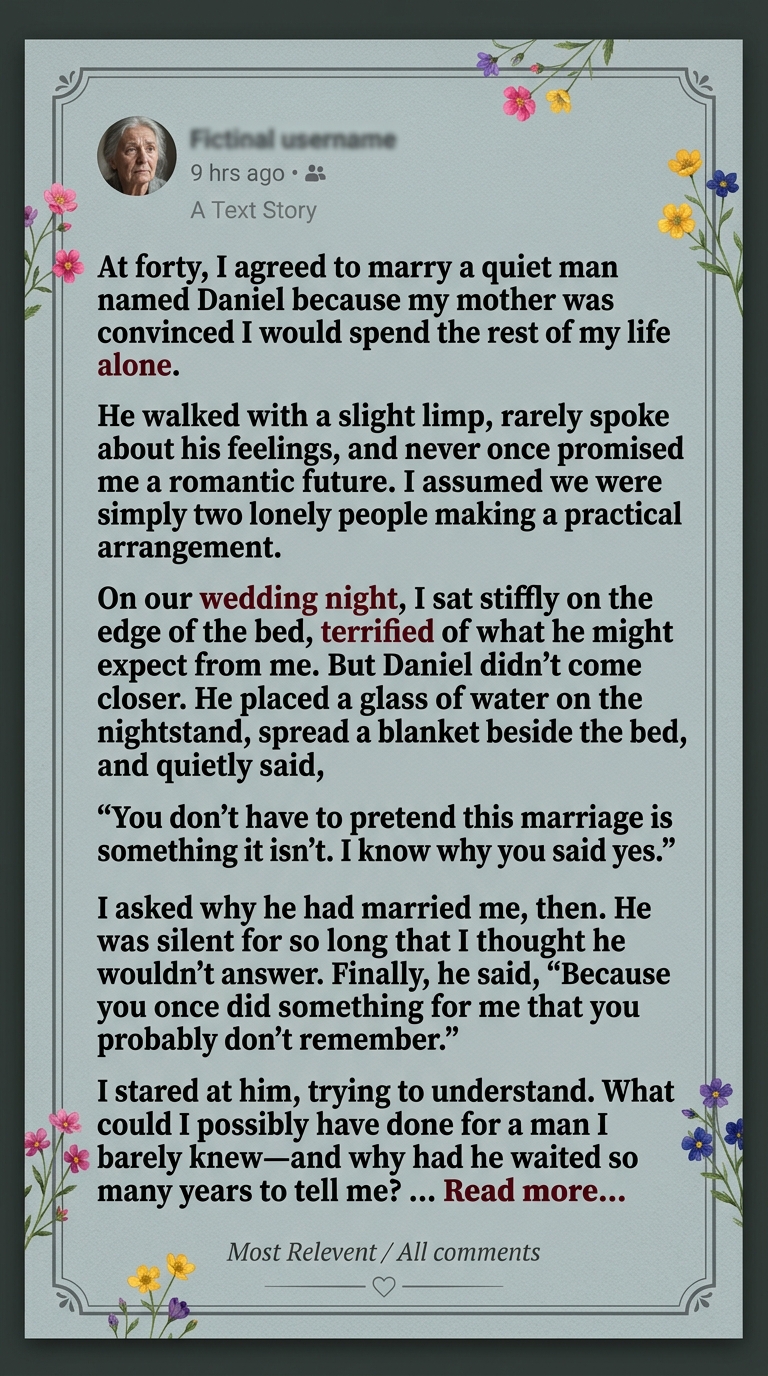
At forty, I married a man I barely knew because my mother had become convinced that I would grow old alone.
Her concern had started as gentle questions and gradually turned into a daily campaign. Every family gathering included a reminder that time was passing. Every phone call ended with another suggestion about someone I should meet.
When she introduced me to Daniel, I almost refused before we had even finished our first conversation.
He was forty-six, quiet, and slightly awkward. A noticeable limp made him walk more slowly than most people, and he seemed uncomfortable whenever anyone asked about it. He worked as a maintenance supervisor at a technical college, lived in a modest house, and spent most weekends repairing old furniture.
He wasn’t unattractive, but he wasn’t the sort of man who made a room feel different when he entered it. He rarely flirted, never sent romantic messages, and didn’t seem particularly interested in impressing me.
Our first dinner lasted less than an hour.
When my mother asked what I thought of him afterward, I shrugged.
“He seems decent.”
“Decent is a good place to start,” she replied.
I should have recognized how desperate she was to hear something positive.
Daniel and I continued meeting. We talked about ordinary things: work, groceries, neighborhood changes, and the books we had recently read. He never pressured me to discuss my past relationships, and he never complained when I declined his invitations.
After four months, he asked whether I would consider marrying him.
There was no elaborate proposal. He didn’t kneel or present a ring beneath candlelight. We were sitting at a small restaurant when he placed a simple gold band on the table.
“I don’t want to promise you a life I can’t guarantee,” he said. “But I can promise that I won’t mistreat you. If we choose this, I would like us to build something honest.”
I looked at him for a long moment.
My previous relationships had ended in disappointment. I had spent years watching friends marry, have children, and build families while my own life remained largely unchanged. I wasn’t desperate for a husband, but I was tired of feeling that something important had passed me by.
So I said yes.
The wedding was small. My mother cried throughout the ceremony, while Daniel’s older sister, Margaret, hugged me and told me she was glad her brother had finally found someone.
I noticed that Daniel looked more nervous than happy.
I assumed he was simply uncomfortable with attention.
That night, after the guests had gone home, I sat on the edge of our bed with my hands folded tightly in my lap.
I had no idea what was expected of me. We had never been physically affectionate beyond an occasional touch on the hand. I was forty, not a teenager, but the uncertainty made me feel strangely inexperienced.
Daniel entered the bedroom carrying two glasses of water.
He placed one on the nightstand, then took a folded blanket from the wardrobe and spread it on the small sofa beside the window.
“You don’t have to pretend this marriage is something it isn’t,” he said quietly. “I know why you said yes.”
I looked at him.
“Then why did you marry me?”
He remained standing beside the sofa.
For several seconds, he said nothing.
Finally, he answered.
“Because you once did something for me that you probably don’t remember.”
I frowned.
“What did I do?”
He looked down at his hands.
“Twenty years ago, I was a different person.”
I waited.
“I worked as an apprentice electrician at a hospital. I was twenty-six, newly married, and convinced that if I worked hard enough, everything would eventually fall into place.”
He paused.
“My wife, Sarah, was pregnant. We had been married less than a year when she developed complications. One evening, she began bleeding heavily, and I drove her to the emergency department.”
His voice became quieter.
“She needed surgery. I remember standing in the corridor while people rushed past me. I had no idea what was happening, and I was terrified.”
Daniel explained that the hospital was overwhelmed that evening. His wife was taken into surgery, but he was told there would be a delay before anyone could provide an update.
He sat on a plastic chair outside the operating department for hours.
Eventually, he received a phone call from his employer. A major electrical inspection had been scheduled for the following morning, and his supervisor was demanding to know why he hadn’t reported for work.
Daniel was too frightened to explain himself properly. He simply said his wife was in surgery and that he couldn’t leave.
His supervisor threatened to dismiss him.
“I was already behind on rent,” Daniel said. “I had borrowed money for the hospital deposit, and I knew I couldn’t afford to lose my job.”
He looked at me.
“That’s when you appeared.”
I shook my head.
“I don’t remember working at that hospital.”
“You weren’t an employee. You were visiting your father.”
The memory came back slowly.
My father had suffered a stroke when I was twenty. During his rehabilitation, I had spent several months visiting him at a large hospital across town. I remembered the corridors, the vending machines, and the endless hours waiting for doctors.
But I couldn’t remember Daniel.
He continued.
“You were carrying a folder and wearing a blue cardigan. You saw me trying to make a phone call. I was speaking to my supervisor, and I was so upset that I could barely get the words out.”
Daniel said I had waited until he finished, then asked whether he needed help.
He had explained that his wife was in surgery and that his employer was threatening to dismiss him. I had listened without interrupting.
Then I had done something he had never forgotten.
I had walked to the hospital’s patient assistance office and asked whether they could provide him with a temporary employment letter confirming that his wife was receiving emergency treatment.
The hospital couldn’t intervene in his employment dispute, but the staff could provide documentation confirming his circumstances.
I had helped him complete the request, then found a telephone number for the hospital’s social worker, who explained how to contact an emergency family-support service.
But that wasn’t the part Daniel remembered most.
“You came back with a sandwich and a cup of tea,” he said. “You told me I couldn’t help my wife by collapsing from exhaustion.”
I felt my throat tighten.
“I remember giving someone food,” I whispered. “There were always people sitting in that corridor.”
“I hadn’t eaten since morning. I was too frightened to leave in case the doctor came out.”
He smiled faintly.
“You sat beside me for twenty minutes. You told me your father had been in the hospital for months and that waiting was sometimes the hardest part.”
I remembered that conversation now.
Not his face, but the feeling of sitting beside a frightened stranger who looked as though he might fall apart if someone asked him one more question.
“What happened to your wife?” I asked.
Daniel’s expression changed.
“Sarah survived the surgery. But the baby didn’t.”
He looked toward the window.
“She never recovered emotionally. Neither did I. We stayed married for another three years, but we became strangers. Eventually, she left. I don’t blame her. We were both carrying grief we didn’t know how to share.”
He explained that he had later developed a serious infection in his leg after an industrial accident at work. Several surgeries followed, and the damage left him with a permanent limp.
For years, he worked, came home, and avoided forming close relationships. He had no children and very few friends outside his family.
Then, about a year earlier, he had returned to the hospital for a follow-up appointment.
He recognized me in the rehabilitation waiting area.
I had been sitting with my mother, helping her complete paperwork after a minor operation.
He hadn’t approached me immediately. He had simply stood across the corridor, wondering whether I was the same woman who had once brought him a sandwich.
Later, he saw me again at a small grocery store near my neighborhood. He introduced himself, explained where we had met, and thanked me.
I remembered that meeting too.
I had thought he was being unusually grateful for a small act of kindness.
“You could have told me all this before we married,” I said.
“I wanted to.”
“Then why didn’t you?”
He took a breath.
“Because I didn’t want you to feel obligated. I didn’t want you to marry me because you felt sorry for the man whose wife lost a baby twenty years ago.”
I looked at him carefully.
“Is that why you asked me to marry you? Because you felt indebted?”
“No.”
His answer came quickly.
“I remembered your kindness, but that wasn’t enough. I wanted to know who you had become. I wanted to spend time with you. I wanted to see whether we could be comfortable together.”
He sat on the edge of the sofa.
“I also knew you weren’t looking for a grand romance. Neither was I. But I didn’t want a marriage built on pretending.”
I looked at the blanket he had spread beside the bed.
“Do you actually want to sleep on that sofa?”
“I thought you might feel more comfortable if I gave you space.”
“And what if I don’t want you to sleep there?”
He looked up.
“Then I’ll stay.”
I studied his face. For the first time since our wedding, I noticed how carefully he had been watching me, not with expectation but with concern.
“Daniel,” I said, “I didn’t marry you because I thought I had no other options.”
He nodded, but I could tell he wasn’t entirely convinced.
“I married you because you seemed like a good man,” I continued. “I didn’t know whether I would fall in love with you. I still don’t know. But I would like the chance to find out.”
His eyes softened.
“That’s more than I expected.”
“Then stop expecting so little.”
He laughed quietly.
That night, he stayed beside me rather than on the sofa. We didn’t rush into anything. We simply talked until the conversation faded and the room became quiet.
Over the following months, I began to discover the man behind his silence.
Daniel wasn’t naturally expressive, but he noticed everything. He remembered how I liked my tea, kept an extra umbrella in the car because I often forgot mine, and quietly repaired the loose kitchen cabinet without making a production of it.
When I had a difficult day, he didn’t tell me to cheer up. He asked whether I wanted company or quiet.
I learned that his limp became worse in cold weather, that he disliked crowded restaurants, and that he sometimes woke from dreams about the hospital corridor where he had once waited for news of his wife.
He learned that I was afraid of becoming dependent on someone, that I hated being treated as a burden, and that I had spent years pretending I didn’t mind being alone.
We began taking short walks together. At first, Daniel moved slowly, and I adjusted my pace without thinking. Eventually, he stopped apologizing for it.
One afternoon, while we were sitting in the garden, he told me he had kept the hospital assistance letter for twenty years.
“Why?” I asked.
“Because it was the first time someone helped me without making me feel ashamed of needing help.”
I reached for his hand.
“I wish I had remembered you.”
“I don’t.”
I looked at him.
“If you had remembered, you might have felt you owed me something. I would rather you chose me for who I am now.”
That evening, I understood something I had missed on our wedding night.
Daniel hadn’t married me to repay an old kindness. He had married me because he believed that the person who had once shown him compassion might also understand the quiet life he wanted to build.
And he had been brave enough to ask for that life without pretending he could offer me a fairy tale.
A year after our wedding, we returned to the hospital together. We were visiting a family-support office because Daniel had decided to volunteer one afternoon each week, helping relatives of patients navigate the confusing paperwork that had once overwhelmed him.
As we walked through the corridor, he slowed near the operating department.
“Is this where you found me?” I asked.
He nodded.
We stood there for a moment.
Then Daniel took my hand.
“I used to think the worst night of my life was the night I lost my child,” he said. “But I also remember that someone sat beside me when I thought I had nobody.”
I squeezed his fingers.
“You weren’t alone.”
“No,” he said. “I wasn’t.”
We continued down the corridor together.
Our marriage had not begun with passion, grand promises, or the certainty that we would spend the rest of our lives together. It had begun with two people who were afraid of being disappointed again.
But somewhere between the ordinary dinners, the quiet mornings, and the small kindnesses we began returning to each other, something neither of us had expected started to grow.
My mother had believed Daniel was my last chance to avoid loneliness.
She was wrong.
He wasn’t my last chance.
He was my choice.
And for the first time in my life, I understood that love didn’t always arrive like a storm. Sometimes it arrived quietly, carrying a glass of water, offering you a blanket, and giving you the freedom to decide whether you wanted it to stay.

