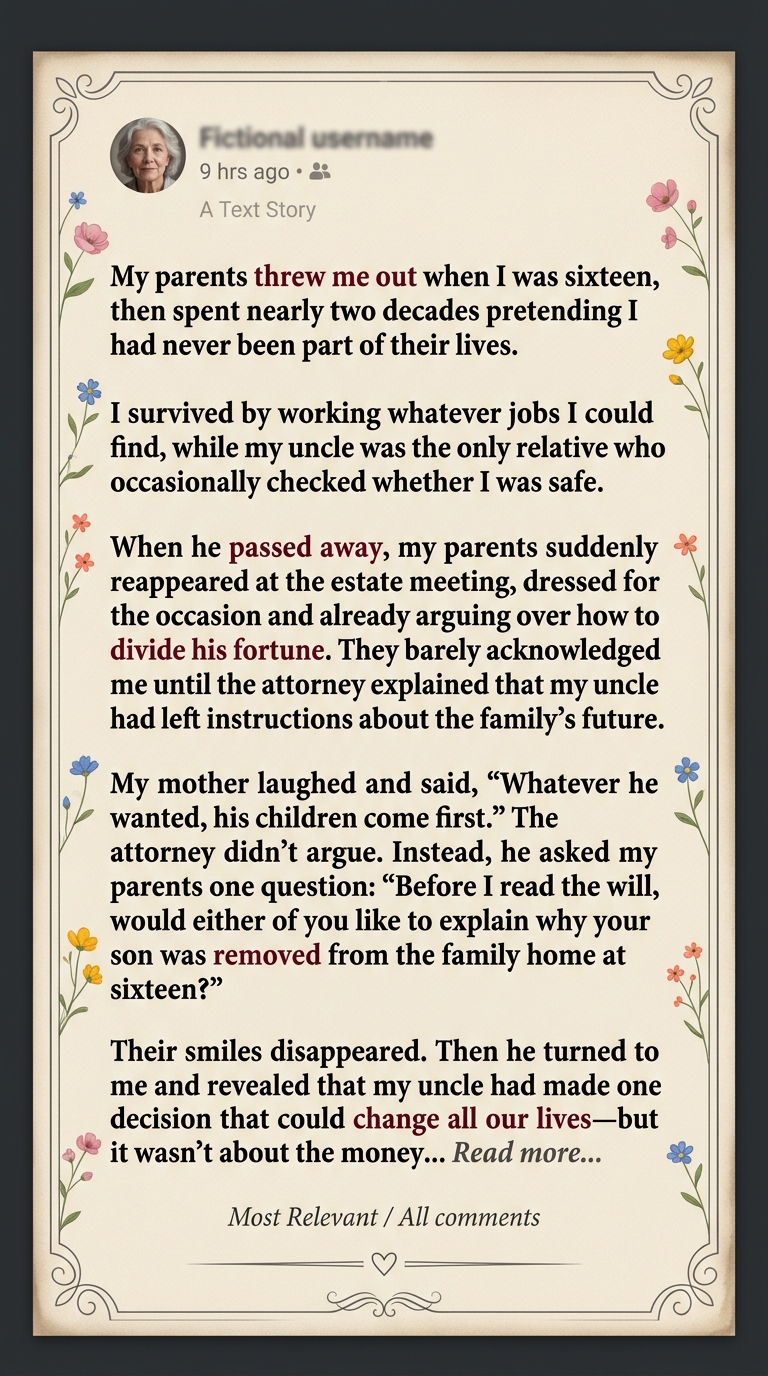
The first time my parents threw me out, I was sixteen years old and carrying everything I owned in a school backpack.
My father stood in the doorway while my mother watched from the kitchen. Neither of them looked particularly upset. They looked inconvenienced, as though I had broken something expensive and they wanted it removed before guests arrived.
“You’ve made your choice,” my father said.
I hadn’t made a choice. I had refused to lie for him.
Three days earlier, I had discovered that he was using money from my late grandmother’s account to cover debts from his failing construction business. When I confronted him, he demanded that I tell my grandmother’s solicitor she had given him permission.
She hadn’t.
I told him I wouldn’t do it.
My mother called me ungrateful. My father said I was turning against my own family. By the following evening, my clothes were outside the front door.
I spent the first night at a friend’s house. After that, I moved between temporary rooms, relatives who didn’t want trouble, and a youth shelter where a counselor helped me enroll in a vocational program.
My uncle Thomas was the only person in the family who occasionally checked on me.
He was my father’s younger brother, a quiet man who owned a small engineering company. He never promised to rescue me, but every few months he would call and ask how I was managing.
Sometimes he sent money for books or work clothes. Other times, he simply took me for dinner and listened.
He never asked me to forgive my parents.
“You don’t have to hate them forever,” he told me once. “But you don’t have to put yourself back in danger to prove you’re a good son.”
I remembered those words long after I stopped needing his help.
By twenty-one, I had completed my training as an electrical technician. I worked on building sites during the day and studied for additional qualifications at night. Eventually, I started a small electrical maintenance business with two former classmates.
It wasn’t glamorous, but it paid the bills.
I rented a modest apartment, bought a used van, and built a life that didn’t depend on anyone’s approval.
My parents never contacted me.
My mother blocked my number. My father told relatives that I had left home because I was difficult and rebellious. At family gatherings, people stopped mentioning me because it was easier than asking questions.
For years, I believed my uncle was the only person who remembered what had happened.
Then, when I was thirty-four, he died unexpectedly.
Thomas had suffered a heart attack while driving home from work. He survived long enough to reach the hospital, but complications developed, and he died two days later.
I was devastated.
At his funeral, I stood near the back, surrounded by people who had known him for decades. My parents sat in the front row, dressed in black, accepting condolences as though they had been devoted family members.
My mother glanced at me once.
She didn’t approach.
A week later, I received a letter from Thomas’s solicitor, inviting me to an estate meeting.
I arrived early.
My parents were already there.
My father wore a dark suit and carried a leather folder. My mother sat beside him, speaking quietly with my older sister, Rachel, who had barely spoken to me since I was sixteen.
They looked surprised when I entered.
“Oh,” my mother said. “I didn’t realize you were invited.”
“The solicitor invited me.”
My father gave a dismissive nod.
“Let’s just get through this. Your uncle had a complicated estate, and we have things to discuss.”
I took a seat at the far end of the table.
The solicitor, a woman named Helen Price, entered a few minutes later. She introduced herself, confirmed everyone’s identity, and placed several documents in front of her.
My father immediately began asking about the value of the properties.
“There’s the company, the workshop, the investment accounts, and the house,” he said. “We need to know how those will be distributed.”
Helen remained calm.
“Mr. Thomas Morgan left detailed instructions regarding his estate. I will explain those shortly.”
My mother leaned back.
“Whatever he wanted, his children come first.”
Helen looked at her.
“Before I read the will, would either of you like to explain why your son was removed from the family home at sixteen?”
The room went silent.
My mother’s expression hardened.
“That has nothing to do with this meeting.”
“Perhaps not,” Helen replied. “But Mr. Morgan believed it had everything to do with the decisions he made.”
My father shifted in his chair.
“Thomas had no idea what happened in our household. The boy was impossible to manage.”
Helen opened a folder.
“Your brother kept a different account.”
She removed a letter and placed it on the table.
It was dated eighteen years earlier, written in my uncle’s unmistakable handwriting.
Helen read the first paragraph.
I have tried to understand why my brother and his wife believed throwing their sixteen-year-old son onto the street was an acceptable response to a disagreement. I have also tried to understand why they told the rest of the family that he abandoned them.
My mother looked away.
Helen continued.
I know what happened to the money from my mother’s account. I know what my brother asked his son to do. I also know that the boy refused to lie. That refusal cost him his home, but it may have saved him from becoming the kind of man his father has chosen to be.
My father’s face turned red.
“That is a private family matter.”
Helen folded the letter.
“Mr. Morgan did not consider it private.”
She then explained that Thomas had discovered the withdrawals years earlier. He had confronted my father and demanded that the money be returned to the estate. My father had claimed the withdrawals were authorized gifts.
They were not.
My uncle had obtained bank records and spoken with the solicitor who handled my grandmother’s affairs. He had also discovered that my father had tried to persuade me to provide a false statement confirming the withdrawals.
When I refused, my father had thrown me out.
Thomas had considered reporting the matter at the time, but my grandmother’s estate had already been settled, and the remaining money had been repaid through a private arrangement. He had kept the evidence because he feared my father would repeat the same behavior.
My mother interrupted.
“He was protecting you, not us.”
Helen looked at her.
“Your husband had already received considerable help from his brother. Mr. Morgan believed that protecting his nephew was more important than protecting his brother’s reputation.”
My father pushed his chair backward.
“This is ridiculous. We’re here to discuss an inheritance.”
“Yes,” Helen said. “And that is precisely what we will do.”
She opened the will.
Thomas had left his house and personal savings to a charitable trust supporting young people who had been forced out of their homes.
His engineering company was not being divided among family members. Instead, it had been transferred into a separate employee ownership structure, with the existing managers and staff receiving shares over time.
My father stared at her.
“He can’t give away the company like that. I’m his brother.”
“You were not a shareholder,” Helen replied. “The company belonged to Mr. Morgan, and he had the right to decide what happened to it.”
My mother turned toward me.
“So what did he leave you?”
Helen didn’t answer immediately.
She removed a smaller envelope and placed it in front of me.
“Your uncle left you something, but it is not a cash inheritance.”
I opened it.
Inside was a letter and a set of keys.
The letter was several pages long.
Dear Daniel,
If you’re reading this, I am no longer around to call you and ask whether you’re eating properly or working too hard.
I smiled despite myself.
He had always said that.
I have watched you build a life without the people who should have protected you. I know you think you survived because you had no choice. But I saw how you kept your promises, learned your trade, and treated people who had less than you.
I don’t want to reward you for suffering. I want to give you an opportunity that I wish someone had given me when I was young.
The letter explained that Thomas had spent the last six years developing a vocational training center on a property he owned outside the city.
It contained classrooms, electrical and mechanical workshops, a small dormitory, and space for a community kitchen. He had originally planned to run it himself after retiring, but his health had prevented him from completing the project.
He had left the property, the completed facilities, and a substantial operating fund to a nonprofit organization that would be governed by an independent board.
I had been appointed its first director.
The keys in my hand belonged to the main building.
I read the next paragraph twice.
You are not being asked to carry this alone. The board has already been established, the funding secured, and the first instructors recruited. Your job is to help young people learn practical skills and build a future they can stand on.
I chose you because I know what it means to need an opportunity more than a handout.
I couldn’t speak.
Helen explained that Thomas had discussed the project with several community organizations. The center had already received the required approvals, and its first intake of students was scheduled for the following spring.
The charitable trust would fund scholarships, accommodation, tools, and training for young people who had experienced homelessness, family breakdown, or financial hardship.
My uncle hadn’t left me a fortune to spend.
He had left me a responsibility that could change other people’s lives.
My mother finally found her voice.
“So he’s giving him a building, a job, and control of all that money?”
Helen shook her head.
“No. The nonprofit owns the property and controls the operating funds. Daniel has been appointed director, subject to the board’s oversight. He will be paid a salary for his work, just as any other director would be.”
My father looked at me.
“You can’t run something like that. You have no experience managing a charity.”
I placed the letter on the table.
“I have experience being sixteen and having nowhere to sleep.”
He opened his mouth, but nothing came out.
My mother leaned toward me.
“Daniel, whatever happened years ago, we’re still your parents. Surely we can discuss how to move forward as a family.”
I looked at her.
For eighteen years, they had managed without being my parents. They had attended birthdays, holidays, and family gatherings while telling everyone I had chosen to disappear.
Now, with an inheritance in front of them, they suddenly remembered our relationship.
“I don’t know what you expect me to say,” I replied.
“We were under pressure back then,” my father said. “Things were difficult. You were young, and you didn’t understand the situation.”
“I understood that I had nowhere to sleep.”
“You could have come back.”
I stared at him.
“You never invited me back.”
My father looked toward Helen, perhaps hoping she would interrupt.
She didn’t.
My sister, who had remained silent throughout the meeting, finally spoke.
“Dad, you told us Daniel left because he was stealing from Grandma.”
My father turned sharply.
“Rachel, not now.”
“You told me he was dangerous. You said Uncle Thomas was only helping him because he wanted to turn the family against you.”
She looked at me, her expression full of confusion.
“Was that all a lie?”
I didn’t answer immediately.
“I don’t know what he told you. I only know what happened to me.”
Rachel lowered her eyes.
For the first time, I realized that my parents hadn’t simply removed me from their home. They had rewritten the story so thoroughly that even my sister had grown up believing I was the problem.
The meeting ended shortly afterward.
My parents left without saying goodbye.
Rachel remained in the hallway.
“I should have called you,” she said.
“Yes,” I replied.
She nodded, accepting that I wasn’t going to make the moment easier for her.
“I’d like to get to know you again, if you’ll let me.”
“I don’t know if I can do that yet.”
“I understand.”
We exchanged numbers before she left.
Over the following months, I visited the training center regularly. I met the instructors, reviewed the schedules, and worked with the board to prepare the first courses.
The first student to arrive was a nineteen-year-old named Marcus. He had been sleeping in a friend’s garage after his stepfather told him he could no longer stay at home.
He barely spoke during his interview.
When I asked why he wanted to learn electrical installation, he shrugged.
“I just want a job where nobody can tell me I don’t belong.”
I looked at him for a long moment.
Then I showed him the workshop.
“You belong here if you’re willing to learn and treat people properly. Nobody is going to ask you to earn the right to be safe.”
He began the course the following Monday.
Over the next year, the center welcomed thirty-two students. Some learned electrical work, others trained in carpentry, plumbing, and mechanical maintenance. A few struggled and left, but most completed their courses and found employment.
I kept my uncle’s letter in my office.
Not because it reminded me of what I had inherited, but because it reminded me why the center existed.
My parents never received a share of Thomas’s company or property. The charitable trust operated independently, exactly as he had instructed. The estate was settled according to his will, and there was nothing left for them to contest.
My father sent one letter several months later. He wrote that he regretted how things had ended and suggested that we should put the past behind us.
I read it twice.
Then I placed it in a drawer.
I wasn’t ready to forgive him, and I no longer believed that forgiveness required me to reopen a door he had once slammed in my face.
My relationship with Rachel developed more slowly. We began with occasional messages, then lunch every few weeks. She eventually admitted that she had believed our parents because she was afraid of becoming their next target.
I didn’t excuse her silence, but I understood it better.
One afternoon, she visited the training center and watched Marcus demonstrate the electrical panel he had installed for his final assessment.
When he finished, he looked at me nervously.
“Did I do it right?”
I checked the connections and smiled.
“Exactly right.”
He grinned.
After he left, Rachel turned to me.
“Uncle Thomas would have loved this.”
I looked through the workshop window at the young people preparing for their next lesson.
“He did love it,” I said. “That’s why he built it.”
I had once believed my uncle’s occasional phone calls were the only thing keeping me connected to my family.
I eventually understood that he had been doing something much more important.
He had been making sure that what happened to me would not have to happen to someone else.
My parents had thrown me out when I was sixteen because I refused to become part of their lie. Eighteen years later, my uncle made sure that the truth would outlive them—and that the boy they had abandoned would have the chance to help others find their way home.

