My 14-Year-Old Daughter Stopped Eating—Then I Found Her Diary. The Principal Said Nothing Was Wrong Until He Read One Page
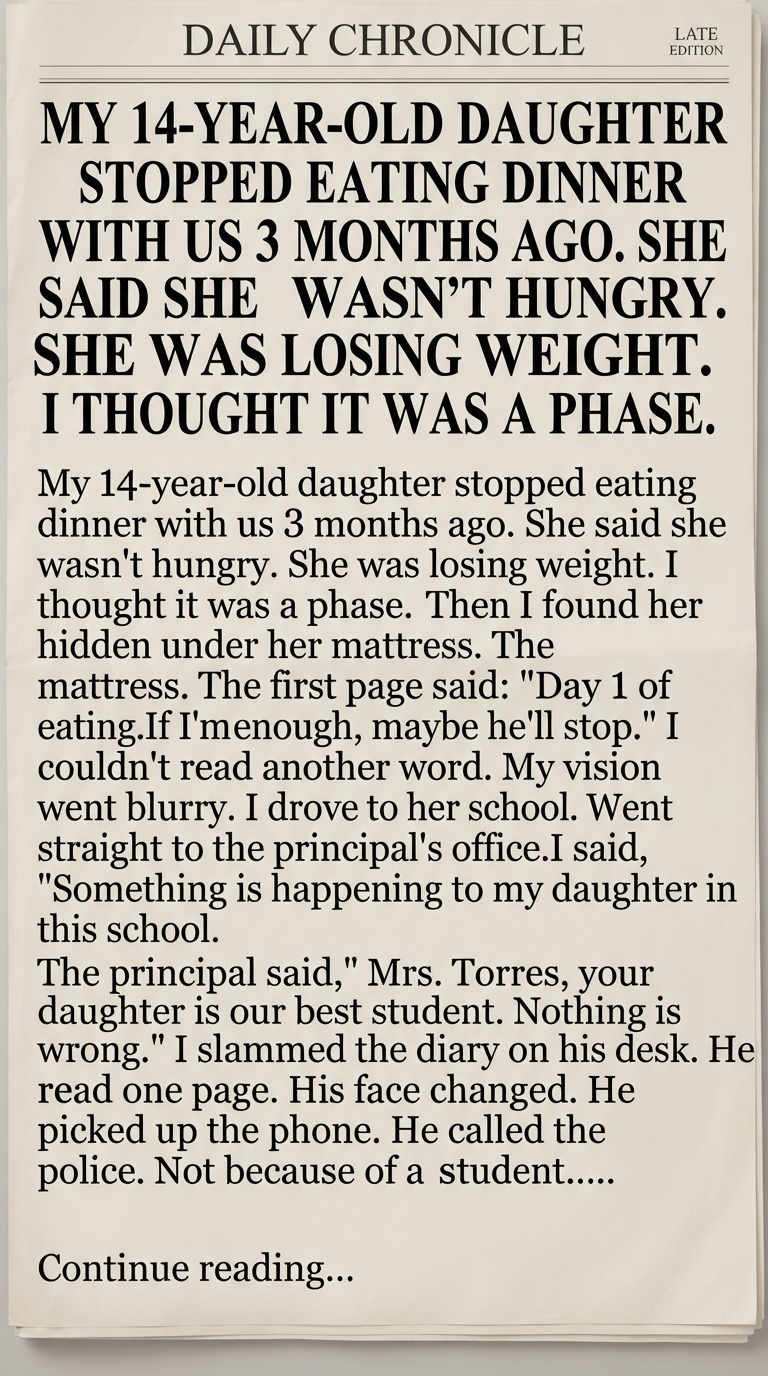
Three months ago, my fourteen-year-old daughter stopped eating dinner with us.
At first, I didn’t think much of it.
“I’m not hungry, Mom.”
That was all she would say.
I was busy. Her father was working late. Her younger brother was going through a difficult phase of his own.
Teenagers skipped meals sometimes.
At least, that’s what I told myself.
Then I noticed her clothes getting loose.
Her cheeks looked thinner.
She stopped asking for snacks after school.
She stopped eating breakfast.
And whenever I asked if she was okay, she smiled.
“I’m fine.”
I believed her because I desperately wanted to.
Her name is Sofia.
She had always been a serious child.
At fourteen, she was already at the top of her class.
Teachers loved her.
She never caused trouble.
She rarely complained.
She was the kind of student adults described as “mature beyond her years.”
I thought that meant she was doing well.
I didn’t understand that sometimes the quietest child in the room is the one screaming the loudest.
One Tuesday night, I went into her room looking for a missing charger.
She wasn’t home yet.
I checked her desk.
Nothing.
Then I noticed one corner of her mattress wasn’t sitting quite right.
I lifted it.
There was a small purple diary underneath.
I shouldn’t have opened it.
But something inside me told me I needed to.
The first page said:
Day 1 of not eating.
Underneath:
If I’m thin enough, maybe he’ll stop.
I couldn’t breathe.
I read the next line.
Then another.
My vision blurred.
I closed the diary.
I didn’t need to read more to know that my daughter wasn’t simply “not hungry.”
She was afraid.
I grabbed my keys.
I didn’t even wait for her to come home.
I drove straight to her school.
The principal’s office was on the second floor.
I walked in without an appointment.
The secretary tried to stop me.
“Mrs. Torres, do you have an appointment?”
“No.”
“Principal Wilson is in a meeting.”
“Then interrupt him.”
She stared at me.
I didn’t care.
A few minutes later, I was sitting across from Principal Wilson.
He was a polite man in his fifties.
He folded his hands on the desk.
“Mrs. Torres, I understand you’re concerned, but Sofia is doing exceptionally well.”
“I know.”
“She has excellent grades.”
“I know.”
“She has never been involved in disciplinary issues.”
“I know.”
He smiled.
“So perhaps you can tell me what specifically you’re concerned about.”
I pulled the diary from my bag.
“My daughter has stopped eating.”
His smile disappeared.
“She has lost weight.”
He opened his mouth.
I put the diary on his desk.
“And she wrote this.”
He looked at me.
Then at the diary.
I pushed it toward him.
“Read the first page.”
He hesitated.
Then he opened it.
He read one line.
His expression changed.
He read the next.
His face became pale.
He looked up at me.
“Where did you find this?”
“Under her mattress.”
He closed the diary.
“Mrs. Torres, does Sofia know you have this?”
“No.”
He stood.
“Wait here.”
“Why?”
He picked up the phone.
“I’m calling the police.”
I stared at him.
“The police?”
He nodded.
“But I came here because something is happening to my daughter in this school.”
He looked at me.
“I know.”
“Then why are you calling the police?”
He swallowed.
“Because what happened to Sofia may not have happened to a student.”
I didn’t understand.
“What does that mean?”
He didn’t answer.
He dialed a number.
“This is Principal Wilson at Westbrook Middle School. I need officers here immediately.”
He hung up.
Then he turned to me.
“Mrs. Torres, I’m going to ask you something difficult.”
“Ask.”
“Has Sofia ever told you that an adult at school made her uncomfortable?”
My heart stopped.
“No.”
“Has she mentioned anyone following her?”
“No.”
“Anyone sending her messages?”
“No.”
He nodded slowly.
“Then we need to find out.”
“What do you know?”
He sat down again.
“There have been concerns.”
“What concerns?”
He looked toward the closed office door.
“Not about Sofia.”
“Then who?”
He didn’t answer.
Instead, he asked:
“Does Sofia ever stay after school?”
“For tutoring.”
“Who provides the tutoring?”
I gave him the teacher’s name.
His face changed again.
“What?”
He looked down at the desk.
“I need to verify something.”
“Principal Wilson, what is happening?”
He finally looked at me.
“We received a complaint two months ago.”
“About whom?”
“One of our staff members.”
My stomach tightened.
“Which staff member?”
He said the name.
I recognized it immediately.
Mr. Daniel Reeves.
Sofia’s favorite teacher.
The teacher who had written her recommendation for an academic scholarship.
The teacher who had told me at parent night:
“Your daughter has incredible potential.”
I felt sick.
“What kind of complaint?”
“A student said he was receiving inappropriate messages.”
I stared at him.
“Why wasn’t I told?”
“Because the complaint was anonymous.”
“Anonymous?”
“The student refused to identify herself.”
“Did you investigate?”
“Yes.”
“And?”
“We couldn’t establish enough evidence to take formal action.”
I grabbed the diary.
“Maybe you should have looked harder.”
He nodded.
“You’re right.”
There was a knock.
Two police officers entered.
Behind them was a detective.
She introduced herself as Detective Ramirez.
Principal Wilson handed her the diary.
The detective read the first page.
Then she looked at me.
“Is Sofia currently at school?”
“Yes.”
“Do you know where she is?”
“Her last class ends in twenty minutes.”
The detective exchanged a look with the principal.
Then she said something that made my blood run cold.
“Where is Mr. Reeves?”
Principal Wilson checked the schedule.
“Room 214.”
Detective Ramirez immediately picked up her radio.
“Unit three, check room 214. Do not approach alone.”
I stood.
“I want to see my daughter.”
“You will.”
“Now.”
The detective put a hand up.
“Mrs. Torres, please trust us.”
“No.”
She looked surprised.
“I trusted the school.”
My voice broke.
“I trusted her teacher.”
Then I whispered:
“I trusted my daughter when she said she was fine.”
Detective Ramirez softened.
“You didn’t know.”
“But I should have.”
“No,” she said firmly.
“You’re her mother. You’re not supposed to know everything. You’re supposed to notice when something changes and act when you do.”
Then her radio crackled.
“Room 214 is empty.”
The principal frowned.
“His car is still outside.”
Detective Ramirez looked at him.
“Check his office.”
Another pause.
Then:
“We found something.”
“What?”
“A second phone.”
The room went silent.
The detective asked:
“Where?”
“In a locked drawer.”
My knees nearly gave out.
“What was on it?”
The officer hesitated.
“Messages.”
“From whom?”
“We’re still going through them.”
Then Detective Ramirez looked at me.
“Mrs. Torres, I need you to prepare yourself.”
“For what?”
“We found messages to several students.”
I closed my eyes.
“How many?”
“We don’t know yet.”
Twenty minutes later, the school was placed under lockdown.
Parents began arriving.
Teachers were escorted from classrooms.
Students were kept inside.
And somewhere in that building was my daughter.
I found her in the counselor’s office.
The moment she saw me, she ran into my arms.
I held her so tightly she cried.
“Mom.”
“I’m here.”
“I’m sorry.”
“No.”
“I didn’t tell you.”
“You don’t have to apologize.”
“I was scared.”
“I know.”
She pulled away.
Her face was wet with tears.
“Did you read my diary?”
I nodded.
She looked down.
“I’m sorry.”
“Stop saying you’re sorry.”
I touched her face.
“You did nothing wrong.”
She finally whispered:
“He said if I told anyone, he’d make sure nobody believed me.”
My heart shattered.
“Who?”
She said the name.
I already knew.
Mr. Reeves.
She told me he’d started sending messages months earlier.
At first they were harmless.
Then personal.
Then manipulative.
He told her she was special.
That she was more mature than other girls.
That adults wouldn’t understand their “friendship.”
When she tried to pull away, he threatened to ruin her grades.
He told her she was imagining things.
And then he began criticizing her appearance.
“You’re getting bigger.”
“You should take better care of yourself.”
“Maybe people would pay more attention to you if you were thinner.”
Sofia believed him.
So she stopped eating.
Not because she wanted to disappear.
Because she thought becoming smaller might make him stop noticing her.
I wanted to find him myself.
I wanted to scream.
But Detective Ramirez stopped me.
“We’ll handle him.”
That afternoon, police found Mr. Reeves several miles from the school.
He had left through a rear exit and abandoned his car nearby.
The second phone contained conversations with multiple students.
Investigators also found evidence suggesting he had been targeting vulnerable students for months.
The school district launched a full investigation.
Other families came forward.
And suddenly, the anonymous complaint from two months earlier wasn’t anonymous anymore.
It was one of several.
Sofia’s diary became evidence.
But to me, it was something else.
It was the moment my daughter had finally asked for help without realizing she was asking.
Months passed.
Sofia began working with a counselor who specialized in helping children recover from manipulation and abuse.
Her relationship with food slowly improved.
So did her smile.
One evening, she sat beside me at the dinner table.
She looked at her plate.
Then at me.
“Mom?”
“Yeah?”
“Can I eat dessert first?”
I laughed.
“You can eat whatever you want.”
She smiled.
“I want pie.”
“Then pie it is.”
She took a bite.
And I watched her.
Not because I was afraid anymore.
Because I was grateful.
Later that night, I found the purple diary on my desk.
I opened it.
The final page said:
Day 92. Mom knows.
Underneath:
I’m not hiding anymore.
I cried when I read it.
But these weren’t the tears I’d shed the day I found the diary.
Those were tears of fear.
These were tears of relief.
I closed the diary and put it somewhere safe.
Because my daughter had taught me something I will never forget.
A child doesn’t always say:
“Someone is hurting me.”
Sometimes she says:
“I’m not hungry.”
Sometimes she becomes quieter.
Sometimes her grades get better while her world gets worse.
Sometimes she smiles because she’s terrified that if she stops smiling, someone will finally ask why.
And sometimes the difference between a tragedy and a rescue is simply one adult who refuses to accept:
“Nothing is wrong.”
The principal initially told me Sofia was their best student.
He was right.
But he had missed the most important part.
She wasn’t just a student.
She was a fourteen-year-old girl who was trying to survive something she didn’t know how to name.
And that day, when I slammed her diary onto his desk, I wasn’t looking for someone to blame.
I was looking for someone to listen.
Thankfully, someone finally did.
And that was the day my daughter stopped fighting alone.