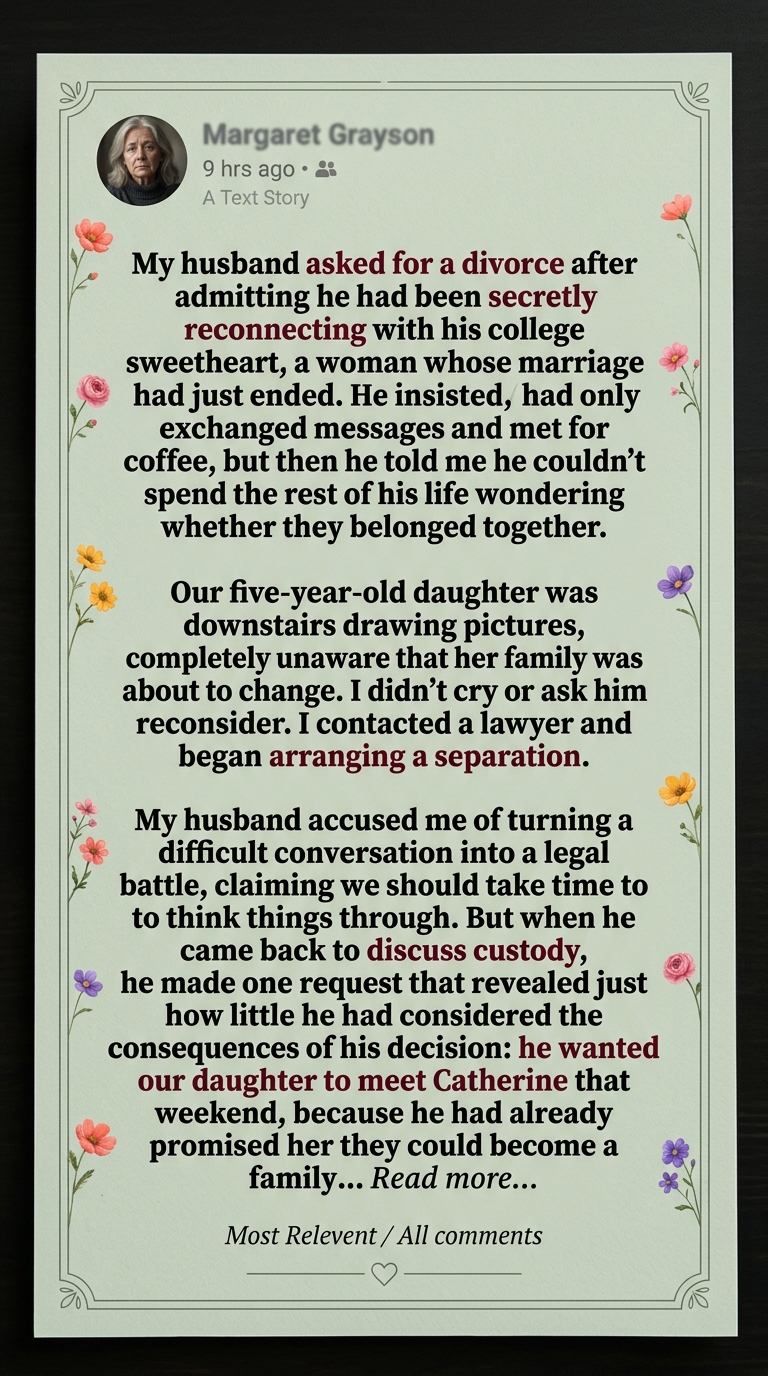
My husband asked me for a divorce on a Sunday afternoon.
Our five-year-old daughter, Sophie, was downstairs drawing butterflies at the kitchen table. Every few minutes, she called up to ask whether we wanted to see her newest picture.
My husband, Nathan, closed the bedroom door and told me he couldn’t keep pretending our marriage was working.
I asked whether there was someone else.
He looked toward the window before answering.
“There’s someone from college. Catherine.”
Her marriage had ended recently, and she had apparently reached out to him a few months earlier. They had started exchanging messages, then met twice for coffee.
Nathan insisted nothing physical had happened.
“I know how it sounds,” he said. “But talking to her reminded me of a part of myself I thought I’d lost. I can’t spend the rest of my life wondering whether we were supposed to be together.”
I looked at him for a long moment.
“What about Sophie?”
His expression softened, but only briefly.
“She’ll be fine. Children adjust.”
I heard a familiar voice downstairs.
“Mummy! Daddy! Look! I made a butterfly family!”
Nathan glanced at the door.
“See? She’ll be fine.”
That was when I understood something I hadn’t wanted to admit: he had already imagined his new life in enough detail to make room for our daughter, but not enough to consider what his decision would actually do to her.
I didn’t beg him to stay.
I didn’t throw anything or demand to see his phone.
I simply said, “Then we need to arrange things properly.”
The following morning, I contacted a family lawyer.
Nathan was furious when he found out.
“You’ve turned a difficult conversation into a legal battle,” he said during our next discussion.
“I’m trying to make sure Sophie doesn’t become an afterthought.”
“I never said she would.”
“You said she’d adjust. That’s not the same as making a plan.”
He accused me of being cold and unnecessarily formal. He wanted us to separate informally, work out custody between ourselves, and avoid involving lawyers until we knew what we wanted.
I explained that I wasn’t trying to punish him. I wanted clear arrangements for our daughter’s home, school, expenses, and time with each parent.
He reluctantly agreed to meet again.
Three days later, he arrived with a notebook.
I thought he had finally prepared a practical proposal.
Instead, he sat across from me and said, “There’s something I want to discuss before we get into the schedule.”
I waited.
“Catherine would like to meet Sophie.”
I stared at him.
“Why?”
“Because we’re serious.”
“You’ve known her again for a few months.”
“We’ve known each other since college. This isn’t some random relationship.”
“Your marriage isn’t even over.”
He sighed.
“I don’t want to keep everyone separate forever. Catherine and I have talked about the future.”
Then he made the request that changed the entire conversation.
“I promised her Sophie could come over this weekend. We thought we could have lunch together, maybe take her to the park. I want Sophie to understand that Catherine is going to be part of our family.”
I felt a chill move through me.
“You promised Catherine she could meet our daughter?”
“I promised we’d start making things work.”
“You haven’t even told Sophie we’re separating.”
“Then we’ll explain it together.”
“No. You don’t get to introduce a new partner as part of her family before she’s had time to understand that her parents are no longer living together.”
Nathan leaned forward.
“You’re making this difficult because you don’t like Catherine.”
“I don’t know Catherine. That’s the point.”
He shook his head.
“She’s kind. She wants children. She already knows about Sophie.”
“Has Sophie heard about her?”
“No.”
“Then why is Catherine already making plans for her?”
Nathan rubbed his forehead.
“Because we’re trying to build something. I don’t want to pretend she doesn’t exist.”
I closed the notebook he had brought.
“Your relationship with Catherine is your decision. Introducing her to Sophie is a parenting decision. Those are not the same thing.”
He left without reaching an agreement.
That evening, I sat beside Sophie while she colored.
She had drawn three people holding hands beneath a large yellow sun. One was taller than the others, and she had given all three enormous smiles.
“Who’s this?” I asked.
“That’s you. That’s Daddy. And that’s me.”
I smiled.
“That’s lovely.”
She studied the picture.
“Are you and Daddy going somewhere?”
I put down the pencil.
“Why do you ask?”
“Because you don’t sit together anymore.”
I had been preparing myself for a conversation about separation, but I hadn’t expected to hear it from a five-year-old who noticed far more than we thought.
I explained that Daddy and I had some grown-up problems we couldn’t fix by living together. I told her that neither of us was leaving her, that she would continue seeing both of us, and that she hadn’t done anything wrong.
She listened quietly.
“Will you both come to my school play?”
“Yes,” I said. “We’ll both be there.”
“Even if you’re not married?”
I swallowed.
“Even then.”
She leaned against me.
“Okay. I don’t want to choose.”
“You won’t have to.”
The next week, Nathan moved into a furnished apartment. We arranged a temporary schedule through our lawyers, with Sophie staying primarily in the family home while he spent regular afternoons and overnight visits with her.
The arrangement was deliberately simple. We agreed not to introduce new partners during the initial adjustment period and to give Sophie consistent explanations about where she would be sleeping and who would collect her from school.
Nathan objected to the restriction.
“My relationship with Catherine shouldn’t be controlled by your lawyer,” he said.
“It isn’t. The agreement is about how we handle changes in Sophie’s life.”
He signed it eventually, although I could tell he considered it an unnecessary obstacle.
For the first few weeks, he was attentive. He arrived on time, took Sophie to the playground, and called her every evening when she was staying with me.
But he also kept talking about Catherine.
He mentioned her favorite restaurant. He told Sophie that a friend of his had a lovely garden. Once, he referred to a weekend trip he hoped to take with “someone special.”
Sophie began asking questions.
“Is Catherine Daddy’s friend?”
“Yes,” I told her.
“Is she going to be my new mummy?”
I knelt in front of her.
“No one replaces me, sweetheart. And you don’t need a new mummy.”
She looked relieved.
A few days later, Nathan called and said he wanted to discuss the introduction again.
“Catherine feels like you’re treating her as something shameful.”
“I’m not responsible for how Catherine feels.”
“She’s worried you’ll never allow her to know Sophie.”
“I haven’t said that. I’ve said Sophie needs time.”
“How much time?”
“Enough for her to understand that her parents’ marriage has ended before she’s expected to welcome someone new into her family.”
He accused me of using our daughter to punish him.
I reminded him that the temporary agreement had been signed by both of us.
He ended the call.
Two weeks later, something happened that forced us to confront how differently we understood our daughter’s needs.
Nathan was supposed to collect Sophie from kindergarten on Thursday. I received a message from the school office saying he had arrived with a woman and asked whether she could come inside.
The school followed its normal procedure and contacted me because the approved pickup arrangements did not include Catherine.
I called Nathan.
“Why did you bring Catherine to Sophie’s school?”
“She was with me. I thought it would be nice for them to meet.”
“That wasn’t what we agreed.”
“I didn’t bring her to collect Sophie. I just wanted to introduce them.”
“At her school, without preparing her?”
He sounded irritated.
“You’re acting as if I’ve brought a stranger off the street.”
I ended the call and drove to the school.
When I arrived, Sophie was sitting in the office with her teacher. She wasn’t crying, but she was gripping her little backpack with both hands.
Nathan stood near the entrance. Catherine was beside him.
Catherine looked uncomfortable.
“I didn’t realize this would upset anyone,” she said quietly.
I looked at Nathan.
“What did you tell her?”
He crossed his arms.
“I told Sophie that Catherine was someone important to me.”
Sophie looked up.
“Daddy said Catherine might live with us.”
Nathan turned toward her.
“I said someday, maybe.”
“But I don’t want to move houses again,” she whispered.
The words seemed to surprise him.
I crouched beside her.
“You don’t have to decide anything today.”
She wrapped her arms around my neck.
Catherine stepped back. For the first time, she seemed to understand that this wasn’t a simple matter of being introduced to a partner’s child.
Nathan tried to speak, but I raised my hand.
“Not here. We’ll discuss this privately.”
I took Sophie home.
That night, she asked whether Daddy would stop loving her if he lived with Catherine.
I told her that a parent’s love was not supposed to depend on where a person lived or who they dated.
She considered that.
“Then why does Daddy keep asking me to like her?”
I didn’t have a good answer.
The following morning, I contacted our lawyer and requested that we arrange a meeting with a family mediator. I wasn’t asking to change custody or restrict Nathan’s relationship with Sophie. I wanted us to agree on a consistent way of introducing major changes into her life.
At the mediation session, Nathan arrived defensive.
He said I had exaggerated the school incident and that Sophie had simply been confused.
The mediator asked him a question.
“Before you promised Catherine that she could meet your daughter, did you ask yourself whether Sophie was ready?”
Nathan hesitated.
“I thought it would help her understand that I was moving forward.”
“Did you ask what she understood about the separation?”
He looked down.
The mediator continued.
“Children don’t experience a new relationship as an abstract adult decision. They experience changes in routines, homes, loyalties, and attention. You may be ready for a new relationship, but that doesn’t mean your daughter is ready for a new family structure.”
Nathan didn’t answer.
Then the mediator asked me whether I would eventually agree to Sophie meeting Catherine.
I said I would, provided the relationship was stable, the introduction was gradual, and Sophie wasn’t expected to treat Catherine as a replacement parent.
Catherine herself had not asked for that role. Nathan had made the promise on her behalf.
That distinction mattered.
A week later, Nathan called me.
His voice was quieter than usual.
“Catherine and I talked.”
I waited.
“She said she doesn’t want Sophie to feel pressured. She also said I shouldn’t have promised anything without discussing it with you.”
I was surprised.
“She said that?”
“Yes.”
He paused.
“I think I got ahead of myself.”
It wasn’t a full apology, but it was the first time he had acknowledged that his choices affected someone besides himself.
He agreed to follow the mediator’s recommendations. Sophie would continue her regular schedule with him, and Catherine would not be introduced until Nathan and I had agreed on a suitable approach.
Several months passed.
Nathan and Catherine remained together, but their relationship moved more slowly than he had originally planned. He eventually told me that Catherine had been uncomfortable with the idea of becoming a family so quickly. She wanted to know him as he was now, not as the person he remembered being in college.
That surprised him.
He had imagined their old connection would make everything effortless. Instead, they discovered that they had spent years becoming different people.
Meanwhile, Sophie settled into her new routine.
She still missed having both parents under one roof. Sometimes she asked whether we could all eat dinner together, and occasionally she became upset when Nathan left after an overnight visit.
We didn’t pretend those feelings didn’t exist.
Nathan began attending some of her school activities with me. We sat on opposite sides of the auditorium during her winter performance, but we both applauded when she walked onto the stage wearing silver wings.
Afterward, she ran between us.
“Did you see me?”
“We saw you,” Nathan said.
“Both of you?”
“Both of us.”
She smiled.
A few months later, Nathan asked whether Catherine could meet Sophie for a short afternoon at a park.
We discussed the plan with the mediator, agreed on a simple introduction, and made sure Sophie knew she could leave whenever she wanted.
Catherine arrived with no presents, no grand gestures, and no promises about the future.
She greeted Sophie politely and asked about the butterflies she liked drawing.
Sophie showed her a picture from her backpack.
They talked for a few minutes, then played on the swings while Nathan watched.
When it was time to leave, Catherine didn’t ask Sophie to call her anything special or tell her how much she wanted to be part of their lives.
She simply said, “It was nice meeting you. Maybe we’ll see each other another time.”
Sophie nodded.
On the drive home, she said, “Catherine is nice.”
“That’s good,” I replied.
“But she’s not my mummy.”
“No, sweetheart. I’m your mummy.”
“And Daddy is still my daddy.”
“Always.”
She seemed satisfied.
Nathan and I never became close friends after the divorce. We had too much history, and our ideas about marriage had turned out to be very different. But we learned to communicate about Sophie without making every disagreement a battle.
The divorce was finalized the following spring.
I kept the house, and Nathan moved into a smaller place near Sophie’s school. We divided our responsibilities, arranged holidays in advance, and agreed that neither of us would use our daughter to carry messages or settle arguments.
One evening, while I was helping Sophie put away her drawings, I found the butterfly family she had made on the afternoon Nathan asked for a divorce.
She had added another picture beside it.
This one showed two houses, each with a little garden. In one, she had drawn herself with me. In the other, she had drawn herself with her father. Between the houses was a long path covered in flowers.
I asked what it meant.
“That’s the way I go between your houses,” she explained. “The flowers make it less scary.”
I felt my throat tighten.
I placed the drawing on the refrigerator.
Nathan had once told me children adjusted.
He had been partly right. Children could adjust to enormous changes, but they needed adults who understood that adjustment was not the same as pretending nothing hurt.
I couldn’t save my marriage by myself, and I couldn’t control who my former husband loved.
But I could insist that our daughter never be treated as an accessory to someone else’s new beginning.
And that was one promise I intended to keep.

