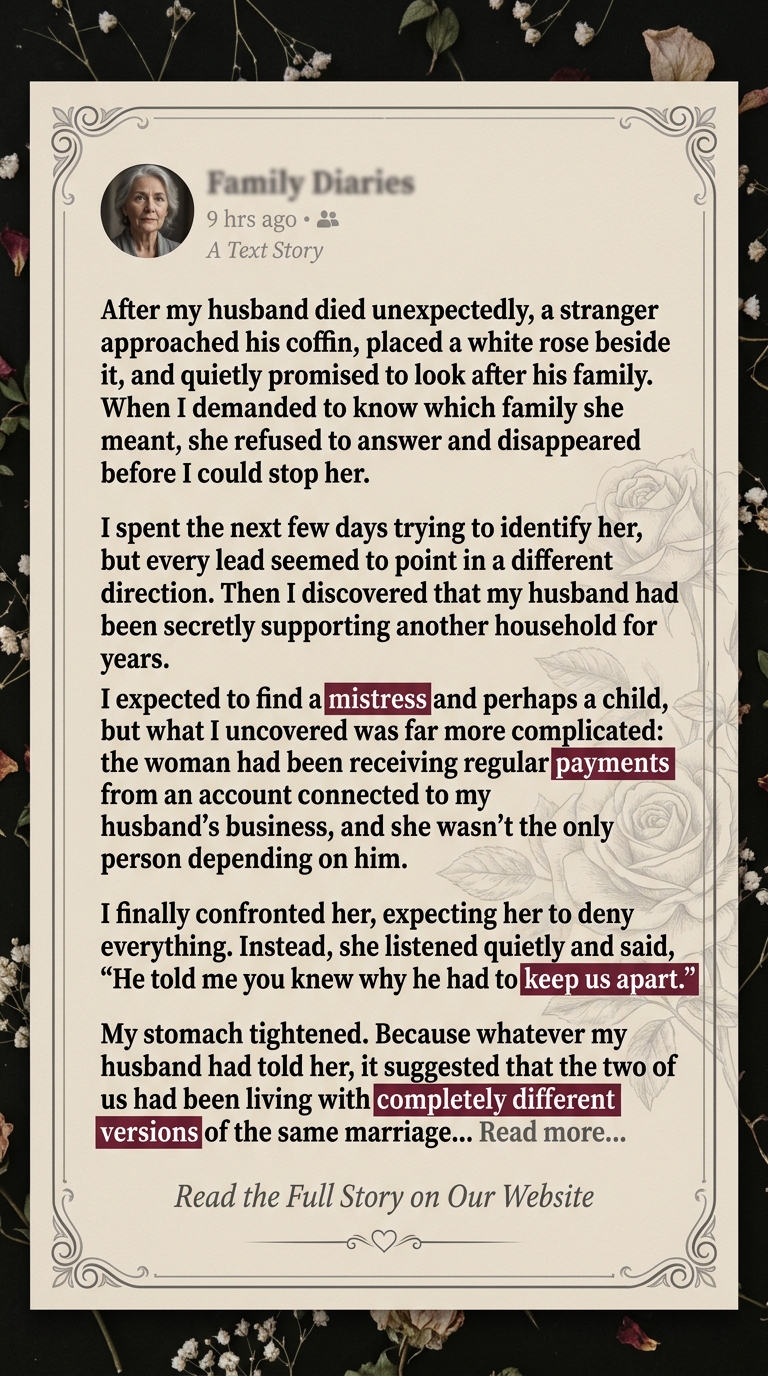
The woman appeared just as the funeral director was preparing to close my husband’s coffin.
She was in her early fifties, dressed in a simple black coat, with silver beginning to show in her dark hair. I had never seen her before. She stood at the foot of Daniel’s coffin, holding a single white rose.
She placed it beside his folded hands, lowered her head, and whispered, “I promise I’ll look after your family. I won’t let them suffer.”
Then she turned toward the exit.
I stepped away from my sister and caught up with her near the chapel doors.
“Excuse me. Who are you?”
She stopped but didn’t turn around immediately.
“I knew your husband,” she said.
“That doesn’t answer my question. What family were you talking about?”
Her expression tightened.
“The people who need him most.”
“He’s dead. If you know something about my husband, you need to tell me.”
She looked at me then. There was grief in her eyes, but also something that resembled guilt.
“He loved you,” she said quietly. “Please don’t let what happened between us make you doubt that.”
Before I could ask what she meant, she walked through the doors and disappeared into the crowd outside.
I stood there, unable to move.
My husband, Daniel, and I had been married for twenty-two years. We had a seventeen-year-old daughter named Sophie. I thought I knew his habits, his friendships, his worries, and even the small lies he told to avoid hurting my feelings.
He wasn’t perfect, but he had never given me a reason to believe he was living another life.
At least, that was what I believed until the woman with the white rose appeared.
For the next three days, I tried to identify her. I asked relatives, friends, and former colleagues whether they recognized her from the funeral. Nobody did.
My brother-in-law suggested she might have been someone Daniel had helped through his business. My sister thought she was an old girlfriend.
I hated that possibility, but I couldn’t dismiss it.
Then, while sorting through Daniel’s office, I found something that changed the direction of my search.
His business accountant had sent him monthly statements from an account I had never seen. The payments were modest but regular, usually transferred on the first working day of each month. The account was connected to the company Daniel had co-owned with his business partner, Martin.
The recipient’s name was Eleanor Price.
I searched the name in Daniel’s contacts. There was no photograph, no address, and no explanation. Only a telephone number saved under the initials E.P.
I called it.
A woman answered after several rings.
“Hello?”
“Is this Eleanor Price?”
There was a long silence.
“Who is asking?”
“My name is Laura. I’m Daniel’s wife.”
I heard her take a sharp breath.
“I’m sorry,” she whispered.
“Don’t apologize. Tell me who you are.”
“I think we should speak in person.”
“Then give me an address.”
She hesitated before telling me where to find her.
The following morning, I drove to a small neighborhood on the other side of town. The house was modest, with a narrow garden and a wooden ramp leading to the front door.
When Eleanor opened it, I recognized her immediately.
She was the woman from the funeral.
For a moment, neither of us spoke.
Then I asked the question that had been haunting me.
“How long were you seeing my husband?”
Her face fell.
“I wasn’t seeing him in the way you think.”
“Then why was he sending you money every month? Why did you stand beside his coffin and promise to look after your family?”
Eleanor stepped aside.
“Please come in. There are things you need to understand.”
I entered reluctantly.
The living room contained two worn armchairs, a small television, and framed photographs covering an entire wall. In one photograph, Daniel stood beside Eleanor, smiling at a much younger man. Another showed him holding a little girl who looked about six.
My heart began to pound.
“Who are they?” I asked.
Eleanor followed my gaze.
“My son, Michael, and my granddaughter, Grace.”
“Is Michael Daniel’s son?”
“No.”
The answer came so quickly that I almost didn’t believe her.
“Then why was my husband supporting you?”
Eleanor sat down and folded her hands.
“Because Daniel made a promise to someone a long time ago. He spent years trying to keep it.”
She reached for a photograph and handed it to me.
It showed Daniel at about twenty-five, standing beside a young man in a hospital corridor. The younger man had one arm around Daniel’s shoulders. They looked like brothers.
“That’s my son, Michael,” Eleanor said. “He and Daniel grew up together. Their families lived on the same street. They were closer than most brothers.”
I looked again at the photograph.
“Why have I never heard of him?”
“Because Daniel believed you knew what happened.”
She paused, then continued.
“Michael was involved in a serious accident when he was twenty-three. He was driving home after working a night shift when another car crossed the center line. The other driver died. Michael survived, but he suffered a brain injury that changed his life.”
I remembered Daniel mentioning a friend who had been injured years before we met. He had never given me a name.
“Michael needed years of rehabilitation,” Eleanor continued. “His father had died, and I was working two jobs. Daniel helped us. At first, it was just a little money for transportation and medical appointments. Then the rehabilitation center closed its funding program, and Michael needed more care than I could afford.”
“Why didn’t he tell me?”
Eleanor looked down.
“Because he thought you would recognize the family.”
I frowned.
“What family?”
She stood and walked toward a cabinet. From a drawer, she removed an old photograph, yellowed at the edges.
It showed two young men standing outside a house. One was Daniel. The other was Michael.
Behind them stood a little boy with a round face and a missing front tooth.
I stared at the child’s face.
I knew that boy.
He was my younger brother, Peter.
My hands began to shake.
“What is this?”
Eleanor looked at me carefully.
“Daniel and Michael were with Peter the night of the accident.”
The room seemed to tilt.
Peter had died when he was seventeen. My parents had always told me he had been injured in a car accident caused by a drunk driver. I had been away at university and arrived at the hospital too late to see him alive.
Daniel and I hadn’t met until four years later.
“Why was my brother with them?” I asked.
“Peter was working part-time at the same workshop as Michael. They had become friends. That night, Michael was driving Peter home. The other car hit them.”
I sank into the chair.
“Why didn’t my parents tell me?”
“They were told the accident was caused by the other driver. They didn’t know Michael had been driving.”
I looked at her.
“Are you saying my brother died because of Michael?”
Eleanor nodded slowly.
“Daniel was in the passenger seat. He survived with minor injuries. Michael survived too, but Peter didn’t.”
I pressed my hands against my mouth.
For years, I had believed my brother’s death was a terrible accident involving a stranger. Now I was learning that Daniel had been there.
“Did he know who Peter was?”
“Not at first. He only realized after the hospital staff found Peter’s identification. Daniel was devastated. He went to your parents and told them everything. They knew the driver had not been drinking and that Michael had not been reckless. The other driver had caused the collision.”
“Then why did they hide it from me?”
Eleanor’s eyes filled with tears.
“Your father asked them to. He was afraid you would blame Michael. He knew the young man was already struggling with the accident and might never recover emotionally if he believed Peter’s sister would hate him.”
I stood up.
“So my husband spent our entire marriage secretly supporting the man who was driving the car that killed my brother?”
“Yes.”
“And he never told me?”
“He believed telling you would reopen a wound your parents had worked so hard to close.”
I felt anger rise through my grief.
“He had no right to make that decision for me.”
Eleanor didn’t argue.
“No,” she said. “He didn’t.”
I looked again at the photograph of Daniel and Michael.
“Why did you say he had been supporting another family? What did you mean when you said he promised to look after us?”
Eleanor hesitated.
“Michael has a daughter. Her mother left when Grace was very young. Michael can no longer work consistently because of his injuries. I cared for him, but as I got older, I became ill and couldn’t manage everything alone.”
She glanced toward the hallway.
“Daniel paid for Michael’s rehabilitation, helped with Grace’s school expenses, and covered some of my medical bills. He never wanted us to feel that we owed him anything.”
“Was the money coming from his business?”
“Some of it.”
That answer made me look up sharply.
“What do you mean, some of it?”
Eleanor seemed confused.
“Daniel told me the payments came from a fund he had arranged with his business partner. He said it was money set aside for long-term assistance.”
I remembered the account statements. The transfers had been recorded as company expenses.
“Did you know the business was paying you?”
“I knew where the money came from. I didn’t know how it was recorded.”
I left her house with more questions than answers.
That afternoon, I called Martin, Daniel’s business partner.
At first, he sounded sympathetic. When I mentioned Eleanor and the monthly payments, his voice changed.
“Laura, I think you should come to the office. There are things I need to explain.”
I arrived the next morning.
Martin looked exhausted. He had been Daniel’s partner for nearly fifteen years, and I had always considered him a decent man.
He opened a folder and placed several statements on the desk.
“Daniel established a support arrangement for Michael’s family,” he explained. “It was originally paid from his personal income. But about six years ago, he began using the company’s charitable assistance account.”
“Was that allowed?”
Martin hesitated.
“Not exactly. The account was intended for emergency assistance to employees and their dependents. Michael had never been employed by the company.”
“Then why did you approve it?”
“Because Daniel was a major shareholder, and I trusted him. He told me the arrangement had been reviewed by an accountant and that the payments were temporary.”
“How much money?”
Martin showed me the records.
The amount was substantial, but not enough to threaten the company’s survival. Still, it had been taken from a fund intended for workers who had suffered injuries or lost their income.
“Did you know why Daniel was doing this?”
“I knew about the accident,” he said. “I didn’t know Peter was your brother until much later.”
“How much later?”
“About eight months ago.”
I stared at him.
“Eight months?”
Martin nodded.
“Daniel came to me after he found an old photograph in his parents’ house. He said he had made a mistake by keeping the truth from you. He was planning to tell you.”
“Why didn’t he?”
“Because he wanted to speak to you after your daughter finished her final examinations. He didn’t want to upset her during the school year.”
I looked at the folder.
“Did he intend to stop the payments?”
“No. Michael still needed assistance. But Daniel wanted to move the arrangement out of the company and take responsibility for it personally. He had already begun discussing a repayment plan with the accountant.”
For the first time, I understood that the situation was more complicated than a secret affair or a hidden child.
Daniel had been carrying guilt for decades. He had tried to turn that guilt into something useful. But in doing so, he had taken decisions that belonged to other people and hidden the truth from the person who had the greatest right to know.
I went home and found Sophie sitting at the kitchen table.
She had noticed the photographs I had brought back from Eleanor’s house.
“Mom, why is Uncle Peter in that picture?”
I sat beside her.
“Because I found out something about the accident.”
I explained what I had learned, carefully and honestly. Sophie listened without interrupting.
When I finished, she asked, “Did Dad know Uncle Peter was your brother?”
“Yes.”
“And he never told you?”
“No.”
She looked down at the photograph.
“Maybe he thought he was protecting you.”
“Maybe,” I said. “But protecting someone by keeping the truth from them can become another kind of harm.”
Sophie leaned against my shoulder.
“Are you angry with him?”
I looked at the empty chair where Daniel usually sat.
“Yes. And I miss him. Both things can be true.”
A week later, I returned to Eleanor’s house.
This time, Michael was there.
He was in his forties, with a slight limp and a careful way of moving. He looked older than his years, but his eyes were alert.
When I entered, he stood up.
“Laura,” he said. “I don’t know what to say.”
“Then don’t say anything until I ask you something.”
He nodded.
I sat across from him.
“Do you remember my brother?”
Michael’s face changed.
“I remember Peter every day.”
“Do you remember what happened that night?”
“Every second.”
He told me that Peter had been laughing in the back seat, talking about a girl from school. Michael had been driving within the speed limit. The other car had crossed into their lane without warning.
After the collision, Michael had been trapped in the wreckage. He remembered hearing Peter calling his name, then nothing.
When he woke in the hospital, Daniel was beside his bed.
“Your husband told me Peter had died,” Michael said. “I wanted to die too. I thought I had killed him. Daniel stayed with me for months. He helped me through rehabilitation, and when I could finally understand what had happened, he told me your parents didn’t blame me.”
I swallowed hard.
“Did you ever want to meet me?”
“Many times. But Daniel said you had built a life and that bringing me into it might hurt you. I believed him because I thought he knew what was best.”
“Did you know he was married to me?”
“Yes.”
“Did you ever ask him to keep us apart?”
Michael shook his head.
“No. I asked him once whether you knew. He said you did, and that you had agreed to let him help us privately.”
I closed my eyes.
Daniel had told two people two different versions of the same truth.
He had told Michael that I knew. He had allowed me to believe there was nothing to know.
I couldn’t tell whether he had done it out of shame, fear, or a misguided sense of responsibility. Perhaps all three.
“Why did you put the rose beside his coffin?” I asked.
Michael looked at Eleanor.
“Because Daniel was the only person who never treated me like a burden. He gave me a chance to raise my daughter without feeling that my life was already over. I wanted to thank him.”
Eleanor spoke softly.
“And I promised to look after the family because Daniel had asked me to make sure Michael and Grace were not abandoned if something happened to him.”
I finally understood the promise.
But understanding it didn’t make everything right.
Over the following weeks, I met with the company’s accountant and an independent financial adviser. We reviewed the payments, separated the legitimate assistance from the improperly recorded company expenses, and arranged for the money Daniel had taken from the employee fund to be repaid from his estate.
Martin agreed to establish a properly governed assistance program for injured workers and their dependents. Michael’s family would receive support through a separate, transparent arrangement funded by Daniel’s remaining personal assets, with clear limits and independent oversight.
I also asked Michael to meet me at Peter’s grave.
He arrived carrying a small bunch of white roses.
For a long time, neither of us spoke.
Then he placed the flowers beside the headstone.
“I’m sorry,” he whispered.
I looked at the name carved into the stone.
For years, I had imagined my brother’s final moments as something I would never understand. Now I knew that a young man had survived the same accident carrying a burden he had never been able to put down.
I didn’t forgive Michael that day. There was nothing to forgive him for, not in the way I had once imagined. He had been a victim too.
But I did tell him that I wanted to know Grace. I wanted her to understand that her father’s past did not make her responsible for it.
As for Daniel, forgiveness was harder.
I missed the man who made coffee for me every morning, who remembered Sophie’s school performances, and who always called when he was running late. I also resented the man who had decided I couldn’t be trusted with the truth about my own brother.
Both men had been my husband.
Several months later, Eleanor invited Sophie and me to Grace’s school recital. We sat beside Michael in the second row. When Grace finished playing, she spotted us and smiled.
For the first time, I saw the family Daniel had been trying to protect.
It wasn’t a second family built on romance or betrayal. It was a family formed by an accident, a promise, and decades of silence.
After the recital, Grace approached me.
“Are you Daniel’s wife?”
I nodded.
She held out a white rose.
“My grandmother said he always wanted us to meet you.”
I accepted it, unable to speak for a moment.
Then I smiled.
“Your grandmother was right. We should have met a long time ago.”
That evening, I placed the rose in a glass beside Daniel’s photograph.
I still wished he had trusted me enough to tell me everything while he was alive. His silence had cost us years we could never recover.
But I no longer saw the woman at his coffin as someone who had come to claim part of my marriage.
She had come to keep a promise.
And now, with the truth finally in the open, I could decide for myself what that promise should become.

